Arterial Blood Gas (ABG) Test: Purpose, Procedure, Normal Values and Results

Updated: 5 days ago
Written and medically reviewed by Dr. Baraa Alnahhal, MD · Last reviewed: November 2026 · How we review
Quick Answer: What is an arterial blood gas (ABG) test?
An arterial blood gas (ABG) test is a blood test taken from an artery, usually at the wrist, that measures the oxygen and carbon dioxide in your blood and its acid-base (pH) balance. It's used mainly in emergencies and to check lung, heart and metabolic conditions, and results usually come back within 10 to 15 minutes. [1]
What the research says
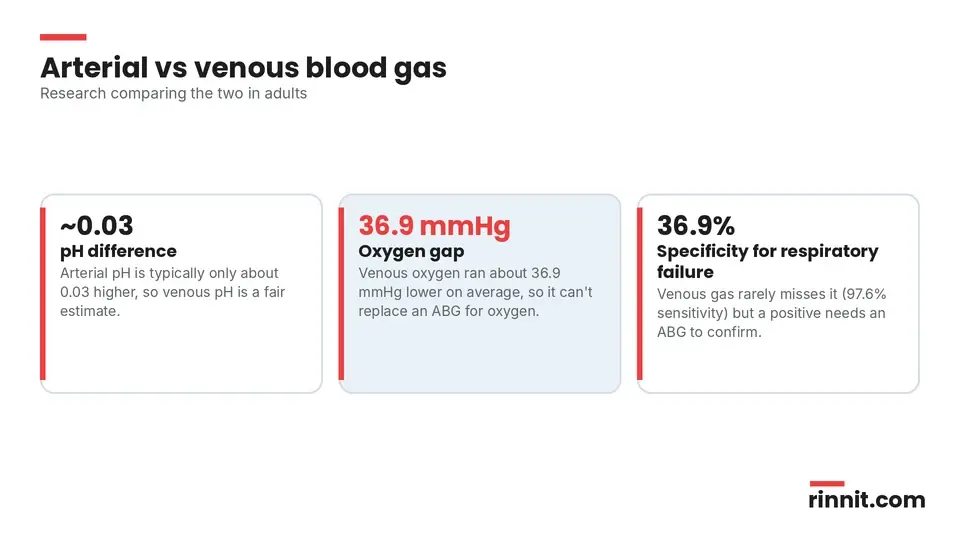
Vein samples estimate pH well, but not oxygen or carbon dioxide. A meta-analysis of 18 studies (1,768 adults) found arterial pH was typically only about 0.03 higher than venous pH, but venous oxygen was on average 36.9 mmHg lower and venous carbon dioxide varied too widely to replace an ABG. (Byrne et al., Respirology, 2014) [2]
Venous gases can rule out, but not confirm, respiratory failure. A Cochrane review of 6 studies (805 participants analyzed for this outcome) found venous blood gas had 97.6% sensitivity but only 36.9% specificity for respiratory failure, so a positive result still needs an ABG to confirm it. (Byrne et al., Cochrane Database of Systematic Reviews, 2025) [3]
Key takeaways
An ABG uses blood from an artery, not a vein, so it reflects oxygen levels more accurately. [1]
It measures pH, oxygen (PaO2), carbon dioxide (PaCO2), bicarbonate (HCO3) and oxygen saturation. [1]
A respiratory therapist usually draws the sample from the radial artery in your wrist. [1]
It stings more than a regular blood draw, but serious risks are rare. [1]
Results are fast, usually within 10 to 15 minutes. [1]
Why is an arterial blood gas test done?
Your body tightly controls the oxygen and carbon dioxide in your blood, because low blood oxygen (hypoxemia) can damage organs, especially the brain and heart. An ABG helps your care team understand problems with your respiratory system, circulation and metabolism, especially in emergencies. [1]
ABGs are ordered often in emergency medicine, anesthesiology and pulmonology. Conditions they help evaluate include: [1]
Acute respiratory distress syndrome (ARDS) and acute respiratory failure
Severe sepsis and septic shock
Hypovolemic shock from severe blood or fluid loss
Diabetes-related ketoacidosis (DKA) and renal tubular acidosis (RTA)
Acute heart failure and cardiac arrest
A severe asthma attack
Inborn errors of metabolism
If you live with asthma, COPD, cystic fibrosis or heart disease, your provider may also use ABGs to check that treatment is working. [1]
ABG vs blood gas analysis
A general blood gas analysis can use blood from an artery, a vein or a capillary. An ABG uses only arterial blood, because blood in an artery carries more oxygen than blood in a vein. [1] Other names for the test include blood gas test and arterial blood gases. [1]
What does an ABG measure?
An arterial blood gas report usually includes these values: [1]
Measurement | What it shows |
pH | The acid-base balance of your blood |
Partial pressure of oxygen (PaO2) | How well oxygen moves from your lungs into your blood |
Partial pressure of carbon dioxide (PaCO2) | How well carbon dioxide moves out of your body |
Bicarbonate (HCO3) | A base made from carbon dioxide, calculated from pH and PaCO2 |
Oxygen saturation (O2Sat) | How much of your hemoglobin is carrying oxygen |
Oxygen content (O2CT) and hemoglobin | How much oxygen and oxygen-carrying protein are in your blood |
Sources: [1]
How do you prepare for an ABG test?
You don't usually need to do anything special. Before a wrist sample, the respiratory therapist may do a quick circulation check called an Allen test: you hold your hand up in a tight fist while they press on the wrist arteries for a few seconds. This makes sure both arteries in your wrist are open and working. [1]
If you use supplemental oxygen, they may turn it off for about 20 minutes before the draw (a "room air" test). They won't do this if you can't breathe without oxygen. [1]
What happens during an arterial blood gas test?
A respiratory therapist usually takes the sample, most often from the radial artery inside your wrist. Sometimes they use the brachial artery in the arm or the femoral artery in the groin. In newborns, the sample may come from the heel or umbilical cord. [1]

You sit or lie down, and the therapist finds an artery, sometimes with the help of ultrasound.
They clean and disinfect the skin.
They insert a small needle into the artery, and blood collects in a syringe. You may feel a sharp pain.
They remove the needle and press on the site for 5 to 10 minutes, or longer if you take blood thinners.
A bandage goes over the site.
Sources: [1]
An ABG usually hurts more than a regular blood draw, because arteries sit deeper than veins and are surrounded by nerves. You may feel lightheaded, dizzy or nauseated. [1]
What to expect after an ABG
You may have some bruising or soreness at the needle site. Your provider may suggest avoiding heavy lifting for 24 hours. [1]
Risks are rare when the test is done correctly, but can include: [1]
Fainting or lightheadedness
Several needle sticks to find the artery
A hematoma (blood collecting under the skin)
Heavy bleeding
Infection at the puncture site
What are normal ABG values?
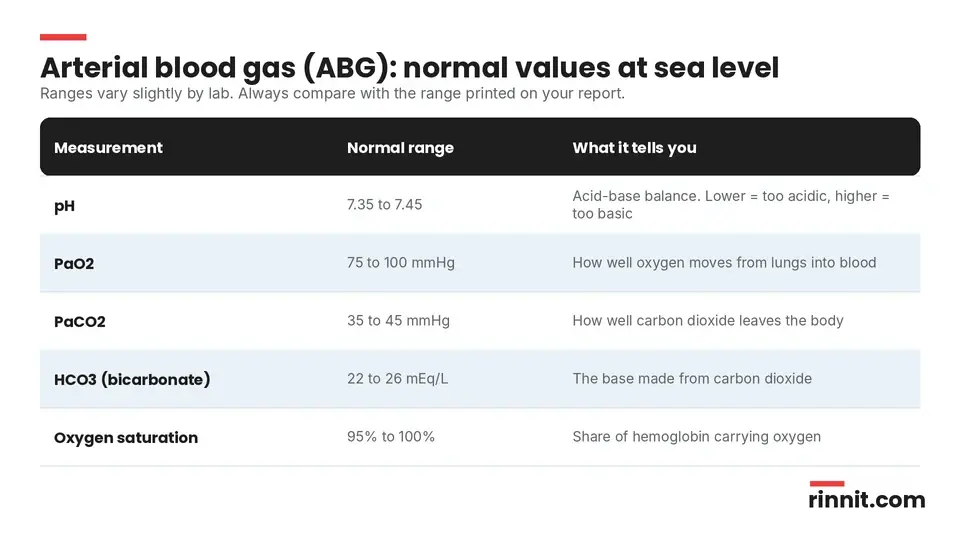
Automated blood gas analyzers usually give results within 10 to 15 minutes. Normal ranges vary slightly from lab to lab, so always compare your result with the range on your report. In general, normal values at sea level are: [1]
Measurement | Normal range at sea level |
pH | 7.35 to 7.45 |
PaO2 | 75 to 100 mmHg |
PaCO2 | 35 to 45 mmHg |
HCO3 | 22 to 26 mEq/L |
Oxygen saturation (SaO2) | 95% to 100% |
Sources: [1]
At altitudes of 3,000 feet (900 meters) or higher, normal oxygen levels are lower. [1]
What do abnormal ABG results mean?
A blood pH below 7.35 means the blood is too acidic; above 7.45 means it's too basic (alkaline). [1] Abnormal results may mean you: [1]
Aren't taking in enough oxygen
Aren't getting rid of enough carbon dioxide
Have a pH imbalance, with blood that's too acidic or too basic
If your results are abnormal, your provider may order more blood tests or imaging to confirm or rule out a diagnosis. [1]
When should you call your doctor?
If you have a chronic lung condition like COPD or asthma, you may need regular checkups and ABG tests to make sure your treatment is working. Call your provider as soon as possible if your lung symptoms get worse. [1]
Conclusion
An arterial blood gas test gives a fast, precise snapshot of how well your lungs and body handle oxygen, carbon dioxide and acid-base balance. It stings more than a routine blood draw, but it's quick, low risk and often guides urgent treatment decisions.
If you've been told you need an ABG, ask which artery will be used, whether you'll stay on your oxygen, and what your numbers mean for your care plan.
Keep learning: Read our guides to respiratory acidosis and metabolic acidosis, two problems an ABG can uncover. For more background, see the MedlinePlus page on blood gases.
FAQ
What is an arterial blood gas test?
It's a blood test from an artery that measures oxygen, carbon dioxide and pH balance in your blood.
Why is an ABG taken from an artery instead of a vein?
Arterial blood has higher oxygen levels than venous blood, so it shows how well your lungs supply oxygen.
What are normal ABG values?
At sea level: pH 7.35 to 7.45, PaO2 75 to 100 mmHg, PaCO2 35 to 45 mmHg, HCO3 22 to 26 mEq/L and oxygen saturation 95% to 100%.
Does an ABG test hurt?
Usually more than a regular blood draw, because arteries are deeper and surrounded by nerves; you may feel a sharp pain.
Where is blood taken for an ABG?
Most often from the radial artery in the wrist, sometimes the brachial artery in the arm or femoral artery in the groin.
What is the Allen test before an ABG?
It's a quick hand-circulation check to make sure both wrist arteries are open before a wrist sample.
How long do ABG results take?
Automated analyzers usually give results within 10 to 15 minutes.
What does a low pH on an ABG mean?
A pH below 7.35 means your blood is too acidic; above 7.45 means it's too basic.
What conditions does an ABG help diagnose?
It helps evaluate ARDS, respiratory failure, sepsis, shock, DKA, renal tubular acidosis, heart failure and severe asthma attacks.
What are the risks of an ABG?
Risks are rare and include fainting, a hematoma, heavy bleeding, infection and needing more than one needle stick.
What should I do after an ABG?
Expect some bruising or soreness, and your provider may suggest avoiding heavy lifting for 24 hours.
Related Reading
Understanding Respiratory Acidosis: Symptoms, Causes, and Care explains acidic blood caused by carbon dioxide buildup, a pattern an ABG can show.
Understanding Metabolic Acidosis: Causes, Symptoms, and Treatment explains acid buildup from metabolism or the kidneys, which an ABG helps confirm.
Diabetic Ketoacidosis (DKA): Signs, Triggers, and What To Do in an Emergency covers a diabetes emergency where ABG results guide treatment.
Respiratory Failure: Symptoms, Causes, and Management explains low oxygen or high carbon dioxide states that an ABG measures.
What Is Chronic Obstructive Pulmonary Disease (COPD)? Symptoms, Causes, Stages, and Treatment covers a lung disease where repeat ABGs check that treatment is working.
Hypoxemia: Causes, Symptoms, and Emergency Management explains low blood oxygen, a key reason to order an ABG.
References
Cleveland Clinic. Arterial Blood Gas (ABG): What It Is, Purpose, Procedure & Levels. Cleveland Clinic. Last updated February 18, 2022. https://my.clevelandclinic.org/health/diagnostics/22409-arterial-blood-gas-abg
Byrne AL, Bennett M, Chatterji R, et al. Peripheral venous and arterial blood gas analysis in adults: are they comparable? A systematic review and meta-analysis. Respirology. 2014;19(2):168-175. PMID 24383789. https://doi.org/10.1111/resp.12225
Byrne AL, Pace NL, Thomas PS, et al. Peripheral venous blood gas analysis for the diagnosis of respiratory failure, hypercarbia and metabolic disturbance in adults. Cochrane Database Syst Rev. 2025;6(6):CD010841. PMID 40557830. https://doi.org/10.1002/14651858.CD010841.pub2
Medical disclaimer
This article is for general education only and does not replace advice from a qualified healthcare professional. Talk to your doctor about your own diagnosis and treatment, and seek emergency care right away for severe or sudden symptoms.



Comments