Understanding Respiratory Acidosis: Symptoms, Causes, and Care

Updated: 2 days ago
Medically reviewed by Dr. Baraa Alnahhal, MD · Last reviewed: October 2026
Respiratory acidosis occurs when the lungs cannot adequately remove carbon dioxide, causing the blood to become overly acidic. [1] This condition can develop suddenly (acute) or gradually (chronic) [1] due to lung diseases, nerve disorders, or external factors like medication overuse. Symptoms range from anxiety and headaches to severe complications like seizures or coma. [1] Treatment focuses on addressing the underlying cause, often utilizing oxygen therapy or mechanical ventilation [1] to restore a healthy blood pH balance.
Quick Answer
Respiratory acidosis is a condition in which blood pH falls below normal because the lungs fail to exhale enough carbon dioxide, making the blood more acidic. [1] Normal blood pH is between 7.35 and 7.45 [1], and lower levels can disrupt vital functions. It may be acute, requiring emergency care, or chronic, developing slowly from respiratory or neuromuscular disease.
What the research says
Breathing support lowers the risk of death and intubation in acute episodes. In a Cochrane review of 17 randomized trials (1,264 adults) of patients admitted with acute hypercapnic respiratory failure from a COPD exacerbation, non-invasive ventilation plus usual care reduced the risk of death by 46% (RR 0.54, 95% CI 0.38 to 0.76; 12 studies) and the need for intubation by 65% (RR 0.36, 95% CI 0.28 to 0.46; 17 studies), and improved blood pH by 0.05 at one hour (95% CI 0.02 to 0.07; 8 studies) (Osadnik et al., Cochrane Database of Systematic Reviews, 2017) [2].
Targeting chronic carbon dioxide buildup can improve survival. In a randomized trial of 195 patients with stable, severe (GOLD stage IV) COPD and a PaCO2 of 7 kPa (51.9 mm Hg) or higher, adding long-term non-invasive ventilation aimed at markedly reducing carbon dioxide lowered 1-year mortality to 12% (12 of 102 patients) versus 33% (31 of 93) with standard treatment (hazard ratio 0.24, 95% CI 0.11 to 0.49) (Köhnlein et al., The Lancet Respiratory Medicine, 2014) [3].
What is respiratory acidosis and how does it affect blood pH?
Blood pH balance is critical for the proper functioning of human biological systems. The pH scale, which measures the acidity or alkalinity of a substance, ranges from 0 (highly acidic) to 14 (highly basic). [1] In a healthy individual, the blood pH is tightly regulated between 7.35 and 7.45. [1] Respiratory acidosis occurs when this balance shifts toward the acidic end of the scale because the respiratory system cannot effectively clear carbon dioxide [1], a natural byproduct of metabolism that forms acid in the blood.
There are two primary classifications of this condition based on the speed of onset. Acute respiratory acidosis involves a rapid buildup of carbon dioxide [1] and can be life-threatening if not addressed immediately. Chronic respiratory acidosis develops gradually [1], allowing the body time to adapt, though it still poses significant long-term health risks. In some cases, individuals with chronic conditions may experience a sudden worsening, known as acute-on-chronic respiratory acidosis.
Feature | Acute Respiratory Acidosis | Chronic Respiratory Acidosis |
Onset Speed | Rapid/Sudden | Gradual/Long-term |
Urgency | Emergency (Fatal if untreated) | Ongoing management required |
Primary Symptoms | Confusion, choking, anxiety | Fatigue, memory loss, hypertension |
What are the symptoms and warning signs of respiratory acidosis?
The symptoms of respiratory acidosis are highly dependent on the severity of the CO2 buildup and the speed at which it occurs. Initial signs of acute onset often include a sense of anxiety, blurred vision, and a persistent headache. [1] As oxygen levels drop, the skin may take on a discolored blue, purple, or gray-green appearance, a condition known as cyanosis. [1] Shortness of breath and wheezing are also common indicators [1] that the lungs are struggling to function.
If the condition is left untreated or becomes severe, it can lead to neurological complications. These may include muscle twitching (myoclonus), significant behavioral changes, seizures, and even coma. [1] Chronic sufferers may experience a different set of symptoms, such as excessive daytime fatigue, loss of coordination, and memory loss. [1] Because severe respiratory acidosis can be fatal, immediate emergency medical help is necessary if an individual experiences extreme difficulty breathing or choking.

What causes respiratory acidosis and who is at risk?
Breathing disorders are the primary drivers of respiratory acidosis, but the specific causes often vary between the acute and chronic types. Acute cases are frequently triggered by sudden obstructions or conditions that rapidly impair breathing, such as severe pneumonia, emphysema, or an acute asthma attack. [1] Additionally, the overuse of substances that affect the central nervous system, including alcohol, opioids, and amphetamines [1], can impair breathing enough to cause a dangerous buildup of carbon dioxide.
Chronic respiratory acidosis is often the result of long-standing diseases that gradually reduce lung efficiency or chest wall movement. Conditions such as Chronic Obstructive Pulmonary Disease (COPD), pulmonary fibrosis, and severe scoliosis are common contributors. [1] Furthermore, neuromuscular disorders like Amyotrophic Lateral Sclerosis (ALS), multiple sclerosis, and muscular dystrophy [1] can weaken the muscles responsible for breathing. Obesity can also play a role by physically limiting the expansion of the lungs during inhalation. [1]

How is respiratory acidosis diagnosed and treated?
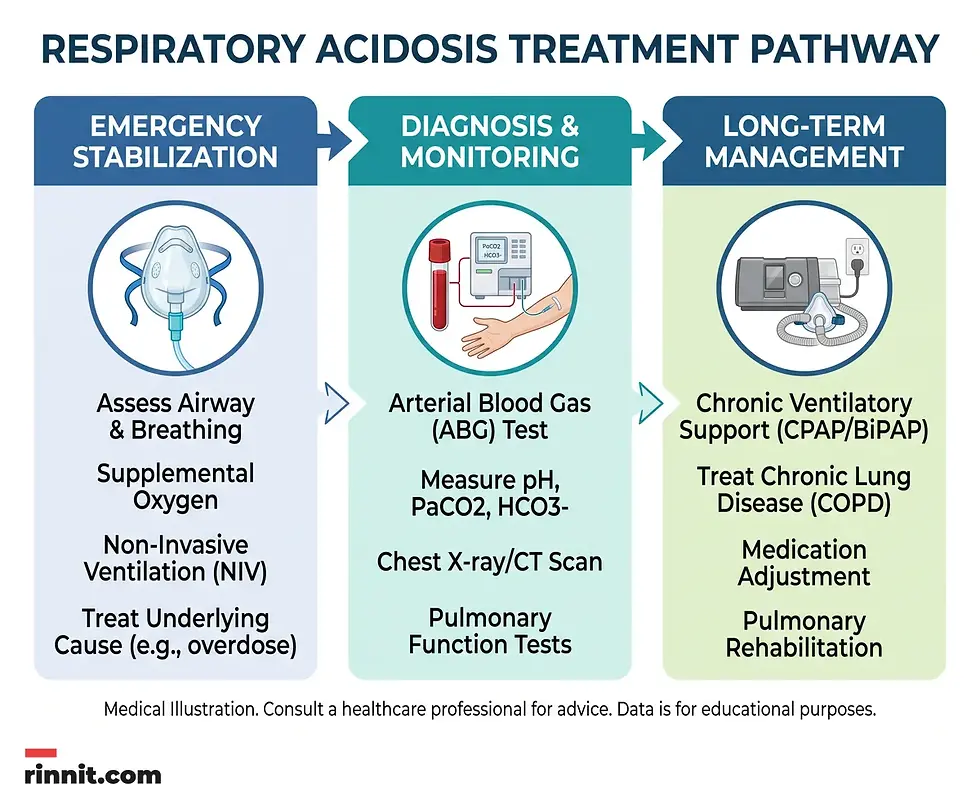
Diagnosing respiratory acidosis requires a combination of physical examinations and specialized laboratory tests. The most critical test is an arterial blood gas (ABG) analysis, which directly measures the levels of oxygen and carbon dioxide in the blood [1] to determine pH levels. Healthcare providers may also utilize chest X-rays, CT scans, and pulmonary function tests [1] to evaluate the physical health of the lungs and identify underlying obstructions or damage.
Treatment is centered on addressing the root cause of the breathing impairment. [1] For acute emergencies, mechanical ventilation or oxygen therapy may be required to stabilize the patient. [1] Chronic management often involves the use of CPAP machines for sleep apnea [1] or medications to open airways and reduce inflammation. Depending on the cause, providers may prescribe bronchodilators, corticosteroids, or diuretics [1] to manage fluid buildup and improve overall respiratory efficiency.
Conclusion
Respiratory acidosis is a serious condition that highlights the vital link between lung function and blood chemistry. Whether it appears as a sudden emergency or a slow-developing chronic issue, the accumulation of carbon dioxide can have profound effects on the brain, heart, and nervous system. By understanding the risk factors and recognizing early warning signs like confusion and shortness of breath, individuals can seek the necessary interventions to restore their blood pH and maintain long-term respiratory health.
Frequently Asked Questions
What is a normal blood pH level?
A healthy blood pH range is between 7.35 and 7.45. Levels below 7.35 are considered acidic and may indicate respiratory acidosis.
Can anxiety be a symptom of respiratory acidosis?
Yes. Anxiety is often one of the initial symptoms of acute respiratory acidosis, along with confusion and headaches.
Is respiratory acidosis fatal?
Sudden or acute respiratory acidosis can be fatal if not treated immediately. It is considered a medical emergency if breathing becomes difficult.
What is the difference between acute and chronic respiratory acidosis?
Acute respiratory acidosis occurs suddenly when CO2 builds up quickly, while chronic respiratory acidosis develops gradually over a long period.
Can obesity cause respiratory acidosis?
Yes. Severe obesity can affect how far your lungs can expand, leading to chronic respiratory acidosis.
What is cyanosis in respiratory acidosis?
Cyanosis is a discoloration of the skin (turning blue, purple, or gray) caused by a lack of oxygen in the blood.
How do doctors test for respiratory acidosis?
The primary test is an arterial blood gas (ABG) test, which measures the oxygen and carbon dioxide levels in your blood.
Can medications cause breathing problems that lead to acidosis?
Yes. Overuse of substances that affect the central nervous system, such as opioids or alcohol, can cause acute respiratory acidosis.
What is the role of a CPAP machine in treatment?
A CPAP machine is often used to manage underlying conditions like sleep apnea that contribute to respiratory acidosis.
Can neuromuscular diseases lead to lung problems?
Yes. Conditions like ALS, MS, and muscular dystrophy can weaken the muscles needed for breathing, causing chronic respiratory acidosis.
Related Reading
Arterial Blood Gas (ABG) Test: Purpose, Procedure, Normal Values and Results explains the blood test that measures oxygen, carbon dioxide and pH in this condition.
References
Cleveland Clinic. Respiratory Acidosis. Cleveland Clinic. March 17, 2023. https://my.clevelandclinic.org/health/diseases/24834-respiratory-acidosis
Osadnik CR, Tee VS, Carson-Chahhoud KV, et al. Non-invasive ventilation for the management of acute hypercapnic respiratory failure due to exacerbation of chronic obstructive pulmonary disease. Cochrane Database of Systematic Reviews. 2017;7(7):CD004104. PMID 28702957. https://doi.org/10.1002/14651858.CD004104.pub4
Köhnlein T, Windisch W, Köhler D, et al. Non-invasive positive pressure ventilation for the treatment of severe stable chronic obstructive pulmonary disease: a prospective, multicentre, randomised, controlled clinical trial. The Lancet Respiratory Medicine. 2014;2(9):698-705. PMID 25066329. https://doi.org/10.1016/S2213-2600(14)70153-5
Medical disclaimer
The information provided in this article is for educational purposes only and should not be used as a substitute for professional medical advice, diagnosis, or treatment. Always seek the advice of your physician or other qualified health provider with any questions you may have regarding a medical condition.



Comments