What Is Mixed Connective Tissue Disease (MCTD)? Symptoms, Causes & Treatment of This Rare Disorder

Updated: 3 days ago
Medically reviewed by Dr. Baraa Alnahhal, MD · Last reviewed: October 2026
Quick Answer: Key Facts About Mixed Connective Tissue Disease
Mixed connective tissue disease (MCTD) is an autoimmune disease in which the immune system attacks the body's support fibers, causing features of more than one rheumatic condition. [1] It often starts with puffy fingers, Raynaud's phenomenon and mild illness, most often in women under 50. [1] Diagnosis requires anti-RNP antibodies. There is no cure, but medicines are matched to affected organs. [2]
Question | Answer |
What it is | An autoimmune disease where the immune system attacks the body’s support fibers, producing features of more than one rheumatic condition at once. |
How it starts | Often with puffy fingers, cold and numb fingertips (Raynaud’s phenomenon), and mild illness like tiredness and low fever. |
Who gets it | It can strike at any age, but most often affects women under 50. |
How it’s found | A physical exam, blood tests for ANA and anti-RNP antibodies (required for diagnosis), and urine tests for kidney involvement. |
How it’s treated | No cure exists. Treatment combines corticosteroids, hydroxychloroquine, calcium channel blockers, and other medicines matched to the organs affected. |
What the research says
MCTD is rare, and how common it looks depends on how it is defined. In the Manhattan Lupus Surveillance Program registry, 258 people (7.7% of registry cases) met a definition of MCTD. The age-adjusted prevalence ranged from 1.28 to 16.22 per 100,000, and the incidence from 0.39 to 1.90 per 100,000, depending on the case definition used. (Hasan et al., Rheumatology (Oxford), 2023) [5]
Lung complications are recorded in a minority of people with MCTD. In a Danish nationwide registry of 11,731 people with connective tissue diseases (2000–2015), interstitial lung disease was recorded in 9.1% of people with MCTD, compared with 13.4% in systemic sclerosis and 4.1% in lupus. Pulmonary hypertension was recorded in 4.1% of people with MCTD, and five-year survival in MCTD with interstitial lung disease was 81.0%. This registry relied on diagnosis codes, so it shows how often complications were recorded, not why they happened. (Hyldgaard et al., J Clin Med, 2021) [6]
What Is Mixed Connective Tissue Disease?
Mixed connective tissue disease, often shortened to MCTD and sometimes called mixed connective tissue disorder, is an illness that combines symptoms of more than one rheumatic (joint and tissue) condition. Those overlapping conditions include lupus, scleroderma and polymyositis (muscle inflammation that causes muscle weakness). Because of this mix, MCTD is often described as an overlap syndrome. Many people with MCTD also live with inflammatory arthritis and Sjogren syndrome. [1] [3]
To understand MCTD, it helps to know what connective tissue does. Connective tissue is the fibers and scaffolding that support and hold the body together. In connective tissue diseases, the immune system mistakenly attacks these support fibers. That is why MCTD is called an autoimmune disorder — “auto” meaning self, because the body’s defenses turn against the body itself. [1]
One more thing makes MCTD unusual: it is not common. [1] And the way it develops is unusual too, as the next section explains.
Why Is MCTD So Hard to Pin Down?
The symptoms of each mixed condition don’t usually appear at once. Instead, they tend to show up over years. Some symptoms are mild while others can be more serious. [1]
This slow, patchy pattern makes diagnosis harder. [1] A person may feel generally unwell for a long time before the full picture of MCTD emerges. That is why doctors rely on specific antibody blood tests — covered later in this guide — rather than symptoms alone.
What Are the First Signs of MCTD?
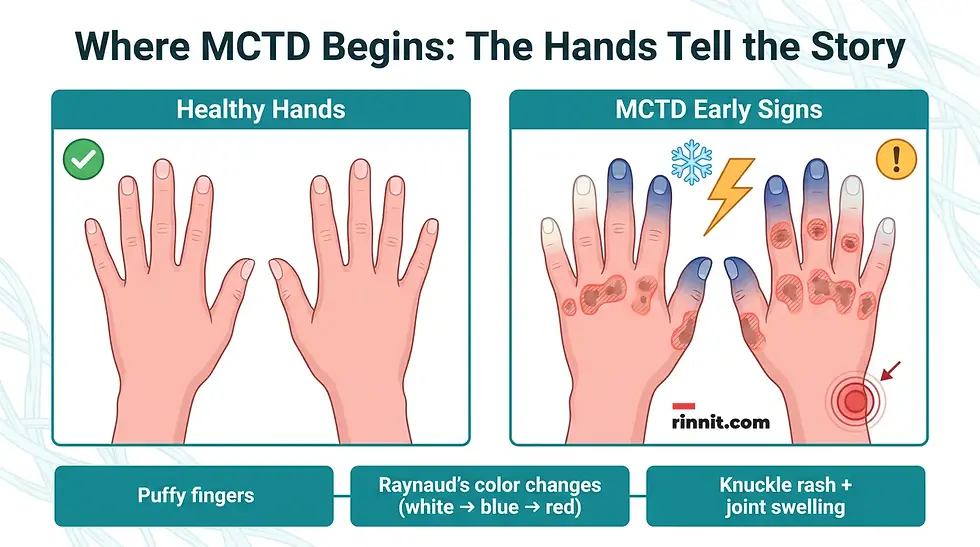
Early symptoms of MCTD usually show up in the hands, but they can also feel like a general flu that never fully goes away. [1]
Feeling of not being well. This can include tiredness and a mild fever that lingers. [1]
Cold and numb fingers or toes. This is called Raynaud’s disease. It happens in response to cold or stress, which briefly reduces blood flow to the fingers or toes. The fingers or toes might turn white, then blue or gray. After warming, they turn red. Depending on skin color, these color changes may be harder or easier to see. [1]
Swollen fingers or hands. Some people have noticeable swelling of the fingers. [1]
Muscle and joint pain. Joints can become irritated and swollen, which doctors call inflamed. Over time, joints may change shape — similar to what happens with rheumatoid arthritis. [1]
Rash. Red or brown patches can appear over the knuckles. Again, depending on skin color, these changes may be harder or easier to see. [1]
Early Sign | What It Looks Like | What Triggers It |
General unwellness | Tiredness, mild fever [1] | None specific |
Raynaud’s phenomenon | Fingers turn white, then blue or gray, then red after warming [1] | Cold or stress [1] |
Hand swelling | Puffy or swollen fingers and hands [1] | Often appears early in the disease [1] |
Joint pain | Inflamed, swollen joints that may change shape [1] | Progressive, like rheumatoid arthritis [1] |
Knuckle rash | Red or brown patches over the knuckles [1] | Varies by skin tone visibility |
How Common Is MCTD, and Who Gets It?
Mixed connective tissue disease can happen at any age. But it seems to be most common in people assigned female at birth who are younger than age 50. [1]
The condition is not common in any group. In a New York City population-based registry, the age-adjusted prevalence ranged from about 1.3 to 16.2 per 100,000 people, and new cases from about 0.4 to 1.9 per 100,000 each year, depending on how MCTD was defined. [5]
What Causes Mixed Connective Tissue Disease?
Experts don’t know what causes mixed connective tissue disease. What they do know is that it is an autoimmune condition — meaning the immune system attacks healthy cells by mistake. [1]
Normally, the immune system fights off diseases. In MCTD, it attacks the fibers that provide support for the body. [1]
Some people with MCTD have a family history of the condition. But the role of genes isn’t clear. [1] No clear environmental trigger has been identified. [4] There is no known way to prevent the disease today.

What Complications Can MCTD Cause?
Mixed connective tissue disease can lead to serious complications. Some of them can be fatal. [1] This is why regular medical follow-up is so important, even when symptoms feel mild.
High blood pressure in the lungs. Also called pulmonary hypertension, this is a major cause of death in people with mixed connective tissue disease. [1] [4]
Interstitial lung disease. This large group of disorders can cause scarring in the lungs. Scarring makes it harder to breathe. Many people with interstitial lung disease need oxygen for treatment. [1]
Heart disease. Parts of the heart can get larger or not work as they should. There can be swelling and irritation, called inflammation, around the heart. Heart failure can happen. [1]
Kidney damage. Some people with MCTD have kidney symptoms. These are most often mild. But kidney damage can lead to kidney failure. [1] [3]
Digestive tract damage. MCTD often affects the long tube of organs involved with digesting food and liquids. You might have heartburn, belly pain, and trouble swallowing or digesting food. [1] [3]
Tissue death. The tissue in the fingertips of people with serious Raynaud’s disease can die. This is also called gangrene. [1]
Hearing loss. One small study reported hearing loss in almost half the people with mixed connective tissue disease. This link needs more research. [1]
Dry mouth. Sjogren syndrome is one of the autoimmune conditions that can be part of MCTD. It can cause dental issues and loss of teeth. [1]
Organ System | Possible Complication | Why It Matters |
Lungs (blood vessels) | Pulmonary hypertension | |
Lungs (tissue) | Interstitial lung disease with scarring [1] | Often requires oxygen treatment [1] |
Heart | Enlargement, inflammation, heart failure [1] | Heart failure can develop [1] |
Kidneys | Damage progressing to failure [1] | Symptoms often start mild [1] |
Digestive tract | Heartburn, belly pain, swallowing trouble [1] | Daily comfort and nutrition affected |
Fingertips | Tissue death (gangrene) [1] | From serious Raynaud’s disease [1] |
Ears | Hearing loss [1] | Reported in almost half in one small study [1] |
Mouth | Dry mouth, dental issues, tooth loss [1] | From Sjogren syndrome overlap [1] |
When Should I See a Doctor?
See your healthcare professional if you have symptoms that worry you. [1] That is the simple guidance from clinical experts.
In practice, it is wise to get checked sooner rather than later if your fingers turn white or blue in the cold, your hands stay puffy, or you have ongoing joint pain and tiredness that don’t go away. Early diagnosis is linked to better outcomes. [4]
How Is Mixed Connective Tissue Disease Diagnosed?
Diagnosis of MCTD involves a physical exam, a medical history, and tests. During the physical exam, the healthcare professional may check for puffy fingers and painful, swollen joints. [2]
Blood tests. A complete blood count, called a CBC, checks for anemia and overall health. Blood tests can also measure the degree of inflammation in the body. [2]
Antibody tests. A blood test can check for antibodies linked with MCTD. These are antinuclear antibodies (ANA), and antiribonucleoprotein antibodies, called anti-RNP antibodies. Here is the key point: these antibodies must be present for the diagnosis. But not all people who carry these antibodies have the condition. [2]
Urine tests. These help show whether the kidneys are affected and how badly. [2]
Diagnostic Step | What Happens | What It Reveals |
Physical exam | Doctor checks for puffy fingers and swollen, painful joints [2] | Visible signs of the disease |
CBC blood test | Checks blood cell counts | Anemia and overall health [2] |
Inflammation tests | Measures body-wide inflammation [2] | Usually raised in people with MCTD [4] |
ANA and anti-RNP tests | Checks for the disease’s signature antibodies | Must be present for diagnosis [2] |
Urine tests | Screens the urine for kidney markers | Whether kidneys are involved and how badly [2] |

How Is MCTD Treated?
There’s no cure for mixed connective tissue disease. Medicines can help manage the symptoms. The type of medicine depends on how bad the condition is and what organs it affects. [2]
Corticosteroids. Medicines such as prednisone help keep the immune system from attacking healthy cells and ease swelling and irritation. Long-term use can lead to serious side effects, including mood swings, weight gain, high blood sugar, increased blood pressure, higher risk of infection, weakened bones, and cataracts. [2]
Medicines that treat malaria. Hydroxychloroquine (Plaquenil, Sovuna) can treat mild MCTD and might prevent flares of the condition. [2]
Calcium channel blockers. These medicines, including nifedipine (Procardia) and amlodipine (Norvasc), help relax the muscles in the walls of blood vessels. They can help treat Raynaud’s phenomenon. [2] [3]
Immunosuppressants. These are medicines that keep the immune system from attacking healthy cells. Doctors may prescribe them based on symptoms. For example, if symptoms look like lupus, medicines most often given to people with lupus might be tried. [2]
Medicines for pulmonary hypertension. Doctors might prescribe bosentan (Tracleer) or sildenafil (Revatio, Viagra) to treat high blood pressure in the lungs. [2] [3]
Medicines for interstitial lung disease. If lung scarring already exists, treatment won’t reverse it. But treatments may stop the condition from getting worse. Corticosteroids and other medicines can ease symptoms for a time or slow the worsening. [2]
Medicine Type | Examples | What It Does | Watch Out For |
Corticosteroids | Prednisone | Calms the immune system, eases swelling [2] | Long-term side effects (weight gain, bone loss, cataracts, infection risk) [2] |
Malaria medicines | Hydroxychloroquine (Plaquenil, Sovuna) | Treats mild MCTD, may prevent flares [2] | Needs monitoring |
Calcium channel blockers | Nifedipine (Procardia), amlodipine (Norvasc) | Relaxes blood vessel muscles, treats Raynaud’s [2] | Used alongside avoiding cold, smoking, and caffeine [4] |
Immunosuppressants | Lupus-style medicines when symptoms match [2] | Keeps immune system from attacking the body [2] | Chosen based on symptoms [2] |
Pulmonary hypertension drugs | Bosentan (Tracleer), sildenafil (Revatio, Viagra) | Lowers lung blood pressure [2] | Targets a serious complication |
Lung scarring medicines | Corticosteroids and others | Can’t reverse scarring but may stop worsening [2] | Eases symptoms for a time [2] |
What Can I Do at Home to Manage MCTD?
Beyond prescription medicines, several self-care steps help manage symptoms.
Take nonsteroidal anti-inflammatory drugs (NSAIDs). Medicines such as ibuprofen (Advil, Motrin IB) or naproxen sodium (Aleve) might help ease pain and swelling if the condition is mild. [2]
Protect hands from cold. Wear gloves and use hand warmers if needed. Keeping your hands warm can help prevent Raynaud’s phenomenon. [2]
Don’t smoke. Smoking causes blood vessels to narrow. This can make Raynaud’s disease worse. [2]
Lower stress. Stress can worsen Raynaud’s disease. Try deep breathing or meditation to bring stress down. [2]
How Should I Prepare for My Doctor’s Appointment?
You might start by seeing your main healthcare professional. You may then be referred to a doctor who specializes in joint diseases, called a rheumatologist. [2]
Before the visit, have a friend or family member go with you to help remember all the information. [2]
Make a list of four things: your symptoms (including any that don’t seem related, and when they began), key medical information (other conditions and family history), all medicines, vitamins, and supplements with dosages, and questions to ask. [2]
Basic questions to ask include: What’s the most likely cause of my symptoms? What tests do I need? What treatments are there? And if you have other health conditions — how can they best be managed together? [2]
Expect the doctor to ask about your symptoms too. Be ready to answer: Do symptoms stay constant, or do they come and go? How bad are they? What makes them better or worse? [2]
What Is the Long-Term Outlook?
Mixed connective tissue disease has no cure, and its course varies from person to person. [2] [3] The outlook is generally good, depending on which organs are involved. [4] But some people face serious organ complications, with pulmonary hypertension being the most common cause of death. [4]
Early diagnosis is linked to a better outlook. [4] Treatment is matched to the organs involved, and self-care helps with Raynaud’s — keeping hands warm, avoiding smoking, and managing stress. [2] Regular monitoring for lung, heart, and kidney problems is key to better outcomes. [4]
Take the Next Step
If your fingers go white or blue in the cold, stay puffy, or your joints ache for months on end, don’t write it off as “just circulation” or normal wear and tear. Mixed connective tissue disease hides behind everyday symptoms — which is exactly why it takes a blood test for ANA and anti-RNP antibodies to confirm it. Rinnit.com’s plain-language guides help you walk into your appointment knowing exactly what to ask for.
Talk with a healthcare professional about your symptoms and get an antibody blood test if MCTD could be the cause. Early diagnosis is linked to better outcomes. [4]
Frequently Asked Questions
What exactly is mixed connective tissue disease?
MCTD is an autoimmune illness that combines symptoms of more than one rheumatic condition — most commonly lupus, scleroderma, and myositis — in a single person. Many people with it also have inflammatory arthritis and Sjogren syndrome. [1] [3]
Is MCTD the same as lupus or scleroderma?
No. MCTD overlaps with both (and often myositis), but it is its own condition. The distinguishing feature is the anti-RNP antibody, which must be present for the diagnosis. [1] [2] [3]
What are the first symptoms I should watch for?
Early signs usually involve the hands — puffy fingers, cold-triggered color changes (Raynaud’s phenomenon), and swollen hands — plus general tiredness, mild fever, joint pain, and a knuckle rash. [1]
Is mixed connective tissue disease rare?
Yes. In a New York City population-based registry, the age-adjusted prevalence ranged from about 1.3 to 16.2 per 100,000 people, and new cases from about 0.4 to 1.9 per 100,000 each year, depending on how MCTD was defined. [5] It most often affects women under 50 but can occur at any age. [1]
How do doctors confirm the diagnosis?
Through a physical exam, medical history, blood tests (CBC, inflammation markers, and the required ANA and anti-RNP antibodies), and urine tests to check kidney involvement. [2]
Can MCTD be cured?
No. There is no cure, but medicines such as corticosteroids, hydroxychloroquine, and calcium channel blockers can control symptoms, and organ-specific treatments can stop complications like lung scarring from worsening. [2]
What is the most serious complication of MCTD?
Pulmonary hypertension — high blood pressure in the lungs — is a major cause of death in people with the disease. [4] Heart disease, kidney failure, and interstitial lung disease are also serious risks. [1]
What lifestyle steps help manage MCTD at home?
Keep hands warm with gloves and hand warmers, don’t smoke (it narrows blood vessels and worsens Raynaud’s), manage stress through breathing or meditation, and use NSAIDs like ibuprofen for mild pain and swelling. [2]
What medicines are used to treat MCTD?
Treatment depends on which organs are affected. Common options include corticosteroids, hydroxychloroquine, calcium channel blockers for Raynaud's, and other immune-calming medicines chosen by your care team.
What kind of doctor treats MCTD?
A rheumatologist, a doctor who treats joint and autoimmune diseases, usually leads care. Lung, heart, or kidney specialists may join if those organs are involved.
Related Reading
ENA Panel: Which Antibodies It Tests and What Results Mean explains the follow-up antibody test that narrows down a positive ANA.
Read next on Rinnit.com:
ANA Test (Antinuclear Antibody Test): Purpose, Results and What a Positive Means explains how this blood test looks for autoimmune disease and what a positive result means.
References
Mayo Clinic Staff. Mixed connective tissue disease - Symptoms & causes. Mayo Clinic. September 20, 2025. https://www.mayoclinic.org/diseases-conditions/mixed-connective-tissue-disease/symptoms-causes/syc-20375147
Mayo Clinic Staff. Mixed connective tissue disease - Diagnosis & treatment. Mayo Clinic. September 20, 2025. https://www.mayoclinic.org/diseases-conditions/mixed-connective-tissue-disease/diagnosis-treatment/drc-20375152
National Organization for Rare Disorders. Mixed Connective Tissue Disease. NORD. October 16, 2024. https://rarediseases.org/rare-diseases/mixed-connective-tissue-disease-mctd/
Sapkota B, et al. Mixed Connective Tissue Disease. In: StatPearls. Treasure Island (FL): StatPearls Publishing; 2024 Jan-. PMID 31194355. https://www.ncbi.nlm.nih.gov/books/NBK542198/
Hasan G, et al. Population-based prevalence and incidence estimates of mixed connective tissue disease from the Manhattan Lupus Surveillance Program. Rheumatology (Oxford). 2023;62(8):2845-2849. PMID 36538873. https://doi.org/10.1093/rheumatology/keac703
Hyldgaard C, et al. Interstitial Lung Disease in Connective Tissue Diseases: Survival Patterns in a Population-Based Cohort. J Clin Med. 2021;10(21):4830. PMID 34768349. https://doi.org/10.3390/jcm10214830
Medical disclaimer
This article is for general informational purposes only and does not replace professional medical advice, diagnosis, or treatment. Always consult a qualified healthcare provider for guidance specific to your situation.



Comments