Psoriatic Arthritis: Symptoms, Causes, Diagnosis, Treatment & Complete Guide

Updated: 2 days ago
Medically reviewed by Dr. Baraa Alnahhal, MD · Last reviewed: October 2026
Quick Answer
Psoriatic arthritis is a type of arthritis that develops in people who have psoriasis, a skin condition causing itchy, scaly patches. The main symptoms are joint pain, stiffness, and swelling, and they can affect any joint in the body. There is no cure, but medicines called DMARDs, along with self-care habits, can ease symptoms, protect joints from lasting damage.
What the research says
Biologic therapy for psoriasis was linked to a lower chance of later developing psoriatic arthritis. A meta-analysis of 15 cohort studies (124,138 people with psoriasis, over 778,690 person-years of follow-up) found that biologic use was associated with a 46% lower psoriatic arthritis risk than non-biologic therapy (pooled hazard ratio 0.54, 95% CI 0.43 to 0.68); the authors note the data are observational, so cause and effect cannot be proven. (Xie et al., Am J Clin Dermatol, 2026) [3]
Not every analysis agrees, so this link is still unproven. A separate meta-analysis of 18 studies found no significant overall difference between biologic and non-biologic treatment in preventing psoriatic arthritis (hazard ratio 0.71, 95% CI 0.44 to 1.17), although some subgroups suggested lower risk; the authors call the findings hypothesis-generating and say they need confirmation in prospective studies and randomized trials. (Yang et al., J Eur Acad Dermatol Venereol, 2026) [4]
Psoriatic arthritis was not linked to a higher overall cancer risk. In a systematic review and meta-analysis of 112 studies (2,053,932 patients), psoriatic arthritis was not associated with increased overall cancer risk (risk ratio 1.02, 95% CI 0.97 to 1.08), while people with psoriasis had a slightly higher risk (risk ratio 1.21, 95% CI 1.11 to 1.33); the authors note that data on psoriatic arthritis remain scarce. (Vaengebjerg et al., JAMA Dermatol, 2020) [5]
At a Glance
Item | Summary |
Definition | Long-term arthritis affecting people who have psoriasis |
What happens | The immune system attacks healthy joints and skin |
Most common age of onset | Typically 30–55 years (can occur at any age) |
Main symptoms | Joint pain, stiffness, swelling |
Distinctive signs | Sausage-like fingers/toes, foot pain, lower back pain, nail changes, eye inflammation, fatigue |
Diagnosis | Physical exam + X-ray, MRI, rheumatoid factor test, joint fluid test |
Main treatments | DMARDs (conventional, biologic, targeted synthetic), NSAIDs, apremilast, steroid injections, surgery |
Cure | No cure — treatment manages symptoms and protects joints |
See a doctor when | You have psoriasis and new joint pain or stiffness |

What Is Psoriatic Arthritis?
Psoriatic arthritis is a type of arthritis that can affect people who have psoriasis — a skin condition that causes itchy, scaly patches. These patches may be red, purple, or brown depending on your skin color. Psoriasis causes skin cells to build up rapidly on the surface, forming thick, silvery scales and itchy, dry patches that may be painful.
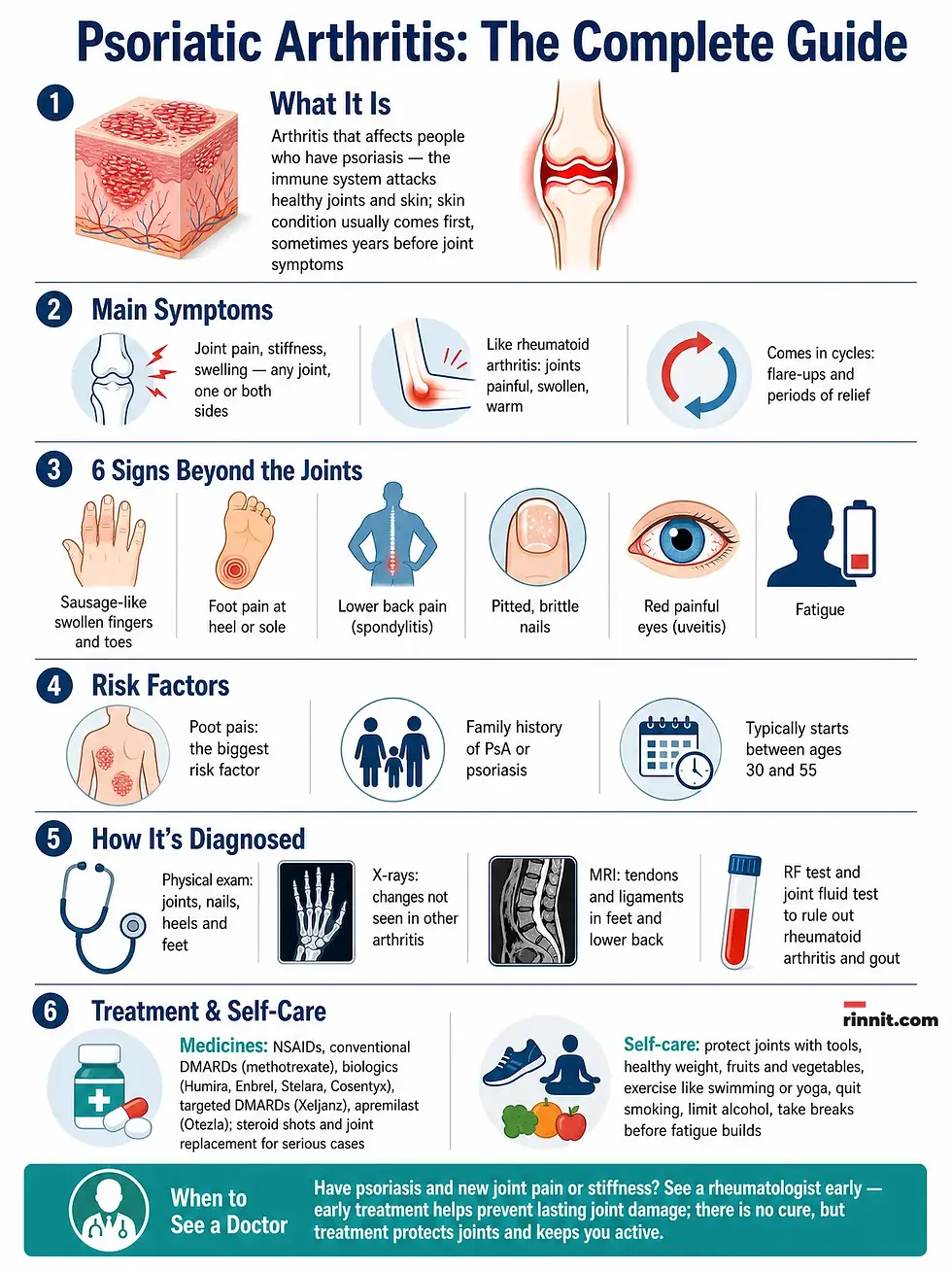
Here is the key pattern to know: most people get psoriasis first, sometimes years before symptoms of psoriatic arthritis start. The main symptoms are joint pain, stiffness, and swelling, and they can affect any joint in the body. Symptoms range from mild to serious.
Like psoriasis itself, psoriatic arthritis often goes through cycles. Sometimes symptoms flare up. Other times, they ease or go away for a while. The condition can affect joints on one or both sides of your body, and it shares some symptoms with rheumatoid arthritis — in both conditions, joints may feel painful, swollen, and warm to the touch.
What are the 9 signs of psoriatic arthritis?
The three main symptoms — joint pain, stiffness, and swelling — are joined by six other signs that often give the condition away. Many of these are unique to psoriatic arthritis and rarely appear in other types.
Swollen Fingers and Toes
Fingers and toes may become swollen and puffy, sometimes looking like sausages. This whole-digit swelling is one of the condition's most recognizable hallmarks.
Foot Pain
You may feel pain where tendons or ligaments attach to bones. This is especially common at the back of the heel — called Achilles tendinitis — or in the sole of the foot, called plantar fasciitis. We covered Achilles tendinitis in a separate guide, and here it appears as one way psoriatic arthritis can show up.
Lower Back Pain
Some people develop a condition called spondylitis, which causes pain and stiffness in the spine and pelvis.
Nail Changes
Fingernails or toenails may develop tiny dents called pits. The nails may become brittle or crumbly, and they may start to lift away from the skin underneath. These changes can look like a fungal nail infection, so it is important to have your care team check to be sure of the cause.
Eye Inflammation
A condition called uveitis can cause red, painful eyes and blurry vision. If it is not diagnosed and treated, it can lead to vision loss.
Fatigue
Many people with psoriatic arthritis get very tired. Fatigue is a real symptom of the inflammation itself — and sometimes a side effect of the medicines used to treat it.
When should you see a doctor about psoriatic arthritis?
If you have psoriasis and start to notice joint pain or stiffness, tell your healthcare professional. Ask about seeing a rheumatologist — a doctor who specializes in arthritis and other joint and immune conditions.
Treating psoriatic arthritis early can help prevent lasting joint damage.
Because symptoms come and go in cycles, it is easy to wait out a flare. But the window between first symptoms and permanent joint damage is the best time to start treatment.
What Causes Psoriatic Arthritis?
Psoriatic arthritis happens when the immune system attacks healthy joints and skin by mistake. The immune system is the part of the body that fights illness, but in this condition it turns on healthy tissue. This causes swelling in the joints and makes the body make too many skin cells.
Researchers are not exactly sure what causes it. But it seems to be linked to both your genes and things in the environment. Many people with psoriatic arthritis have family members with the condition or with psoriasis.
Certain genes may make someone more likely to get it, including a gene that makes a protein called HLA-B27. This protein is found on the surface of some white blood cells and plays a role in how the immune system works (HLA stands for human leukocyte antigen). Testing for this gene is called HLA typing. Importantly, not everyone with this gene develops psoriatic arthritis, and not everyone with the disease has the gene.
For some people, environmental factors — such as an injury, a virus, or a bacterial infection — may trigger the condition if they already have the genetic risk.
What are the risk factors for psoriatic arthritis?
Psoriatic arthritis is more likely to develop when any of three main risk factors is present.
Risk factor | What it means |
Psoriasis | The biggest risk factor — most people who get psoriatic arthritis already have psoriasis |
Family history | A parent or sibling with psoriatic arthritis raises your chances |
Age | Can happen at any age, but typically starts between ages 30 and 55 |
What complications and related conditions come with psoriatic arthritis?
Psoriatic arthritis can rarely lead to arthritis mutilans and is linked with conditions such as high blood pressure, metabolic syndrome, diabetes, heart disease, gout, anxiety and depression.
Arthritis Mutilans
In rare cases, psoriatic arthritis can lead to a serious form called arthritis mutilans. It causes severe pain and damage to the small bones in the hands, especially the fingers. Over time, it can change the shape of the fingers and make everyday hand tasks hard.
Associated Conditions
Psoriatic arthritis can also be associated with several other health conditions. This is part of why a rheumatologist typically looks at your whole health picture, not just your joints:
High blood pressure (hypertension)
Metabolic syndrome — a group of conditions that raise the risk of heart disease
Diabetes
Heart disease
Gout
Anxiety and depression
How is psoriatic arthritis diagnosed?
No single test can confirm a diagnosis of psoriatic arthritis. Instead, different tests help rule out other causes of joint pain, such as rheumatoid arthritis or gout.
Physical Exam
During the visit, your healthcare professional may:
Look at your joints for swelling or tenderness.
Check your fingernails for signs of pitting or peeling.
Press on the bottoms of your feet and around your heels to check for sore spots.
Imaging Tests
X-rays can show changes in the joints that are common in psoriatic arthritis but not seen in other types of arthritis. MRI scans create detailed pictures of bones, joints, and soft tissue — they are especially helpful for checking the tendons and ligaments in the feet and lower back.
Laboratory Tests
The rheumatoid factor test (RF test) checks for an antibody found in people with rheumatoid arthritis. If the antibody is missing, this may help confirm psoriatic arthritis instead. A joint fluid test removes a small sample of fluid from a swollen joint, often the knee, using a needle. If the fluid contains uric acid crystals, this may mean gout — and some people can have both gout and psoriatic arthritis.
How is psoriatic arthritis treated?
Psoriatic arthritis has no cure, but treatment can manage symptoms, lessen inflammation and protect the joints and skin from damage. Your treatment plan will depend on how serious your symptoms are and which joints are affected — and you may need to try different treatments to find what works best for you.
Medicines
Medicine type | What it does | Examples and notes |
NSAIDs | Lessen pain and swelling | Over-the-counter ibuprofen (Advil, Motrin IB) and naproxen sodium (Aleve); stronger versions can be prescribed. Side effects: stomach upset, heart issues, liver or kidney damage |
Conventional DMARDs | Slow the disease and prevent lasting joint damage | Methotrexate (Trexall, Otrexup) most common; also leflunomide (Arava), sulfasalazine (Azulfidine). Side effects: liver damage, bone marrow suppression, lung inflammation and scarring (fibrosis) |
Biologic DMARDs | Target specific parts of the immune system that cause joint inflammation | TNF blockers: adalimumab (Humira), certolizumab (Cimzia), etanercept (Enbrel), golimumab (Simponi), infliximab (Remicade); also ustekinumab (Stelara), secukinumab (Cosentyx), ixekizumab (Taltz), guselkumab (Tremfya), abatacept (Orencia). Can increase risk of common and rare infections, such as tuberculosis |
Targeted synthetic DMARDs | Lessen inflammation when other drugs haven't helped | Tofacitinib (Xeljanz) pill. It carries an FDA boxed warning for serious infections, death, cancer, major heart problems and blood clots, so it is usually used only after other treatments |
Newer oral medicine | Lessens inflammation for mild-to-moderate cases | Apremilast (Otezla) pill; used especially if you cannot take conventional DMARDs or biologics. Common side effects: diarrhea, nausea, headaches |
The prescription medicines collectively known as disease-modifying antirheumatic drugs (DMARDs) are one of the main treatment options.
Therapies
Physical and occupational therapy help lessen pain, improve movement, and make everyday activities easier. These therapies teach you new ways to move and use your body to avoid stress on your joints — ask your healthcare professional for a referral. Massage therapy may also offer relief by easing muscle tension and pain.
Surgery and Other Procedures
A steroid shot directly into a painful joint can quickly lessen swelling and pain. But steroid shots are typically used sparingly, because repeated use may weaken tendons or cartilage and lead to joint damage.
If a joint has been seriously damaged, joint replacement surgery can replace it with an artificial joint made of metal and plastic. This typically improves movement and lessens pain.
Which self-care and lifestyle steps help psoriatic arthritis?
Psoriatic arthritis self-care includes protecting your joints, staying at a healthy weight, eating healthy foods and keeping active, among other daily habits. The seven habits below are worth building into daily life:
Protect your joints. Change how you do everyday tasks: use jar openers, lift heavy items with both hands, and push doors open with your whole body instead of just your hands. These small changes lessen strain.
Stay at a healthy weight. Extra weight puts more pressure on your joints and makes pain worse. Losing weight can also help some arthritis medicines work better.
Eat healthy foods. More fruits and vegetables, less sugar, fat, and salt. Eating too many unhealthy foods may increase inflammation and fatigue.
Keep moving. Regular exercise keeps joints flexible and muscles strong. Good gentle options include biking, swimming, walking, yoga, and tai chi.
Quit smoking. Smoking makes both psoriasis and psoriatic arthritis worse. Quitting can help lessen symptoms.
Drink less alcohol. Alcohol can make some medicines less effective and increase side effects — especially with drugs such as methotrexate.
Take breaks when needed. Fatigue from pain and inflammation is common, and some medicines also cause tiredness. Rest before you become too tired, and break exercise or work activities into smaller steps.
How can people cope with psoriatic arthritis and find support?
Living with psoriatic arthritis can be challenging, but you do not have to face it alone. Support from family and friends can make a big difference. Some people find comfort in support groups, where they can talk with others who understand what they are going through. A counselor or therapist can help you manage stress and cope with the emotional side of living with a long-term condition.
How should you prepare for a psoriatic arthritis appointment?
You will likely start by talking to your regular healthcare professional about your symptoms. If needed, you may be referred to a rheumatologist — a doctor who focuses on arthritis and similar conditions.
What You Can Do
If possible, bring a friend or family member with you to help you remember all the information you get. Make a list of:
Your symptoms and when they began.
Your medical and family history, including any family members with psoriatic arthritis.
All medications, vitamins, and supplements you take, including doses.
Questions to ask your healthcare professional.
Basic questions to consider include:
What's causing my symptoms?
What tests do I need?
What treatments are available?
What lifestyle changes will I need to make?
Do you have printed information or recommended websites about psoriatic arthritis?
What to Expect From Your Doctor
Your healthcare professional might ask:
What joints are affected?
Are there activities or positions that make your symptoms better or worse?
What treatments have you tried? Have any helped?
Frequently Asked Questions (FAQ)
What is psoriatic arthritis in simple terms?
Psoriatic arthritis is a type of arthritis that affects people who have psoriasis, a skin condition that causes itchy, scaly patches. The immune system attacks healthy joints and skin by mistake, causing joint pain, stiffness, and swelling. Most people develop psoriasis first, sometimes years before the joint symptoms begin.
What does psoriatic arthritis feel like?
Psoriatic arthritis feels like painful, stiff, swollen joints — and the symptoms can come and go in cycles of flare-ups and relief. Distinctive signs include sausage-like swollen fingers and toes, pain at the heel or sole of the foot, lower back pain, pitted or lifting nails, red painful eyes, and deep fatigue.
What is the main cause of psoriatic arthritis?
The immune system attacks healthy joints and skin by mistake, causing joint swelling and rapid skin cell buildup. The exact trigger is unknown, but it appears linked to a combination of genes — including the HLA-B27 gene — and environmental factors such as injuries, viruses, or bacterial infections.
Who is most at risk for psoriatic arthritis?
The biggest risk factor is having psoriasis — most people who develop psoriatic arthritis already have it. Having a parent or sibling with the condition also raises your risk. It can occur at any age but typically starts between ages 30 and 55.
How do doctors test for psoriatic arthritis?
No single test confirms it. Doctors start with a physical exam of your joints, nails, and feet, then use X-rays and MRI scans to look for characteristic changes. Blood tests (like the rheumatoid factor test) and a joint fluid test help rule out rheumatoid arthritis and gout.
Can psoriatic arthritis be cured?
No — there is no cure. But treatment can lessen symptoms, reduce inflammation, and protect your joints and skin from damage. Starting treatment early is important, because it helps prevent lasting joint damage.
What medicines treat psoriatic arthritis?
Options include anti-inflammatory pain relievers (NSAIDs) for milder symptoms, disease-modifying drugs such as methotrexate, and biologic or targeted medicines that calm specific parts of the immune system. A rheumatologist helps choose based on which joints, skin, and nails are affected.
Can you have psoriatic arthritis without psoriasis?
Yes. Some people develop joint symptoms before any skin psoriasis appears, and a family history of psoriasis can be a clue. Your provider may still diagnose psoriatic arthritis based on joint, nail, and imaging findings.
How is psoriatic arthritis different from rheumatoid arthritis?
Both cause joint inflammation, but psoriatic arthritis is linked with psoriasis and often affects the ends of the fingers and toes, the nails, the heels, and the spine. People with psoriatic arthritis usually test negative for rheumatoid factor.
Does exercise help psoriatic arthritis?
Yes. Regular low-impact activity, such as walking, swimming, or cycling, can ease stiffness, keep joints moving, and support heart health. A physical therapist can help you plan safe exercise, especially during flares.
Conclusion
Three lessons to take away from this guide:
Psoriasis comes first — if you have psoriasis and develop new joint pain, stiffness, or swelling, don't wait for the flare to pass; psoriatic arthritis is likely the cause.
The signs go beyond joints — sausage-like fingers and toes, foot pain, lower back pain, nail changes, red eyes, and fatigue are all part of the picture.
Treatment protects your future — there is no cure, but early treatment with DMARDs and healthy self-care habits can keep your joints working and your life active.
This guide has covered what psoriatic arthritis is, the nine signs to recognize, why it develops, how it is diagnosed, and the full range of treatments from NSAIDs to biologics to surgery. If you're noticing joint symptoms alongside your psoriasis, the single most valuable step is an early conversation with a rheumatologist.
Curious about other forms of arthritis? Explore our guides on gout and juvenile idiopathic arthritis, or browse the full rinnit.com library for more complete health guides.
What are your next steps after learning about psoriatic arthritis?
Read a related guide — explore more complete condition guides on rinnit.com, including our gout and juvenile idiopathic arthritis articles.
Share your thoughts — comment below with your questions or experiences with psoriatic arthritis.
Disclaimer: This article is for general informational purposes only and is not a substitute for professional medical advice, diagnosis, or treatment. Always consult a qualified healthcare professional for guidance about your specific condition.
Related Reading
ANA Test (Antinuclear Antibody Test): Purpose, Results and What a Positive Means explains how this blood test looks for autoimmune disease and what a positive result means.
References
Mayo Clinic Staff. Psoriatic arthritis - Symptoms & causes. Mayo Clinic. September 19, 2025. https://www.mayoclinic.org/diseases-conditions/psoriatic-arthritis/symptoms-causes/syc-20354076
Mayo Clinic Staff. Psoriatic arthritis - Diagnosis & treatment. Mayo Clinic. September 19, 2025. https://www.mayoclinic.org/diseases-conditions/psoriatic-arthritis/diagnosis-treatment/drc-20354081
Xie W, et al. Impact of Biologic Therapies on the Risk of Progression from Psoriasis to Psoriatic Arthritis: A Systematic Review and Meta-Analysis of Cohort Studies. Am J Clin Dermatol. 2026. PMID 42579249. https://doi.org/10.1007/s40257-026-01065-8
Yang L, et al. Biologic therapies and psoriatic arthritis risk in psoriasis: A systematic review and meta-analysis. J Eur Acad Dermatol Venereol. 2026. PMID 42227826. https://doi.org/10.1111/jdv.70540
Vaengebjerg S, et al. Prevalence, Incidence, and Risk of Cancer in Patients With Psoriasis and Psoriatic Arthritis: A Systematic Review and Meta-analysis. JAMA Dermatol. 2020;156(4):421-429. PMID 32074260. https://doi.org/10.1001/jamadermatol.2020.0024



Comments