Gout: Symptoms, Causes, Diagnosis, Treatment & Complete Guide

Updated: 2 days ago
Medically reviewed by Dr. Baraa Alnahhal, MD · Last reviewed: October 2026
Quick Answer
Gout is a common form of arthritis that can affect anyone. It's known for sudden attacks of intense pain, swelling, redness, and tenderness in one or more joints — and the big toe is the joint most affected. The cause is a buildup of uric acid in the blood, which forms sharp crystals in the joints.
An attack may strike suddenly, often in the middle of the night. The big toe might feel like it's burning, and the joint can be so tender that the weight of a bedsheet feels like too much pressure.
The good news: there are ways to manage symptoms and prevent attacks.
What the research says
Starting uric-acid-lowering medicine can itself trigger flares, but colchicine cuts that risk. A network meta-analysis of 27 trials (29 publications) found that, compared with urate-lowering therapy alone, adding colchicine lowered flare risk (risk ratio 0.50, 95% CI 0.35 to 0.72) and adding rilonacept 160 mg lowered it further (0.35, 95% CI 0.25 to 0.50); the authors note that flare risk varies by drug and dosing strategy and that more research is needed on prophylaxis harms and duration. (Maher et al., Arthritis Care Res, 2024) [3]
Flares peak when treatment starts and again when preventive medicine stops. In a secondary analysis of the CARES trial (6,183 participants, median age 65, 84% male), flare rates peaked in months 0–6 as urate-lowering therapy began and in months 6–12 after flare prophylaxis stopped; after the first year, flares stayed higher when serum urate was 6 mg/dL or above, and the authors suggest a longer duration of prophylaxis may be warranted. (Tedeschi et al., Ann Rheum Dis, 2024) [4]
Starting a urate-lowering medicine during a flare showed neither clear harm nor clear benefit. A meta-analysis of 6 randomized trials (445 participants) found no significant difference in time to flare resolution (standardized mean difference 0.77 days; 95% CI −0.26 to 1.79) or in recurrent flares over the next 28 to 30 days (risk ratio 1.06; 95% CI 0.59 to 1.92); the authors caution the findings have limited applicability to tophaceous gout or kidney impairment. (Tai et al., Semin Arthritis Rheum, 2024) [5]
At a Glance
Item | Summary |
What it is | A common form of arthritis with sudden attacks of intense joint pain and swelling |
Joint most affected | The big toe (the joint at its base) |
Root cause | Uric acid buildup in the blood forming sharp crystals in joints |
Attack timing | Sudden, often in the middle of the night; worst in first 8–12 hours |
Key risk factors | Diet, weight, certain medical conditions and medicines, family history |
Main diagnosis | Joint fluid test (crystals under a microscope), blood test, X-ray, ultrasound, DECT |
Attack treatment | NSAIDs, colchicine, corticosteroids, (off-label) anakinra |
Prevention treatment | Allopurinol, febuxostat, probenecid, pegloticase — sometimes for life |
Lifestyle levers | Limit alcohol, fructose, and purines; drink plenty of water; keep a healthy weight |
What Is Gout?
Gout is a common form of arthritis that can affect anyone. It's known for sudden attacks of intense pain, swelling, redness, and tenderness in one or more joints. The big toe is the joint most affected.
An attack of gout may happen suddenly, often in the middle of the night. The big toe might feel like it's burning. The affected joint is hot, swollen, and so tender that the weight of the bedsheet on it may feel like too much pressure.
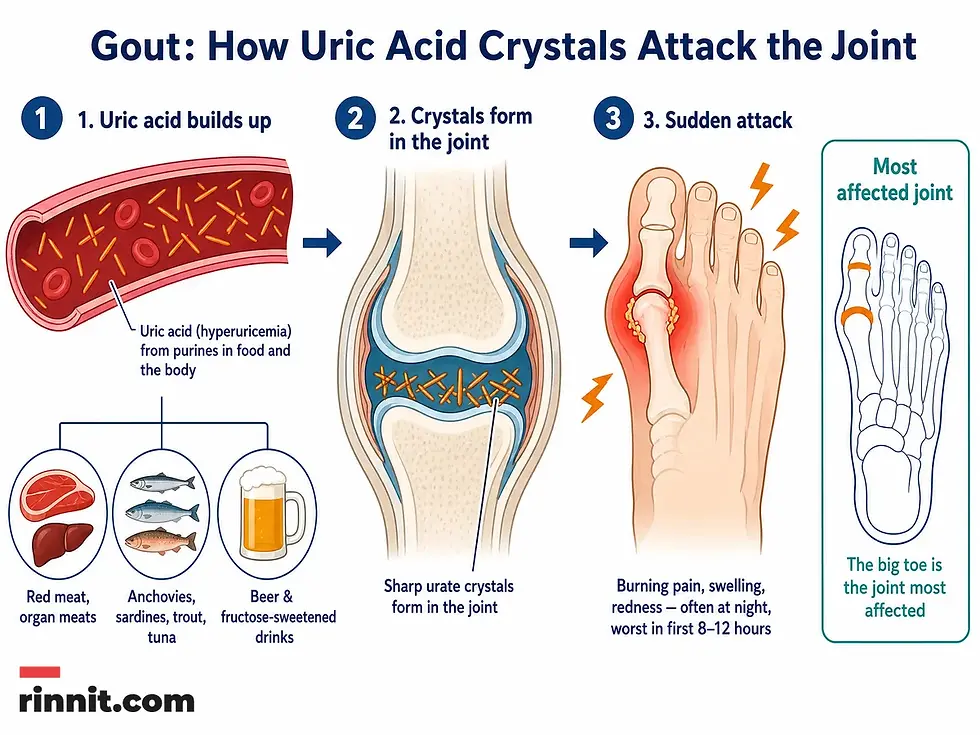
Gout symptoms may come and go. The redness may be harder to see on Black or brown skin. In people with long-term or poorly managed gout, a buildup of uric acid crystals may form firm, painless lumps under the skin called tophi (pronounced TOE-fie). But there are ways to manage symptoms and prevent attacks.
Symptoms of Gout
The symptoms of gout almost always happen suddenly, often at night. They include:
Symptom | What you notice |
Intense joint pain | Gout most often affects the big toe, but it can happen in any joint, including the ankles, knees, elbows, wrists, and fingers. The pain is likely to be the worst within the first 8 to 12 hours after it starts. |
Discomfort that lasts | After the worst pain eases, some joint discomfort may last from a few days to a few weeks. |
Irritation, swelling, and redness | The affected joint or joints become swollen, tender, warm, and red. Redness may be harder to see on Black or brown skin. |
Limited range of motion | As gout goes on, moving the affected joints may be hard. |
When to See a Doctor
If you have sudden, intense pain in a joint, call your healthcare professional. Gout that isn't treated or that comes back can lead to worse pain and joint damage. Seek medical care right away if you have a fever and a joint is hot and inflamed — these symptoms may mean you have an infection.
Causes
The cause of gout is the buildup of uric acid in the blood. High levels of uric acid, also called hyperuricemia, can cause sharp uric acid crystals to form in the joints. This sets off an attack of pain and swelling.
The body makes uric acid when it breaks down substances called purines. Purines are also in certain foods: red meat and organ meats, such as liver; purine-rich seafood including anchovies, sardines, mussels, scallops, trout, and tuna. Alcoholic beverages — mainly beer — and drinks sweetened with a type of sugar called fructose can raise uric acid levels too.
Most often, uric acid passes through the kidneys into the urine. But sometimes either the body makes too much uric acid or the kidneys get rid of too little of it.
Risk Factors
Having a high level of uric acid in the body raises the risk of gout — but some people who have high levels never get a gout attack. Factors that raise the uric acid level include:
Risk factor | How it raises risk |
Diet | Eating a diet rich in red meat and shellfish and drinking fructose-sweetened beverages raises uric acid levels. Drinking alcohol, mainly beer, also raises the risk. |
Weight | If you're overweight or have obesity, your body makes more uric acid, and your kidneys have a harder time getting rid of it. |
Medical conditions | Untreated high blood pressure raises risk, as do long-term conditions such as diabetes, obesity, metabolic syndrome, and heart and kidney diseases. |
Certain medicines | Low-dose aspirin and some blood pressure medicines can raise uric acid levels, including thiazide diuretics, ACE inhibitors, and beta blockers. Organ-rejection medicines after a transplant may also raise levels. |
Family history of gout | If other family members have had gout, you're more likely to get the condition. |
Sex assigned at birth | People assigned male at birth are more likely than people assigned female at birth to have high uric acid levels. Once women go through menopause, their uric acid levels approach those of men. |
Older age | Men are more likely to get gout from age 30 to 50. Women are more likely to get gout after age 60. |
Recent surgery or injury | Either of these can sometimes bring on a gout attack. |
Complications
People with gout can develop worse conditions:
Complication | What happens |
Recurrent gout | Some people who get gout may never have symptoms again. Others may have gout several times each year. Medicines may help prevent attacks in people with recurrent gout. If not treated, gout can damage a joint. |
Advanced gout | Untreated gout may cause urate crystals to form under the skin in lumps called tophi. Tophi can appear on the fingers, hands, feet, elbows, or Achilles tendons (the tendons along the backs of the ankles). They don't often hurt, but they can get swollen and tender during gout attacks. |
Kidney stones | Urate crystals may collect in the urinary tracts of people with gout, causing kidney stones. Medicines can help lower the risk. |

How Gout Is Diagnosed
Healthcare professionals diagnose gout based on symptoms and how the affected joint looks. Tests that may help include:
Test | What it does |
Joint fluid test | A needle is used to take fluid from the affected joint. Urate crystals may show in the fluid under a microscope. |
Blood test | Measures uric acid levels in the blood. Note: high uric acid doesn't always mean gout, and some people who have gout symptoms don't have high uric acid during an attack. |
X-ray imaging | Joint X-rays can help rule out other causes of joint swelling and irritation, and certain features of gout show up on X-rays. |
Ultrasound | Uses sound waves to find urate crystals in joint cartilage or in tophi (the lumps that may form under the skin). |
DECT (dual-energy computerized tomography) | Uses X-ray images taken from different angles to show urate crystals in joints. |
Treatment of Gout
Two types of medicines treat gout. One type helps lessen the swelling, irritation, and pain of gout attacks. The other works to prevent gout complications by lowering uric acid in the blood. Which type is right for you depends on how often you get symptoms, how bad they are, and other health conditions you have.
Medicines to Treat Gout Attacks
Medicine | What to know |
NSAIDs (nonsteroidal anti-inflammatory drugs) | Include over-the-counter medicines such as ibuprofen (Advil, Motrin IB) and naproxen sodium (Aleve), and stronger prescription medicines such as indomethacin (Indocin) and celecoxib (Celebrex, Elyxyb). Too much NSAID use may cause stomach pain, bleeding, and ulcers. |
Colchicine (Colcrys, Gloperba, others) | An anti-inflammatory medicine that lessens gout pain. It works best when taken within 24 hours of the start of symptoms. Side effects include upset stomach, vomiting, and loose stools — which may make it hard to take. |
Corticosteroids (prednisone, others) | Steroid medicines may control gout irritation, swelling, and pain. You take them by mouth or as a shot into a joint. Side effects include mood changes, high blood sugar levels, and high blood pressure. |
Anakinra (Kineret) | Although not approved for treating gout, some healthcare professionals may suggest it for a few days to treat an attack. Taken as a daily shot. Side effects include increased risk of infection, plus swelling, bruising, and itching at the injection site. |
Medicines to Prevent Gout Complications
These medicines may be prescribed for people who have more than two gout attacks each year — or fewer attacks that are very painful — if X-rays show joint damage from gout or tophi, or if you have a long-term kidney condition or kidney stones. You may need to take them for life.
Medicines that block the making of uric acid:
Medicine | What to know |
Allopurinol (Aloprim, Lopurin, Zyloprim) | Taken as a pill by mouth. Side effects include fever, rash, hepatitis, and kidney issues. |
Febuxostat (Uloric) | Also a pill taken by mouth. Side effects include rash, upset stomach, and liver issues. It may also increase the risk of heart-related death. |
Medicines that help rid the body of uric acid:
Medicine | What to know |
Probenecid (Probalan) | Helps the kidneys remove uric acid from the body. Taken as a pill by mouth. Side effects include rash, stomach pain, and kidney stones. |
Pegloticase (Krystexxa) | Given through a vein, it helps break down uric acid. Used for gout that is very bad or resists other treatment. Side effects include a serious allergic reaction called anaphylaxis, upset stomach, vomiting, and constipation. |
One important caveat: medicines that lower uric acid levels can cause gout to recur (a “flare”) when first taken. So treatment may include NSAIDs, colchicine, or low-dose steroids to prevent flares at the start.
Lifestyle and Home Remedies
These lifestyle choices are vital for people who have gout, even if they take medicines:
Drink healthier. Limit or avoid alcohol, especially beer — that includes non-alcoholic beer. Limit or avoid fructose-sweetened beverages, and fruit juice too, which is high in fructose. Drink plenty of water.
Limit foods high in purines. These include red meat and organ meats, such as liver. Purine-rich seafood includes anchovies, sardines, mussels, scallops, trout, and tuna.
Exercise regularly and keep a healthy weight. Keeping your body at a healthy weight lowers your risk of gout. Low-impact activities such as walking, bicycling, and swimming are easier on your joints.
Preparing for Your Appointment
Make an appointment with your healthcare professional if you have symptoms of gout. You may be sent to a specialist in joint, muscle, and bone conditions, called a rheumatologist.
What You Can Do
Make a list of:
Your symptoms, including when they started and how often they happen.
Key medical information, including other conditions you have and any family history of gout.
All medicines, vitamins, and supplements you take, including dosages.
Questions to ask your healthcare professional.
If possible, take a family member or friend along to help you remember all the information you get.
Questions to ask your healthcare professional include:
What are the possible causes of my symptoms?
What tests do I need?
Are there treatments or lifestyle changes that might help my symptoms?
Should I see a specialist?
Questions to ask a rheumatologist include:
What are the possible side effects of the drugs you're prescribing?
How soon after I start treatment should my symptoms improve?
Do I need to take medicines long-term?
I have other health conditions. How can I best manage them together?
How should I change my diet?
Is it safe for me to drink alcohol?
Where can I find more information about this condition?
Be sure to ask all the questions you have.
What to Expect From Your Doctor
Your healthcare professional may ask:
Do your symptoms come and go? How often?
What seems to set off your symptoms, such as certain foods or stress?
Have any of your parents, brothers, or sisters had gout?
What do you eat in a day?
Do you drink alcohol? How much and how often?
FAQ: Gout
What is gout?
Gout is a common form of arthritis that causes sudden attacks of intense pain, swelling, redness, and tenderness in one or more joints. The big toe is the joint most affected, and attacks often strike suddenly in the middle of the night.
What causes a gout attack?
Gout is caused by a buildup of uric acid in the blood, a condition called hyperuricemia. High uric acid levels cause sharp urate crystals to form in the joints, setting off an attack of pain and swelling. The body makes uric acid when it breaks down purines, which are also found in red meat, organ meats, certain seafood, and fructose-sweetened drinks.
Why does gout often hit at night?
Gout attacks typically happen suddenly and often start in the middle of the night. The joint becomes hot, swollen, and so tender that even the weight of a bedsheet can feel like too much pressure — with the big toe feeling like it's burning. The pain is usually worst within the first 8 to 12 hours after it starts.
What foods trigger gout?
Foods high in purines — red meat, organ meats such as liver, and purine-rich seafood including anchovies, sardines, mussels, scallops, trout, and tuna — raise uric acid levels. Alcoholic beverages, mainly beer, and fructose-sweetened drinks also raise uric acid and gout risk.
Can gout be treated or prevented?
Yes. Gout attacks are treated with NSAIDs, colchicine, or corticosteroids, while uric-acid-lowering medicines such as allopurinol, febuxostat, probenecid, and pegloticase prevent complications — and are sometimes taken for life. Lifestyle steps like limiting alcohol and purines and keeping a healthy weight are vital even when taking medicines.
How is gout diagnosed?
Gout is diagnosed based on symptoms and how the joint looks, confirmed by a joint fluid test that looks for urate crystals under a microscope. Blood tests, X-rays, ultrasound, and DECT scans can also help — though high uric acid alone doesn't always mean gout.
Is gout the same as other types of arthritis?
No. Unlike osteoarthritis, which is caused by cartilage wear, gout is driven by uric acid crystals depositing in the joints. It comes in sudden attacks rather than developing slowly, and it's treated with uric-acid-lowering medicines rather than joint-focused therapies.
Conclusion
Gout has a reputation as the arthritis that strikes without warning — a burning big toe at 3 a.m., a joint too tender to bear even a bedsheet. But beneath the sudden pain lies a simple, measurable problem: too much uric acid in the blood, forming sharp crystals in the joints. And because the problem is measurable, gout is highly treatable. This guide has covered the four signs of an attack, the eight risk factors that raise uric acid, the five diagnostic tests, the two medicine paths — calming the attack now and lowering uric acid for the long run — and the lifestyle steps that matter even alongside medication. If sudden, intense joint pain ever strikes, especially with a fever, the single most important step is making that call to your healthcare professional right away.
Explore more condition guides on rinnit.com — gout is one of several distinct forms of arthritis, and knowing the differences helps you ask the right questions.
Disclaimer: This article is for general informational purposes only and does not constitute medical advice. Always consult a qualified healthcare professional for diagnosis and treatment of any health condition. Never disregard professional medical advice or delay seeking it because of something you have read here.
Related Reading
Arthrocentesis (Joint Aspiration): Uses, Procedure and Risks explains arthrocentesis (joint aspiration).
References
Mayo Clinic Staff. Gout - Symptoms and causes. Mayo Clinic. June 12, 2026. https://www.mayoclinic.org/diseases-conditions/gout/symptoms-causes/syc-20372897
Mayo Clinic Staff. Gout - Diagnosis and treatment. Mayo Clinic. June 12, 2026. https://www.mayoclinic.org/diseases-conditions/gout/diagnosis-treatment/drc-20372903
Maher D, et al. Comparative Risk of Gout Flares When Initiating or Escalating Various Urate-Lowering Therapy: A Systematic Review With Network Meta-Analysis. Arthritis Care Res (Hoboken). 2024;76(6):871-881. PMID 38303574. https://doi.org/10.1002/acr.25309
Tedeschi SK, et al. Identifying the association between serum urate levels and gout flares in patients taking urate-lowering therapy: a post hoc cohort analysis of the CARES trial with consideration of dropout. Ann Rheum Dis. 2024;83(10):1375-1380. PMID 38724073. https://doi.org/10.1136/ard-2024-225761
Tai V, et al. An updated systematic review and meta-analysis of randomised controlled trials on the effects of urate-lowering therapy initiation during a gout flare. Semin Arthritis Rheum. 2024;65:152367. PMID 38215627. https://doi.org/10.1016/j.semarthrit.2024.152367



Comments