Arthrocentesis (Joint Aspiration): Uses, Procedure and Risks

Updated: 2 days ago
Written and medically reviewed by Dr. Baraa Alnahhal, MD · Last reviewed: November 2026 · How we review
Quick Answer
Arthrocentesis, or joint aspiration, is a simple procedure that draws fluid out of a joint with a hollow needle to relieve swelling and pain. The fluid can be tested for infection, bleeding or crystals from gout. It takes about 10 minutes in a provider's office. Complications are rare, though fluid can come back.
What the research says
Ultrasound made knee aspiration less painful and more effective: in a trial of 64 swollen knees, ultrasound-guided aspiration caused 48% less procedure pain, removed 183% more fluid (34 vs. 12 mL) and gave better pain scores at 2 weeks than aspiration by feel (Sibbitt WL et al., Scandinavian Journal of Rheumatology, 2012) [2]
Joint fluid tests were key to spotting infection: a review of 14 studies with 6,242 people found the white blood cell count in fluid from arthrocentesis was one of the two most powerful lab tests for septic arthritis, with risk rising sharply above 100,000 cells per microliter (Margaretten ME et al., JAMA, 2007) [3]
Key takeaways
Arthrocentesis drains fluid from a joint with a needle.
It relieves pain and swelling.
The fluid can be tested for infection, gout and bleeding.
Medicine can be injected through the same needle.
It takes about 10 minutes, and complications are rare.
What is arthrocentesis?
A joint can fill with extra synovial fluid after injury, infection or arthritis, causing a swollen joint. Draining it eases pressure. Sources: [1]
Why it's done
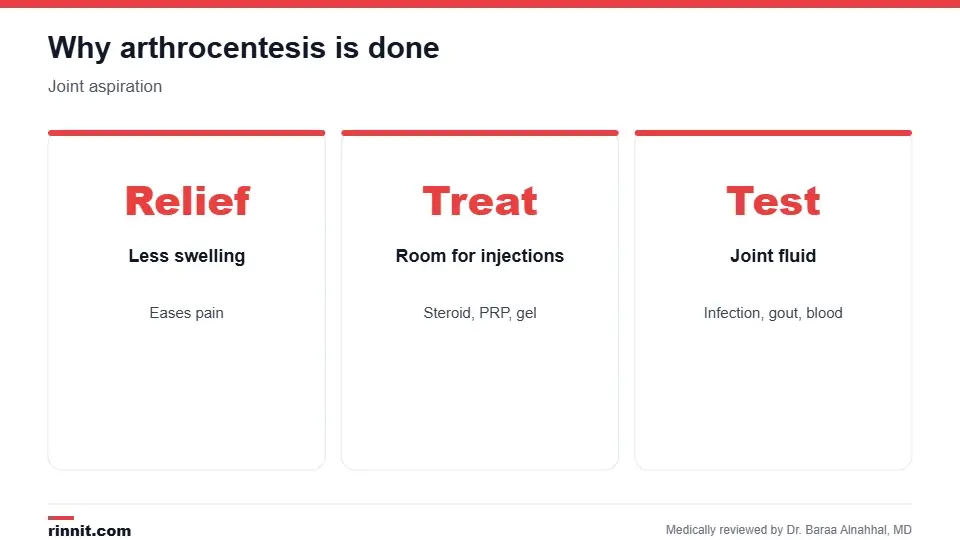
It's often done on the knee, hip or ankle.
Purpose | Details |
Pain relief | Removes extra fluid that causes swelling and pain |
Treatment | Makes room for steroid shots, PRP, bone marrow concentrate or gel injections |
Diagnosis | Tests fluid for infection, bleeding and crystals |
Fluid testing can help diagnose septic arthritis, gout and pseudogout. Sources: [1, 3]
How to prepare
No special preparation is needed. It's done in a provider's office or as an outpatient hospital procedure. Sources: [1]
What happens during the procedure
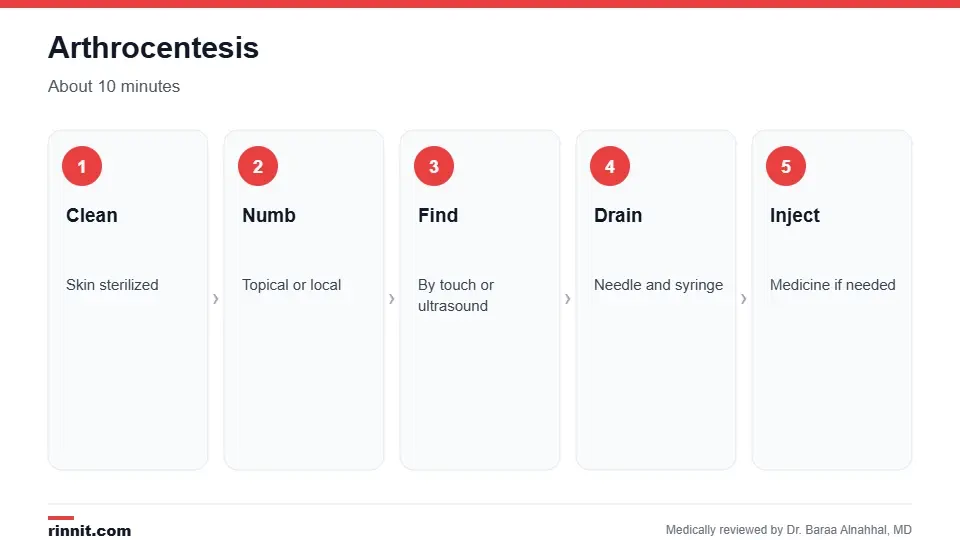
It takes about 10 minutes.
The skin is cleaned and numbed.
Your provider finds the joint, sometimes with ultrasound or X-ray.
More numbing medicine may be injected.
A needle with a syringe withdraws as much fluid as possible.
Medicine may be injected through the same needle.
The fluid may go to a lab for testing. Sources: [1]
Risks

Complications are rare.
Infection.
Bleeding.
Allergic reaction to numbing medicine.
After an injection, a flare of swelling and pain in about 1 in 50 people, fading in a few days. Sources: [1]
Recovery
Your joint is bandaged.
You may need to rest the joint for a while.
Pain and swelling relief usually starts within a day or so.
Lab results come when they're ready. Sources: [1, 2]
Outlook
Relief may be temporary. Fluid can return in a few days, and another aspiration may be needed. With arthritis, symptoms may return more gradually. Sources: [1]
When to call your provider
Pain that gets worse and doesn't improve with pain relievers.
Redness, warmth or a rash at the site.
Bleeding or discharge.
Fever or chills. Sources: [1]
Conclusion
Arthrocentesis is a quick, low-risk way to relieve a swollen joint and find out what's causing it. Ask your provider whether an injection at the same visit could help.
Keep learning: read about knee swelling and steroid injections.
Frequently asked questions
What is arthrocentesis?
Draining fluid from a joint with a needle.
What is another name for it?
Joint aspiration.
Why is it done?
To relieve swelling, give injections and test joint fluid.
Which joints can be drained?
Often the knee, plus the hip, ankle and others.
Does it hurt?
The skin is numbed first, so it's usually mild.
How long does it take?
About 10 minutes.
What can the fluid show?
Infection, bleeding or gout and pseudogout crystals.
Will the fluid come back?
It may, and another aspiration may be needed.
What is a post-injection flare?
Swelling and pain after an injection that fades in a few days.
Do I need to prepare?
No special preparation is needed.
Related Reading
Swollen Knee (Knee Effusion): Symptoms, Causes, and Treatment fluid on the knee.
Cortisone Shots (Steroid Injections): How They Work, Side Effects, and What to Expect injections given after draining.
Knee Gel Injections: Restoring Lubrication and Reducing Arthritis Pain gel injections for arthritis.
Gout: Symptoms, Causes, Diagnosis, Treatment & Complete Guide a condition fluid tests can find.
Bone & Joint Infections (Septic Arthritis): Symptoms, Causes, Diagnosis & Treatment — Complete Guide joint infections.
References
Cleveland Clinic. Arthrocentesis (Joint Aspiration): What It Is & Procedure. Cleveland Clinic. Last updated December 22, 2024. https://my.clevelandclinic.org/health/treatments/14512-arthrocentesis-joint-aspiration
Sibbitt WL, Kettwich LG, Band PA, et al. Does ultrasound guidance improve the outcomes of arthrocentesis and corticosteroid injection of the knee? Scandinavian Journal of Rheumatology. 2012;41(1):66-72. PMID 22103390. https://doi.org/10.3109/03009742.2011.599071
Margaretten ME, Kohlwes J, Moore D, et al. Does this adult patient have septic arthritis? JAMA. 2007;297(13):1478-1488. PMID 17405973. https://doi.org/10.1001/jama.297.13.1478
Medical disclaimer
This article is for general education only and does not replace advice from a qualified healthcare professional. Talk to your doctor about your own diagnosis and treatment, and seek emergency care right away for severe or sudden symptoms.



Comments