Cortisone Shots (Steroid Injections): How They Work, Side Effects, and What to Expect

Updated: 6 days ago
Written and medically reviewed by Dr. Baraa Alnahhal, MD · Last reviewed: October 2026 · How we review
Quick Answer: What is a cortisone shot?
A cortisone shot is an injection of a corticosteroid into an inflamed joint, tendon, or bursa to relieve pain and swelling. It treats conditions such as arthritis, bursitis, tendinitis, and carpal tunnel syndrome. Relief can take up to a week and usually lasts weeks to months. Most people should have no more than three shots a year. [1]
What the research says
Knee arthritis relief is real but fades over months. A review of 27 trials with 1,767 people found steroid shots lowered knee pain by about 1 point on a 10-point scale compared with a dummy injection — roughly 1 in 8 people benefited. The effect was clearest at 1–2 weeks, smaller by 13 weeks, and not seen at 26 weeks. (Jüni et al., Cochrane Database Syst Rev, 2015)
For tennis elbow, quick relief can come at a long-term cost. Across 41 trials with 2,672 people, steroid shots strongly reduced tennis elbow pain in the short term, but people who had no injection did better at 6 and 12 months. Serious harm was rare: 1 of 991 people (0.1%) had a tendon rupture. (Coombes et al., Lancet, 2010)
Blood sugar can rise for days in people with diabetes. A review of 22 studies covering 368 adults with type 1 diabetes found that local steroid injections caused delayed but prolonged rises in blood sugar, so careful glucose checks are needed afterward. (Katz et al., Diabetes Obes Metab, 2026)
Key takeaways
Cortisone shots, steroid shots, and steroid injections are the same treatment.
They deliver a corticosteroid directly to an inflamed area to calm pain and swelling.
Relief may take up to a week; call your provider if you're not better after 10 days.
Effects usually last a few weeks to a few months.
Common side effects are mild: soreness, brief swelling, bruising, and skin color changes.
People with diabetes should check blood sugar more often for about five days afterward.
You shouldn't get a shot while you have an infection.
Cortisone shots at a glance
Question | Short answer |
What is injected? | A corticosteroid — a lab-made drug similar to the hormone cortisol |
Where is it given? | Joints (shoulders, spine, hands, hips, knees, feet), tendons, or bursae |
Does it hurt? | A brief sting; the area may be numbed first |
When does it start working? | Within about a week |
How long does it last? | A few weeks to a few months |
How often can I get one? | Usually at least 3 months apart; most people no more than 3 a year |
Who should avoid it? | People with an active infection; possibly people on blood thinners or with bleeding disorders |
What is a cortisone shot?
A cortisone shot is an injection of medicine that relieves pain and reduces inflammation (swelling). You may also hear it called a steroid injection or steroid shot — these names all describe the same treatment.
The medicine is a corticosteroid. Corticosteroids are manufactured drugs that closely resemble cortisol, a hormone your adrenal glands make naturally.
They work by temporarily turning down your immune system's activity in one area. Less immune activity means less inflammation.
How does a cortisone shot work?
A cortisone shot works by calming the immune response at the exact spot where it's injected, which reduces pain and swelling there.
Inflammation is your immune system's way of fighting infection or healing an injury. It sends cells to the area, which causes swelling and pain. When cortisone is injected into that area, it quiets this response.
Does it affect the whole body? Some of the medicine does enter your bloodstream and travel to other areas. But these whole-body effects are usually so small you won't notice them.
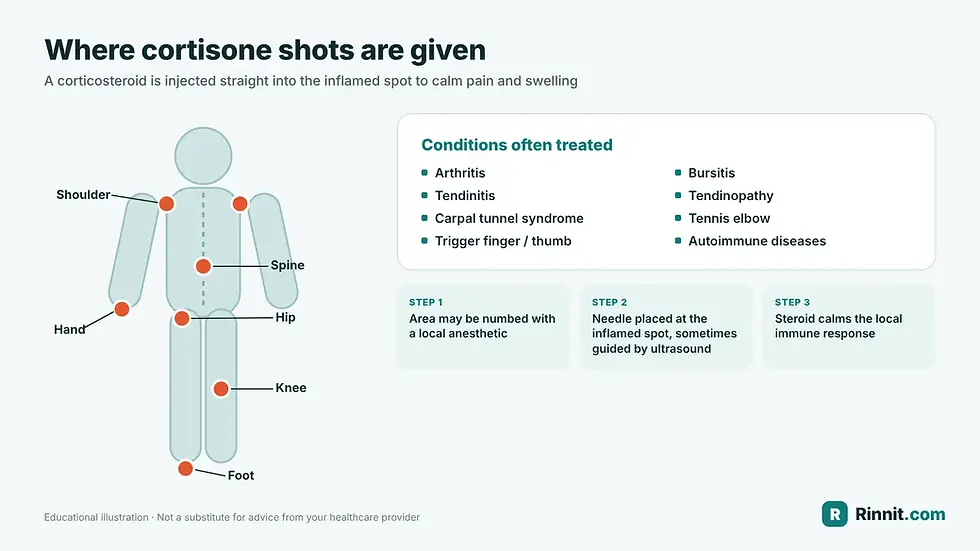
Cortisone shots are most often given into joints, tendons, or bursae.
What conditions do cortisone shots treat?
Cortisone shots can treat almost any condition that causes pain and inflammation, most often in the joints, tendons, and bursae.
Common injection sites:
Shoulders
Spine
Hands
Hips
Knees
Feet
They can also treat inflamed tendons and bursae — the small fluid-filled sacs that cushion the spaces around joints, tendons, and bones.
Conditions often treated with cortisone shots:
Condition | What's inflamed |
Arthritis | Joints |
Autoimmune diseases | Tissues the immune system attacks |
Tendinitis and tendinopathy | Tendons |
Bursitis | Bursae |
Tissue around a nerve in the wrist | |
Tendons on the outside of the elbow | |
Trigger finger and trigger thumb | Finger or thumb tendons |
If you live with a long-term inflammatory joint condition such as rheumatoid arthritis or frozen shoulder, your provider may discuss injections as one part of your treatment plan.
What happens during a cortisone shot?
A cortisone shot is a quick procedure in which a provider inserts a needle into the inflamed area and injects the steroid.
Here's what to expect:
Timing. You may get the shot during a regular office visit, or your provider may book a separate appointment.
Numbing. Your provider may use a local anesthetic to numb the skin around the injection site.
Guidance. Sometimes an ultrasound is used to guide the needle to the right spot.
Injection. The steroid is injected directly into the problem area.
Do cortisone shots hurt?
A cortisone shot may sting when the needle goes in, but it shouldn't cause intense pain.
If needles make you anxious, tell your provider before the shot. They can help you relax and feel more comfortable.
How long does a cortisone shot take to work?
A cortisone shot can take up to a week to start working, and the timing varies from person to person.
Your pain and swelling might not improve right away. That's normal. If it has been more than 10 days and you don't feel better, contact your healthcare provider.

Most people notice relief within a week; effects usually last weeks to months.
How long does a cortisone shot last?
A cortisone shot usually lasts between a few weeks and a few months, depending on how your body responds.
After an injury: The shot should work long enough for your body to heal fully.
With a chronic condition: Your symptoms may slowly come back over time.
Talk to your provider if you notice new or worsening inflammation.
How often can you get a cortisone shot?
Most people need to wait at least three months between cortisone shots and shouldn't have more than three in a year.
You may only need one shot, especially if you're recovering from a short-term injury. If you have a long-term condition, you might need more injections in the future. Your provider will tell you when it's safe to have another dose.
Situation | Typical approach |
Short-term injury | Often one shot is enough |
Chronic (long-term) condition | Repeat shots may be needed |
Time between shots | Usually at least 3 months |
Yearly limit | Most people no more than 3 |
What are the benefits of cortisone shots?
Cortisone shots are a safe, effective way to relieve pain and inflammation. They can help you manage symptoms that make it hard — or impossible — to do your normal daily activities.
What are the side effects of cortisone shots?
The side effects of cortisone shots are usually mild and temporary, and severe reactions are rare.
How often | Side effect |
Common | Pain at the injection site |
A temporary increase in swelling | |
Bruising | |
Temporarily higher blood sugar | |
Redness or discoloration of the skin at the site | |
Skin lightening or paleness near the site | |
Rare | Infection at the injection site |
High blood pressure (hypertension) | |
Fluid retention and increased swelling | |
With many repeat shots | Higher risk of osteoporosis |
If you have diabetes: Check your blood sugar more often for about five days after a cortisone shot.

Most side effects fade in a few days. Rarely, shots can weaken or tear a nearby tendon, damage a nerve, or thin nearby bone, which is one reason the number of shots is limited. Fever, intense pain, or worsening swelling need prompt attention.
Who should not get a cortisone shot?
You shouldn't get a cortisone shot if you have an infection, and some people with bleeding risks may not be able to have one.
Situation | Why it matters |
Active infection | Steroids briefly weaken the immune system, making it harder to fight the infection and heal |
Taking blood thinners (anticoagulants) | May not be able to receive the injection |
Bleeding disorder, such as hemophilia | May not be able to receive the injection |
Before your shot, tell your provider about all your health conditions and how you manage them — including every medication and supplement you take.
When should you call your doctor after a cortisone shot?
You should call your healthcare provider if your pain and swelling haven't improved more than 10 days after a cortisone shot, or if you notice warning signs.
Contact your provider if you have:
Intense pain
Fever
Swelling that keeps getting worse
Symptoms that return a few months after your shot
Is cortisone the same as the steroids athletes use?
Cortisone is not the same as the steroids some athletes misuse. Cortisone is a corticosteroid — an anti-inflammatory medicine.
The steroids some athletes use to gain an unfair advantage are anabolic steroids, which are manufactured forms of testosterone. They are a completely different type of drug.
Prescribed cortisone shots given by a healthcare provider are safe. Anabolic steroids are not safe to use without a prescription. Nonprescription doses are often 10 to 100 times higher than medical doses, and their side effects can be life-threatening.
Conclusion
Cortisone shots are a fast, targeted way to calm pain and inflammation in joints, tendons, and bursae. Some people need only one shot to let an injury heal. Others with long-term conditions need repeat shots spaced at least three months apart.
Give the shot up to a week to work, keep an eye on blood sugar if you have diabetes, and call your provider if you're not better after 10 days or notice fever, intense pain, or worsening swelling.
Planning to ask about a cortisone shot? Save or print this guide and bring it to your appointment. Use the side effects table and the "who should not get a shot" list to start the conversation with your doctor. For more plain-language guides on joint and bone health, explore our Diseases & Conditions library.
FAQ
Are a cortisone shot and a steroid injection the same thing?
Yes. Cortisone shots, steroid shots, and steroid injections are all names for the same treatment: a corticosteroid injected into an inflamed area.
Do cortisone shots hurt?
You may feel a sting when the needle goes in, but it shouldn't cause intense pain. Your provider may numb the area first with a local anesthetic.
How long after a cortisone shot will I feel better?
It can take up to a week. If you're not feeling better after 10 days, contact your provider.
How long does a cortisone shot last?
Usually a few weeks to a few months. With chronic conditions, symptoms may slowly return over time.
How many cortisone shots can you get in a year?
Most people shouldn't have more than three a year, with at least three months between shots. Your provider will decide what's safe for you.
Can I get a cortisone shot if I have diabetes?
Cortisone shots can temporarily raise blood sugar. If you have diabetes, check your blood sugar more often for about five days after the shot.
Can I get a cortisone shot if I have an infection?
No. Steroids briefly weaken your immune system, which can make it harder to fight an infection and heal.
Does a cortisone shot affect the whole body?
A small amount of the medicine enters your bloodstream, but these whole-body effects are usually too small to notice.
What is a cortisone flare?
A cortisone flare is a short-lived increase in pain and swelling at the injection site, usually within a day or two of the shot. Ice and rest often help, and it usually settles on its own.
What should I do after a cortisone shot?
Rest the treated area for a day or two and avoid heavy use of the joint. Call your doctor if you have fever, or redness, warmth or swelling that keeps getting worse, since these can be signs of infection.
Related Reading
Arthrocentesis (Joint Aspiration): Uses, Procedure and Risks explains arthrocentesis (joint aspiration).
References
Cleveland Clinic. Cortisone Shots (Steroid Injections): Benefits & Side Effects. Cleveland Clinic. Last updated February 5, 2024. https://my.clevelandclinic.org/health/treatments/cortisone-shots-steroid-injections
Jüni P, Hari R, Rutjes AWS, et al. Intra-articular corticosteroid for knee osteoarthritis. Cochrane Database of Systematic Reviews. 2015;2015(10):CD005328. PMID 26490760. https://doi.org/10.1002/14651858.CD005328.pub3
Coombes BK, Bisset L, Vicenzino B. Efficacy and safety of corticosteroid injections and other injections for management of tendinopathy: a systematic review of randomised controlled trials. Lancet. 2010;376(9754):1751-1767. PMID 20970844. https://doi.org/10.1016/S0140-6736(10)61160-9
Katz A, Shulkin A, Housni A, et al. A systematic review of glucocorticoid use in type 1 diabetes: glycaemic effects and clinical management strategies. Diabetes, Obesity & Metabolism. 2026;28(4):2594-2614. PMID 41521936. https://doi.org/10.1111/dom.70465
Medical disclaimer
This article is for general education and does not replace advice from your healthcare provider. Talk to your doctor about whether a cortisone shot is right for you.



Comments