Tennis Elbow: Symptoms, Causes, and Treatment

Updated: 3 days ago
Medically reviewed by Dr. Baraa Alnahhal, MD. Last reviewed October 17, 2026. This content is for educational purposes and is not medical advice.

Quick Answer
Tennis elbow is pain on the outside of the elbow caused by overuse and breakdown of the tendon connecting the forearm muscles to the lateral epicondyle. It mostly affects adults aged 30 to 60 who do repetitive arm work or play racket sports. Most cases improve with rest, ice and pain relievers, with surgery as a last option.
What the research says
Exercise helps, but the effect is small. A meta-analysis of 30 randomized trials with 2,123 participants found that exercise outperformed corticosteroid injections (low certainty) on all outcomes at all time points except short-term pain reduction, including pain-free grip strength at long-term follow-up (mean difference 18; 95% CI 11.17 to 24.84), though the authors described the effect as small (Karanasios et al., British Journal of Sports Medicine, 2021).
Injections trade short-term relief for long-term results. In a meta-analysis of 11 randomized trials with 730 patients, platelet-rich plasma was worse than corticosteroid for short-term (under 2 months) pain on the 10-point visual analog scale (mean difference 0.93; 95% CI 0.42 to 1.44) but better at 6 months or longer (mean difference −2.18; 95% CI −3.13 to −1.22) (Xu et al., American Journal of Sports Medicine, 2024).
No single non-surgical treatment has proven clearly better than no treatment. In a pooled analysis of randomized trials, strengthening physiotherapy (5 studies) did not differ from no active treatment for pain (mean difference −0.07; 95% CI −0.56 to 0.41), and in 7 corticosteroid studies the control group actually had better pain scores (mean difference 0.70; 95% CI 0.22 to 1.18); the authors concluded the evidence does not support these options (Lapner et al., JSES International, 2022).
Key facts at a glance
Fact | What it means |
Medical name | Lateral epicondylitis, or lateral elbow tendinopathy |
What is injured | The tendon that attaches forearm muscles to the bony bump on the outside of the elbow |
Most common age | Adults between 30 and 60 years old |
Do you need to play tennis? | No — most people with tennis elbow do not play tennis |
Typical work causes | Plumbing, painting, carpentry, butchering, cooking |
Typical self-care | Rest, ibuprofen or naproxen, ice 15 minutes 3 to 4 times a day |
Usual outcome | Often gets better on its own with self-care |
Last-resort treatment | Surgery to remove damaged tissue, only after 6 to 12 months of other treatments |
What is tennis elbow?
The name is misleading. Tennis elbow, formally called lateral epicondylitis, is an overuse condition of the muscles and tendons in the elbow — and most people who develop it have never picked up a racket [1].
The pain centers on a specific spot: the bony bump on the outside of the elbow. Tough, cord-like tissues called tendons connect your forearm muscles to this bump. When the forearm muscles are tensed over and over again — especially the muscles that straighten and raise the hand and wrist — tiny tears and longtime swelling can cause the tendon to break down. That breakdown is what causes the pain [1].
Pain can also spread from the outside of the elbow down into the forearm and wrist [1].
What are the symptoms and warning signs of tennis elbow?
The hallmark of tennis elbow is pain on the outside of the elbow. Over time, that pain can travel into the forearm and wrist [1].
The pain and weakness it creates make everyday grip tasks surprisingly difficult. Three activities are classic trouble spots:
Shaking hands or gripping an object becomes painful. Turning a doorknob strains the same forearm muscles. Even holding a coffee cup can be hard [1].

When to see a doctor. If simple self-care steps — rest, ice, and pain relievers — do not ease your elbow pain and tenderness, talk to a health care provider [1].
What causes tennis elbow, and why does it happen?
The exact cause of tennis elbow is not fully understood, but it is clearly linked to overuse and muscle strain [1].
The most common explanation is repeated tensing of the forearm muscles that straighten and raise the hand and wrist. Over time, this repeated strain breaks down the fibers in the tendon that attaches those muscles to the bony bump on the outside of the elbow [1].
Everyday activities that can trigger this pattern include:
Activity | Why it strains the tendon |
Playing racket sports, especially backhands with poor form | Repeated gripping and wrist motion |
Using plumbing tools | Repetitive twisting and gripping |
Painting | Repetitive arm strokes |
Driving screws | Repetitive wrist rotation |
Cutting up foods for cooking, particularly meat | Repetitive gripping and slicing |
Using a computer mouse a lot | Repetitive small wrist motions |
Less often, a direct injury or a condition that affects the body's connective tissues causes tennis elbow. And often, the cause is not known at all [1].
What are the risk factors for tennis elbow?
Risk factor | Details |
Age | Affects all ages, but most common in adults 30 to 60 |
Work | Jobs repeating wrist and arm motions: plumbers, painters, carpenters, butchers, cooks |
Racket sports | Poor form or poor equipment raises risk further; playing more than 2 hours a day raises risk |
Smoking | Increases risk |
Obesity | Increases risk |
Certain medicines | Increases risk |
How is tennis elbow diagnosed?
Diagnosis is usually straightforward. Often, your medical history and a physical exam are enough [2].
During the exam, the health care provider presses on the affected area and asks you to move your elbow, wrist, and fingers in various ways. If the provider suspects something else might be causing the symptoms, X-rays, sonograms, or other imaging tests might be ordered [2].
What are the treatment options for tennis elbow?
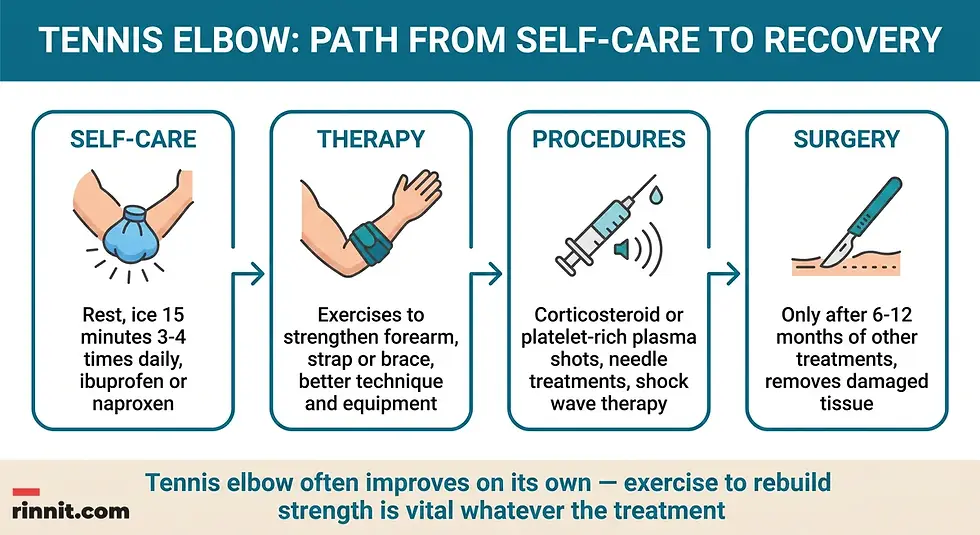
The good news: tennis elbow often gets better on its own [2]. When it does not, treatment follows a step-by-step ladder.
Step 1: Self-care at home
Start with three simple measures [2]:
Rest. Stop activities that aggravate the elbow pain.
Pain relievers. Over-the-counter options such as ibuprofen (Advil, Motrin IB) or naproxen sodium (Aleve) can help.
Ice. Apply ice or a cold pack for 15 minutes, 3 to 4 times a day.
Step 2: Therapy
If self-care is not helping, physical therapy is the usual next step [2].
If symptoms are tied to tennis or job tasks, a specialist may watch how you play or work, or check your equipment, to find the best ways to reduce stress on the injured tissue. A physical, occupational, or hand therapist can teach exercises that strengthen the muscles and tendons of the forearm. A forearm strap or brace may also reduce stress on the injured tissue [2].
Step 3: Procedures
For pain that persists, several procedures can help [2]:
Procedure | How it works |
Corticosteroid shots | Anti-inflammatory injection into the affected tendon |
Platelet-rich plasma (PRP) shots | Your own concentrated blood platelets injected to encourage healing |
Other injections (less common) | Botulinum toxin A (Botox) or an irritant solution called prolotherapy (sugar water or salt water) |
Dry needling | A needle gently pierces the damaged tendon in many places |
Needle fenestration | Ultrasound guides a needle through a numbed tendon again and again, starting a new healing process |
Ultrasonic tenotomy (TENEX) | Ultrasound guides a needle that vibrates so fast the damaged tissue turns to liquid and is removed |
Shock wave therapy (ESWT) | Shock waves sent into the injured tissue to relieve pain and help it heal |
Step 4: Surgery
Surgery is a last resort. It is considered only when symptoms have not improved after 6 to 12 months of other treatments [2].
The surgery removes the damaged tissue. It may be open surgery through a large incision, or arthroscopic surgery through several small openings [2].
Whatever treatment you choose, one thing is vital: exercises to rebuild strength and regain use of the elbow are essential to recovery [2].
How should you prepare for a tennis elbow appointment?
You will likely start by seeing your regular health care provider. You might then be referred to a sports medicine specialist or an orthopedic surgeon [2].
What you can do beforehand. Be ready to answer: When did your symptoms begin? Does any motion or activity make the pain better or worse? Have you recently injured your elbow? What medications or supplements do you take [2]?
What to expect from your doctor. Your provider may ask: Do you have rheumatoid arthritis or a nerve disease? Does your job involve repetitive motions of your wrist or arm? Do you play sports, and if so, has your form ever been evaluated [2]?
Conclusion and next steps
Tennis elbow is a common, usually self-limiting condition caused by overuse of the forearm tendons. Most people improve with simple self-care — rest, pain relievers, and ice — and by adjusting the repetitive activities that triggered it. If pain persists, therapy and a range of procedures are available, with surgery reserved for stubborn cases.
Take action: If your elbow pain does not ease with rest and ice, do not ignore it. See a health care provider for an exam, and ask whether physical therapy is right for you. Strength-building exercises are vital to recovery, whatever treatment you receive.
Frequently asked questions
Can tennis elbow go away on its own? Yes. Tennis elbow often gets better on its own with simple self-care such as rest, ice, and over-the-counter pain relievers [2].
Do you have to play tennis to get tennis elbow? No. Despite the name, most people with tennis elbow do not play tennis. It commonly affects people with jobs that involve repeated wrist and arm motions, such as plumbers, painters, carpenters, butchers, and cooks [1].
How long does tennis elbow take to heal? There is no fixed timeline, but the condition often improves with self-care. If symptoms have not improved after 6 to 12 months of other treatments, surgery may be considered [2].
Is tennis elbow the same as golfer's elbow? No. Tennis elbow affects the outside of the elbow (lateral epicondylitis), where tendons from the forearm muscles that straighten the wrist attach. Golfer's elbow affects the inside of the elbow [2].
What exercises help tennis elbow recover? Exercises taught by a physical, occupational, or hand therapist that strengthen the muscles and tendons of the forearm help. Whatever treatment you receive, rebuilding strength and regaining use of the elbow is vital to recovery [2].
Trusted External Resources
Related Reading
Elbow X-Ray: What It Shows, Views Taken and What to Expect explains the X-ray views used to check the elbow bones after an injury.
References
Miller M, et al. Elbow tendinopathies and bursitis. In: DeLee, Drez & Miller's Orthopaedic Sports Medicine: Principles and Practice. 5th ed. Elsevier; 2020.
Witstein JR, Alaia MJ. Tennis Elbow (Lateral Epicondylitis). OrthoInfo, American Academy of Orthopaedic Surgeons. Accessed October 15, 2026. https://www.orthoinfo.org/diseases--conditions/tennis-elbow-lateral-epicondylitis
UpToDate. Elbow tendinopathy (tennis and golf elbow). UpToDate. Accessed October 30, 2026. https://www.uptodate.com/contents/elbow-tendinopathy-tennis-and-golf-elbow
Ferri FF. Epicondylitis. In: Ferri's Clinical Advisor 2023. Elsevier; 2023.
Mayo Clinic. The evolving use of extracorporeal shock wave therapy in managing musculoskeletal and neurological diagnoses. Mayo Clinic. February 4, 2022. https://www.mayoclinic.org/medical-professionals/physical-medicine-rehabilitation/news/the-evolving-use-of-extracorporeal-shock-wave-therapy-in-managing-musculoskeletal-and-neurological-diagnoses/mac-20527246
Karanasios S, Korakakis V, Whiteley R, et al. Exercise interventions in lateral elbow tendinopathy have better outcomes than passive interventions, but the effects are small: a systematic review and meta-analysis of 2123 subjects in 30 trials. Br J Sports Med. 2021;55(9):477-485. PMID 33148599. https://doi.org/10.1136/bjsports-2020-102525
Xu Y, Li T, Wang L, et al. Platelet-Rich Plasma Has Better Results for Long-term Functional Improvement and Pain Relief for Lateral Epicondylitis: A Systematic Review and Meta-analysis of Randomized Controlled Trials. Am J Sports Med. 2024;52(10):2646-2656. PMID 38357713. https://doi.org/10.1177/03635465231213087
Lapner P, Alfonso A, Hebert-Davies J, et al. Nonoperative treatment of lateral epicondylitis: a systematic review and meta-analysis. JSES Int. 2022;6(2):321-330. PMID 35252934. https://doi.org/10.1016/j.jseint.2021.11.010



Comments