Pseudogout Guide: Symptoms, Causes, Diagnosis, and Treatment

Updated: 2 days ago
Medically reviewed by Dr. Baraa Alnahhal, MD · Last reviewed: September 2026
TL;DR
Pseudogout (pronounced SOO-doe-gout) is a type of arthritis caused by calcium pyrophosphate crystals building up in a joint, most often the knee. It produces sudden, swollen, warm, and very painful attacks that last for days or weeks. It mimics gout, but the crystals are different: calcium in pseudogout versus uric acid in gout. Nearly half of people over 85 carry these crystal deposits on X-ray, though most never develop symptoms. There is no cure, but a combination of pain-relieving medicines, joint drainage, and simple home measures such as rest and ice can end a flare-up and reduce how often attacks return.
Quick Answer
What is pseudogout? Arthritis caused by calcium pyrophosphate crystals depositing in a joint — the medical term is calcium pyrophosphate deposition (CPPD) disease.
Which joint is hit first? Usually the knee; less often the wrists, ankles, hips, fingers, or toes.
How long does an attack last? Days or weeks.
How is it confirmed? A doctor draws fluid from the joint with a needle (joint aspiration) and checks it for crystals; X-rays show crystal deposits in the cartilage.
What helps? Over-the-counter NSAIDs, rest, and ice for mild flares; prescription NSAIDs, colchicine, corticosteroids, or joint drainage for stronger flares. There is no cure, but treatment relieves pain and improves joint function.
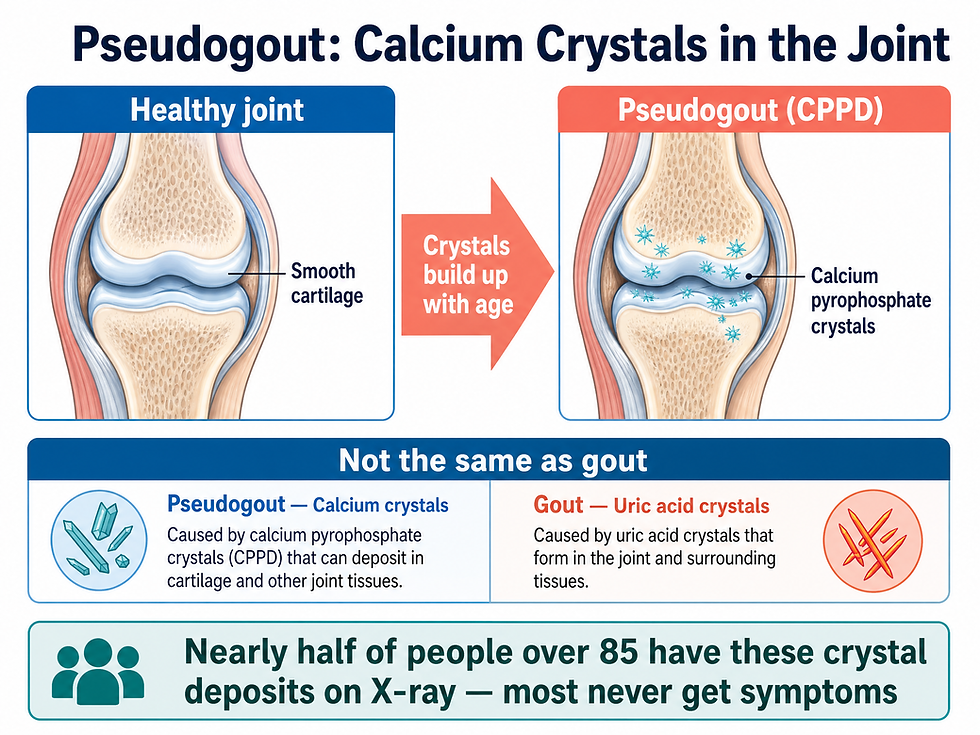
What Is Pseudogout?
Pseudogout is a form of arthritis that causes sudden, painful swelling in one or more joints. The attacks arrive without warning, and each one can last for days or weeks before settling down.
The condition gets its everyday name because the flare-ups look and feel very similar to gout. In both diseases, crystals deposit inside a joint and trigger inflammation. The difference is the type of crystal involved.
Pseudogout is caused by calcium crystals (calcium pyrophosphate). Gout is caused by uric acid crystals.
The medical name for the condition is calcium pyrophosphate deposition disease, usually shortened to CPPD. You may also see the word chondrocalcinosis, which describes the calcium deposits themselves when they show up on X-rays.
What Do the Attacks Feel Like?
Pseudogout typically strikes the knees. It less often affects the wrists and ankles. It can also involve the larger joints such as the hips, and even small joints in the fingers and toes.
When an attack happens, the affected joint is usually:
Sign | What it means |
|---|---|
Swollen | The joint visibly puffs up |
Warm | The skin over the joint feels warm to the touch |
Very painful | The pain is intense and hard to ignore |
Hard to move or bear weight | Moving the joint or standing on it is difficult |
If you develop sudden, intense joint pain with swelling, seek medical care. The sudden onset is exactly what can make people mistake it for gout or an infection, and only a doctor can tell the difference.

What Causes Pseudogout?
The trigger is calcium pyrophosphate dihydrate crystals forming inside the joint. These crystals become more common as people age — they appear on X-rays in nearly half of people over the age of 85.
Here is the surprising part: most people who carry these crystal deposits never develop symptoms at all. Doctors do not yet know why some people develop painful attacks while others carry the crystals silently for decades.
Who Is at Higher Risk?
Several factors raise the chances of developing pseudogout. None of them guarantees an attack, but together they help doctors understand who is most likely to be affected.
Risk factor | How it raises the risk |
|---|---|
Age | The likelihood of pseudogout rises steadily with age |
Joint injury or surgery | Trauma to a joint — a serious injury or a surgery — increases the risk of pseudogout in that specific joint |
Family history | Some families have a higher risk, suggesting genetics play a role; the inherited tendency can also make the condition appear at a younger age |
Mineral imbalances | Too much iron in the blood (hemochromatosis) or too little magnesium (hypomagnesemia) raises the risk |
Other medical conditions | Pseudogout has been linked to an underactive thyroid gland or an overactive parathyroid gland |
It is worth noting that an inherited condition called hemochromatosis — which causes the body to store too much iron — appears twice in the risk picture, both as a family-history link and as a mineral imbalance.
What Are the Possible Complications?
Over time, the crystal deposits associated with pseudogout can damage the joint itself. This damage can cause long-term symptoms similar to osteoarthritis or rheumatoid arthritis, so the condition is more than just a series of painful flare-ups.
How Is Pseudogout Diagnosed?
Pseudogout symptoms resemble those of gout and other types of arthritis, so doctors typically rely on a combination of laboratory and imaging tests to confirm the diagnosis rather than on symptoms alone.
Test | What it checks |
|---|---|
Joint aspiration (arthrocentesis) | A doctor withdraws a fluid sample from the affected joint with a needle and tests it for the presence of calcium crystals — the most direct way to confirm pseudogout |
X-rays | Show joint damage and the crystal deposits within the joint's cartilage |
Blood tests | Assess the function of the thyroid and parathyroid glands, and find mineral imbalances linked to pseudogout |
The diagnosis path makes sense together: the needle test proves the crystals are present, the X-ray shows where they sit in the cartilage, and the blood tests uncover the underlying risk factors — such as a thyroid problem or low magnesium — that may be contributing.

How Is Pseudogout Treated?
There is no cure for pseudogout. A combination of treatments can, however, relieve pain during flare-ups and improve the joint's function, and some options help prevent future attacks altogether.
Medicines
If over-the-counter pain medicines do not calm a flare-up, a doctor may prescribe one or more of the following.
Medicine | How it helps | What to watch for |
|---|---|---|
Prescription-strength NSAIDs (naproxen, indomethacin) | Lessen pain and swelling during flare-ups | Can cause stomach bleeding and reduce kidney function, especially in older adults |
Colchicine | Reduces pain and inflammation during a flare; a low daily dose can prevent future attacks in people with frequent episodes | Used for both treatment and prevention |
Corticosteroids (such as prednisone) | Reduce inflammation and end the attack when NSAIDs or colchicine cannot be taken | Long-term use can weaken bones and cause cataracts, diabetes, and weight gain — use only as directed |
Joint Drainage
Removing fluid from a swollen joint can ease both pain and pressure. During this procedure — the same needle test used for diagnosis — a doctor withdraws the fluid with a needle. That step not only relieves discomfort but also removes some of the crystals that may be causing the inflammation.
After the fluid is removed, a numbing medicine and a corticosteroid may be injected directly into the joint to relieve pain and further lessen inflammation.
Home Care During a Flare-Up
Simple home measures can help calm a flare while it runs its course.
Measure | How to do it |
|---|---|
Over-the-counter NSAIDs | Ibuprofen (Advil, Motrin IB) or naproxen sodium (Aleve) often help |
Rest the joint | Avoid using the affected joint for a couple of days to lessen inflammation and support healing |
Apply ice | Wrap an ice pack in a thin cloth and hold it on the inflamed joint for 15 to 20 minutes, several times a day — this numbs the area and lessens swelling |
What to Expect at the Doctor
You will likely start with your primary care doctor, who may refer you to a rheumatologist — a doctor who specializes in diagnosing and treating arthritis and other inflammatory joint conditions.
Preparing for the visit goes faster if you write down answers beforehand. Consider when your symptoms began, whether you have had them before, whether any activity or position makes the joint feel better or worse, whether the joint has ever been injured, and what other medical conditions or medicines you have.
Expect the doctor to ask which body parts are affected, whether the symptoms come and go, how long they last, whether they have worsened over time, and whether anything seemed to trigger them — such as injury, overuse, dehydration, recent surgery, or another illness.
Conclusion
Pseudogout may be a lesser-known cousin of gout, but its attacks are anything but minor: sudden, swollen, intensely painful knees that can sideline you for days or weeks. The good news is that it is diagnosable with a straightforward needle test and X-ray, and treatable with a clear ladder of options — from ibuprofen and ice at home to prescription medicines, colchicine prevention, and joint drainage for stubborn flares. If you or a loved one develops sudden, intense joint pain and swelling, see a doctor promptly so the attack can be calmed quickly and the crystals confirmed.
Pseudogout has been linked to an underactive thyroid — explore our related guide on Hypothyroidism for more, or read about Sacroiliitis for another joint condition often mistaken for something else.
*This guide is for general information only and is not a substitute for professional medical advice. Always consult a qualified healthcare provider for diagnosis and treatment.*
Frequently Asked Questions
What exactly is pseudogout?
Pseudogout is a type of arthritis caused by calcium pyrophosphate crystals depositing in a joint — medically called calcium pyrophosphate deposition (CPPD) disease. It causes sudden, swollen, very painful attacks, usually in the knee.
Is pseudogout the same as gout?
No. Both involve crystal deposits in a joint, but pseudogout is caused by calcium crystals while gout is caused by uric acid crystals.
Which joint does pseudogout attack most often?
The knee, by a wide margin. It less often affects the wrists and ankles, and can also involve the hips, fingers, and toes.
How long does a pseudogout attack last?
Episodes can last for days or weeks.
What causes the crystals to form?
The exact reason is unclear. The calcium deposits become more common with age — appearing on X-rays in nearly half of people over 85 — and some people with the deposits never develop symptoms.
Who is most at risk?
Older adults, people with a past joint injury or surgery, those with a family history, and people with mineral imbalances (excess iron or low magnesium), an underactive thyroid, or an overactive parathyroid gland.
How do doctors confirm pseudogout?
With a joint aspiration — a needle draws fluid from the joint to check for crystals — plus X-rays that show crystal deposits in the cartilage and blood tests that check the thyroid, parathyroid, and mineral levels.
Is there a cure for pseudogout?
No. But treatment reliably relieves pain and improves joint function, using over-the-counter and prescription NSAIDs, colchicine, corticosteroids, joint drainage, and home care such as rest and ice.
What This Guide Is Based On
Specialist-reviewed hospital clinical guidance on calcium pyrophosphate deposition (CPPD) disease, updated March 2026, alongside patient guidance from the American College of Rheumatology and the Arthritis Foundation, the peer-reviewed treatment review in Best Practice & Research: Clinical Rheumatology (2021), and UpToDate clinical overviews by rheumatologist Ann K. Rosenthal.
References
Pseudogout — Symptoms & causes — Mayo Clinic, updated March 10, 2026.
Pseudogout — Diagnosis & treatment — Mayo Clinic, updated March 10, 2026.
Additional references consulted:
American College of Rheumatology, Calcium Pyrophosphate Deposition (CPPD) patient resource.
Arthritis Foundation, CPPD Disease overview.
Stack J, et al. Calcium pyrophosphate deposition (CPPD) disease — Treatment options. Best Practice & Research Clinical Rheumatology, 2021.
Elsevier Point of Care, Calcium Pyrophosphate Deposition Disease (Pseudogout) clinical overview.
Comments