Sacroiliitis: Complete Guide to the Joint Pain Often Mistaken for Low Back Pain

Updated: 2 days ago
Medically reviewed by Dr. Baraa Alnahhal, MD · Last reviewed: September 2026
TL;DR
Sacroiliitis is inflammation of the joints where the spine meets the pelvis. It most often causes pain in the buttocks and lower back that can travel down one or both legs. It is hard to diagnose because it mimics other causes of low back pain. Treatment usually starts with stretching and strengthening exercises plus over-the-counter pain relievers, then moves to injections or other procedures if needed. If sacroiliitis pain lasts more than a few weeks or affects your sleep, see a health care professional.
Quick Answer
Sacroiliitis is a painful condition of swelling and irritation that affects one or both sacroiliac joints — the joints that link the pelvis and lower spine. It most often causes pain and stiffness in the buttocks and lower back, and the pain may travel down one or both thighs. Sitting, standing, running, or climbing stairs can make it worse. The most common first treatments are stretching and strengthening exercises along with over-the-counter pain relievers. If these do not help, options include steroid injections into the joint, muscle relaxers, biologics, radiofrequency denervation, or, rarely, joint fusion surgery.
What Is Sacroiliitis?
Sacroiliitis (say-kroe-il-e-I-tis) is inflammation — painful swelling and irritation — that affects one or both sacroiliac joints. These joints sit where the lower spine and pelvis meet.
Each sacroiliac joint is made up of two bones: the sacrum and the ilium. The sacrum is the bony structure above the tailbone. The ilium is the top part of the pelvis. Together, the sacroiliac joints support the weight of your upper body when standing.
When these joints become inflamed, the result is typically pain and stiffness in the buttocks or lower back. The pain may travel down one or both thighs.

A healthy sacroiliac joint, where the sacrum meets the ilium with a thin joint space, compared with an inflamed joint showing swelling and a widened joint space.
One reason this condition is frustrating is that it can be hard to diagnose. Its symptoms can look like many other causes of low back pain. It has also been linked to a group of diseases that cause inflammatory arthritis of the spine. Treatment often involves physical therapy and medicines.
Sacroiliitis Symptoms to Watch For
The pain of sacroiliitis most often happens in the buttocks and lower back. It also can affect the legs, groin, and even the feet. One clue that distinguishes it from some other back conditions: the pain may get better with certain movements.

Sacroiliitis pain zones — buttocks, lower back, legs, groin, and sometimes feet — and the four triggers that make it worse: prolonged sitting or standing, stair climbing, and sleeping on the painful side.
Certain activities reliably make the pain worse. Knowing these patterns helps you describe your symptoms accurately at your appointment.
Sitting, walking, or standing for a long time: Pain increases with prolonged positions
Running: Pain increases with impact
Stair climbing: Pain increases with load on the joint
Sleeping on the side with the pain: Pain increases with pressure on the inflamed joint
Certain movements: Pain may actually improve — a key clue
When the condition is not addressed, it can take a toll beyond the joint itself. The lasting pain can lead to depression and loss of sleep. It can also make everyday actions difficult, such as bending, lifting, staying in one place, and rising from a seated position.
Six Causes of Sacroiliitis
No single cause explains every case. In fact, there are six recognized pathways that can inflame these joints.
Injury: A sudden hit, such as from a motor vehicle accident or a fall, can damage the joints
Arthritis: Wear-and-tear osteoarthritis can affect the joints; so can ankylosing spondylitis, an arthritis that targets the spine
Pregnancy: Joints loosen and stretch for childbirth; added weight and a changed walking pattern stress them
Not moving enough: Lack of exercise leads to tight muscles and tension around the joint
Infection: Rarely, a joint becomes infected; risk is higher with diabetes or injecting street drugs with a needle
Spinal fusion surgery: Surgery to fuse the spine can damage the joint, ligaments, and nerves around it
This range of causes is exactly why diagnosis is so challenging. The same pain can stem from a mechanical injury, an autoimmune disease, or an infection — and each calls for a different treatment.
Who Is at Risk?
Certain conditions raise the odds of inflammation in the sacroiliac joints. The strongest risk factor is inflammatory disease elsewhere in the body.
Inflammatory arthritis: Ankylosing spondylitis; psoriatic arthritis
Inflammatory bowel disease: Crohn's disease; ulcerative colitis
Pregnancy and childbirth: Hormonal loosening and stretching of the joints; added weight
People with psoriatic arthritis or ankylosing spondylitis should be especially alert to this pain pattern. The same is true for people living with Crohn's disease or ulcerative colitis, since these inflammatory bowel diseases can reach beyond the gut.
How Sacroiliitis Is Diagnosed
Diagnosis requires piecing together several pieces of evidence, because no single test confirms the condition. The first step is a physical exam.
During the exam, a health care professional may press on your hips and buttocks while you lie in certain positions. These are called provocation tests. The examiner also checks how the condition affects the way you walk.
Physical exam with provocation tests: Pressing on the hips and buttocks in specific positions reproduces the pain
Gait assessment: Shows how the condition affects walking
Pelvic X-ray: Can show damage to the sacroiliac joint
MRI: Can show whether the damage is the result of ankylosing spondylitis
Numbing injection: If numbing medicine injected into the joint eases the pain, the problem is likely in the sacroiliac joint
The numbing shot deserves a closer look. It serves a double purpose: it can both diagnose the source of pain and relieve it. If the injection settles the pain, the sacroiliac joint itself is almost certainly the culprit.
The Four-Step Treatment Ladder
Treatment depends on your symptoms and the underlying cause. Care almost always begins with the gentlest options and advances only if they fall short.
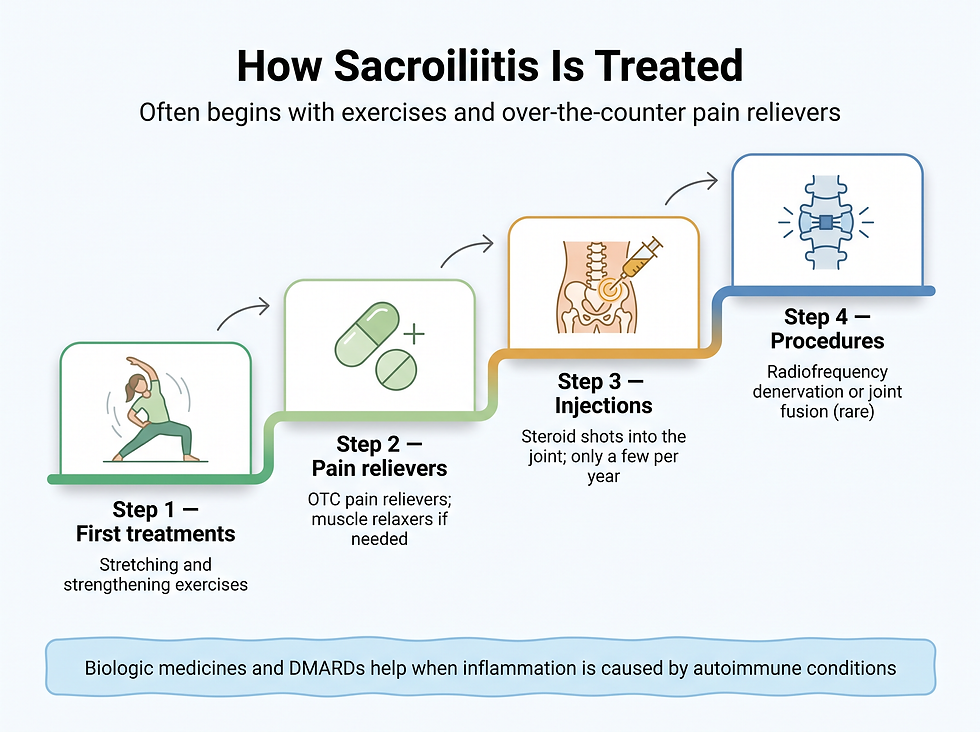
The four-step sacroiliitis treatment ladder: stretching and strengthening exercises, over-the-counter pain relievers and muscle relaxers, steroid injections, and procedures such as radiofrequency denervation or, rarely, joint fusion.
Step 1: Exercises and first-line care
Stretching and strengthening exercises taught by a physical therapist are often the first treatment, combined with over-the-counter pain relievers. A therapist teaches range-of-motion and stretching exercises to ease pain and help the low back and hips move better. Strength exercises protect the joints and improve posture.
A physical therapist may also suggest a support, such as a pelvic belt, to limit motion and ease pain.
Step 2: Medicines
Depending on the cause of the pain, several classes of medicines may be used.
Pain relievers (OTC): Ibuprofen (Advil, Motrin IB), naproxen sodium (Aleve), acetaminophen (Tylenol) — first-line relief; stomach, kidney, or liver issues are possible
Prescription pain relievers: Stronger formulations used when over-the-counter options fall short
Topical pain relievers: Lidocaine or menthol patches applied to the skin over the sore area
Muscle relaxers: Cyclobenzaprine (Amrix, Tonmya) to ease the muscle spasms that often accompany sacroiliitis
Biologics: IL-17 inhibitors (secukinumab/Cosentyx, ixekizumab/Taltz) and TNF inhibitors (etanercept/Enbrel, adalimumab/Humira, infliximab/Remicade, golimumab/Simponi) to relieve sacroiliitis, especially when driven by autoimmune disease
DMARDs / JAK inhibitors: Tofacitinib (Xeljanz), upadacitinib (Rinvoq) to lessen inflammation and pain; some block the Janus kinase (JAK) enzyme
Step 3: Injections
If other methods do not relieve pain, steroid shots into the joint may ease swelling and pain. An image-guided injection — using X-ray or ultrasound to reach the right place — can help when other treatments have failed. There is an important limit: only a few of these shots are possible each year, because the steroids can weaken nearby bones and tendons.
Step 4: Procedures and surgery
Three more involved options exist for stubborn cases. Radiofrequency denervation uses radiofrequency energy to damage or destroy the nerve causing the pain. Platelet-rich plasma treatment injects a portion of your own blood that contains more platelets than usual; platelets help blood clot and repair tissue damage. Some studies show this eases sacroiliitis pain, but more study is needed. Finally, joint fusion surgery — joining the two bones with metal hardware — is a rare last resort.
Home Care and Self-Management
Alongside formal treatment, three home habits can ease sacroiliac pain.
Over-the-counter pain relievers: Ibuprofen and acetaminophen may help; some can cause stomach upset or kidney or liver issues
Rest and posture: Changing or pausing activities that worsen pain helps; good posture also helps
Ice and heat: Switching between ice and heat might ease sacroiliac pain
Preparing for Your Appointment
You might start by seeing your main health care professional, who may send you to a rheumatologist (a specialist in diseases of the bones and joints) or an orthopedic surgeon.
Bring a family member or friend if possible — someone who can help you remember what you are told. Prepare a list covering your symptoms and when they began, key information including recent life changes and whether any first-degree relatives (such as a parent or sibling) have had similar symptoms, and all medicines, vitamins, and supplements you take with dosages.
Questions to ask your provider include: What is likely causing my symptoms? What are other possible causes? What tests do I need? Is my condition likely to go away or to last? What is a good treatment for me? How can I manage this condition with my other health conditions?
Your provider may ask you: Do you have your symptoms all the time, or do they come and go? Where exactly is the pain, and how bad is it? Does anything make the pain better or worse?
Conclusion: Act on Pain That Does Not Quit
Sacroiliitis hides inside one of the most common complaints in medicine — low back pain. But the pattern is distinctive: buttock pain that worsens with sitting, standing, running, and stair climbing; relief with certain movements; and a possible link to inflammatory arthritis or bowel disease.
If you have had buttock or lower back pain for more than a few weeks, or if the pain is disrupting your sleep or daily activities, do not wait. Talk with a health care professional. Early diagnosis matters, because treatment choices depend on finding the cause. Bring this guide's appointment questions with you, and ask whether provocation testing or imaging is right for your case.
Frequently Asked Questions
1. What is sacroiliitis?
Sacroiliitis is inflammation — painful swelling and irritation — of one or both sacroiliac joints, which link the pelvis and lower spine. These joints are made up of the sacrum (the bony structure above the tailbone) and the ilium (the top of the pelvis), and they support the weight of the upper body when standing.
2. What does sacroiliitis pain feel like, and where is it?
The pain most often occurs in the buttocks and lower back. It can travel down one or both thighs and sometimes affect the legs, groin, or even the feet. It typically worsens with prolonged sitting, standing, or walking, running, and stair climbing, and may improve with certain movements.
3. Is sacroiliitis the same as sciatica or general low back pain?
No. Sacroiliitis is specifically inflammation of the sacroiliac joints. It is difficult to diagnose precisely because its symptoms can look like other causes of low back pain, which is why provocation testing, imaging, and sometimes diagnostic injections are used to pinpoint the true source.
4. What causes sacroiliitis?
Six main pathways can inflame these joints: injury (such as from a car accident or fall), arthritis (osteoarthritis or ankylosing spondylitis), pregnancy, lack of exercise, infection (rare; risk is higher with diabetes or injecting street drugs), and damage from spinal fusion surgery.
5. Can sacroiliitis be caused by ankylosing spondylitis or psoriatic arthritis?
Yes. Inflammatory forms of arthritis such as ankylosing spondylitis and psoriatic arthritis increase the risk of sacroiliac joint inflammation. Inflammatory bowel disease, including Crohn's disease and ulcerative colitis, also raises the risk.
6. What is the best treatment for sacroiliitis?
Treatment depends on symptoms and cause. The most common first treatments are stretching and strengthening exercises plus over-the-counter nonsteroidal anti-inflammatory pain relievers such as ibuprofen or naproxen. If these fall short, options include muscle relaxers, biologics (IL-17 or TNF inhibitors), DMARDs, steroid injections into the joint, radiofrequency denervation, or, rarely, joint fusion surgery.
7. How many steroid injections can I get for sacroiliitis?
Only a few steroid injections per year are possible, because repeated steroids can weaken the nearby bones and tendons. Injections are often image-guided with X-ray or ultrasound and may also be used to help confirm the diagnosis.
8. Will sacroiliitis go away on its own?
The outlook depends on the cause. Mechanical causes such as pregnancy-related stress or a one-time injury often improve with exercises, rest, and pain relief. Cases linked to inflammatory arthritis or bowel disease typically need ongoing treatment of the underlying condition. Persistent pain that disrupts sleep or daily activities should be evaluated by a professional.
External Resources
References
Medical Disclaimer
This article is for general educational purposes only and is not a substitute for professional medical advice, diagnosis, or treatment. Always seek the guidance of a qualified health care professional with any questions you may have about a medical condition. Never disregard professional medical advice or delay seeking it because of something you have read here.
Comments