Bone & Joint Infections (Septic Arthritis): Symptoms, Causes, Diagnosis & Treatment — Complete Guide

Updated: 2 days ago
Medically reviewed by Dr. Baraa Alnahhal, MD · Last reviewed: October 2026
Quick Answer: What Is Septic Arthritis?
Septic arthritis is a painful joint infection caused by germs traveling through the bloodstream or entering directly through an injury such as an animal bite. Knees are most often affected. The infection can quickly damage bone and cartilage, so it needs fast treatment. Treatment involves draining the joint with a needle or during surgery, plus antibiotics. [1]
What the research says
Arthroscopic washout looks best for infected knees. In a network meta-analysis of 25 studies (21,917 patients; 24 retrospective cohorts and 1 randomized trial), arthroscopic lavage had higher clinical success than open arthrotomy (odds ratio 2.52, 95% CI 1.02–6.27) and fewer complications (OR 0.69, 95% CI 0.49–0.97); repeated needle aspiration carried a higher risk of needing another procedure than arthroscopy (OR 3.35, 95% CI 1.10–10.23). (Ramirez-Acosta et al., J Orthop, 2025) [3]
Knees washed out arthroscopically moved better. Across 7 studies, arthroscopic washout was linked to about 20° more knee range of motion than open washout (mean difference 20.18°, 95% CI 14.35–26.02), with a non-significant tendency toward fewer repeat operations (OR 0.64, 95% CI 0.26–1.57). (Kennedy et al., Syst Rev, 2024) [4]
The shoulder may be different. In 9 studies covering 5,643 patients, arthroscopy was followed by more reoperations for reinfection than open arthrotomy (OR 2.61, 95% CI 1.04–6.56), although the authors rated the evidence as low quality. (Abdelmalek et al., Eur J Orthop Surg Traumatol, 2023) [5]
Septic Arthritis at a Glance
What it is: A painful infection in a joint (also called septic arthritis)
Joints most affected: Knees most often; also hips, shoulders, and other joints
Most common germ: Staphylococcus aureus (staph) — lives on skin and in noses
How germs get in: Through the bloodstream, or directly via a bite, puncture, injection, or surgery
Key warning sign: Bad joint pain that comes on fast, with swelling, warmth, and possibly fever
Who's at higher risk: Older age, joint conditions, artificial joints, RA medicines, fragile skin, weak immunity, joint injuries
Diagnosis: Medical history and exam, joint fluid study, blood tests, imaging
Treatment: Drain the joint (needle, arthroscopy, or open surgery) plus antibiotics for 2–6 weeks or longer
Why fast action matters: Delayed treatment can cause joint breakdown and long-term damage
What Is Septic Arthritis?
Septic arthritis is a painful infection in a joint. It can come from germs that travel through the bloodstream from another part of the body. It can also happen when an injury that goes through the skin — such as an animal bite or trauma — sends germs into the joint.
There are many risk factors for septic arthritis, including having other joint conditions and having artificial joints, called prosthetic joints. Knees are most often affected, but septic arthritis can also affect hips, shoulders, and other joints.
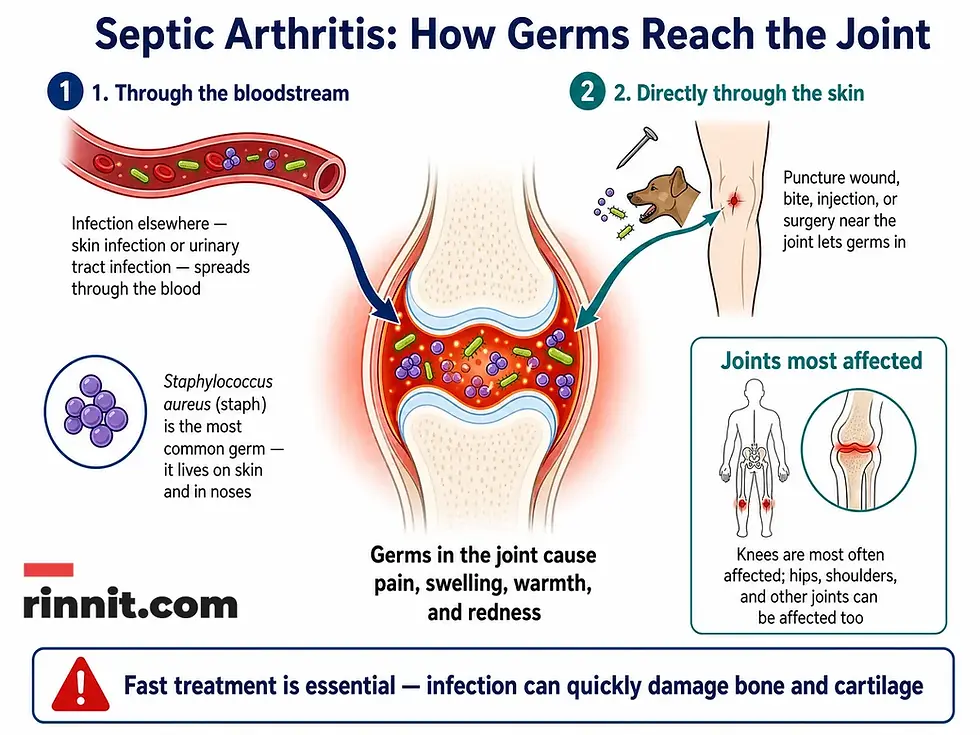
Germs reach the joint through the bloodstream or directly through the skin; knees are most often affected.
The infection can quickly damage the bone and the tissue that connects the bone to the joint, called cartilage. So the infection needs fast treatment. Treatment involves draining the joint with a needle or during surgery, and most often antibiotics as well.
What are the symptoms of septic arthritis?
Septic arthritis often causes bad pain that comes on fast. The pain makes it hard to use the affected joint. The joint may be swollen and warm, and the skin over the joint area may have a change of color. You might have a fever. [1]
If septic arthritis happens in an artificial joint, it's called a prosthetic joint infection. Pain and swelling may start months or years after surgery to replace a joint. The joint may also loosen — and that causes pain when you move the joint or put weight on it.
When to See a Doctor
See your healthcare professional if bad pain in a joint comes on quickly. Fast treatment can help lessen joint damage. If you have had a joint replaced, see your healthcare professional if you have pain while using the joint.
What causes septic arthritis?
Bacterial, viral, or fungal infections can all cause septic arthritis. Bacterial infection with Staphylococcus aureus (staph) is the most common cause. Staph lives on the skin and in the noses of many people.
You can also get septic arthritis when an infection — such as a skin infection or a urinary tract infection — spreads through your bloodstream to a joint. Less often, a puncture wound, a shot of medicine or drugs, or surgery in or near a joint — including joint replacement surgery — can let the germs into the joint space. [1]
Who is at risk of septic arthritis?
Risk factors for septic arthritis include older age and:
Having joint issues: Long-term (chronic) conditions that affect your joints can raise your risk, including osteoarthritis, gout, rheumatoid arthritis, and lupus. Having had joint surgery or a joint injury may also raise the risk.
Having an artificial joint (prosthetic joint): Germs can enter the joint area during joint replacement surgery. Germs can also infect the joint by traveling through the bloodstream from another area of the body.
Taking medicines for rheumatoid arthritis: Some RA medicines lower the body's immune response, making infections more likely. Diagnosing septic arthritis in people with RA may be hard, since many of its symptoms look like those of rheumatoid arthritis.
Having fragile skin: Skin that breaks easily and heals poorly can let germs into the body. Psoriasis and eczema raise the risk, as do skin sores that become infected. People who take drugs with a needle also have a higher risk of infection at the needle site.
Having a weak immune system: People with diabetes, kidney and liver issues, or those taking medicines that lower their immune response are at higher risk.
Having a joint injury: Animal bites, puncture wounds, or cuts over a joint can raise the risk of septic arthritis.
One important point: having a mix of risk factors puts you at greater risk than having just one risk factor does.
What complications can septic arthritis cause?
Delayed treatment for septic arthritis can lead to joint breakdown and long-term damage. In an artificial joint, septic arthritis may cause the joint to loosen or move.

Septic arthritis at a glance: signs, risk factors, diagnosis, treatment, and when to seek care.
How is septic arthritis diagnosed?
To diagnose septic arthritis, your healthcare professional takes a medical history and does a physical exam. The exam may involve looking at all your joints for swelling, warmth, pain, and a change of color. The following tests can help: [2]
Study of joint fluid: Infections can change the color and other factors of the fluid within joints. A healthcare professional uses a needle to take a sample of this fluid. Lab tests can show which germ is causing the infection — this helps your provider know which medicines to prescribe.
Blood tests: These can show if there are signs of infection in your blood. A blood sample is taken from a vein with a needle.
Imaging tests: X-rays and other imaging of the affected joint can show damage to the joint or loosening of an artificial joint.
How is septic arthritis treated?
Joint drainage and antibiotic medicines treat septic arthritis. [2]
Joint Drainage
A healthcare professional may need to remove fluid from the infected joint. The ways to drain the fluid include:
Needle: Sometimes a healthcare professional can remove fluid from the infected joint with a needle put into the joint space.
Scope procedure (arthroscopy): In arthroscopy (ahr-THROS-kuh-pee), a tube with a video camera at its tip goes into the joint through a small cut called an incision. Tubes to drain the fluid are placed through small cuts around the joint.
Open surgery: Some joints, such as the hip, are harder to drain with a needle or arthroscopy — so you might need an open surgical procedure.
Antibiotics
You most often get an antibiotic through a vein in your arm at first. Later, you may be able to switch to an antibiotic in pill form. Treatment may last from 2 to 6 weeks or longer.
Side effects of antibiotics may include upset stomach, vomiting, and loose stool. Allergic reactions can also happen. Ask your healthcare professional what side effects to expect from your medicine.
Removal of a Replacement Joint
If a replacement joint is infected, treatment often involves removing the joint and temporarily replacing it with a joint spacer. A joint spacer is made of bone cement and is full of antibiotics. The spacer helps you use the joint during treatment. After a few months, you get a new replacement joint.
Sometimes a surgeon removes the implant, washes out the joint, and places a new implant in a single surgery.
It's not always possible to remove the replacement joint. In that case, your healthcare professional may clean the joint and remove damaged tissue but keep the joint in place. You get antibiotics through a vein, then in a pill for several months to keep the infection from coming back.
How should you prepare for a septic arthritis appointment?
You'll likely first see your main healthcare professional. They may send you to a doctor who specializes in joint and bone surgery, called an orthopedist, an infectious disease specialist, or a joint specialist, called a rheumatologist.
What You Can Do
When you call to make the appointment, ask if you need to do anything before you go, such as fasting before certain tests. Make a list of:
Your symptoms, including any that may not seem linked to the reason for your appointment, and when they began.
Key personal information, including other medical conditions you have and recent infections.
All medicines, vitamins, and supplements you take, including doses.
Questions to ask your healthcare professional.
If possible, take a family member or friend along to help you remember the information you get. Questions to ask include:
What might be causing my symptoms?
What are other possible causes?
What tests do I need?
Is my condition likely to go away or to last?
What treatment do you suggest?
How soon can I expect my symptoms to get better with treatment?
What can I do in the meantime for my joint pain?
Am I at risk of long-term complications from this condition?
How can I best manage this condition with my other health issues?
Are there brochures or other printed material I can have? What websites do you suggest?
Be sure to ask all the questions you have.
What to Expect From Your Doctor
Be ready to answer questions such as:
How bad are your symptoms?
Do they come and go or stay with you?
What, if anything, seems to make your symptoms better?
What, if anything, seems to make your symptoms worse?
Have you ever had joint surgery or joint replacement?
Do you use needles to take drugs?
Frequently Asked Questions
What is septic arthritis?
Septic arthritis is a painful infection in a joint. Germs can reach the joint by traveling through the bloodstream from another part of the body, or directly through a skin injury such as an animal bite or puncture wound. Knees are most often affected, and the infection needs fast treatment because it can quickly damage bone and cartilage.
What causes most joint infections?
Bacterial infection with Staphylococcus aureus (staph) is the most common cause. Staph lives on the skin and in the noses of many people. Viral and fungal infections can also cause septic arthritis, and infections elsewhere — such as a skin or urinary tract infection — can spread through the bloodstream to a joint.
How quickly does septic arthritis develop?
The pain of septic arthritis usually comes on fast. The joint becomes swollen and warm, the skin over it may change color, you might have a fever, and the pain makes it hard to use the joint. This sudden onset is exactly why fast medical attention matters.
Who is at risk for a joint infection?
Risk factors include older age, chronic joint conditions (osteoarthritis, gout, rheumatoid arthritis, lupus), artificial joints, certain rheumatoid arthritis medicines, fragile skin such as psoriasis or eczema, a weak immune system from diabetes or kidney/liver issues, and joint injuries like bites or puncture wounds — and a mix of risk factors raises risk more than one alone.
Can a replaced joint get infected years later?
Yes. When septic arthritis happens in an artificial joint, it's called a prosthetic joint infection. Pain and swelling may start months or years after the replacement surgery, and the joint may loosen, causing pain when you move it or put weight on it.
How is septic arthritis treated?
Treatment combines joint drainage — by needle, arthroscopy, or open surgery — with antibiotics, usually through a vein at first and later by pill, for 2 to 6 weeks or longer. An infected replacement joint is often removed and replaced temporarily with an antibiotic-filled spacer before a new joint is placed. [2]
Can joint damage be prevented?
Fast treatment is the key. Delayed treatment for septic arthritis can lead to joint breakdown and long-term damage, so bad joint pain that comes on quickly should never be ignored — especially if you have had a joint replacement.
Conclusion: Septic Arthritis Is a Race Against Time
Septic arthritis is one of those conditions where speed is everything. Unlike slowly developing arthritis, it strikes fast — a joint turns hot, swollen, and painful in a matter of hours, and the infection can begin damaging bone and cartilage before long. But it is also very treatable when caught early: drain the joint, give the right antibiotic, and most people avoid the long-term damage that delayed care can cause.
This guide has covered the sudden-onset warning signs, the germ that causes most infections, the risk factors that stack up against you, the three diagnostic tests, and the three ways joints are drained — including the special path for infected replacement joints. If a joint suddenly becomes badly painful, make that appointment fast.
This article is for general information only and is not a substitute for professional medical advice, diagnosis, or treatment. Always seek the advice of your physician or other qualified health provider with any questions you may have regarding a medical condition.
Related Reading
Arthrocentesis (Joint Aspiration): Uses, Procedure and Risks explains arthrocentesis (joint aspiration).
Fine-Needle Aspiration (FNA): What It Is, Why It's Done, What to Expect and Results explains how a thin needle samples cells or fluid from a lump, what to expect and what results can show.
References
Mayo Clinic Staff. Septic arthritis — Symptoms and causes. Mayo Clinic. December 22, 2025. https://www.mayoclinic.org/diseases-conditions/bone-and-joint-infections/symptoms-causes/syc-20350755
Mayo Clinic Staff. Septic arthritis — Diagnosis and treatment. Mayo Clinic. December 22, 2025. https://www.mayoclinic.org/diseases-conditions/bone-and-joint-infections/diagnosis-treatment/drc-20350760
Ramirez-Acosta K, Sánchez-Enríquez S, Madrigal-Rodriguez M, et al. Comparative effectiveness of repeated joint aspiration, arthroscopic lavage, and open arthrotomy in adult native knee septic arthritis: a systematic review and network meta-analysis. J Orthop. 2025;70:183-195. PMID 40585786. https://doi.org/10.1016/j.jor.2025.06.003
Kennedy GEM, Tharmaseelan A, Phillips JRA, et al. Does arthroscopic or open washout in native knee septic arthritis result in superior post-operative function? A systematic review and meta-analysis of randomised controlled trials and observational studies. Syst Rev. 2024;13(1):106. PMID 38610047. https://doi.org/10.1186/s13643-024-02508-1
Abdelmalek A, Haines S, Tadros BJ, et al. Re-operation rates of arthroscopic management versus arthrotomy in treatment of septic arthritis of native shoulder joint in adults. A systematic review and meta-analysis. Eur J Orthop Surg Traumatol. 2023;33(7):2717-2727. PMID 36869912. https://doi.org/10.1007/s00590-023-03495-0



Comments