Achilles Tendinitis: Complete Guide to Symptoms, Causes, Self-Care, and Treatment Options

Updated: 2 days ago
Medically reviewed by Dr. Baraa Alnahhal, MD · Last reviewed: September 2026
Quick Answer: What Is Achilles Tendinitis?
Achilles tendinitis is an injury of the Achilles tendon, the band of tissue that joins the calf muscles to the heel bone, usually caused by overuse from too much or too intense activity without enough rest. It typically starts as a mild ache above the heel after exercise and stiffness in the morning. Most cases improve with self-care guided by a healthcare professional, and a steady recovery plan reduces the chance of it returning.
TL;DR
What it is: An injury of the Achilles tendon, the tissue band connecting the calf muscles to the heel bone; also called Achilles tendinopathy.
Main symptom: Mild ache in the back of the leg or above the heel after exercise; tender and stiff area, especially in the morning; soreness eases with mild activity.
Cause: Overuse, meaning repeated or intense strain, though it can develop without a clear cause; the tendon weakens with age.
Emergency sign: Pain that is suddenly severe or keeps you from moving may mean a torn Achilles tendon. Seek medical help right away.
First-line care: R.I.C.E. (Rest, Ice, Compression, Elevation) plus pain relievers, physical therapy, and the right shoes.
Outlook: Most cases do well with self-care; serious cases can lead to rupture, which often needs surgery.
Achilles Tendinitis at a Glance
What it is: An injury of the Achilles tendon caused by overuse or, sometimes, no clear cause.
What the tendon does: Joins the calf muscles to the heel bone; used for walking, running, jumping, climbing, and standing on tiptoes.
Early symptom: Mild ache above the heel after running or sports.
Ongoing symptoms: Tender, stiff area especially in the morning; soreness improves with mild activity; severe pain after long runs, stair climbing, or sprinting.
Key risk factors: Age; flat or high arches; obesity; tight calf muscles; legs of different lengths; worn-out shoes; poor form; cold weather; hill running; psoriasis; high cholesterol; high blood pressure; fluoroquinolone antibiotics.
Serious complication: Tendon weakening that can lead to a rupture, often needing surgery.
Diagnosis: Physical exam plus X-rays, ultrasound, or MRI.
Self-care (R.I.C.E.): Rest, ice for about 15 minutes, compression wraps, elevation above heart level.
Further treatments: Pain medicines, nitroglycerin patch, physical therapy with weighted heel raises, orthotics, shock wave therapy, platelet-rich plasma, tenotomy, tendon scraping, surgery.
Prevention: Build activity slowly, stretch daily, wear cushioned supportive shoes, strengthen calves, cross-train.
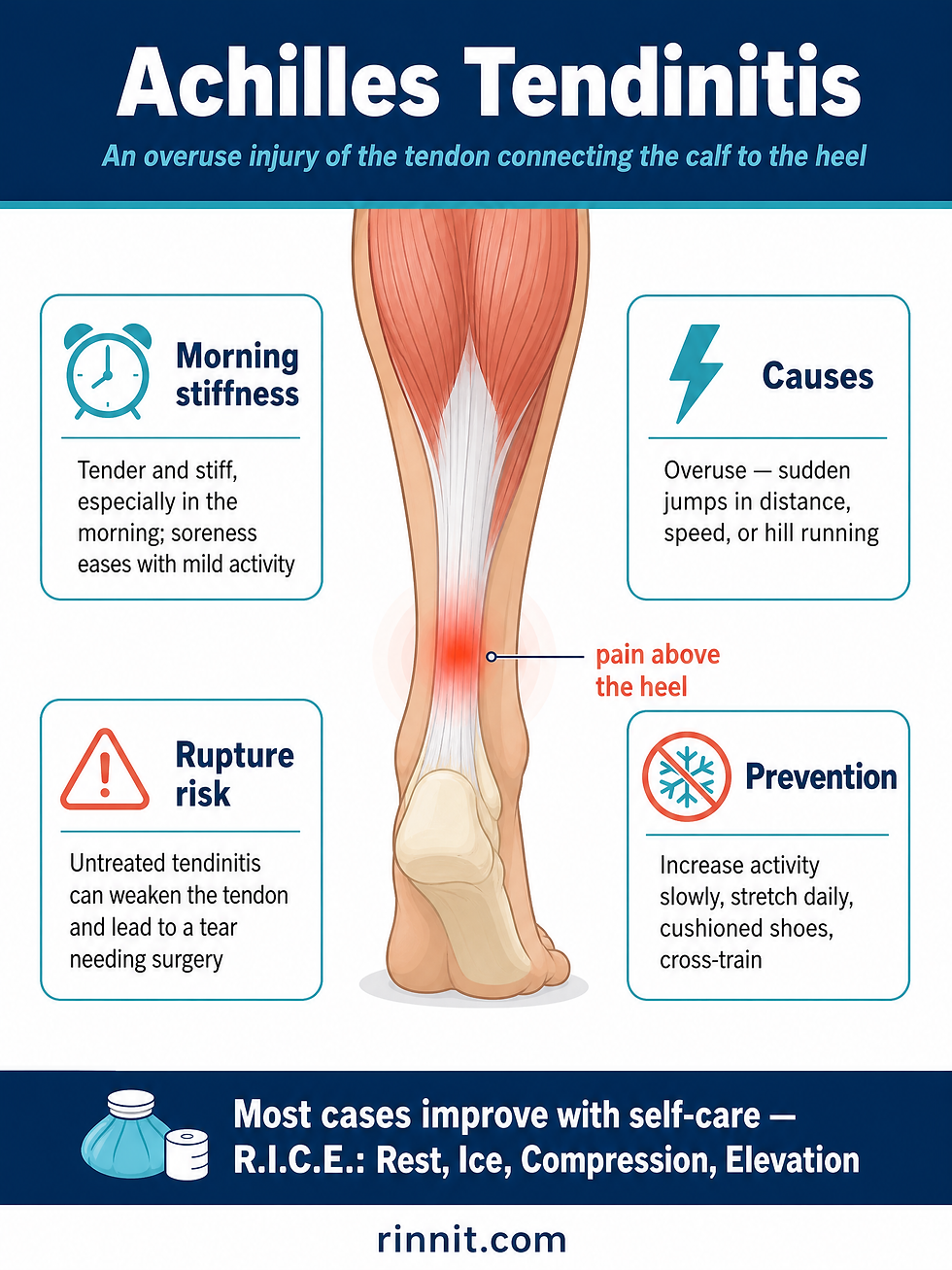
Morning stiffness that eases with mild activity is a hallmark of Achilles tendinitis.
What Is Achilles Tendinitis?
Achilles tendinitis (uh-KILL-eez) is an injury of the Achilles tendon. It can be caused by using the tendon too much or too hard without enough rest, called overuse, or it can develop without a clear cause.
The Achilles tendon is the band of tissue that joins the calf muscles at the back of the lower leg to the heel bone.
Achilles tendinitis is sometimes called Achilles tendinopathy. Tendinopathy is an umbrella term for conditions affecting the tendon. It often occurs in runners who suddenly increase how hard or long they run. It is also common in middle-aged people who play sports such as tennis or basketball only on weekends.
Most often, Achilles tendinitis can be treated with at-home care guided by a healthcare professional. Serious cases can lead to tendon tears, also called ruptures, which might need surgery to fix.
Symptoms of Achilles Tendinitis
Achilles tendinitis pain most often begins as a mild ache in the back of the leg or above the heel after running or other sports activity. More-severe burning or aching pain might occur after running a long time, stair climbing, or sprinting. Over time, there might be pain even at rest.
The condition can make it hard to use the affected foot. The area also might be tender or stiff, especially in the morning. The soreness usually gets better with mild activity.

Tendinitis can develop in the middle of the tendon or where it attaches to the heel bone.
When to See a Doctor
If you have pain around the Achilles tendon that doesn't go away, call your healthcare professional.
Emergency: If the pain is suddenly severe or keeps you from moving, you may have torn your Achilles tendon. Seek medical help right away.
Causes: How Overuse Hurts the Tendon
Repeated or intense strain on the Achilles tendon can cause Achilles tendinitis, though sometimes the cause is not clear. This tendon is used while walking, running, jumping, climbing, or standing on tiptoes.
Achilles tendinitis can occur within the middle part of the tendon or where it attaches to the heel bone.
The Achilles tendon weakens with age, which makes it easier to injure. This is true for people who play sports only on weekends or who start running farther, faster, or longer without building up over time.
Risk Factors
Factors that can raise the risk of Achilles tendinitis include:
Age: more common with age.
Physical problems: a flat arch or high arch increases strain; obesity and tight calf muscles increase tendon stress; legs of different lengths also raise the risk.
Prior tendinitis: having had Achilles tendinitis increases the chance of getting it again.
Training choices: worn-out running shoes, poor form, cold weather, and hill running all raise the risk.
Medical conditions: psoriasis, high cholesterol, and high blood pressure increase the risk.
Medicines: certain antibiotics called fluoroquinolones have been linked with higher rates of Achilles tendinitis.
Complications: The Rupture Risk
Achilles tendinitis can weaken the tendon. That weakness makes it more likely to tear, also called a rupture. An Achilles rupture is a serious injury that often needs surgery to repair.
How Achilles Tendinitis Is Diagnosed
Diagnosis starts with a physical exam. Your healthcare professional will press gently on the area to find where the pain, tenderness, or swelling is and watch how the foot and ankle look while moving and at rest.
One or more imaging tests can help confirm the diagnosis:
X-rays: do not show soft tissues such as tendons, but may show some signs of Achilles tendinitis and help rule out other conditions with similar symptoms.
Ultrasound: uses sound waves to look at soft tissues and makes real-time images of the tendon to show how it moves; color-Doppler ultrasound can look at blood flow around the tendon.
MRI: uses radio waves and a strong magnet to show the Achilles tendon in detail.
Treatment Options
Tendinitis most often does well with self-care. If symptoms are severe or long-lasting, other treatments may be tried.
Self-Care: The R.I.C.E. Method
Self-care includes the steps known as R.I.C.E.:
Rest. You may need to skip exercise for several days, or switch to activities that don't strain the tendon, such as swimming or deep-water running. For severe cases, you might wear a walking boot and use crutches.
Ice. Apply an ice pack to the tendon for about 15 minutes after exercising or when you feel pain, to lessen pain or swelling.
Compression. Wraps or elastic bandages holding in the affected area reduce swelling and limit tendon movement.
Elevation. Raise the affected foot above the level of your heart to reduce swelling; sleep with your affected foot raised at night.
Medicines
Over-the-counter pain medicines such as ibuprofen (Advil, Motrin IB) or naproxen sodium (Aleve) might help. If these don't help enough, a prescription for medicines that reduce swelling and irritation (inflammation) and relieve pain may follow.
One prescription option is a nitroglycerin patch placed on the tendon to help with healing and pain relief, worn on the sore part of the tendon every day for 2 to 3 months.
Physical Therapy
A physical therapist might suggest:
Exercise: exercises designed to heal and strengthen the Achilles tendon. Resistance exercises using heavy loads, such as weighted heel raises, may be especially helpful for chronic (ongoing) Achilles tendinitis.
Orthotic devices: a shoe insert or wedge that slightly raises your heel relieves strain on the tendon; a heel pad can cushion the sore area for some tendon pain.
Newer Therapies
These therapies have been used for Achilles tendinitis with some success:
Extracorporeal shock wave therapy (ESWT): a noninvasive treatment that sends shock waves to injured tissue to relieve pain and help healing. It is often used when self-care hasn't worked but before deciding on surgery. Sessions last 30 minutes or less. Side effects are usually mild: bruising, swelling, pain, numbness, or tingling in the treated area.
Platelet-rich plasma (PRP): shots using your own platelets, the cells that form clots to stop bleeding and start healing; their growth factors may help the body heal.
Ultrasound-guided tenotomy: a device breaks up damaged parts of the tendon and removes unhealthy tissue through a small cut, guided by ultrasound. It gets the tendon to start healing; crutches and a walking boot are needed for the first few weeks, and full healing usually takes several months.
Ultrasound-guided tendon scraping: in tendinopathy, tiny nerves and vessels grow into the tendon and may cause pain. A device scrapes the tendon's surface through a small cut, disconnecting those unusual nerves and vessels. This can give quick pain relief and a return to activities within a week.
Surgery
If several months of more-conservative treatments don't work or if the tendon has torn, you might need traditional surgery to repair your Achilles tendon.
Prevention: Six Habits That Protect the Tendon
It may not be possible to prevent Achilles tendinitis, but these steps can reduce the risk:
Increase your activity level slowly. Starting a new exercise? Begin slowly and increase how long and hard you train little by little.
Take it easy. Avoid high-stress activities such as hill running if you're not used to them. Warm up at a slower pace before hard activity, and stop and rest if you notice pain during exercise.
Choose your shoes well. Exercise shoes should cushion your heel and have firm arch support. Replace worn-out shoes, and try arch supports in both shoes if yours don't support your feet well.
Stretch daily. Stretch your calf muscles and Achilles tendon in the morning and before and after exercise to keep the tendon flexible and help prevent the condition from returning.
Strengthen your calf muscles. Strong calves help the tendon handle the stresses of exercise.
Cross-train. Avoid high-impact activities like running and jumping every day; on off-days, do low-impact activities such as cycling and swimming.
Preparing for Your Appointment
You'll likely start with your family healthcare professional, who may send you to a sports medicine doctor or a physiatrist, a specialist in physical and rehabilitative medicine. If the tendon has torn, you may need an orthopedic surgeon.
Before your appointment, prepare answers to: Did the pain begin suddenly or gradually? Are symptoms worse at certain times of day or after certain activities? What shoes do you wear during exercise? What medicines and supplements do you take?
Your healthcare team will likely ask where exactly it hurts, whether rest helps, what your usual exercise routine is, and what you've done for pain relief.
Frequently Asked Questions
What is Achilles tendinitis?
Achilles tendinitis is an injury of the Achilles tendon, the band of tissue that joins the calf muscles to the heel bone. It is usually caused by overuse, such as suddenly running harder or longer without enough rest.
What does Achilles tendinitis feel like?
It typically begins as a mild ache above the heel after exercise. The area may be tender or stiff, especially in the morning, and the soreness usually eases with mild activity. Severe pain can follow long runs, stair climbing, or sprinting.
What causes Achilles tendinitis?
Repeated or intense strain on the tendon, often from sudden jumps in distance, speed, or hill running, causes most cases, though it can develop without a clear cause. The tendon also weakens with age, and risk factors include flat or high arches, tight calf muscles, and certain antibiotics.
When should I seek emergency help for heel pain?
If pain is suddenly severe or keeps you from moving, you may have torn your Achilles tendon. Seek medical help right away, as a rupture is a serious injury that often needs surgery.
How is Achilles tendinitis treated?
Most cases respond to self-care using the R.I.C.E. method (rest, ice for about 15 minutes, compression wraps, and elevation) plus over-the-counter pain relievers. Persistent cases may need physical therapy, orthotics, shock wave therapy, or in rare cases, surgery.
How do I prevent Achilles tendinitis from coming back?
Build activity slowly, stretch your calves and tendon daily, wear shoes that cushion the heel with firm arch support, strengthen your calf muscles, and cross-train with low-impact activities like cycling and swimming on off-days.
Conclusion: What to Remember About Achilles Tendinitis
Achilles tendinitis rewards patience: push through it and the tendon weakens; give it a structured recovery and most cases heal. The three lessons to carry from this guide are:
Morning stiffness above the heel is the first warning. An ache that appears after exercise and eases with mild activity is your signal to slow down before it becomes something worse.
R.I.C.E. is your first treatment. Rest, ice, compression, and elevation resolve most cases, with medicines and physical therapy as the next steps.
Never ignore sudden severe pain. A torn Achilles tendon is a medical emergency, and acting quickly protects your tendon and your mobility.
This guide gives you one clear, plain-language place to understand Achilles tendinitis, from the first morning ache to a stronger, protected tendon. If your heel pain won't go away, the best next step is to see your healthcare professional.
This article is for informational purposes only and is not a substitute for professional medical advice. Always consult a qualified healthcare provider for diagnosis and treatment.
Comments