Gilbert Syndrome: What It Is, and Why It Usually Needs No Treatment at All

Updated: 3 days ago
Medically reviewed by Dr. Baraa Alnahhal, MD · Last reviewed: October 2026
Gilbert syndrome is a harmless liver condition in which the liver doesn't properly process bilirubin, a yellowish substance produced by the breakdown of red blood cells [1]. It is genetic, it is often found by accident on a blood test, and it needs no treatment [2].
Quick Answer
Gilbert syndrome is a genetic condition, present from birth, in which bilirubin is processed slowly, causing occasional mild jaundice. Episodes can be triggered by illness, fasting, dehydration, exercise or stress. It does not damage the liver and needs no treatment. Tell every healthcare professional you have it, because it can increase the side effects of certain medicines. [1] [2]
What the research says
It is common. In a study of Egyptian adults, 101 people met the criteria for Gilbert syndrome, a prevalence of about 8%. Among them, recurrent jaundice was the only presentation in 47 people, and the risk factors for jaundice included fasting for more than 12 hours, low-calorie weight-loss plans, systemic infections, and intensive physical effort (Kamal et al., BMC Gastroenterology, 2019 [3]).
The enzyme runs at about 30% of normal, and medicine handling can change. A review describes Gilbert syndrome as affecting roughly 10% of the population, and notes that the UGT1A1*28 variant may reduce glucuronidation by about 30%. Liver function stays normal, yet metabolism of some cancer drugs can be altered, and little guidance exists on dose adjustment (Ha et al., Pharmacotherapy, 2017 [4]).
It is benign, but other conditions can add to it. A clinical review reports enzyme activity reduced to about 30% of normal, says no specific management is necessary, and notes that combining Gilbert syndrome with conditions such as G-6-PD deficiency, thalassemia, spherocytosis, or cystic fibrosis may worsen hyperbilirubinemia or lead to gallstones (Fretzayas et al., European Journal of Pediatrics, 2012 [5]).
What is Gilbert syndrome?
Gilbert syndrome is a harmless liver condition in which the liver doesn't properly process bilirubin. Bilirubin is a substance produced by the breakdown of red blood cells [1].
It is passed down from your parents. You might not know you have it until it is discovered by accident, such as when a blood test shows raised bilirubin levels [1]. The liver is your largest internal organ. About the size of a football, it sits mainly in the upper right portion of your abdomen, beneath the diaphragm and above your stomach. To learn more about how it works, see our guide to the human liver.
What are the symptoms?
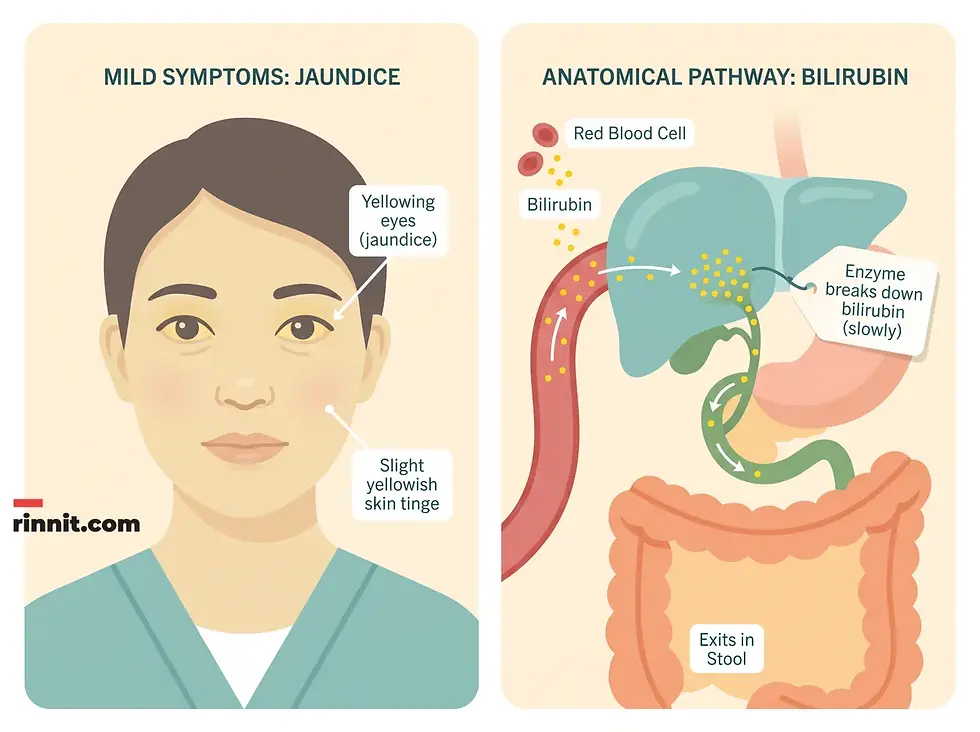
The most common sign is an occasional yellowish tinge of the skin and the whites of the eyes, called jaundice. It results from slightly higher levels of bilirubin in the blood [1]. Bilirubin levels may increase due to specific triggers:
Illness: a cold or the flu can push bilirubin levels up temporarily.
Fasting: fasting or eating a very low-calorie diet can raise levels.
Dehydration: not getting enough fluids may increase bilirubin.
Menstruation: levels may rise during menstruation.
Strenuous exercise: heavy physical exertion can trigger higher levels.
Stress: emotional or physical stress can increase bilirubin [1].
When to see a doctor
Make an appointment with a healthcare professional if you have jaundice. It has many possible causes, so it is worth getting checked rather than assuming it is Gilbert syndrome [1].
What causes Gilbert syndrome?
Gilbert syndrome is caused by a modified gene inherited from your parents. This gene usually controls an enzyme that helps break down bilirubin in the liver. When the gene is ineffective, the body doesn't produce enough of the enzyme and the blood contains too much bilirubin [1].
How the body normally processes bilirubin
Bilirubin is a yellowish pigment made when the body breaks down old red blood cells. It travels through the bloodstream to the liver, where the enzyme breaks down the pigment and removes it from the bloodstream. The bilirubin then passes from the liver into the intestines with bile and is excreted in stool. A small amount remains in the blood [1].

How the modified gene is passed through families
The modified gene is common, and many people carry one copy. In most cases, two modified copies are needed to cause Gilbert syndrome [1].
Who is at higher risk?
Although it is present from birth, Gilbert syndrome usually isn't noticed until puberty or later, because bilirubin production increases during puberty [1]. Risk factors include:
Both parents carry the modified gene: in most cases the gene must come from both parents.
Being male: males are more likely than females to have the condition noticed [1].
What are the possible complications?
Gilbert syndrome itself is harmless. But the low level of the bilirubin-processing enzyme may increase the side effects of certain medicines, since the enzyme helps clear them from the body. These include [1]:
Irinotecan (Camptosar): a cancer chemotherapy drug.
Some protease inhibitors: used to treat HIV.
If you have Gilbert syndrome, talk to a healthcare professional before taking new medicines. Also, having any other condition that affects the destruction of red blood cells may increase the risk of developing gallstones [1]. For more on that topic, see our guide to gallbladder disease.
How is Gilbert syndrome diagnosed?
A healthcare professional may suspect it if you have unexplained jaundice or an elevated bilirubin level. Dark urine and belly pain can also suggest Gilbert syndrome as well as a few other liver conditions. To rule out more-common liver conditions, you may have a complete blood count and liver function tests [2].
Normal blood counts and liver enzymes together with an elevated bilirubin level point to Gilbert syndrome. No other testing is usually needed, although genetic testing can confirm the diagnosis [2].
How is Gilbert syndrome treated?
It doesn't need treatment. Bilirubin levels may go up and down over time, and someone with Gilbert syndrome may sometimes have jaundice, which usually resolves on its own with no ill effects [2].
Self-care: managing the triggers
Life events such as stress can trigger episodes of higher bilirubin levels. Managing those situations can help keep levels under control [2]:
Tell your healthcare providers: every professional you visit needs to know you have the condition, since it affects how your body processes certain medicines.
Eat a healthy diet: avoid extremely low-calorie diets, keep a routine eating schedule, and don't fast or skip meals.
Manage stress: exercise, meditation, and listening to music may be helpful.

Preparing for your appointment
Before your appointment, you might want to jot down questions to ask [2]:
Is my bilirubin level significantly elevated?
Should I have my bilirubin level tested again?
Could Gilbert syndrome cause my symptoms?
Could the medicines I'm taking for other conditions worsen Gilbert syndrome?
Can Gilbert syndrome cause complications or lead to liver damage?
Do I have a higher risk of gallstones?
Is there anything I can do to maintain a low bilirubin level?
Is jaundice harmful?
How likely is it that my children will inherit Gilbert syndrome?
Bottom line
Gilbert syndrome sounds alarming, with a liver condition, elevated bilirubin, and jaundice, but the facts are reassuring. It is a common, harmless genetic trait in which the liver processes bilirubin slightly slower than usual. Episodes of jaundice come and go with illness, fasting, stress, or exercise, and resolve on their own without treatment [1] [2].
Your next step: if you have jaundice or an elevated bilirubin reading, see a healthcare professional to rule out other causes. Once Gilbert syndrome is confirmed, keep up a healthy diet, avoid fasting, manage stress, and mention the condition before starting any new medicine. For related reading, see our guides on the liver and gallbladder disease.
FAQ
What is Gilbert syndrome?
Gilbert syndrome is a harmless genetic liver condition in which the liver doesn't properly process bilirubin, a substance produced by the breakdown of red blood cells. It is present from birth but often discovered by accident during a blood test.
What are the symptoms of Gilbert syndrome?
The most common sign is an occasional yellowish tinge of the skin and whites of the eyes, called jaundice, caused by slightly higher bilirubin levels. It usually resolves on its own with no ill effects.
What triggers Gilbert syndrome jaundice?
Bilirubin levels may rise due to illness such as a cold or flu, fasting or very low-calorie diets, dehydration, menstruation, strenuous exercise, and stress.
Does Gilbert syndrome need treatment?
No. Gilbert syndrome doesn't need treatment. Bilirubin levels may go up and down over time, and jaundice usually resolves on its own with no ill effects.
Is Gilbert syndrome harmful or dangerous?
No. It is a harmless liver condition that does not damage the liver. It is present from birth but usually isn't noticed until puberty or later.
How is Gilbert syndrome diagnosed?
A complete blood count and liver function tests are used to rule out more-common liver conditions. Normal blood counts and liver enzymes together with elevated bilirubin point to Gilbert syndrome. Genetic testing can confirm it but usually isn't needed.
Can Gilbert syndrome affect my medicines?
Yes, potentially. The enzyme deficiency can increase the side effects of certain medicines, including the chemotherapy drug irinotecan and some HIV protease inhibitors. Always tell healthcare professionals you have the condition before starting new medicines.
Does Gilbert syndrome increase gallstone risk?
Having any other condition that affects the destruction of red blood cells may increase the risk of developing gallstones. Gilbert syndrome alone is not described as a gallstone cause.
How common is the gene for Gilbert syndrome?
The modified gene is common; many people carry one copy. In most cases, two modified copies, one inherited from each parent, are needed to cause Gilbert syndrome.
Why is Gilbert syndrome noticed at puberty?
Although present from birth, it usually isn't noticed until puberty or later, because bilirubin production increases during puberty. Being male is also a listed risk factor.
Related Reading
Bilirubin Test: Normal Levels, High Bilirubin Causes and Newborn Jaundice explains the blood test that measures bilirubin and what high levels mean.
References
Mayo Clinic Staff. Gilbert syndrome - Symptoms and causes. Mayo Clinic. September 20, 2025. https://www.mayoclinic.org/diseases-conditions/gilberts-syndrome/symptoms-causes/syc-20372811
Mayo Clinic Staff. Gilbert syndrome - Diagnosis and treatment. Mayo Clinic. September 20, 2025. https://www.mayoclinic.org/diseases-conditions/gilberts-syndrome/diagnosis-treatment/drc-20372816
Kamal S, Abdelhakam S, Ghoraba D, et al. The frequency, clinical course, and health related quality of life in adults with Gilbert's syndrome: a longitudinal study. BMC Gastroenterology. 2019;19(1):22. PMID 30717703. https://doi.org/10.1186/s12876-019-0931-2
Ha VH, Jupp J, Tsang RY. Oncology drug dosing in Gilbert syndrome associated with UGT1A1: a summary of the literature. Pharmacotherapy. 2017;37(8):956-972. PMID 28494109. https://doi.org/10.1002/phar.1946
Fretzayas A, Moustaki M, Liapi O, Karpathios T. Gilbert syndrome. European Journal of Pediatrics. 2012;171(1):11-15. PMID 22160004. https://doi.org/10.1007/s00431-011-1641-0
Further reading: American Liver Foundation. Gilbert Syndrome. American Liver Foundation. March 20, 2023. https://liverfoundation.org/for-patients/about-the-liver/diseases-of-the-liver/gilbert-syndrome/.
Medical disclaimer
This article is for general informational purposes and is not a substitute for professional medical advice, diagnosis, or treatment. Always consult a qualified healthcare professional about any medical condition.



Comments