The Human Liver: Anatomy, Function, and Vital Health Insights

Updated: 2 days ago
Medically reviewed by Dr. Baraa Alnahhal, MD | Last reviewed: October 7, 2026
Quick Answer: What is the liver?
The liver is a vital organ in the upper right abdomen that acts as the body's primary filtration system. It processes more than 250 gallons of blood daily [1], produces bile for fat digestion and regulates blood sugar by storing glycogen. One of the only organs that can regenerate itself [1], it is essential for detoxification and nutrient processing.
What the research says
About three in ten adults worldwide have fatty liver disease, and the share is rising. A meta-analytic systematic review of 92 studies (9,361,716 people) estimated a global prevalence of 30.05% (95% CI 27.88–32.32) for what was then called NAFLD, which rose by 50.4% from 25.26% in 1990–2006 to 38.00% in 2016–2019 (Younossi et al., Hepatology, 2023) [2].
Mediterranean-style eating improves several markers of fatty liver disease. A systematic review and meta-analysis of 26 articles (3,037 participants) found that Mediterranean diet interventions (13 studies) reduced alanine aminotransferase (P = 0.02), the Fatty Liver Index (P < 0.001) and liver stiffness (P = 0.05). The authors also found a dose-response relationship between the degree of calorie restriction and liver benefits, and concluded that calorie restriction should remain the cornerstone of management (Haigh et al., Clinical Nutrition, 2022) [3].
Cirrhosis risk climbs steeply with the amount of alcohol you drink each day. A dose-response meta-analysis of 44 studies (5,122,534 participants) found that, compared with lifetime abstention, drinking 25 g of alcohol a day was linked to a relative risk of cirrhosis morbidity of 1.81 (95% CI 1.68–1.94), rising to 3.54 at 50 g/day and 8.15 at 100 g/day. For cirrhosis mortality, the relative risks were 2.65, 6.83 and 16.38 at 25, 50 and 100 g/day (Llamosas-Falcón et al., Hepatology International, 2024) [4].
Where is the human liver, and what is its structure?
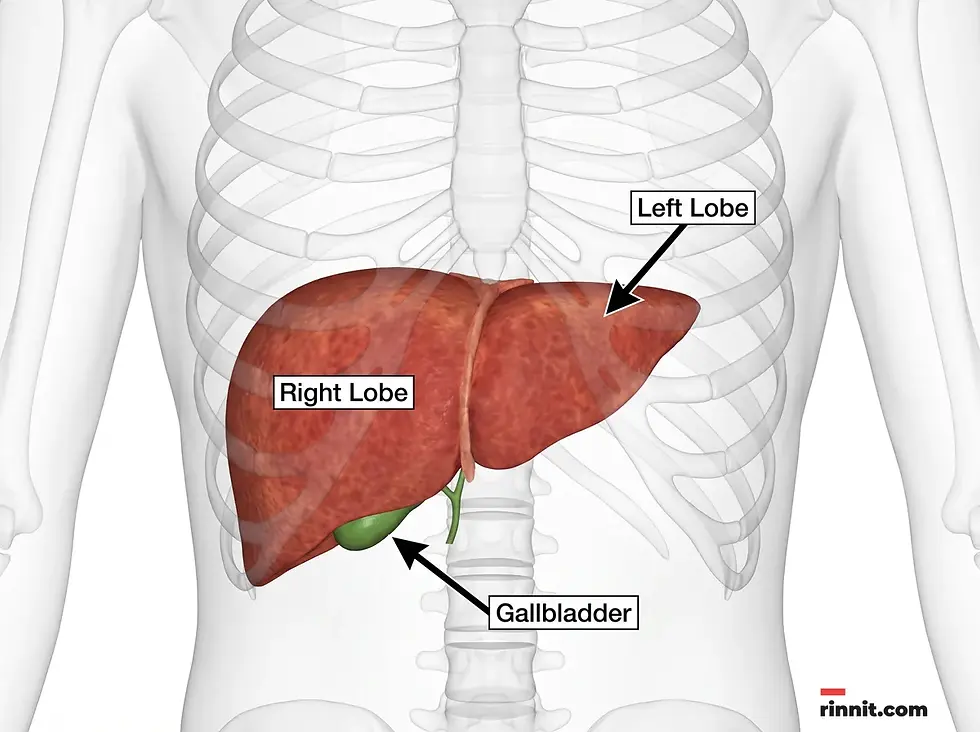
The liver is a spongy, reddish-brown organ shaped roughly like a wedge or a football. [1] It holds the distinction of being the largest internal organ in the human body, typically weighing between 3 and 5 pounds. [1] Situated on the right side of the upper abdomen, it is positioned just beneath the ribs and adjacent to the stomach. [1] Its unique biological structure allows it to perform complex chemical tasks while maintaining the ability to regenerate itself if damaged.
Anatomically, the liver is divided into two primary lobes: a larger right lobe and a slightly smaller left lobe. [1] These lobes are further organized into thousands of microscopic clusters called lobules. Within these lobules, specialized liver cells known as hepatocytes work in tandem with a vast network of blood vessels and bile ducts to process nutrients and filter waste products.
Component | Anatomical Description and Role |
Lobes | The two main sections of the liver; the right lobe is larger than the left. |
Lobules | Tiny clusters of liver cells (hepatocytes) that connect to bile ducts. |
Hepatocytes | The primary functional cells responsible for the liver’s chemical processes. |
Hepatic Veins | Blood vessels that transport filtered blood out of the liver lobes. |
What functions does the human liver perform?
The liver is often described as the body’s chemical factory because it performs more than 500 vital functions every day. [1] Its most prominent role is the continuous filtration of blood, processing over 250 gallons daily to remove toxins, germs, and waste products. These substances are broken down and eventually excreted from the body through urine or feces. [1]
Beyond filtration, the liver is essential for metabolic balance. It regulates blood glucose levels by storing extra sugar as glycogen and releasing it when energy is needed. [1] It also synthesizes critical proteins, such as albumin for fluid pressure management and clotting factors to prevent excessive bleeding. [1] Additionally, the liver produces bile, a yellow-green fluid stored in the gallbladder that is necessary for breaking down fats during digestion.
Function Category | Primary Biological Activities |
Filtration | Removing toxins, industrial chemicals, and waste from the bloodstream. |
Metabolism | Storing glycogen, breaking down fats, and processing nutrients. |
Synthesis | Producing bile, cholesterol, hormones, and blood-clotting proteins. |
Storage | Keeping reserves of glucose to maintain steady blood sugar levels. |

What common liver conditions occur, and how are they diagnosed?
Despite its regenerative capabilities, the liver is susceptible to a wide range of diseases. Hepatitis, or inflammation of the liver, can be caused by viral infections (such as Hepatitis B or C), heavy alcohol consumption, or exposure to toxic chemicals. [1] Another prevalent issue is steatotic (fatty) liver disease, which involves the accumulation of fat within liver tissue and is often linked to metabolic factors or alcohol use.
Early detection of liver problems is vital, as advanced liver disease can lead to cirrhosis or end-stage liver failure. Early liver disease often causes no symptoms; signs such as jaundice (yellowing of the skin and eyes), upper abdominal pain, and nausea often appear as disease advances. [1] Healthcare providers typically use a combination of blood tests to measure liver enzymes and imaging techniques like ultrasound or CT scans to assess the organ’s health. [1] In some cases, a liver biopsy may be performed to examine a small tissue sample in a laboratory setting. [1]

How can you take care of your liver?
Maintaining liver health requires a proactive approach to nutrition and lifestyle. A diet rich in whole foods and healthy fats—such as the Mediterranean diet [1] [3]—can significantly reduce the stress placed on the liver. It is also important to maintain a healthy weight to prevent the onset of metabolic liver diseases. [1]
Limiting the intake of toxins is equally critical. This includes moderating alcohol consumption, quitting tobacco use, and using medications only as directed by a healthcare professional. [1] Furthermore, preventing infections through vaccinations and hygiene practices helps protect the liver from viral hepatitis. [1] Because the liver is essential for life, these small daily choices are fundamental to long-term survival and well-being.
Frequently Asked Questions
What is the liver’s main job?
The liver’s primary role is filtering blood to remove toxins and waste while producing bile for digestion.
Can the liver grow back?
Yes, the liver is one of the only organs in the human body capable of regenerating itself if part of it is removed or damaged.
Where is the liver located?
The liver is found on the upper right side of the abdomen, protected by the rib cage and next to the stomach.
How much does a liver weigh?
A healthy adult liver typically weighs between 3 and 5 pounds, roughly the size of a football.
What is jaundice?
Jaundice is a yellowing of the skin and eyes, which is a common sign that the liver is not functioning correctly.
What causes fatty liver disease?
Fatty liver disease is caused by an accumulation of fat in the liver, often due to alcohol use, poor diet, or metabolic issues.
How much blood does the liver filter?
The liver filters more than 250 gallons of blood every single day.
What is bile?
Bile is a fluid produced by the liver that helps the body break down and digest fats.
What are hepatocytes?
Hepatocytes are the primary functional cells of the liver that perform most of its chemical tasks.
Can you live without a liver?
No, the liver performs functions essential for life. If it fails completely, a transplant is required for survival.
What is cirrhosis?
Cirrhosis is advanced scarring of the liver caused by long-term damage, which can lead to liver failure.
How does the liver help with blood sugar?
The liver stores extra glucose as glycogen and releases it back into the blood to keep sugar levels steady.
What are liver function tests?
Liver function tests are blood tests that measure enzymes and proteins to check how well the liver is working.
Is alcohol the only thing that damages the liver?
No, viral infections, toxins, certain medications, and poor diet can also cause significant liver damage.
What is the best diet for liver health?
A balanced diet like the Mediterranean diet, focusing on whole foods and healthy fats, is highly recommended.
Related Reading
Fatty Liver Disease (MASLD): The Silent Liver Condition Linked to Weight, Diabetes, and Metabolic Health — Causes, Testing, and Treatment explains fat buildup in the liver and how to reverse it.
Cirrhosis of the Liver: What It Is, How Permanent Scarring Damages Your Liver, and What Treatment Involves covers liver scarring, its causes and its treatment.
Hepatitis: Causes, Symptoms, and Modern Treatment Options explains liver inflammation from viruses and other causes.
Liver Function Tests (LFTs): What They Measure, Normal Ranges and Results describes the blood tests used to check liver health.
Sources
Cleveland Clinic. Liver. Cleveland Clinic. Last updated September 26, 2025. https://my.clevelandclinic.org/health/body/21481-liver
Younossi ZM, Golabi P, Paik JM, et al. The global epidemiology of nonalcoholic fatty liver disease (NAFLD) and nonalcoholic steatohepatitis (NASH): a systematic review. Hepatology. 2023;77(4):1335-1347. PMID 36626630. https://doi.org/10.1097/HEP.0000000000000004
Haigh L, Kirk C, El Gendy K, et al. The effectiveness and acceptability of Mediterranean diet and calorie restriction in non-alcoholic fatty liver disease (NAFLD): A systematic review and meta-analysis. Clin Nutr. 2022;41(9):1913-1931. PMID 35947894. https://doi.org/10.1016/j.clnu.2022.06.037
Llamosas-Falcón L, Probst C, Buckley C, et al. How does alcohol use impact morbidity and mortality of liver cirrhosis? A systematic review and dose-response meta-analysis. Hepatol Int. 2024;18(1):216-224. PMID 37684424. https://doi.org/10.1007/s12072-023-10584-z
Medical disclaimer
This content is for informational purposes only and does not constitute medical advice. Always seek the guidance of a qualified healthcare professional regarding any medical condition or treatment.



Comments