What Is Infant Jaundice? What New Parents Should Know

Updated: 3 days ago
Medically reviewed by Dr. Baraa Alnahhal, MD · Last reviewed: October 2026
Quick Answer
Infant jaundice is yellowing of a newborn's skin and eyes from bilirubin buildup, usually because the liver is not yet mature enough to clear it. It is very common and typically appears on the second or third day of life. Call a doctor if yellowing spreads to the belly or limbs, or the baby feeds poorly. [1] [3] [2]
What the research says
Jaundice is very common, especially in preterm babies, and shows up early. The authors of a 10-year hospital review cite global estimates that jaundice affects about 6 in 10 term and 8 in 10 preterm newborns in their first week. In 10,182 mother-newborn pairs in Nigeria, jaundice was recorded in 37.4% of preterm babies compared with 5.7% of high-risk full-term babies, and most cases occurred in the first 0 to 4 days of life. (Okunade & Ogbeye, BMC Pediatr, 2026)
Phototherapy is first-line treatment, with small, mostly symptom-free changes in blood minerals. A meta-analysis of 53 studies (5,413 newborns) found phototherapy was associated with small drops in blood calcium (average -0.66 mg/dL) and magnesium (-0.70 mg/dL) that were predominantly asymptomatic. The authors suggest selective electrolyte monitoring for high-risk newborns. (Ghavi et al., Am J Perinatol, 2026)
IVIg may reduce the need for blood exchange when jaundice comes from blood-type incompatibility. In a meta-analysis of 10 randomized trials (690 newborns with hemolytic disease), high-dose IVIg plus phototherapy was linked to a lower exchange-transfusion rate than low-dose IVIg (Peto OR 0.24), with shorter phototherapy and hospital stays. The authors call for larger trials to confirm this. (Huang et al., Eur J Pediatr, 2026)
Infant jaundice is one of the first things new parents notice, and one of the things that causes them the most worry. The yellow coloring of a baby's skin and eyes is dramatic to look at, but in most cases it is a temporary, treatable condition connected to how a newborn's liver matures after birth. This guide explains what causes jaundice, how to check for it at home, which babies are at higher risk, and how treatment works, from simple feeding changes up to light therapy. Most infants born between 35 weeks of pregnancy and full term need no treatment at all. [1]
What Is Infant Jaundice?
Infant jaundice is the yellow coloring of a newborn baby's skin and eyes. It is caused by a buildup of a pigment called bilirubin in the baby's blood. [1]
Jaundice is a common condition, especially in babies born before 37 weeks of pregnancy (preterm babies) and some breastfed babies. It usually happens because a baby's liver is not mature enough to get rid of bilirubin in the bloodstream. In some babies, an underlying disease may cause infant jaundice. [1]
Most infants born between 35 weeks of pregnancy and full term need no treatment for jaundice. Rarely, an unusually high blood level of bilirubin can place a newborn at risk of brain damage, particularly in the presence of certain risk factors for serious jaundice. [1]
How Does Bilirubin Cause Jaundice?
Excess bilirubin, called hyperbilirubinemia, is the main cause of jaundice. Bilirubin is a yellow-pigmented substance released into the bloodstream when red blood cells break down. Newborns produce more bilirubin than adults do, because of greater production and faster breakdown of red blood cells in the first few days of life. Typically, the liver filters bilirubin from the bloodstream and releases it into the intestinal tract. A newborn's immature liver often cannot remove bilirubin quickly enough, and the buildup causes the yellow coloring. [1]

What Are the Different Causes of Infant Jaundice?
The most common form is called physiologic jaundice, which is caused by typical newborn conditions and typically appears on the second or third day of life. When an underlying condition causes jaundice instead, it often appears much earlier or much later than this common form. [1]
Cause type | What happens | Timing and notes |
Physiologic jaundice | The newborn liver is too immature to clear bilirubin quickly. | Most common form; typically appears on day 2 or 3. |
Internal bleeding (hemorrhage) | Breakdown of extra red blood cells raises bilirubin. | Underlying condition; may appear earlier or later. |
Infection (sepsis or other) | Bacterial or viral infections affect the blood and liver processing. | May appear earlier or later. |
Blood type incompatibility | The baby receives antibodies from the mother through the placenta, causing rapid red blood cell breakdown. | Mother's and baby's blood types differ. |
Liver malfunction | The liver cannot filter bilirubin from the blood. | Underlying liver condition. |
Biliary atresia | The bile ducts connecting to the liver are blocked or scarred. | Underlying condition. |
Enzyme deficiency | Missing enzymes slow bilirubin processing. | May run in families. |
Red blood cell disorder | Red blood cells break down rapidly. | Includes conditions such as G6PD deficiency. |
What Are the Symptoms, and How Do You Check at Home?
Yellowing of the skin and the whites of the eyes, the main sign of infant jaundice, usually appears within a few days after birth. [1]
Parents can do a simple check at home. Press gently on your baby's forehead or nose. If the skin looks yellow where you pressed, it is likely your baby has mild jaundice. If your baby does not have jaundice, the skin color should simply look slightly lighter than its usual color for a moment. Examine your baby in good lighting conditions, preferably in natural daylight. [1]

What Are the Risk Factors?
Certain factors raise the likelihood of jaundice, particularly the severe kind that can cause complications. [1]
Risk factor | Why it raises risk |
Premature birth (before 37 weeks) | The baby may not process bilirubin as quickly. Premature babies also feed less and have fewer bowel movements, so less bilirubin is removed through stool. |
Significant bruising during birth | More broken red blood cells mean higher bilirubin levels. |
Blood type incompatibility | Antibodies passed through the placenta cause rapid red blood cell breakdown. |
Breastfeeding (especially with difficulty) | Dehydration or low caloric intake may contribute. Experts still recommend breastfeeding with adequate feeding. |
Family history of blood disorders | Conditions such as G6PD deficiency increase risk. |
Parent or sibling treated for jaundice | Family history raises the baby's risk. |
Down syndrome | Newborns with Down syndrome have a higher risk of serious jaundice. |
Large baby with a mother who has diabetes | Jaundice occurs in 10% to 30% of babies born to mothers with diabetes, and the risk is even higher before 37 weeks. |
Can Infant Jaundice Cause Complications?
High levels of bilirubin that cause severe jaundice can lead to serious complications if not treated, which is why monitoring matters. [1]
Acute Bilirubin Encephalopathy
Bilirubin is toxic to cells of the brain. If a baby has severe jaundice, there is a risk of bilirubin passing into the brain, a condition called acute bilirubin encephalopathy. Prompt treatment may prevent significant lasting damage. Signs include listlessness, difficulty waking, high-pitched crying, poor sucking or feeding, backward arching of the neck and body, and fever. [1]
Kernicterus
Kernicterus is the syndrome that happens if acute bilirubin encephalopathy causes permanent damage to the brain. Kernicterus may result in movements that are not controlled or intended (athetoid cerebral palsy), permanent upward gaze, hearing loss, and improper development of tooth enamel. [1]
When Should You See a Doctor?
Most hospitals have a policy of examining babies for jaundice before discharge. Guidelines recommend that newborns be examined for jaundice during routine medical checks and at least every 12 hours while in the hospital, and that a newborn's bilirubin level be checked between 24 and 48 hours after birth. [1]
Call a healthcare professional if your baby's skin becomes more yellow, if the skin on the belly, arms or legs looks yellow, if the whites of the eyes look yellow, if the baby seems listless or sick or is hard to wake up, if the baby is not gaining weight or is feeding poorly, if the baby makes high-pitched cries, or if the baby develops any other symptoms that concern you. [1]
How Is Infant Jaundice Diagnosed?
A healthcare professional will likely diagnose infant jaundice by checking a baby's appearance. However, it is still necessary to measure the level of bilirubin in a baby's blood, because the level shows how serious the jaundice is and helps decide the course of treatment. Bilirubin levels tend to peak when a baby is between 2 and 5 days old, so it is important for your baby's healthcare professional to examine the baby during that time. [2]
Diagnostic test | What it involves |
Physical exam | The doctor checks the baby's appearance and skin color. |
Blood sample (laboratory test) | Measures the exact bilirubin level in the blood. |
Transcutaneous bilirubinometer (skin test) | A device measures the reflection of a special light shone through the skin. |
Additional tests | Ordered only if there is evidence the jaundice is caused by an underlying disorder. |
What Are the Treatments for Infant Jaundice?
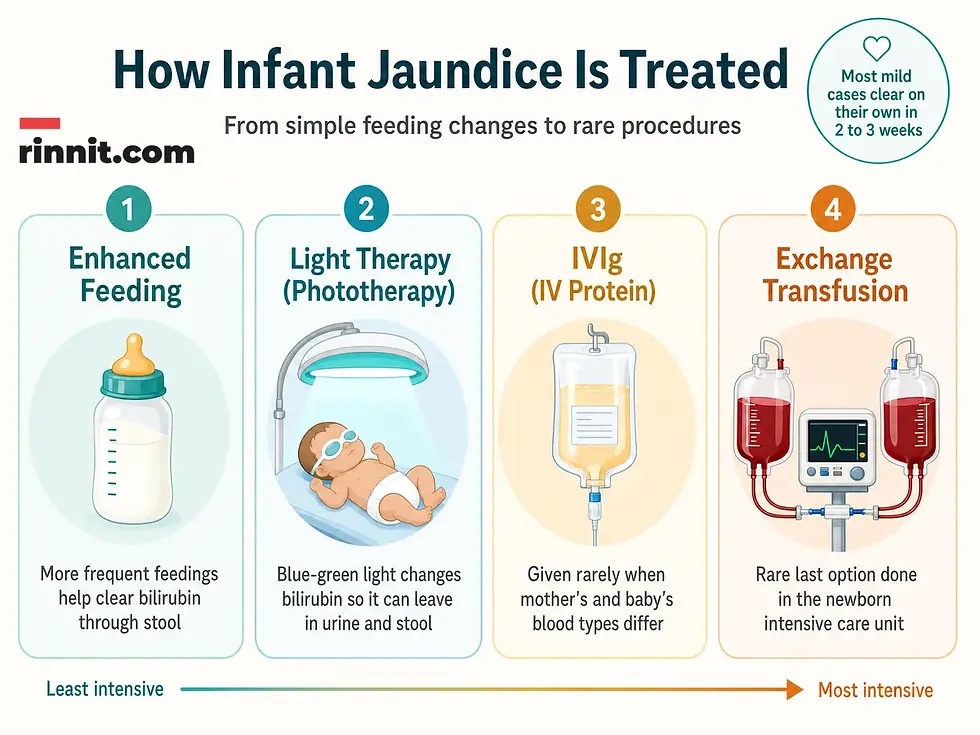
Mild infant jaundice often disappears on its own within two or three weeks. For moderate or severe jaundice, a baby may need to stay longer in the newborn nursery or be readmitted to the hospital. Doctors choose treatment based on the bilirubin level, the baby's age and any risk factors. [2]
Light Therapy (Phototherapy)
Light therapy places your baby under a special lamp that emits light in the blue-green spectrum. The light changes the shape and structure of bilirubin molecules so that they can be excreted in both the urine and stool. During treatment, your baby will wear only a diaper and protective eye patches. Light therapy may be supplemented with a light-emitting pad or mattress. [2]
Enhanced Nutrition
To prevent weight loss, a healthcare professional may recommend more-frequent feeding or supplementation to ensure that your baby receives enough nutrition. [2]
Intravenous Immunoglobulin (IVIg)
Jaundice may be related to blood type differences between mother and baby. This results in the baby carrying antibodies from the mother that contribute to the rapid breakdown of the baby's red blood cells. Intravenous transfusion of an immunoglobulin, a blood protein that can reduce levels of antibodies, may decrease jaundice and lessen the need for an exchange transfusion, although results are not conclusive. [2]
Exchange Transfusion
Rarely, when severe jaundice does not respond to other treatments, a baby may need an exchange transfusion of blood. This involves repeatedly withdrawing small amounts of blood and replacing it with donor blood. The procedure dilutes the bilirubin and maternal antibodies and is done in a newborn intensive care unit. [2]
Self-Care and Feeding at Home
When infant jaundice is not severe, a healthcare professional may recommend changes in feeding habits that can lower bilirubin levels. Talk to your baby's healthcare professional if you have any questions or concerns about how much or how often your baby is feeding or if you are having trouble breastfeeding. [2]
More-frequent feedings provide your baby with more milk and cause more bowel movements, increasing the amount of bilirubin eliminated in your baby's stool. Infants who are breastfed should have 8 to 12 feedings a day for the first several days of life. Formula-fed infants usually should have 1 to 2 ounces (about 30 to 60 milliliters) of formula every 2 to 3 hours for the first week. [2]
If your baby is having trouble breastfeeding, is losing weight, or is dehydrated, your baby's healthcare professional may suggest giving formula or expressed milk to supplement breastfeeding. Depending on the situation, the health professional may recommend using formula alone for a couple of days and then resuming breastfeeding. [2]
Can Infant Jaundice Be Prevented?
The best prevention of infant jaundice is adequate feeding. Breastfed infants should have 8 to 12 feedings a day for the first several days of life. Because dehydration or low caloric intake can contribute to jaundice, making sure your baby gets enough to eat and is adequately hydrated is an important protective step. [1] [2]
How Do You Prepare for a Follow-Up Visit?
If your baby has jaundice at discharge, the healthcare professional will assess the likelihood of severe jaundice based on how much bilirubin is in the blood, whether the baby was born prematurely, how well the baby is feeding, the baby's age, whether the baby has bruising from delivery, and whether an older sibling had severe jaundice. If risk factors for severe jaundice are present, a follow-up visit a day or two after leaving the hospital may be recommended. [2]
Be prepared to answer questions about how well your baby is feeding, whether the baby is breastfed or formula-fed, how often the baby feeds, how often there are wet diapers and stools, whether the baby wakes easily for feeding, whether the baby seems sick or weak, any changes in the color of the skin or eyes, whether yellowing has spread beyond the face, and whether the baby's temperature has been stable. [2]
You can also bring your own questions, such as: [2]
Is the jaundice severe, and what is causing it?
What tests does my baby need?
Does my baby need treatment, or to go back into the hospital?
When should my baby have the next follow-up?
Should I keep feeding the same way?
Conclusion and Next Steps
Infant jaundice is common, usually temporary and very treatable. Most cases appear on the second or third day of life, peak between days 2 and 5, and clear within two to three weeks. The best things parents can do are simple: check the baby's skin in natural daylight, feed frequently, and know the warning signs that mean it is time to call a healthcare professional. If treatment is needed, light therapy is safe, common and effective, and the rare cases that need more intensive care are handled quickly. You do not have to manage this alone; your baby's care team is built to catch and treat jaundice in the first days of life. [1] [2]
Ready to stay ahead of jaundice this week? Keep track of your newborn's feedings and wet diapers, do the forehead press check in daylight, and bring any concerns to your baby's next appointment.
Learn more. For more evidence-based health guides, visit Rinnit.com.
Frequently Asked Questions
What causes infant jaundice?
Infant jaundice is caused by a buildup of bilirubin, a yellow pigment released when red blood cells break down. Newborns produce more bilirubin than adults, and their livers are not yet mature enough to clear it quickly from the bloodstream, so it builds up and colors the skin and eyes yellow.
Is infant jaundice dangerous?
Most cases are mild and clear within two or three weeks, and most infants born between 35 weeks and full term need no treatment. Very high bilirubin levels can rarely cause serious complications, including brain damage, which is why doctors monitor bilirubin closely and treat moderate or severe cases promptly.
How do I check my baby for jaundice at home?
Press gently on your baby's forehead or nose in good lighting, preferably natural daylight. If the skin looks yellow where you pressed, your baby likely has mild jaundice. Without jaundice, the skin simply looks slightly lighter for a moment where you pressed.
When should I call the doctor about jaundice?
Call a healthcare professional if your baby's skin becomes more yellow, yellowing spreads to the belly, arms or legs, the whites of the eyes look yellow, or your baby is hard to wake, listless, feeding poorly, crying in a high-pitched way or not gaining weight.
How is infant jaundice treated?
Mild jaundice often resolves on its own in two to three weeks. Moderate or severe cases are treated with light therapy (phototherapy), which changes bilirubin molecules so they can leave the body in urine and stool. Rarely, intravenous immunoglobulin or an exchange transfusion is needed, and enhanced feeding is recommended throughout.
Should I stop breastfeeding if my baby has jaundice?
No. Experts still recommend breastfeeding when jaundice occurs, and the best prevention is adequate feeding. Your healthcare professional may suggest feeding more often or temporarily supplementing with formula or expressed milk, but the feeding plan should come from your baby's care team.
Related Reading
Coombs Test: Direct vs Indirect, Why It's Done and What Results Mean explains the blood test that finds antibodies attacking red blood cells.
Bilirubin Test: Normal Levels, High Bilirubin Causes and Newborn Jaundice explains the blood test that measures bilirubin and what high levels mean.
G6PD Test: Checking for G6PD Deficiency and Hemolytic Anemia explains the blood test for inherited G6PD enzyme deficiency.
References
Mayo Clinic Staff. Infant jaundice - Symptoms and causes. Mayo Clinic. September 19, 2025. https://www.mayoclinic.org/diseases-conditions/infant-jaundice/symptoms-causes/syc-20373865
Mayo Clinic Staff. Infant jaundice - Diagnosis and treatment. Mayo Clinic. September 19, 2025. https://www.mayoclinic.org/diseases-conditions/infant-jaundice/diagnosis-treatment/drc-20373870
Okunade A, et al. A 10-year retrospective assessment of prevalence and factors associated with jaundice among neonates in selected facilities in Ondo State. BMC Pediatr. 2026;26(1). PMID 42298509. https://doi.org/10.1186/s12887-026-07111-y
Ghavi A, et al. Phototherapy for Neonatal Hyperbilirubinemia: Vitamin D, Calcium, and Magnesium: A Systematic Review and Meta-analysis. Am J Perinatol. 2026. PMID 42705341. https://doi.org/10.1055/a-2943-4904
Huang M, et al. Efficacy and safety of different doses of intravenous immunoglobulin combined with phototherapy in neonatal hemolytic disease: a systematic review and meta-analysis. Eur J Pediatr. 2026;185(8). PMID 42458120. https://doi.org/10.1007/s00431-026-07219-4
Medical disclaimer
This guide is for informational purposes only and is not medical advice. Individual diagnosis and treatment decisions should always be made with a qualified healthcare professional.



Comments