Coombs Test: Direct vs Indirect, Why It's Done and What Results Mean

Updated: 2 days ago
Written and medically reviewed by Dr. Baraa Alnahhal, MD · Last reviewed: November 2026 · How we review
Quick Answer: What is a Coombs test?
A Coombs test is a blood test that checks for antibodies that can attack red blood cells. The direct Coombs test looks for antibodies stuck to red blood cells and helps diagnose autoimmune hemolytic anemia. The indirect Coombs test looks for antibodies in the bloodstream and is used before blood transfusions and during pregnancy. A negative result is normal. [1]
What the research says
The direct Coombs test misses a small share of autoimmune hemolytic anemia. A clinical review explains that the direct antiglobulin test is the basis of diagnosis, but certain antibody types or very low antibody levels can be missed, leaving about 5% of cases test-negative. (Barcellini, Seminars in Hematology, 2015) [2]
Specialized lab methods can find these hidden cases. Among 637 people with unexplained hemolytic anemia, a method that measures antibody bound to red blood cells identified test-negative autoimmune hemolytic anemia with 97% sensitivity and 84% specificity when done before treatment. (Kamesaki, Transfusion, 2022) [3]
Key takeaways
The Coombs test looks for antibodies that can attack and destroy red blood cells. [1]
The direct test checks red blood cells; the indirect test checks the bloodstream. [1]
It's used before transfusions, during pregnancy and for newborns with jaundice. [1]
No preparation is needed, and results usually come back within 24 hours. [1]
A positive result often needs more testing to find the cause. [1]
What is a Coombs test?
A Coombs test checks for antibodies that can attack your red blood cells. Antibodies are a key part of your immune system. They fight antigens such as bacteria, viruses and toxins to keep you healthy, but sometimes they mistakenly attack normal, healthy cells instead. [1]
What are the types of Coombs test?

Both tests use a small blood sample.
There are two types of Coombs test: direct and indirect. [1]
Type | What it checks | Common uses |
Direct Coombs test (direct antiglobulin test) | Antibodies already attached to your red blood cells | Diagnosing blood conditions such as autoimmune hemolytic anemia; newborns with jaundice |
Indirect Coombs test | Antibodies in your bloodstream that could attach to red blood cells | Screening before a blood transfusion; routine prenatal testing |
Sources: [1]
People with autoimmune hemolytic anemia don't have enough red blood cells because their body destroys them too soon. [1]
Why is a Coombs test done during pregnancy?
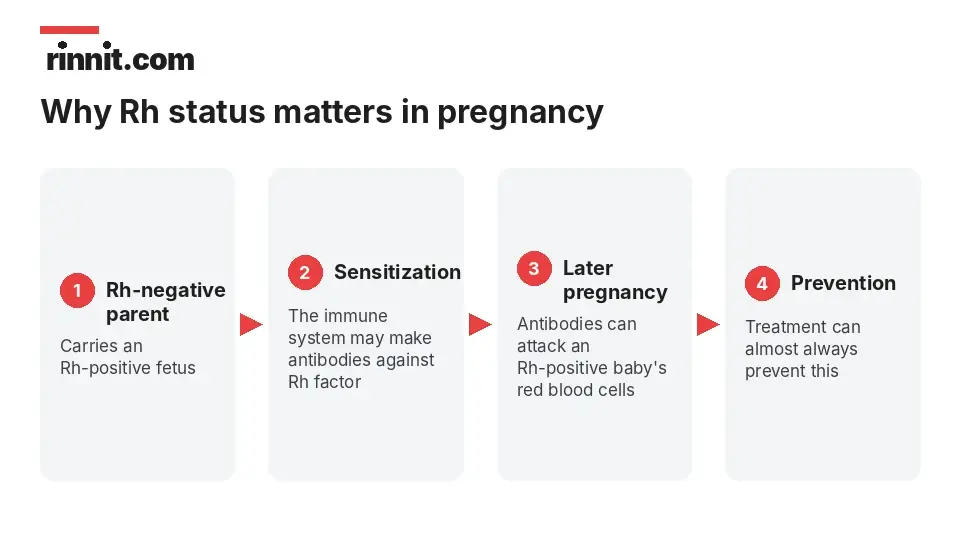
Testing in the first trimester lets your team prevent problems.
If you're pregnant, your provider will give you an indirect Coombs test to see if you have antibodies against Rh-positive blood. If you have an Rh-negative blood type (such as O-, A-, B- or AB-), your red blood cells don't carry the Rh factor marker, while Rh-positive blood does. [1]
If an Rh-negative person is pregnant with an Rh-positive fetus, Rh sensitization can happen. Your immune system mistakenly treats the Rh factor as a threat and makes antibodies against it. [1]
It takes time for your body to make these antibodies, so a first pregnancy usually isn't affected. In a later pregnancy with an Rh-positive fetus, existing antibodies can attack the fetus's red blood cells. This causes Rh disease, which can lead to anemia, jaundice or other serious problems, and it usually gets worse with each Rh-positive pregnancy. [1]
If you're at risk of Rh sensitization, treatment can almost always prevent it. If you're already sensitized, treatment can help protect the fetus. That's why the Coombs test is done in your first trimester. [1]
Why is a Coombs test done in newborns?
If your baby is born with jaundice, your healthcare provider will likely do a Coombs test. It helps detect "foreign" antibodies that have attached to your newborn's red blood cells. [1]
How do you prepare for a Coombs test?
No preparation is needed. [1]
What happens during the test?
A provider uses a small needle to take blood from a vein in your arm or hand. You may feel a slight pinch when the needle goes in. [1]
The sample goes to a lab for analysis. Your provider covers the site with a bandage, which you can remove after 10 to 20 minutes. [1]
What do Coombs test results mean?
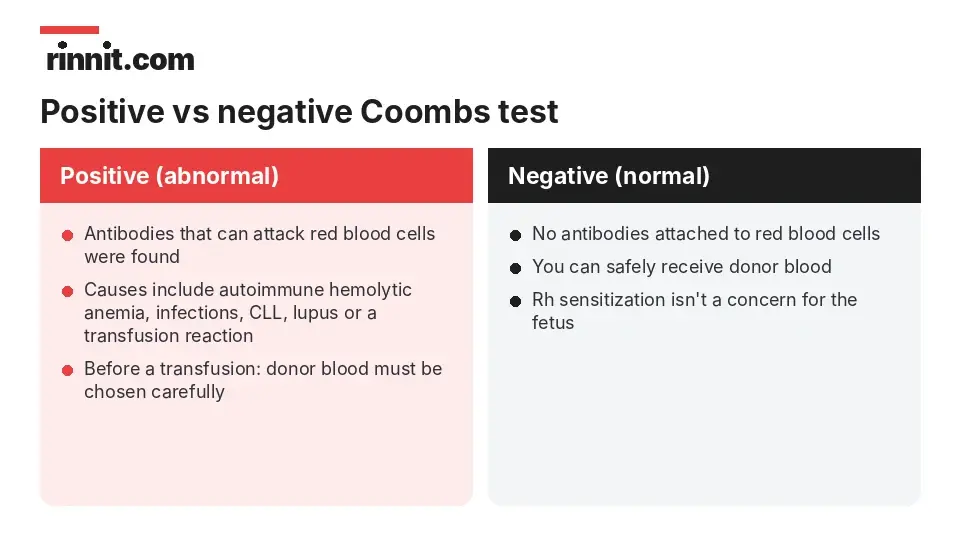
Results usually come back within 24 hours.
In most cases, you'll get your results within 24 hours. [1]
Positive (abnormal) result
A positive Coombs test means you have antibodies that can attack your red blood cells. Possible causes include: [1]
Autoimmune hemolytic anemia
Infectious mononucleosis
Chronic lymphocytic leukemia
Syphilis
Mycoplasma infection, a type of respiratory illness
Lupus
A reaction to a blood transfusion
When the test is done | What a positive result means |
Before a transfusion | Your provider needs to choose donor blood carefully; people who get many transfusions often develop several antibodies |
During pregnancy | You'll need steps to protect the fetus from Rh sensitization |
In a baby | Usually points to anemia or jaundice; your provider will examine the baby and recommend treatment |
Sources: [1]
Negative (normal) result
A negative result means no antibodies attached to red blood cells were found. Depending on your situation, it means you can safely receive donor blood, or you don't need to worry about Rh sensitization affecting the fetus. [1]
When should you call your provider?
Call your provider right away if you develop symptoms of hemolytic anemia, such as jaundice, weakness, dizziness or confusion. Many warning signs overlap with other conditions, so make an appointment if something doesn't feel right. [1]
Conclusion
The Coombs test is a simple blood test that looks for antibodies that may attack and destroy your red blood cells. It protects people receiving transfusions, guides care during pregnancy and helps explain jaundice or anemia. [1]
A Coombs result can point your care team in the right direction, but you may need more tests to reach a diagnosis and the right treatment. [1]
Keep learning: Read our guide to autoimmune hemolytic anemia or our guide to the Rh factor in pregnancy. For more background, see the MedlinePlus page on the Coombs test.
FAQ
What is a Coombs test?
It's a blood test that checks for antibodies that can attack your red blood cells.
What is the difference between direct and indirect Coombs tests?
The direct test checks antibodies on red blood cells; the indirect test checks antibodies in the bloodstream.
Why is a Coombs test done in pregnancy?
To see if you have antibodies against Rh-positive blood that could harm the fetus.
What does a positive Coombs test mean?
You have antibodies that can attack red blood cells, from causes such as autoimmune hemolytic anemia, infection, lupus or a transfusion reaction.
What does a negative Coombs test mean?
No antibodies attached to red blood cells were found, which is normal.
Why do newborns get a Coombs test?
It's often done when a baby has jaundice to look for antibodies on the baby's red blood cells.
Do I need to prepare for a Coombs test?
No preparation is needed.
How long do Coombs test results take?
Usually within 24 hours.
Is a Coombs test done before a blood transfusion?
Yes. The indirect test screens how you may react to donor blood.
What symptoms should I report?
Jaundice, weakness, dizziness or confusion, which can be signs of hemolytic anemia.
Related Reading
What Is Autoimmune Hemolytic Anemia? Symptoms, Causes, and Treatment explains the main condition the direct Coombs test helps diagnose.
Hemolytic Anemia: Understanding Rapid Red Blood Cell Loss covers anemia caused by red blood cells breaking down too early.
Understanding the Rh Factor: Clinical Significance and Pregnancy Management explains why Rh status matters in pregnancy.
Hemolytic Transfusion Reaction: Risks, Symptoms, and Recovery covers the reaction a positive test before transfusion helps prevent.
What Is Infant Jaundice? What New Parents Should Know explains newborn jaundice, a common reason for testing babies.
References
Cleveland Clinic. Coombs Test: Purpose, Procedure & Results. Cleveland Clinic. Last updated May 11, 2022. https://my.clevelandclinic.org/health/diagnostics/22978-coombs-test
Barcellini W. Immune Hemolysis: Diagnosis and Treatment Recommendations. Semin Hematol. 2015;52(4):304-312. PMID 26404442. https://doi.org/10.1053/j.seminhematol.2015.05.001
Kamesaki T. Diagnostic algorithm for classification and characterization of direct antiglobulin test-negative autoimmune hemolytic anemia with 1-year clinical follow-up. Transfusion. 2022;62(1):205-216. PMID 34668206. https://doi.org/10.1111/trf.16709
Medical disclaimer
This article is for general education only and does not replace advice from a qualified healthcare professional. Talk to your doctor about your own diagnosis and treatment, and seek emergency care right away for severe or sudden symptoms.



Comments