Hemolytic Transfusion Reaction: Risks, Symptoms, and Recovery

Updated: 2 days ago
Medically reviewed by Dr. Baraa Alnahhal, MD · Last reviewed: October 2026
Quick Answer
A hemolytic transfusion reaction is an immune attack in which the body destroys donor red blood cells because of a mismatch in blood type or Rh factor. Reactions can be acute or delayed by days or weeks. Warning signs include fever, chills, back pain and confusion. If a reaction is suspected, the transfusion must be stopped immediately. [1] [4]
What the research says
ABO-incompatible transfusions are now rare in the UK, but they still cause real harm. A systematic review of 27 years of UK hemovigilance data (1996–2023) found 368 ABO-incompatible red cell transfusions among 55.3 million units issued, or 0.67 per 100,000 transfusions. Mortality among these events was 6.3% and major morbidity was 23.9%. Clinical errors caused 53.3% of the events, mostly during administration, blood collection and sample collection. (Oyekan et al., Transfus Med Rev, 2025)
Delayed reactions are easy to miss, especially in sickle cell disease. A review notes that pain or dark urine can appear days to weeks after transfusion, that in hyperhemolysis hemoglobin A can fall by more than 50%, and that in up to one-third of cases no new red cell antibody can be found. (Hendrickson & Fasano, Hematology Am Soc Hematol Educ Program, 2021)
What is a hemolytic transfusion reaction?

A hemolytic transfusion reaction occurs when the body's natural defense system—the immune system—misidentifies donor red blood cells as harmful and begins to destroy them. This process, known as hemolysis, can occur within the blood vessels or in organs like the liver and spleen. While blood transfusions are generally safe and lifesaving, this specific complication represents one of the most serious risks associated with the procedure. [1]
Medical professionals categorize these reactions based on their timing and the underlying biological mechanism. Understanding these distinctions is vital for both medical staff and patients to ensure the highest level of safety during and after a transfusion.
Reaction Type | Timing of Onset | Primary Mechanism | Common Outcome |
Acute HTR | During or immediately after | Intravascular destruction | Emergency intervention required |
Delayed HTR | Days to weeks later | Extravascular (liver/spleen) | Often milder, but requires monitoring |
Classifying the reaction: How the body responds
Not all transfusion reactions are identical. The way the immune system reacts depends on the specific cause of the mismatch and the speed at which the body identifies the donor cells.
Immune-mediated vs. non-immune mediated
An immune-mediated reaction is the most common form, triggered when the recipient's blood type and the donor's blood type do not match. This can involve the major ABO blood groups or the Rh factor. Conversely, a non-immune mediated reaction occurs when donor red blood cells are destroyed without an immune attack on the blood type, such as bacteria or viruses present in the donor blood, or donor cells that were damaged due to improper storage. [1]
Intravascular vs. extravascular destruction
In an intravascular reaction, the donor red blood cells are destroyed directly within the bloodstream. This is typically seen in acute cases and can lead to more severe systemic issues. In an extravascular reaction, the donor cells are filtered out of the blood and destroyed in the liver or spleen. This is the hallmark of a delayed reaction and often presents with less immediate urgency. [1]
Recognizing the symptoms: Acute vs. delayed

The signs of a transfusion reaction can vary significantly depending on how quickly the immune system responds. Being aware of these symptoms allows for faster intervention.
Acute symptoms (immediate)
During a transfusion, medical staff monitor for sudden changes in vital signs. Symptoms that occur right away include:
Physical pain: Sudden pain in the chest, back, or side.
Fever and chills: A rapid spike in body temperature often accompanied by shivering.
Neurological signs: Confusion, dizziness, or a feeling of lightheadedness.
Gastrointestinal issues: Sudden nausea or vomiting.
Delayed symptoms (days to weeks later)
A delayed reaction may be harder to spot as it occurs after the patient has left the clinical setting. Signs to watch for include:
Persistent fatigue: Feeling unusually tired or weak days after the procedure.
Jaundice: A yellowing of the skin or the whites of the eyes.
Dark urine: A sign that the body is processing destroyed red blood cells.
Causes, complications, and emergency signs
The primary cause of an acute hemolytic transfusion reaction is human or system error leading to a blood type mismatch. [4] For delayed reactions, the cause is often pre-existing antibodies that were not detected during initial screening, sometimes due to previous transfusions or recent pregnancies. [1]
Potential complications
If not treated promptly, a severe reaction can lead to:
Acute kidney injury: The kidneys can become overwhelmed by the debris from destroyed red blood cells.
Disseminated intravascular coagulation (DIC): A dangerous condition where the blood begins to clot excessively throughout the body.
Hyperhemolytic crisis: In patients with sickle cell disease, a reaction can cause hemoglobin levels to drop dangerously fast.
Diagnosis and life-saving treatment
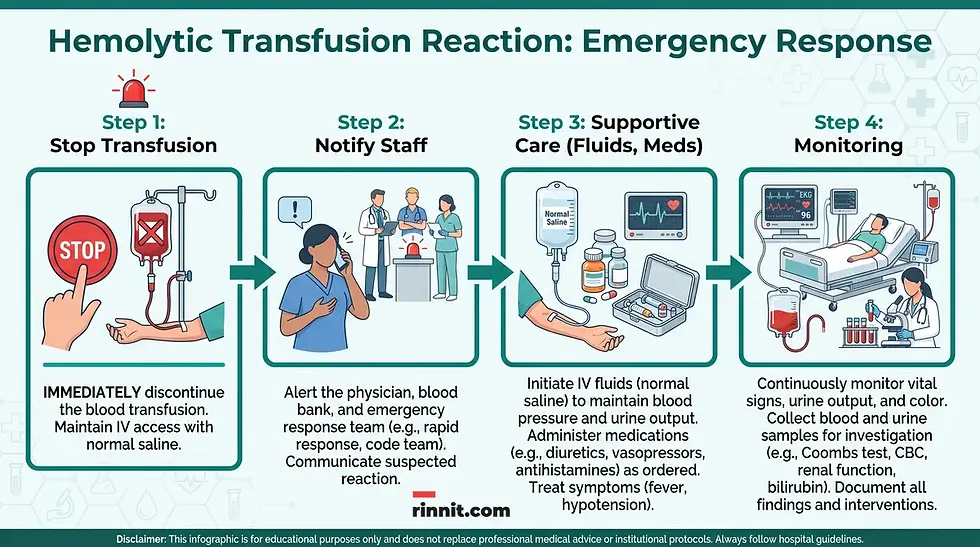
The most important step in treating a transfusion reaction is the immediate cessation of the procedure. Once the transfusion is stopped, the medical team will perform a series of tests to confirm the reaction and assess the damage. [1]
Diagnostic testing
Coombs test: Used to identify antibodies that are actively attacking red blood cells.
Urinalysis: Checking for the presence of blood or hemoglobin in the urine.
Bilirubin and haptoglobin levels: Blood tests that indicate the extent of red blood cell destruction and liver stress.
Treatment pathway
Treatment focuses on managing symptoms and protecting organ function. This may include vasopressors to stabilize low blood pressure, diuretics to support the kidneys, and supportive care like fluids and pain relievers. In delayed cases, medications like corticosteroids may be used to slow the immune system's response. [1]
Conclusion
While a hemolytic transfusion reaction is a serious complication, it is exceptionally rare in modern medicine due to stringent safety protocols. By understanding the symptoms and the importance of immediate reporting, patients can play an active role in their own safety. Many people with mild reactions recover with supportive care, but severe reactions can cause serious complications, which is why prompt recognition, treatment and careful management of future transfusions matter.
For more information on blood health and safe medical procedures, visit Rinnit.com.
Frequently Asked Questions
How common are hemolytic transfusion reactions?
Hemolytic transfusion reactions are very rare. Modern testing, cross-matching, and strict administrative protocols have made blood transfusions safer than ever before.
Can a reaction happen even if the blood type matches?
Yes. A reaction can occur due to minor blood group factors, Rh factor differences, or if the donor blood was contaminated or improperly stored.
What is the first thing a doctor does if a reaction is suspected?
The very first step is to stop the transfusion immediately to prevent any more donor blood from entering the patient's system.
Why does my back hurt during a reaction?
Back pain is a classic symptom of an acute reaction, likely caused by the sudden inflammatory response and the kidneys reacting to the cell debris.
Is a delayed reaction as dangerous as an acute one?
Generally, delayed reactions are less severe and develop more slowly, but they still require medical attention to prevent complications like anemia. In people with sickle cell disease, a delayed reaction can be severe.
Can a reaction be prevented?
Yes, through rigorous pre-transfusion testing, including "type and screen" and "cross-matching," which checks the recipient's blood against the specific donor unit.
What is jaundice, and why does it happen?
Jaundice is the yellowing of the skin and eyes. It happens when red blood cells break down, releasing bilirubin that the liver cannot process fast enough.
Can I have another transfusion if I've had a reaction before?
Yes, but you will require additional, more intensive screening and matching to identify the specific antibodies that caused the previous reaction.
How long does it take to recover?
Most people with mild symptoms recover within a few days with supportive care. Severe cases involving kidney issues may take longer.
Does pregnancy affect the risk of a reaction?
Yes, pregnancy can cause the body to develop new antibodies, which is why recent pregnancy is considered a risk factor for delayed reactions.
What is DIC?
Disseminated Intravascular Coagulation is a serious complication where the blood's clotting mechanism goes into overdrive, potentially causing both clots and bleeding.
Are there medications to stop the reaction?
While you can't "stop" it once it starts, doctors use corticosteroids and other immune-suppressing drugs to slow the body's response.
Can I donate blood if I've had a transfusion reaction?
Eligibility to donate blood depends on the cause of the reaction. You should consult with your local blood donation center to discuss your specific medical history.
What should I tell my nurse during a transfusion?
Report any new symptoms immediately, especially chills, fever, back pain, nausea, or a general feeling that something is "wrong."
Is hemolytic anemia the same as a transfusion reaction?
A transfusion reaction is a type of hemolytic anemia, specifically one caused by the destruction of donor cells by the recipient's immune system.
Related Reading
Coombs Test: Direct vs Indirect, Why It's Done and What Results Mean explains the blood test that finds antibodies attacking red blood cells.
References
Cleveland Clinic. Hemolytic Transfusion Reaction. Cleveland Clinic. Last updated February 17, 2026. https://my.clevelandclinic.org/health/diseases/hemolytic-transfusion-reaction
Hendrickson JE, et al. Management of hemolytic transfusion reactions. Hematology Am Soc Hematol Educ Program. 2021;2021(1):704-709. PMID 34889404. https://doi.org/10.1182/hematology.2021000308
Oyekan F, et al. Quantifying Harms Associated With Red Cell ABO Incompatible Blood Transfusion: A Systematic Review of the UK SHOT Literature. Transfus Med Rev. 2025;39(3):150906. PMID 40628158. https://doi.org/10.1016/j.tmrv.2025.150906
Sarode R. Complications of Transfusion. Merck Manual Professional Version. Last updated April 2026. https://www.merckmanuals.com/professional/hematology/transfusion-medicine/complications-of-transfusion
Abdallah R, et al. Transfusion Reactions and Adverse Events. Clin Lab Med. 2021;41(4):669-696. PMID 34689973. https://doi.org/10.1016/j.cll.2021.07.009
Chavez Ortiz JL, et al. Transfusion-related errors and associated adverse reactions and blood product wastage as reported to the National Healthcare Safety Network Hemovigilance Module, 2014-2022. Transfusion. 2024;64(4):627-637. PMID 38476028. https://doi.org/10.1111/trf.17775
Medical disclaimer
This article is for general educational purposes only and is not a substitute for professional medical advice, diagnosis, or treatment. Always seek the advice of your physician or other qualified healthcare provider with any questions you may have about a medical condition. Never disregard professional medical advice or delay seeking care because of something you have read here. If you think you may have a medical emergency, call your doctor or emergency services immediately.



Comments