G6PD Test: Checking for G6PD Deficiency and Hemolytic Anemia

Updated: 2 days ago
Written and medically reviewed by Dr. Baraa Alnahhal, MD · Last reviewed: November 2026 · How we review
Quick Answer
A G6PD test is a blood test that measures glucose-6-phosphate dehydrogenase, an enzyme that protects red blood cells from damage. Low levels mean G6PD deficiency, an inherited condition that can cause hemolytic anemia. It's a quick blood draw, or a heel prick in babies, with no fasting. Testing during a hemolytic episode can give a falsely normal result.
What the research says
G6PD deficiency is very common worldwide: a systematic review of 280 prevalence estimates from 88 countries found G6PD deficiency is the most common enzyme deficiency, affecting an estimated 400 million people, with the highest rates in sub-Saharan Africa (Nkhoma ET et al., Blood Cells Mol Dis, 2009) [2]
Avoiding triggers is the main treatment: a major review noted that the most common problems in G6PD deficiency are newborn jaundice and sudden hemolytic anemia, usually set off by an outside trigger, and that preventing attacks by avoiding oxidative stress is the most effective management (Cappellini MD, Fiorelli G, Lancet, 2008) [3]
Key takeaways
Measures an enzyme that protects red blood cells.
Low levels mean inherited G6PD deficiency.
Done for hemolytic anemia symptoms, prolonged newborn jaundice or family history.
A quick blood draw or heel prick; no fasting.
Testing during an episode can be falsely normal.
What is G6PD deficiency?
G6PD deficiency is an inherited condition in which red blood cells lack enough of the G6PD enzyme. Without it, certain foods, medicines or infections can damage red blood cells, causing hemolytic anemia. Many people never have symptoms. Symptomatic deficiency is more common in men and in people of African, Asian or Mediterranean heritage. Sources: [1, 2]
Who should be tested?
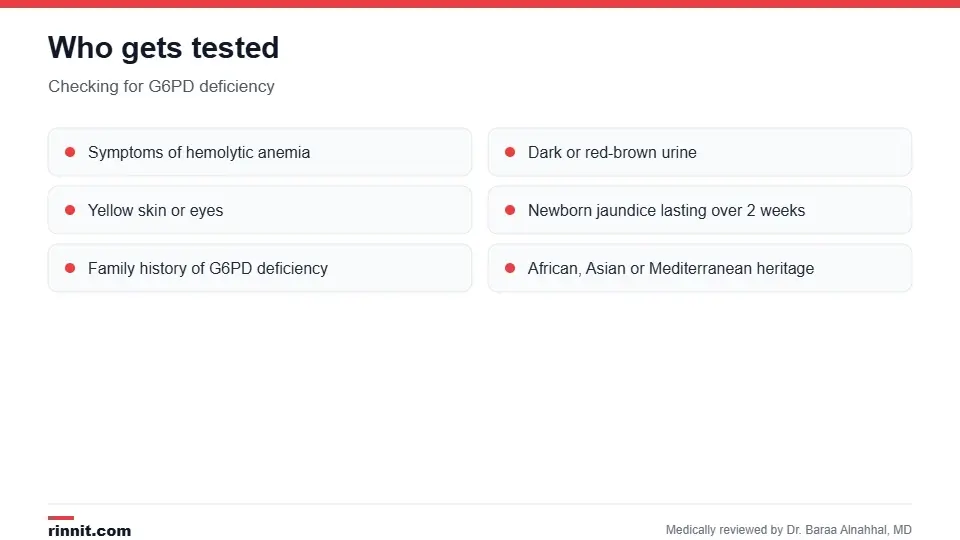
G6PD testing looks for an inherited enzyme deficiency.
People with symptoms of hemolytic anemia: fainting, fatigue, fast heartbeat, shortness of breath, pale skin, dark or red-brown urine or jaundice.
Newborns with jaundice that lasts more than two weeks without a clear cause.
People with a family history of G6PD deficiency. Sources: [1]
Triggers to avoid
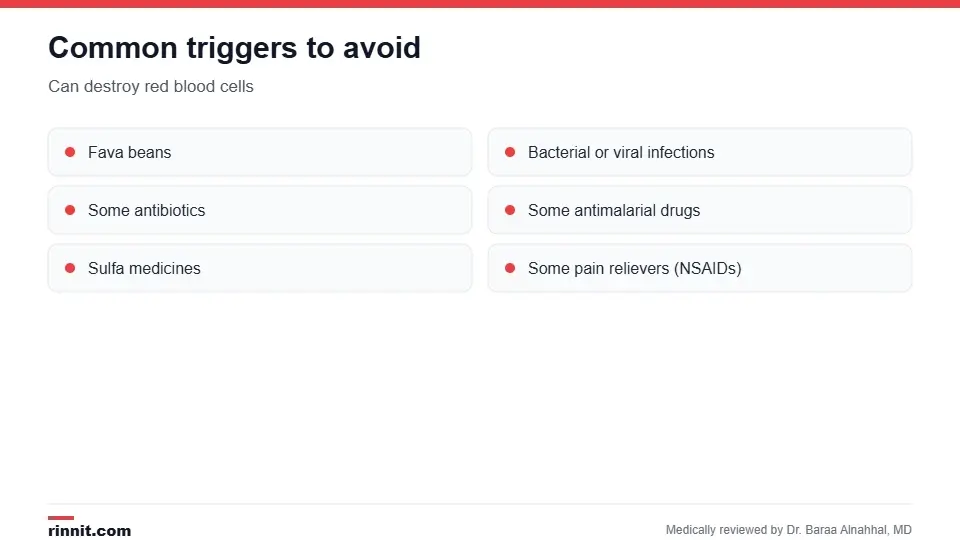
Avoiding triggers prevents most episodes.
Fava beans (favism).
Bacterial or viral infections.
Some antibiotics and antimalarial drugs.
Sulfa medicines, including some antibacterials, antifungals, seizure medicines and water pills.
Some NSAID pain relievers. Sources: [1, 3]
How do I prepare?
Fasting usually isn't needed. Share a full list of your medicines and supplements, and follow any advice to avoid fava beans or sulfa drugs. If you have active hemolysis symptoms on the test day, the test may be rescheduled. Sources: [1]
How is the test done?
For adults, blood is drawn from a vein in the arm in under five minutes. For babies, a heel prick is used. Risks are low: minor soreness or bruising, and rarely bleeding or infection. Sources: [1]
Understanding your results

Timing of the test affects results.
Low G6PD: G6PD deficiency, even if you've never had hemolytic anemia.
Normal during an episode: may be misleading, because cells with low G6PD are destroyed during an attack; testing may be repeated later.
Slightly low in women: may mean carrier status; carriers usually have no symptoms but can pass the deficiency to their children. Sources: [1]
If hemolysis is suspected, your provider may also check a complete blood count and a bilirubin test. Sources: [1]
Living with G6PD deficiency
Most people manage G6PD deficiency by avoiding triggers. Severe episodes may need medical treatment. Contact your provider if hemolysis symptoms interfere with daily life or last more than 24–48 hours. Sources: [1, 3]
Conclusion
The G6PD test is a simple blood test that identifies a common inherited enzyme deficiency. Knowing your status helps you avoid triggers and protect your red blood cells.
Keep learning: read about G6PD deficiency and hemolytic anemia.
Frequently asked questions
What does a G6PD test measure?
An enzyme that protects red blood cells.
Why is it done?
To check for G6PD deficiency, an inherited cause of hemolytic anemia.
Do I need to fast?
Usually not.
How is it done in babies?
With a heel prick.
What does a low result mean?
G6PD deficiency.
Can the test be falsely normal?
Yes, if done during a hemolytic episode.
What should people with G6PD deficiency avoid?
Fava beans, certain medicines and some infections.
Is G6PD deficiency common?
Yes. It affects an estimated 400 million people worldwide.
Can women be carriers?
Yes. Slightly low levels may mean carrier status.
Is it serious?
Many people never have symptoms; avoiding triggers prevents most problems.
Related Reading
G6PD Deficiency: Symptoms, Causes, Diagnosis, Treatment and Outlook — What You Need to Know the condition this test detects.
Hemolytic Anemia: Understanding Rapid Red Blood Cell Loss the anemia G6PD deficiency can cause.
What Is Infant Jaundice? What New Parents Should Know newborn jaundice that may prompt testing.
Bilirubin Test: Normal Levels, High Bilirubin Causes and Newborn Jaundice a blood test often done alongside.
Complete Blood Count (CBC): What It Measures, Normal Ranges and Abnormal Results checks red blood cell levels.
References
Cleveland Clinic. G6PD Test: Purpose, Procedure & Results. Cleveland Clinic. Last updated February 2, 2022. https://my.clevelandclinic.org/health/diagnostics/22381-g6pd-test
Nkhoma ET, Poole C, Vannappagari V, et al. The global prevalence of glucose-6-phosphate dehydrogenase deficiency: a systematic review and meta-analysis. Blood Cells Mol Dis. 2009;42(3):267-278. PMID 19233695. https://doi.org/10.1016/j.bcmd.2008.12.005
Cappellini MD, Fiorelli G. Glucose-6-phosphate dehydrogenase deficiency. Lancet. 2008;371(9606):64-74. PMID 18177777. https://doi.org/10.1016/S0140-6736(08)60073-2
Medical disclaimer
This article is for general education only and does not replace advice from a qualified healthcare professional. Talk to your doctor about your own diagnosis and treatment, and seek emergency care right away for severe or sudden symptoms.



Comments