What Is Malaria? The Mosquito-Borne Disease That Still Infects Hundreds of Millions

Updated: 2 days ago
Medically reviewed by Dr. Baraa Alnahhal, MD · Last reviewed: October 15, 2026
Quick Answer: What is malaria?
Malaria is a parasitic disease spread mainly by infected mosquito bites, causing high fever and chills in hundreds of millions of people each year [1] [4]. Warning signs include fever, chills, headache, nausea and fatigue, often in cycles [1]. It is treatable with prescription antimalarial drugs [2]. Prevention includes bed nets, repellent, preventive medicine for travelers and vaccines for children in high-risk countries [1] [4].
What the research says
A malaria vaccine prevents a substantial share of cases in young children. In a phase 3 trial in sub-Saharan Africa that included 8,922 children aged 5–17 months, three doses of the RTS,S/AS01 vaccine plus a booster reduced clinical malaria episodes by 36.3% over a median of 48 months, averting 1,774 cases per 1,000 vaccinated children (RTS,S Clinical Trials Partnership, Lancet, 2015) [6]
Insecticide-treated bed nets save children's lives. A Cochrane review of 23 trials enrolling more than 275,793 people found that treated nets reduced child deaths from all causes by 17% compared with no nets, nearly halved uncomplicated falciparum malaria episodes (rate ratio 0.55), and cut severe malaria episodes by 44% (Pryce et al., Cochrane Database Syst Rev, 2018) [7]
Fast, effective treatment of severe malaria lowers deaths. In a randomized trial of 5,425 African children with severe malaria, 8.5% of those treated with intravenous artesunate died compared with 10.9% of those given quinine, a 22.5% relative reduction in deaths (Dondorp et al., Lancet, 2010) [8]
What is malaria?
Malaria is a disease caused by a single-celled parasite of the genus Plasmodium [1]. It reaches humans through the bites of infected mosquitoes [1]. People who have malaria usually feel very sick, with a high fever and shaking chills [1].
The disease is uncommon in temperate climates [1]. It remains common in tropical and subtropical countries [1], where there were an estimated 282 million malaria cases and 610,000 malaria deaths in 2024 [4].
The good news is that malaria is both treatable and preventable [4]. World health programs distribute preventive drugs and insecticide-treated bed nets [1]. A malaria vaccine has been recommended for children in countries with high numbers of cases [1] [4], and travelers can protect themselves with medication taken before, during, and after trips to high-risk areas [1].
One important challenge: many malaria parasites have developed resistance to the common drugs used to treat the disease [1].
How does malaria spread?

Malaria spreads through a cycle involving mosquitoes and people. A mosquito becomes infected after biting a person who has malaria. When that same mosquito bites a healthy person, it passes the parasites along [1].
Once inside the body, the parasites travel to the liver. Some types can lie dormant there for as long as a year [1]. When the parasites mature, they leave the liver and infect red blood cells — this is when symptoms typically appear [1].
If an uninfected mosquito bites the sick person at that point, it becomes infected too and can spread the parasites to the next people it bites [1].
Can you catch malaria without a mosquito bite?
Because the parasites live in red blood cells, people can also catch malaria from exposure to infected blood [1]. The three less common routes are:
These routes are rare compared with mosquito transmission, which is the most common way malaria spreads [1] [4].
What does malaria feel like?
Malaria symptoms can vary, and early symptoms can be mild and similar to many other illnesses that cause fever [4].
Symptom | What you might notice |
Fever [1] | High temperature, often with shaking chills [1] |
Chills [1] | Shivering episodes |
Headache [1] | Head pain |
Nausea and vomiting [1] | Feeling sick to the stomach |
Diarrhea [1] | Loose stools |
Abdominal pain [1] | Stomach discomfort |
Muscle or joint pain [1] | Body aches |
Fatigue [1] | Feeling unusually weak or tired |
Rapid breathing and heart rate [1] | Breathing faster, heart beating faster |
Cough [1] | A cough |
The malaria "attack" cycle
Some people with malaria experience cycles of "attacks." An attack usually starts with shivering and chills, followed by a high fever, then sweating, and finally a return to normal temperature [1]. The cycle may repeat.
When do symptoms start?
Malaria signs and symptoms typically begin within a few weeks after the infected mosquito bite [1]. However, some types of malaria parasites can lie dormant in the body for up to a year before causing symptoms [1].

When should you see a doctor?
Talk to your doctor if you develop a fever while living in — or after traveling to — a high-risk malaria region [1].
If your symptoms are severe, seek emergency medical attention right away [1] [4]. Malaria can become dangerous quickly, especially in young children, pregnant women, and older adults [1] [4].
What causes malaria, and who is most at risk?
The greatest risk of malaria comes from living in or visiting areas where the disease is common [1]. These include the tropical and subtropical regions of:
Your actual degree of risk depends on local malaria control efforts, seasonal changes in malaria rates, and the precautions you take against mosquito bites [1].
Who faces more-severe disease?
Certain groups are at increased risk of serious illness. Young children and infants, older adults, pregnant women and their unborn children, and travelers arriving from areas with no malaria are all more vulnerable [1].
In many countries with high malaria rates, the problem is worsened by limited access to preventive measures, medical care, and information [1].
What about immunity?
Residents of malaria regions may be exposed enough to build partial immunity, which can lessen symptom severity [1]. But this protection can fade if you move somewhere without frequent exposure to the parasite [1].
What complications can malaria cause?
Malaria can be fatal, particularly when caused by the Plasmodium species common in Africa [1]. Worldwide, about 95% of all malaria deaths occur in Africa — most often in children under the age of 5 [4] [3].
Deaths are usually linked to one or more serious complications:
Complication | What happens |
Cerebral malaria | Parasite-filled blood cells block small blood vessels in the brain, causing swelling, seizures, or coma [1] |
Breathing problems | Fluid builds up in the lungs (pulmonary edema), making it hard to breathe [1] |
Organ failure | The kidneys or liver can be damaged, or the spleen can rupture [1] |
Anemia | The body loses enough red blood cells to impair oxygen delivery [1] |
Low blood sugar | Severe malaria — and the drug quinine — can cause dangerous hypoglycemia, leading to coma or death [1] |
One more thing to know: some varieties of the malaria parasite, which usually cause milder disease, can persist in the body for years and cause relapses [1].
How is malaria diagnosed?
To diagnose malaria, your doctor will review your medical history and recent travel, conduct a physical exam, and order blood tests [2].
Blood tests can show:
What the test checks | Why it matters |
Presence of the parasite | Confirms that you have malaria [2] |
Parasite type | Determines which Plasmodium species is causing your symptoms [2] |
Drug resistance | Shows whether the parasite resists certain drugs [2] |
Complications | Reveals whether the disease is causing serious damage [2] |
Some blood tests take several days to complete, while others produce results in less than 15 minutes [2]. Depending on your symptoms, your doctor may order additional tests to assess possible complications [2].
How is malaria treated?
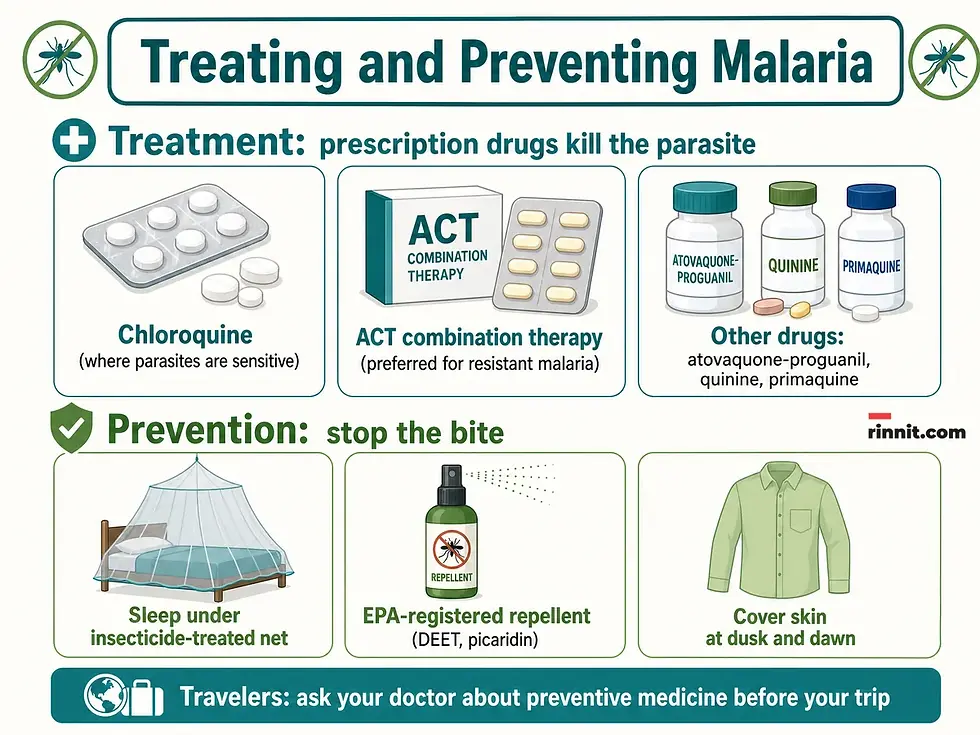
Malaria is treated with prescription drugs designed to kill the parasite [2]. The choice of drug and the length of treatment depend on which parasite type you have, how severe your symptoms are, your age, and whether you are pregnant [2] [4].
Common antimalarial medicines
Medicine | How it is used |
Chloroquine phosphate | Preferred for parasites sensitive to it; resistance in many regions limits its use [2] |
Artemisinin-based combination therapies (ACTs) | Preferred for chloroquine-resistant malaria; combines two or more drugs that attack the parasite in different ways [2] |
Atovaquone-proguanil | Another common treatment option [2] |
Quinine sulfate with doxycycline | Another common antimalarial option [2] |
Primaquine phosphate | Used for certain parasite types [4] |
ACTs — such as artemether-lumefantrine (Coartem) and artesunate-mefloquine — combine two or more drugs that work against the malaria parasite in different ways [2]. They are usually the preferred treatment when parasites resist chloroquine [2].
How can you prevent malaria?
If you live in or are traveling to an area where malaria is common, the single most important step is to avoid mosquito bites [1]. Mosquitoes that carry malaria are most active between dusk and dawn [1].
Prevention step | How to do it |
Cover your skin | Wear pants and long-sleeved shirts; tuck in your shirt and tuck pant legs into socks [1] |
Use EPA-registered repellent | Apply repellents containing DEET, picaridin, IR3535, oil of lemon eucalyptus (OLE), PMD, or 2-undecanone to exposed skin [1] |
Spray clothing with permethrin | Permethrin-containing sprays are safe to apply to clothing [1] |
Sleep under a bed net | Insecticide-treated nets (such as permethrin-treated) prevent bites while you sleep [1] |
A few safety notes: do not spray repellent directly on your face, and do not use products containing oil of lemon eucalyptus or PMD on children under age 3 [1].
Preventive medicine for travelers
If you will be traveling to a malaria-prone area, talk to your doctor a few months ahead of time about taking preventive drugs before, during, and after your trip [1] [5]. The drugs used to prevent malaria are generally the same ones used to treat it [1]. The right choice depends on where you are going, how long you will stay, and your own health [1].
The malaria vaccine
The World Health Organization has recommended a malaria vaccine for children living in countries with high numbers of malaria cases [1] [4], and researchers continue to develop and study vaccines to prevent infection [1].
How should you prepare for a doctor's appointment?
If you suspect malaria or possible exposure, you will likely start by seeing your family doctor. In some cases, you may be referred to an infectious disease specialist [2]. If your symptoms are severe — especially during or after travel in an area where malaria is common — seek emergency medical attention [2].
Before your appointment, write down answers to these questions:
Question | Why it helps |
What are your symptoms, and when did they start? [2] | Helps pinpoint the infection timeline |
Where have you traveled recently? [2] | Identifies exposure risk |
How long did you travel, and when did you return? [2] | Narrows down which parasites are possible |
Did you take any preventive drugs? [2] | Affects diagnosis and treatment choice |
What other medications do you take? [2] | Includes supplements and herbal remedies [2] |
Frequently Asked Questions
Can you get malaria more than once?
Yes. Having malaria once does not give you lasting protection: any partial immunity can fade without regular exposure to the parasite [1], and some parasite types can stay in your body for years and cause the disease to return (relapse) [1] long after the first illness.
How quickly does malaria show up after a mosquito bite?
Signs and symptoms typically begin within a few weeks of the infected bite [1]. However, some types of malaria parasites can lie dormant in the liver for up to a year before causing symptoms [1].
Can malaria be cured completely?
Yes, in most cases. Prescription antimalarial drugs — chosen based on the parasite type, symptom severity, age, and pregnancy status — are designed to kill the parasite [2]. Treatment works best when it starts promptly, before complications develop [4].
Is there a malaria vaccine?
The World Health Organization has recommended a malaria vaccine for children living in countries with high numbers of cases [1] [4], and researchers continue to develop and study vaccines to prevent infection [1].
What happens if malaria is left untreated?
Untreated malaria can become fatal, particularly when caused by the species common in Africa [1]. Serious complications include cerebral malaria (parasite-filled blood cells blocking vessels in the brain), fluid in the lungs, organ failure, severe anemia, and dangerously low blood sugar [1].
Can you catch malaria from someone who is sick?
Not directly. Malaria is not spread through casual contact like the flu [4]. It is transmitted through infected mosquito bites and, much less commonly, through exposure to infected blood such as from mother to child, blood transfusions, or shared needles [1] [4].
Conclusion and Next Steps
Malaria remains common in tropical and subtropical countries [1], but it is preventable and curable, and early treatment can stop mild cases from getting worse [4]. The key facts are simple: mosquito bites spread it, fever and chills are the hallmark symptoms, blood tests confirm it [2], and prescription drugs kill the parasite [2].
If you plan to travel to a malaria-prone region, protection starts before you leave — talk to your doctor about preventive medicine, pack EPA-registered repellent and permethrin-treated clothing, and sleep under a bed net [1].
Talk with a healthcare professional If you have a fever after spending time in a malaria-risk region — or severe symptoms while traveling — contact a healthcare provider or seek emergency care right away.
References
Mayo Clinic Staff. Malaria - Symptoms & causes. Mayo Clinic. February 9, 2023. https://www.mayoclinic.org/diseases-conditions/malaria/symptoms-causes/syc-20351184
Mayo Clinic Staff. Malaria - Diagnosis & treatment. Mayo Clinic. February 9, 2023. https://www.mayoclinic.org/diseases-conditions/malaria/diagnosis-treatment/drc-20351190
World Health Organization. World malaria report 2024. World Health Organization. December 11, 2024. https://www.who.int/teams/global-malaria-programme/reports/world-malaria-report-2024 (263 million cases, 597,000 deaths in 2023)
World Health Organization. Malaria [fact sheet]. World Health Organization. December 4, 2025. https://www.who.int/news-room/fact-sheets/detail/malaria
Centers for Disease Control and Prevention. Data and Statistics on Malaria in the United States. CDC. Updated May 27, 2025. https://www.cdc.gov/malaria/php/surveillance-report/index.html
RTS,S Clinical Trials Partnership. Efficacy and safety of RTS,S/AS01 malaria vaccine with or without a booster dose in infants and children in Africa: final results of a phase 3, individually randomised, controlled trial. Lancet. 2015;386(9988):31-45. PMID 25913272. https://doi.org/10.1016/S0140-6736(15)60721-8
Pryce J, et al. Insecticide-treated nets for preventing malaria. Cochrane Database Syst Rev. 2018;11(11):CD000363. PMID 30398672. https://doi.org/10.1002/14651858.CD000363.pub3
Dondorp AM, et al. Artesunate versus quinine in the treatment of severe falciparum malaria in African children (AQUAMAT): an open-label, randomised trial. Lancet. 2010;376(9753):1647-57. PMID 21062666. https://doi.org/10.1016/S0140-6736(10)61924-1
Medical disclaimer
This article is for informational purposes only and is not medical advice. Always consult a qualified healthcare professional for diagnosis and treatment decisions.



Comments