LDH (Lactate Dehydrogenase) Test: Normal Range and What High LDH Means

Updated: 2 days ago
Written and medically reviewed by Dr. Baraa Alnahhal, MD · Last reviewed: November 2026 · How we review
Quick Answer
An LDH (lactate dehydrogenase) test is a blood test that measures an enzyme found in almost every tissue. A high LDH is a general sign of tissue damage. It helps detect and monitor hemolytic anemia, liver disease, muscle injury and certain cancers. LDH can't tell which tissue is damaged, so other tests are needed.
What the research says
High LDH signals a worse cancer outlook: a meta-analysis of 76 studies with 22,882 people with solid tumors found that a high blood LDH was linked to a 70% higher risk of death, with the strongest effect in kidney cancer, melanoma, stomach, prostate, nasopharyngeal and lung cancers (Petrelli F et al., Acta Oncologica, 2015) [2]
Combining LDH with albumin adds information: a meta-analysis of 19 studies with 11,088 people with cancer found that a high LDH-to-albumin ratio before treatment was linked to worse overall survival, especially in digestive system cancers (Dwi Purwati D et al., Postgraduate Medicine, 2025) [3]
Key takeaways
LDH is an enzyme released when cells are damaged.
Typical normal: 135–225 U/L (males), 135–214 U/L (females); children run higher.
High LDH points to tissue damage but not its location.
Used to monitor hemolysis, liver and lung disease, infections and some cancers.
Exercise, some medicines and a damaged blood sample can falsely raise LDH.
What is LDH?
Lactate dehydrogenase helps cells turn sugar into energy. Because it's present in nearly every tissue, any condition that damages cells can raise blood LDH. Doctors use it as a broad marker, then use more specific tests, such as liver function tests, a creatine kinase test or a troponin test, to find where the damage is. Sources: [1]

The LDH blood test takes under five minutes.
Why is it done?
To check for tissue damage from an injury or illness.
To detect and monitor hemolytic anemia and other causes of hemolysis.
To monitor liver, kidney and lung disease and some infections.
To assess the severity and outlook of some cancers, including lymphoma, melanoma and testicular cancer, as one of several tumor markers.
To check whether cancer treatment is working. Sources: [1, 2]
How the test is done
No special preparation is needed. A provider draws blood from a vein in your arm; it takes less than five minutes. LDH can also be measured in other fluids, such as spinal fluid from a lumbar puncture, fluid around the lungs or fluid in the belly, to help tell infection, inflammation or cancer apart. Results usually take one to two days, or hours in a hospital. Sources: [1]
What do the results mean?
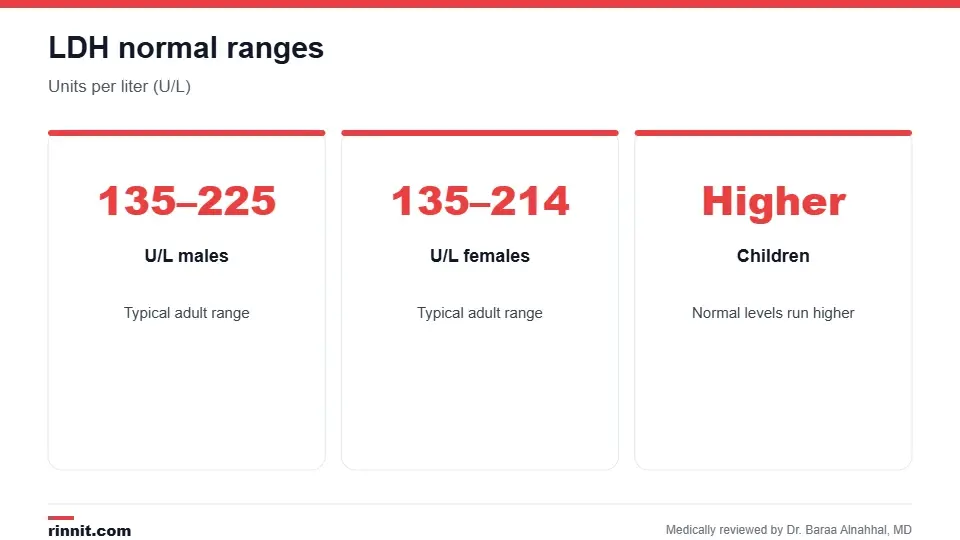
Reference ranges vary by lab.
Group | Typical LDH range |
Adult males | 135–225 U/L |
Adult females | 135–214 U/L |
Children | Normally higher than adults |
Sources: [1]
Causes of high LDH
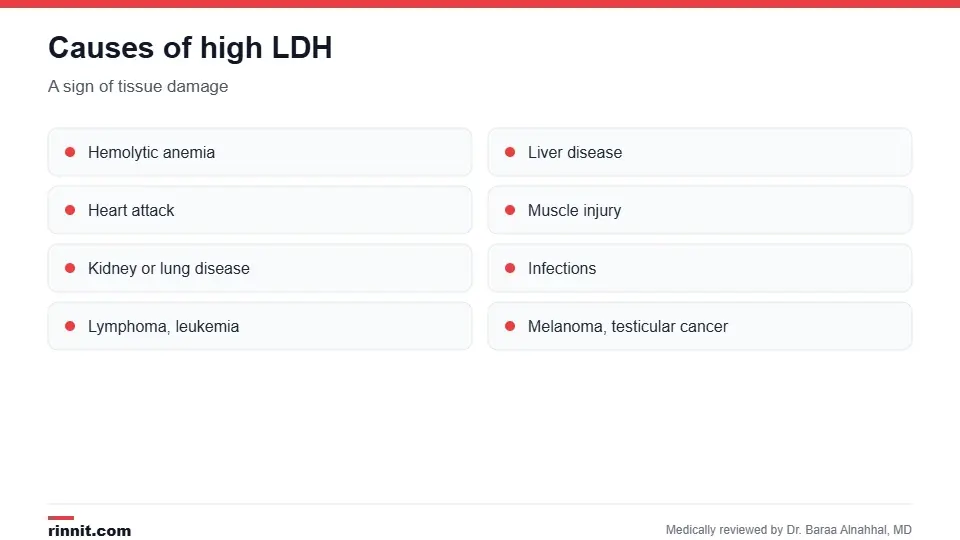
High LDH means tissue damage somewhere in the body.
Anemia, especially hemolytic anemia.
Liver, kidney or lung disease.
Heart attack, muscle injury, muscular dystrophy or a broken bone.
Pancreatitis.
Infections such as meningitis, encephalitis, mononucleosis and HIV.
Cancers such as lymphoma, leukemia, multiple myeloma, metastatic melanoma and testicular cancer. Sources: [1]
False highs can come from hard exercise, some medicines (such as aspirin, anesthetics and narcotics) or red blood cells breaking during the blood draw. Low LDH is uncommon and usually not a concern; it can come from rare inherited deficiencies or high vitamin C intake. Sources: [1]
Risks
Risks are very low: slight tenderness or bruising where the needle went in. Sources: [1]
Conclusion
The LDH test is a broad, inexpensive marker of tissue damage. A high result is a clue rather than a diagnosis, so your provider combines it with your symptoms and more specific tests. In some cancers, LDH also helps estimate outlook and track treatment.
Keep learning: read about hemolytic anemia and tumor markers.
Frequently asked questions
What does an LDH test measure?
An enzyme released into the blood when cells are damaged.
What is a normal LDH level?
About 135–225 U/L for males and 135–214 U/L for females.
What does high LDH mean?
Tissue damage somewhere in the body, from many possible causes.
Can LDH show where the damage is?
No. Other tests are needed to find the source.
Do I need to fast?
No special preparation is needed.
Can exercise raise LDH?
Yes. Hard exercise can raise it temporarily.
Is LDH a cancer test?
It's used to monitor some cancers but can't diagnose cancer alone.
What does low LDH mean?
It's uncommon and usually not a concern.
How long do results take?
Usually one to two days.
Why is LDH tested in spinal fluid?
To help tell bacterial from viral meningitis and detect other problems.
Related Reading
What is Hemolysis? A Guide to Red Blood Cell Breakdown red blood cell breakdown that raises LDH.
Hemolytic Anemia: Understanding Rapid Red Blood Cell Loss a common cause of high LDH.
Lymphoma: Symptoms, Types, Causes, Diagnosis and Treatment a cancer monitored with LDH.
Melanoma: A Comprehensive Guide to Early Detection and Treatment a cancer where LDH guides staging.
Tumor Markers: Common Types, How They're Used, Results and Limits other blood markers used in cancer care.
References
Cleveland Clinic. LDH (Lactate Dehydrogenase) Test: What It Is & Results. Cleveland Clinic. Last updated April 15, 2022. https://my.clevelandclinic.org/health/diagnostics/22736-lactate-dehydrogenase-ldh-test
Petrelli F, Cabiddu M, Coinu A, et al. Prognostic role of lactate dehydrogenase in solid tumors: a systematic review and meta-analysis of 76 studies. Acta Oncol. 2015;54(7):961-970. PMID 25984930. https://doi.org/10.3109/0284186X.2015.1043026
Dwi Purwati D, Utami MDT, Bagus Kurniawan R, et al. Deciphering the potential of the lactate dehydrogenase-to-albumin ratio as a prognostic biomarker in malignancy: a systematic review and meta-analysis. Postgrad Med. 2025;137(6):486-495. PMID 40689557. https://doi.org/10.1080/00325481.2025.2537619
Medical disclaimer
This article is for general education only and does not replace advice from a qualified healthcare professional. Talk to your doctor about your own diagnosis and treatment, and seek emergency care right away for severe or sudden symptoms.



Comments