Tumor Markers: Common Types, How They're Used, Results and Limits

Updated: 2 days ago
Written and medically reviewed by Dr. Baraa Alnahhal, MD · Last reviewed: November 2026 · How we review
Quick Answer
Tumor markers are substances, usually proteins, that cancer cells, or the body in response to cancer, make in larger amounts. Most are measured in a blood test. Common examples include PSA (prostate cancer), CA 125 (ovarian cancer) and CEA (colon cancer). A high level alone never proves cancer, and a normal level can't rule it out.
What the research says
A single marker has limited accuracy: a meta-analysis of 79 studies with 20,991 participants found that CA 19-9 detected pancreatic cancer with 72% sensitivity and 86% specificity, meaning it misses some cancers and is raised in some people without cancer (Zhao B et al., European Journal of Gastroenterology & Hepatology, 2022) [2]
Panels beat single markers: a review of 250 studies of blood markers for pancreatic cancer found that panels of several markers performed significantly better (AUC 0.898) than any single marker (AUC 0.803), and that CA 19-9 alone had limited value (Kane LE et al., Cancer Research Communications, 2022) [3]
Key takeaways
Tumor markers are substances linked to certain cancers, measured mostly in blood.
Used to help diagnose, choose treatment, estimate outlook and track response or recurrence.
Noncancer conditions, medicines and even stress can raise levels.
Many cancers have no reliable marker, so a normal result doesn't rule cancer out.
Trends over time are more useful than a single result.
What are tumor markers?
There are two main kinds. Circulating markers are found in blood, urine, stool or bone marrow; a blood test that looks for them is sometimes called a liquid biopsy. Tumor tissue markers are found in the tumor itself, usually from a biopsy, and include changes in tumor DNA that guide biomarker testing and targeted therapy. Sources: [1]
Common tumor markers

Common blood tumor markers.
Marker | Commonly linked cancers |
Liver cancer, testicular cancer, germ cell tumors | |
CA 19-9 | Pancreatic, colon, gallbladder, bile duct and stomach cancers |
Ovarian cancer | |
Colon and pancreatic cancers | |
hCG | Testicular and ovarian cancers |
LDH | Leukemia, lymphoma, melanoma, neuroblastoma, germ cell tumors |
Prostate cancer |
Sources: [1]
How are tumor markers used?

Tumor markers have five main jobs.
Diagnosis: alongside imaging and biopsy, never on their own.
Treatment planning: some targeted therapies only work when the tumor carries a specific marker or DNA change.
Prognosis: some markers suggest how a cancer may behave.
Monitoring: falling levels can mean treatment is working; rising levels can signal growth, spread or recurrence.
Screening: only in some high-risk groups, such as AFP for people with cirrhosis; a positive screen always needs more testing. Sources: [1]
How is the test done?
Most tumor marker tests use a routine blood draw. Others use urine, stool or saliva, or tissue from a biopsy. Blood, urine, stool and saliva results usually come back within a day or two; biopsy results can take a week or longer. Ask whether you need to fast or pause any medicines. Sources: [1]
Understanding your results
Each marker has its own normal range, and what counts as high can vary by person and by when the test is done. A high level may suggest cancer or that it has grown or spread, but noncancer conditions, medicines, procedures, stress and certain foods can also raise levels. A falling level during treatment is usually a good sign, though levels can fluctuate. Your provider looks at the trend and combines it with your symptoms, exam, imaging and pathology. Sources: [1, 2, 3]
Limits of tumor markers
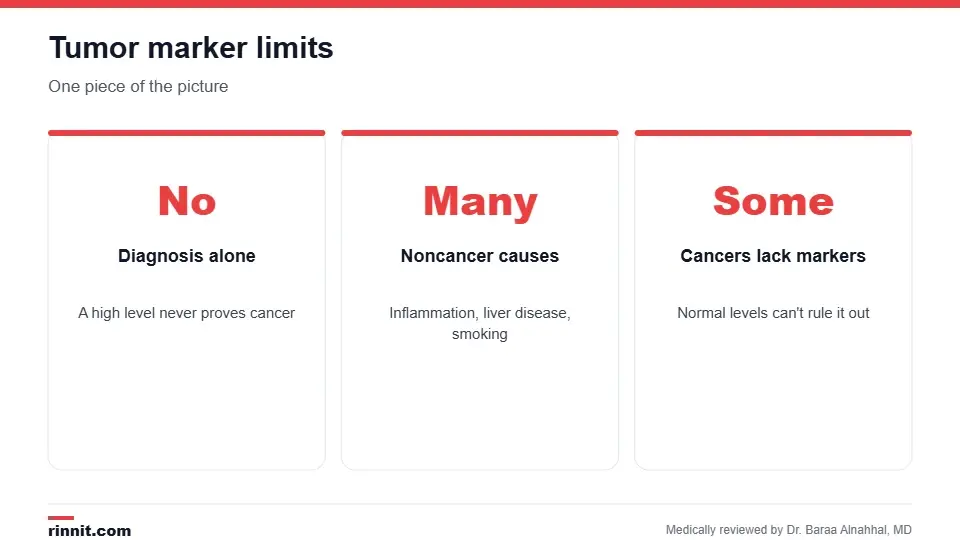
Tumor markers are one piece of the picture.
They can't diagnose cancer on their own.
Many cancers have no known marker.
Noncancer conditions can produce the same markers.
Most aren't recommended for screening people at average risk; see cancer screening for proven methods. Sources: [1, 2]
Conclusion
Tumor markers are useful tools for diagnosing, treating and tracking cancer, but they're only one piece of the puzzle. A single abnormal result shouldn't cause alarm on its own, and a normal result doesn't guarantee you're cancer-free. Talk with your provider about what your specific marker can and can't tell you.
Keep learning: read about blood tests for cancer and biomarker testing.
Frequently asked questions
What is a tumor marker?
A substance, often a protein, made in larger amounts by cancer cells or by the body in response to cancer.
Can a tumor marker test diagnose cancer?
No. It's used alongside imaging and biopsy.
What are the most common tumor markers?
PSA, CA 125, CEA, CA 19-9, AFP, hCG and LDH.
Can tumor markers be high without cancer?
Yes. Inflammation, liver disease, smoking and other conditions can raise them.
Can I have cancer with normal tumor markers?
Yes. Many cancers don't raise any marker.
How are tumor markers tested?
Usually with a blood draw; sometimes urine, stool or biopsy tissue.
How long do results take?
Usually a day or two for blood; a week or more for biopsy tissue.
Are tumor markers used for screening?
Only for some high-risk groups, not most people.
What does a falling tumor marker mean?
It often means treatment is working.
What is a tumor tissue marker?
A marker found in the tumor itself, such as a DNA change that guides targeted therapy.
Related Reading
Blood Tests for Cancer: Types, What They Can Show and What Results Mean other blood tests used in cancer care.
CEA Test (Carcinoembryonic Antigen): Normal Levels, High Results and Limits the tumor marker used for colorectal cancer.
CA-125 Blood Test: What It Measures, Normal Levels and What High Results Mean the tumor marker used for ovarian cancer.
PSA Test: Normal Levels by Age, How to Prepare and What High Results Mean the tumor marker used for prostate cancer.
Alpha-Fetoprotein (AFP) Test: Pregnancy Screening, Cancer Marker and What Results Mean the tumor marker used for liver and testicular cancer.
LDH (Lactate Dehydrogenase) Test: Normal Range and What High LDH Means explains the enzyme blood test that signals tissue damage.
CA 19-9 Blood Test: Uses, High Levels, Limits and Pancreatic Cancer explains the tumor marker test used for pancreatic and bile duct cancers.
Liquid Biopsy: Blood Testing for Tumor Cells and Tumor DNA explains the blood test that looks for tumor cells and tumor DNA.
References
Cleveland Clinic. Tumor Markers Tests. Cleveland Clinic. Last updated May 4, 2026. https://my.clevelandclinic.org/health/diagnostics/24813-tumor-markers
Zhao B, Zhao B, Chen F. Diagnostic value of serum carbohydrate antigen 19-9 in pancreatic cancer: a systematic review and meta-analysis. Eur J Gastroenterol Hepatol. 2022;34(9):891-904. PMID 35913776. https://doi.org/10.1097/MEG.0000000000002415
Kane LE, Mellotte GS, Mylod E, et al. Diagnostic accuracy of blood-based biomarkers for pancreatic cancer: a systematic review and meta-analysis. Cancer Res Commun. 2022;2(10):1229-1243. PMID 36969742. https://doi.org/10.1158/2767-9764.CRC-22-0190
Medical disclaimer
This article is for general education only and does not replace advice from a qualified healthcare professional. Talk to your doctor about your own diagnosis and treatment, and seek emergency care right away for severe or sudden symptoms.



Comments