CEA Test (Carcinoembryonic Antigen): Normal Levels, High Results and Limits

Updated: 2 days ago
Written and medically reviewed by Dr. Baraa Alnahhal, MD · Last reviewed: November 2026 · How we review
Quick Answer
The CEA test is a blood test that measures carcinoembryonic antigen, a protein that some cancers release into the blood. It's a tumor marker used mainly to monitor colorectal cancer: to see whether treatment is working and to watch for recurrence. It's not used to screen for or diagnose cancer. Normal levels are about 0–3 ng/mL in nonsmokers.
What the research says
CEA helps but can't stand alone: a Cochrane review of 52 studies found that at a threshold of 5 ng/mL, CEA detected colorectal cancer recurrence with 71% sensitivity and 88% specificity; at 10 ng/mL sensitivity fell to 68% and specificity rose to 97%, so CEA should be combined with imaging and other follow-up (Nicholson BD et al., Cochrane Database of Systematic Reviews, 2015) [2]
High CEA after surgery signals higher risk: a meta-analysis of 20 studies with 10,114 people with colorectal cancer found that an elevated CEA after surgery was linked to nearly three times the risk of death (HR 2.92) and of recurrence (HR 2.81) (Liu F et al., World Journal of Surgery, 2024) [3]
Key takeaways
CEA is a tumor marker used to monitor colorectal and some other cancers, not to screen or diagnose.
Normal: 0–3 ng/mL in nonsmokers, up to 5 ng/mL in smokers.
Smoking, inflammation, liver disease and other conditions can raise CEA.
Trends over time matter more than one result.
Tested about monthly during treatment and every 3–6 months after remission.
What is CEA?
CEA is a protein normally made in the digestive tract of a developing baby before birth. Adults make very little, but some cancers, especially colorectal cancer, produce large amounts. Like other blood tests for cancer, it gives clues but isn't a diagnosis on its own. Sources: [1]

The CEA test is usually a quick blood draw.
Why is it done?
To get a baseline level before cancer treatment starts.
To check whether treatment is working.
To watch for cancer returning after treatment.
To help find whether cancer has spread.
Most often for colorectal and rectal cancer; also for pancreatic, stomach, lung, breast, ovarian, thyroid (medullary) and other cancers. Sources: [1]
CEA isn't used as a screening test. Colorectal cancer screening relies on colonoscopy and stool tests instead. Sources: [1, 2]
How the test is done
A provider draws blood from a vein in your arm, which takes less than 5 minutes. Rarely, CEA is measured in fluid from the abdomen, chest or spinal canal, which can take up to 30 minutes. Your provider may ask you to stop aspirin or other medicines beforehand. Sources: [1]
What do the results mean?
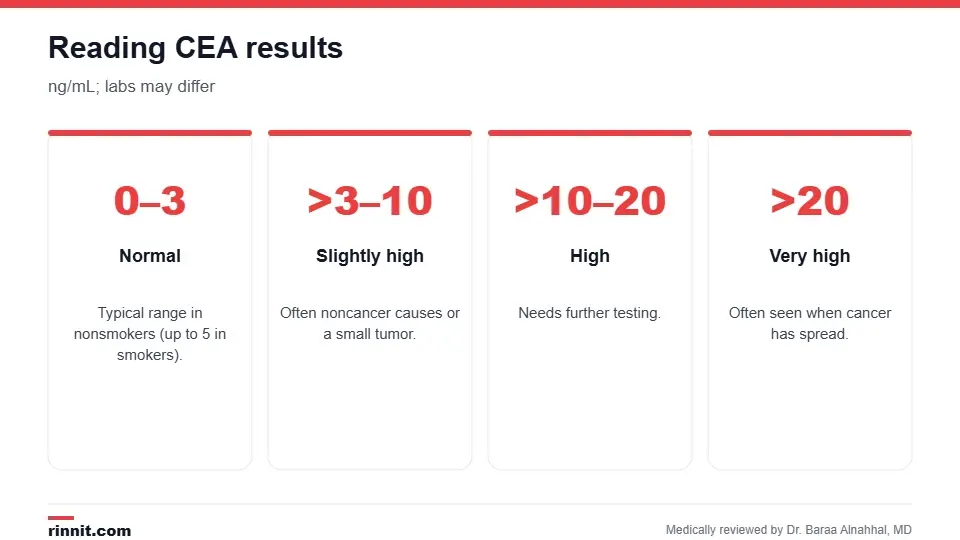
Rough guide to CEA levels.
CEA level (ng/mL) | What it may mean |
0–3 (up to 5 in smokers) | Normal |
Above 3 to under 10 | Slightly high; may be a small localized tumor or a noncancer cause |
10 to under 20 | High; could be cancer |
Above 20 | Often suggests cancer that has spread |
Sources: [1]
During and after treatment, a falling CEA usually means treatment is working, and a rising CEA can be an early sign of recurrence, prompting imaging. One mildly high result isn't cause for alarm on its own. Sources: [1, 2, 3]
Noncancer causes of high CEA
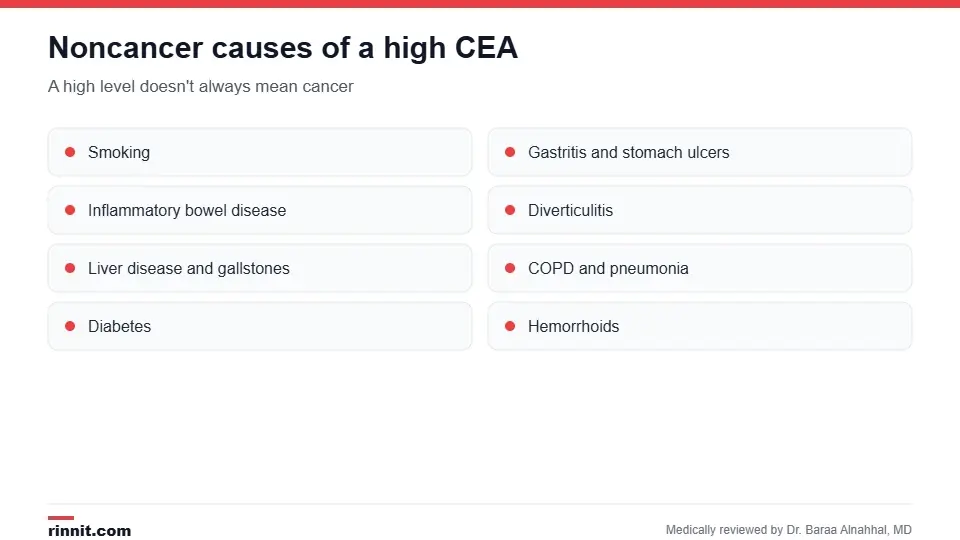
Many noncancer conditions raise CEA.
Smoking.
Gastritis and peptic ulcers.
COPD and pneumonia.
Cirrhosis, fatty liver disease and gallstones.
Diverticulitis and inflammatory bowel disease.
Hemorrhoids.
Diabetes and autoimmune disease. Sources: [1]
How often is CEA checked?
During treatment, CEA is often checked about once a month. After remission, it's usually checked every 3–6 months for several years, along with imaging and colonoscopy. Sources: [1]
Conclusion
CEA is a useful tool for tracking colorectal and some other cancers over time, but it can't diagnose cancer and can be raised by many other conditions. Focus on the trend, not one number, and talk with your oncologist about what your results mean.
Keep learning: read about colon cancer and colorectal cancer screening.
Frequently asked questions
What does CEA stand for?
Carcinoembryonic antigen.
What is a normal CEA level?
0–3 ng/mL in nonsmokers and up to 5 ng/mL in smokers.
Can a CEA test diagnose cancer?
No. It's used to monitor known cancer, not to diagnose or screen.
What does a high CEA mean?
It can mean cancer, but also smoking or noncancer conditions.
Does smoking raise CEA?
Yes. Smokers often have slightly higher levels.
Can CEA be normal with cancer?
Yes. Not all cancers raise CEA.
How often is CEA tested?
About monthly during treatment and every 3–6 months after remission.
What CEA level means cancer has spread?
Levels above 20 ng/mL often suggest spread, but imaging is needed to confirm.
Do I need to prepare?
Usually not, but you may need to pause aspirin.
What happens if my CEA rises after treatment?
Your provider will usually order imaging to check for recurrence.
Related Reading
Colon Cancer: Symptoms, Screening, Diagnosis, Treatment and Support the cancer CEA is most often used to monitor.
Colorectal Cancer Screening: When to Start, Test Options and What Results Mean the tests used to screen for colorectal cancer.
Blood Tests for Cancer: Types, What They Can Show and What Results Mean other blood tests used in cancer care.
Pancreatic Cancer: Symptoms, Causes, and Treatment — A Clear Guide for Patients and Families another cancer that can raise CEA.
What Is Rectal Cancer? A Plain-Language Guide to the Signs, Causes, and Treatment cancer of the rectum monitored with CEA.
Tumor Markers: Common Types, How They're Used, Results and Limits explains the main tumor marker tests and what their results can and can't show.
CA 19-9 Blood Test: Uses, High Levels, Limits and Pancreatic Cancer explains the tumor marker test used for pancreatic and bile duct cancers.
References
Cleveland Clinic. CEA Test (Carcinoembryonic Antigen): What It Is & Results. Cleveland Clinic. Last updated June 5, 2025. https://my.clevelandclinic.org/health/diagnostics/22744-cea-test-carcinoembryonic-antigen
Nicholson BD, Shinkins B, Pathiraja I, et al. Blood CEA levels for detecting recurrent colorectal cancer. Cochrane Database Syst Rev. 2015;(12):CD011134. PMID 26661580. https://doi.org/10.1002/14651858.CD011134.pub2
Liu F, Jiang S, Cui J, et al. Prognostic value of the postoperative carcinoembryonic antigen level in colorectal cancer: a meta-analysis. World J Surg. 2024;48(10):2359-2375. PMID 39304973. https://doi.org/10.1002/wjs.12349
Medical disclaimer
This article is for general education only and does not replace advice from a qualified healthcare professional. Talk to your doctor about your own diagnosis and treatment, and seek emergency care right away for severe or sudden symptoms.



Comments