Colorectal Cancer Screening: When to Start, Test Options and What Results Mean

Updated: 2 days ago
Written and medically reviewed by Dr. Baraa Alnahhal, MD · Last reviewed: November 2026 · How we review
Quick Answer: What is colorectal cancer screening?
Colorectal cancer screening checks the colon and rectum for precancerous polyps and early cancer before you have symptoms. Most people should start at age 45 and continue until age 75. Options include a colonoscopy every 10 years, at-home stool tests every 1 to 3 years and CT colonography every 5 years. Colonoscopy is the most accurate test. [1]
What the research says
A screening colonoscopy lowers the risk of getting colorectal cancer. In a trial of 84,585 people aged 55 to 64 followed for about 10 years, being invited to one screening colonoscopy cut the risk of colorectal cancer from 1.20% to 0.98%, an 18% reduction. Only 42% of the people invited actually had the test. (Bretthauer et al., The New England Journal of Medicine, 2022) [2]
At-home FIT stool tests catch most cancers. A meta-analysis of 31 studies with 120,255 average-risk adults found a single FIT detected 91% of colorectal cancers at a low cutoff, but only about 40% of advanced precancerous polyps. (Imperiale et al., Annals of Internal Medicine, 2019) [3]
Even partial-colon screening saves lives. In a trial of 98,792 people aged 50 to 64, one flexible sigmoidoscopy reduced colorectal cancer deaths by 27% and new cases by 20% over about 11 years. (Holme et al., JAMA, 2014) [4]
Key takeaways
Screening looks for precancerous polyps and early colorectal cancer before symptoms start. [1]
Most people start at 45 and continue until 75; ask about starting earlier if you have higher risk. [1]
Colonoscopy is the most common and most accurate test and is usually repeated every 10 years if normal. [1]
Stool tests are done at home and repeated every 1 to 3 years; an abnormal result means you need a colonoscopy. [1]
Risks from scope tests are extremely small compared with the benefit of finding cancer early. [1]
What is colorectal cancer screening?
Colorectal cancer screening checks your colon (large intestine) and rectum for early-stage cancer and polyps. Polyps are abnormal growths that can turn into cancer if they aren't removed. [1]
Colorectal cancer is the second leading cause of cancer-related death in the U.S. when men and women are counted together. Screening allows early diagnosis and treatment, which can often cure colon cancer or prevent it altogether. [1]
Who should get screened, and when?
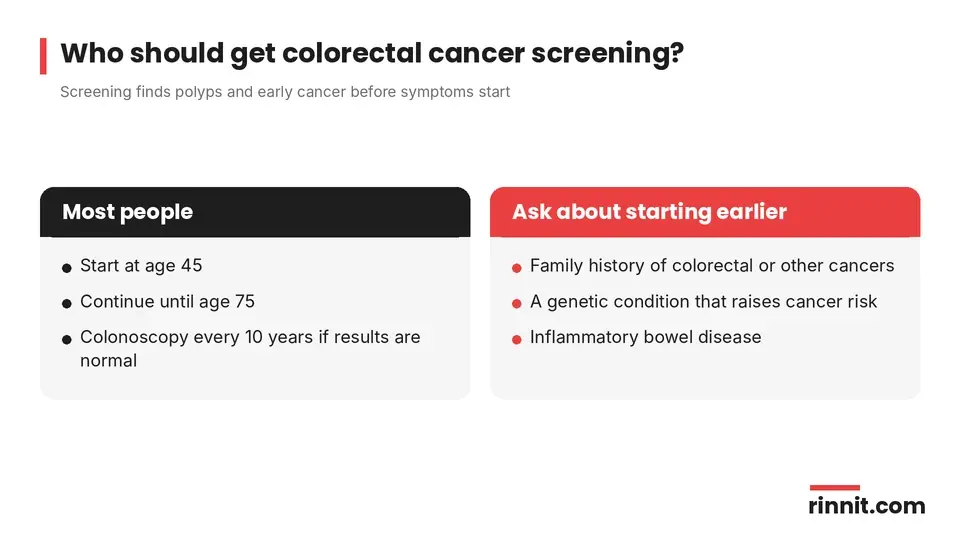
For most people, screening starts at age 45 and continues until age 75. [1]
Ask your provider whether you should start earlier if you have: [1]
A family history of colorectal cancer or other cancers
A genetic condition that raises your risk of cancer
Inflammatory bowel disease, such as Crohn's disease or ulcerative colitis
Which test you have depends on the option you choose with your provider or a gastroenterologist. [1]
What are the colorectal cancer screening tests?

Test | How it works | How often if normal |
Colonoscopy | A flexible scope with a camera checks the whole colon; polyps can be removed during the test | Every 10 years |
Stool tests (FIT, gFOBT, stool DNA with FIT) | You collect a sample at home, and a lab checks it for blood (and DNA changes for the stool DNA test) | Every 1 to 3 years, depending on the test |
CT colonography | A CT scan builds 3D images of the colon without a scope inside | Every 5 years |
Flexible sigmoidoscopy | A scope checks only the rectum and left side of the colon | Every 5 years, or every 10 years with a stool test |
Sources: [1]
Colonoscopy
Colonoscopy is the most common screening test in the U.S. and the most accurate method available. You're given sedation, or rarely put fully to sleep, and a flexible scope with a camera looks for polyps and cancer. Tools passed through the scope can take samples (biopsies) or remove abnormal growths during the same test. If your results are normal, you'll usually repeat it every 10 years, though your provider may suggest a shorter interval. [1]
Stool tests
Stool tests are done at home: you collect a sample and send it to a lab that checks for blood. Many kits can be mailed. They're less reliable than colonoscopy, but many people choose them for convenience. If results are normal, you'll repeat the test every 1 to 3 years, depending on the type. [1]
FIT (fecal immunochemical test): One stool sample, sent to the lab within 24 hours.
gFOBT (guaiac-based fecal occult blood test): Samples from 3 bowel movements in a row, placed on chemically treated cards that change color if blood is present.
Stool DNA test with FIT: A full stool sample, returned within 24 hours, that's checked for blood and for genetic changes linked to colon cancer.
CT colonography
CT colonography, once called "virtual colonoscopy," uses CT scans to build detailed 3D images of your colon. No scope goes inside. If results are normal, you'll repeat it every 5 years. [1]
Flexible sigmoidoscopy
This test is rarely used in the U.S. today. A scope looks only at your rectum and the left side of your colon. If results are normal, you'll repeat it every 5 years, or every 10 years if it's combined with a stool test. [1]
How do you prepare for colorectal cancer screening?
Follow your provider's instructions closely so your results are accurate. [1]
Scope and imaging tests: You'll need diet and medication changes and a bowel prep to clean out your colon.
Colonoscopy: Diet changes usually start 3 days before, and you drink a bowel-cleansing solution the afternoon or evening before your test.
Stool tests: Little or no preparation is needed, though some tests ask you to avoid certain foods or medicines for a few days.
What are the risks?
The risks of screening are extremely small compared with the benefit of finding cancer early. Tests that use a scope can rarely cause a tear (perforation) in the colon wall or bleeding. Your care team watches you after the procedure before you go home. [1]
What do the results mean?

Results are either normal (no cancer or precancerous polyps found) or abnormal. [1]
Result | What happens next |
Normal | Repeat screening at the interval for your test |
Abnormal stool test | A full colonoscopy, usually within 60 days |
Polyps or abnormal tissue on colonoscopy | Tissue goes to a lab; final results usually take about 1 week; you may need more frequent colonoscopies |
Cancer found | Referral to a surgeon and more tests |
Incomplete colonoscopy | Repeat with better bowel prep or choose a different test |
Sources: [1]
A colonoscopy may not be finished if your bowel prep wasn't thorough enough or if there are safety concerns. Results of scope and imaging tests are often discussed right away, while full results that include a biopsy can take a few days to more than a week. Stool test kits explain how and when you'll get results. [1]
Questions to ask your provider
When should I start screening, given my family history?
Which test is best for me?
How do I prepare, and which foods or medicines should I avoid?
What happens if my stool test is abnormal?
How often should I be screened after my results?
Conclusion
Colorectal cancer screening finds polyps and early cancer before symptoms appear, when treatment works best. Most people should start at 45 and continue until 75, and people with a family history, a genetic condition or inflammatory bowel disease should ask about starting sooner.
Colonoscopy is the most accurate option and is usually needed only every 10 years, while stool tests offer an at-home choice repeated every 1 to 3 years. Talk with your provider about which test fits you.
Keep learning: Read our guides to colonoscopy, flexible sigmoidoscopy, colon cancer and colon polyps. For more on screening, see the CDC's colorectal cancer screening page.
FAQ
At what age should I start colorectal cancer screening?
Most people should start at age 45 and continue until age 75. [1]
Should I start screening earlier?
Ask your provider about earlier screening if you have a family history of cancer, a genetic condition that raises cancer risk or inflammatory bowel disease. [1]
What is the best test for colon cancer screening?
Colonoscopy is the most common and most accurate screening test. [1]
How often do I need a colonoscopy?
If your results are normal, most people need a colonoscopy every 10 years. [1]
How often do I need a stool test?
If results are normal, stool tests are repeated every 1 to 3 years, depending on the test. [1]
What happens if my stool test is positive?
An abnormal stool test means you need a full colonoscopy, usually within 60 days. [1]
What is CT colonography?
CT colonography, once called virtual colonoscopy, uses CT scans to make 3D images of the colon and is repeated every 5 years if normal. [1]
How do I prepare for a screening colonoscopy?
Diet changes usually start 3 days before, and you drink a bowel-cleansing solution the afternoon or evening before the test. [1]
What are the risks of colorectal cancer screening?
Risks are extremely small; scope tests can rarely cause a tear in the colon wall or bleeding. [1]
How long do colonoscopy biopsy results take?
Final lab results for removed tissue usually take about 1 week. [1]
Related Reading
Gastrointestinal (GI) Tests: Types, Preparation and What to Expect explains the main types of tests used to check the digestive tract.
Learn more in our guide to Colon Cancer: Symptoms, Screening, Diagnosis, Treatment and Support.
Learn more in our guide to What Is Rectal Cancer? A Plain-Language Guide to the Signs, Causes, and Treatment.
Learn more in our guide to Colon Polyps: Complete Guide to Symptoms, Causes, and Treatment.
Learn more in our guide to Lynch Syndrome: Symptoms, Causes, Inheritance, Diagnosis, and Screening.
Learn more in our guide to Familial Adenomatous Polyposis (FAP): The Inherited Colon Condition That Causes Hundreds of Polyps — Screening, Surgery, and Lifelong Care.
Learn more in our guide to Crohn's Disease: Symptoms, Causes, Flares vs. Remission and Treatment — What You Need to Know.
Learn more in our guide to Ulcerative Colitis: Symptoms, Causes, Diagnosis, and Treatment Explained.
Cancer Screening: Which Tests Are Recommended, When to Start and the Risks gives an overview of recommended cancer screening tests, starting ages and the benefits and risks.
CEA Test (Carcinoembryonic Antigen): Normal Levels, High Results and Limits explains the tumor marker blood test used to monitor this cancer.
Digital Rectal Exam (DRE): Why It's Done, Positions and What to Expect explains the gloved finger exam of the rectum, anus and prostate.
References
Cleveland Clinic. Colorectal Cancer Screening: Purpose, Types & Results. Cleveland Clinic. Last updated June 24, 2025. https://my.clevelandclinic.org/health/diagnostics/colorectal-cancer-screening
Bretthauer M, Løberg M, Wieszczy P, et al. Effect of Colonoscopy Screening on Risks of Colorectal Cancer and Related Death. N Engl J Med. 2022;387(17):1547-1556. PMID 36214590. https://doi.org/10.1056/NEJMoa2208375
Imperiale TF, Gruber RN, Stump TE, et al. Performance Characteristics of Fecal Immunochemical Tests for Colorectal Cancer and Advanced Adenomatous Polyps: A Systematic Review and Meta-analysis. Ann Intern Med. 2019;170(5):319-329. PMID 30802902. https://doi.org/10.7326/M18-2390
Holme Ø, Løberg M, Kalager M, et al. Effect of flexible sigmoidoscopy screening on colorectal cancer incidence and mortality: a randomized clinical trial. JAMA. 2014;312(6):606-615. PMID 25117129. https://doi.org/10.1001/jama.2014.8266
Medical disclaimer
This article is for general education only and does not replace advice from a qualified healthcare professional. Talk to your doctor about your own diagnosis and treatment, and seek emergency care right away for severe or sudden symptoms.



Comments