Digital Rectal Exam (DRE): Why It's Done, Positions and What to Expect

Updated: 2 days ago
Written and medically reviewed by Dr. Baraa Alnahhal, MD · Last reviewed: November 2026 · How we review
Quick Answer
A digital rectal exam (DRE) is a quick physical exam in which a provider gently inserts a gloved, lubricated finger into the rectum to feel for problems in the lower rectum, anus and prostate gland. It can help find hemorrhoids, anal fissures, lumps and prostate enlargement. It takes a few minutes and may feel uncomfortable but shouldn't hurt.
What the research says
DRE alone is a weak prostate cancer screen: a meta-analysis of 7 studies with 9,241 people in primary care found DRE detected prostate cancer with 51% sensitivity and 59% specificity, and the authors recommended against routine DRE for screening (Naji L et al., Annals of Family Medicine, 2018) [2]
DRE can still catch cancers PSA misses: in 114 men with a low PSA (under 4 ng/mL) who had a biopsy, skipping the DRE would have missed 16.8% of the cancers found, including 8.8% that were clinically significant (Franz T et al., Cureus, 2025) [3]
Key takeaways
A gloved finger exam of the lower rectum, anus and, in men, the prostate.
Helps find hemorrhoids, fissures, rectal and prostate lumps, prostate enlargement and bowel control problems.
Takes a few minutes; no preparation; results usually right away.
May cause brief discomfort or an urge to urinate or have a bowel movement.
Not recommended alone for routine prostate cancer screening; a PSA test may be offered instead.
What is a digital rectal exam?
"Digital" refers to the finger. Your provider feels the walls of the lower rectum and the anal canal for lumps, tenderness or bleeding, and checks the tone of the anal sphincter muscle. In men, the prostate lies just in front of the rectum, so its size, shape and texture can be felt. A dedicated prostate exam uses the same technique. Sources: [1]

A DRE takes only a few minutes.
Why is it done?

Common reasons for a digital rectal exam.
Rectal bleeding or blood in stool.
Changes in bowel habits or bowel incontinence.
Hemorrhoids or anal fissures.
Signs of rectal cancer or anal cancer.
Rectal prolapse or injury to the area.
Urinary symptoms or discharge, to check for an enlarged prostate (BPH), prostate infection or prostate cancer.
Nerve problems that affect bowel control.
As part of a pelvic exam for women, or a routine physical. Sources: [1]
DRE and prostate cancer screening
The US Preventive Services Task Force doesn't recommend DRE for prostate cancer screening, because it misses many cancers and finds problems that turn out not to be cancer. A PSA test may be offered instead, after you discuss benefits and risks. Some urologists still use DRE alongside PSA, as it can find cancers when PSA is low. Sources: [1, 2, 3]
How do I prepare?
No preparation is needed. Tell your provider if you have hemorrhoids or fissures, which can make the exam more sensitive. You can ask for a chaperone. Sources: [1]
What happens during the exam?
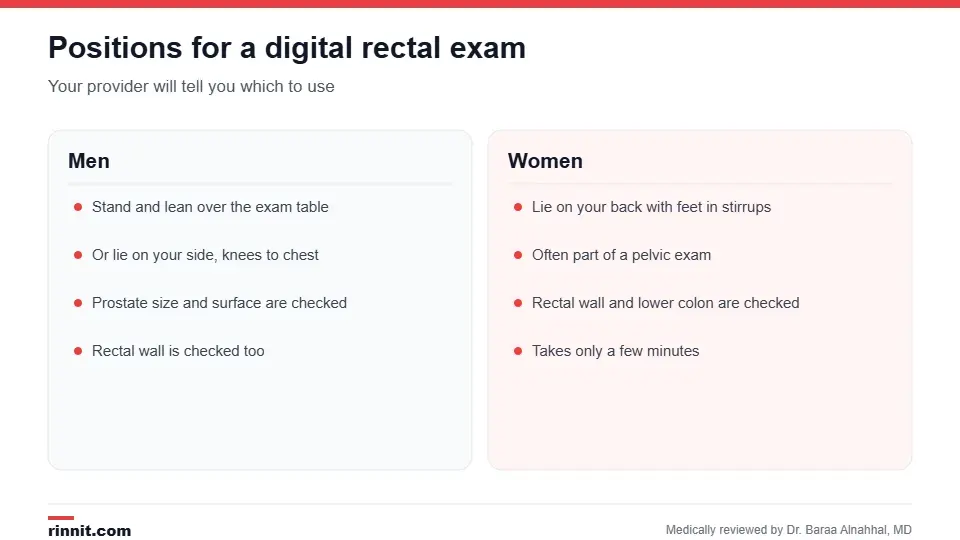
Positions differ for men and women.
Men: usually stand and lean forward over the exam table, or lie on your side with knees drawn toward your chest.
Women: usually lie on your back with feet in stirrups, as for a pelvic exam. Sources: [1]
You undress from the waist down and get into position.
The provider puts on a glove and applies lubricant.
They gently insert one finger into the rectum and feel the walls, and in men, the prostate.
The exam usually lasts less than a minute or two. Sources: [1]
Breathing slowly and relaxing your muscles helps. You may feel pressure or an urge to urinate or have a bowel movement. Sources: [1]
Risks
DRE is safe. Light bleeding is rare and more likely if you have hemorrhoids or a fissure. Tell your provider if you have pain or bleeding that doesn't stop. Sources: [1]
Understanding your results
Your provider can usually tell you right away whether they felt anything unusual. If they find a lump, tenderness, blood or an enlarged prostate, they may recommend tests such as PSA, stool tests, colonoscopy, imaging or a biopsy. A normal DRE doesn't rule out all problems higher in the colon or in the prostate. Sources: [1]
Conclusion
A digital rectal exam is a quick, simple way to check the rectum, anus and prostate. It isn't recommended alone for prostate cancer screening, but it remains useful for evaluating symptoms such as bleeding, bowel changes and urinary problems.
Keep learning: read about the prostate exam and the PSA test.
Frequently asked questions
What is a digital rectal exam?
An exam in which a provider uses a gloved finger to check the rectum, anus and prostate.
Does a DRE hurt?
It may feel uncomfortable, but it shouldn't hurt.
How long does a DRE take?
A few minutes, with the exam itself lasting less than a minute or two.
Do I need to prepare?
No preparation is needed.
Why do women have a DRE?
It may be part of a pelvic exam, or to check the rectum and anus.
Is DRE used to screen for prostate cancer?
It's not recommended alone; a PSA test may be offered instead.
What can a DRE find?
Hemorrhoids, fissures, lumps, prostate enlargement and other problems.
Will I bleed afterward?
Light bleeding is rare and more likely with hemorrhoids or fissures.
When will I get results?
Usually right away.
Can I ask for a chaperone?
Yes. You can ask for one at any time.
Related Reading
Prostate Exam: What It Is, Why It's Done, What to Expect and Results a focused look at the prostate part of the exam.
PSA Test: Normal Levels by Age, How to Prepare and What High Results Mean the blood test often used alongside or instead of DRE.
Benign Prostatic Hyperplasia (BPH): Symptoms, Causes, and Treatment prostate enlargement felt on DRE.
What Is Rectal Cancer? A Plain-Language Guide to the Signs, Causes, and Treatment a cancer a DRE can help find.
Colorectal Cancer Screening: When to Start, Test Options and What Results Mean screening tests for colon and rectal cancer.
References
Cleveland Clinic. Digital Rectal Exam (DRE): What To Expect. Cleveland Clinic. Last updated May 7, 2024. https://my.clevelandclinic.org/health/diagnostics/24212-digital-rectal-exam
Naji L, Randhawa H, Sohani Z, et al. Digital rectal examination for prostate cancer screening in primary care: a systematic review and meta-analysis. Ann Fam Med. 2018;16(2):149-154. PMID 29531107. https://doi.org/10.1370/afm.2205
Franz T, Stolzenburg JU. Clinical relevance of digital rectal examination in men with low and very low prostate-specific antigen (PSA): reassessing its diagnostic value in the MRI era and in light of modern guidelines. Cureus. 2025;17(12):e99145. PMID 41531560. https://doi.org/10.7759/cureus.99145
Medical disclaimer
This article is for general education only and does not replace advice from a qualified healthcare professional. Talk to your doctor about your own diagnosis and treatment, and seek emergency care right away for severe or sudden symptoms.



Comments