Prostate Exam: What It Is, Why It's Done, What to Expect and Results

Updated: 2 days ago
Written and medically reviewed by Dr. Baraa Alnahhal, MD · Last reviewed: November 2026 · How we review
Quick Answer: What is a prostate exam?
A prostate exam is a screening check for early signs of prostate cancer, usually made up of a PSA blood test and a digital rectal exam (DRE). It's typically offered starting by age 50, or earlier if you have a higher risk. An abnormal result does not mean you have cancer, but you need more tests. [1]
What the research says
A finger exam alone misses many prostate cancers in primary care. A review of 7 studies with 9,241 men who had both a DRE and a biopsy found that DRE by primary care clinicians caught about 51% of cancers (sensitivity 0.51) with a specificity of 0.59, and the quality of evidence was very low. (Naji et al., Annals of Family Medicine, 2018) [2]
PSA screening lowered prostate cancer deaths over the long term. In a European trial of 162,236 men aged 55 to 69 followed for a median of 23 years, prostate cancer deaths were 13% lower in the group offered repeated PSA testing, with one death prevented for every 456 men invited to screening. (Roobol et al., The New England Journal of Medicine, 2025) [3]
Screening finds more cancers, and the benefit is modest. A review of six trials with 789,086 men found PSA screening likely means about 2 fewer prostate cancer deaths per 1,000 men, while also raising the number of prostate cancer diagnoses (rate ratio 1.30). (Franco et al., Cochrane Database of Systematic Reviews, 2026) [4]
Key takeaways
A prostate exam usually combines a PSA blood test with a digital rectal exam to look for early signs of prostate cancer. [1]
Most people with a prostate start these checks by age 50, and those at higher risk may start at 45 or younger. [1]
The rectal part of the exam takes only a few seconds and is usually uncomfortable rather than painful. [1]
The exam cannot diagnose prostate cancer on its own, so abnormal results lead to more testing. [1]
PSA levels can rise for reasons other than cancer, such as recent ejaculation, infection or an enlarged prostate. [1]
Prostate cancer often causes no symptoms until it is advanced, which is why screening matters. [1]
What is a prostate exam?
A prostate exam is a screening method that looks for early warning signs of prostate cancer before symptoms appear. Primary care providers often suggest it as part of a yearly physical. [1]
The prostate is a small gland that sits just in front of the rectum. Because of this position, your provider can feel its back surface through the rectal wall. [1]
The two parts of a prostate exam

Most providers use both tests together for a fuller picture.
The PSA test is the more accurate of the two for finding prostate cancer. Still, a DRE can sometimes find cancer when the PSA level is normal, which is why many providers recommend both. [1]
What a prostate exam cannot do
A prostate exam is a screening step, not a diagnosis. If something looks or feels unusual, you will need more testing to learn what is going on. [1]
Who needs a prostate exam and when?
The usual advice is to have your first prostate exam by age 50. Because screening has both benefits and possible harms, such as false alarms and treating slow-growing cancers, guidelines advise deciding together with your provider, and routine PSA screening is generally not advised after age 70. Some people benefit from starting earlier because their risk is higher. [1]
You may want to begin at 45 or younger if:
Group | When to start | How often |
Average risk | By age 50 | Every 2 to 4 years |
Family history of prostate cancer | Age 45 or younger | Every 2 to 4 years |
Black men | Age 45 or younger | Every 2 to 4 years |
Sources: [1]
Your provider can help you decide the right starting age and schedule based on your health and history. [1]
How to prepare for a prostate exam
You need very little preparation for a prostate exam. A few simple steps can make the visit go more smoothly. [1]
Let your provider know if you have hemorrhoids, anal fissures or tears, or a narrowed anus (anal stenosis), since these can make the DRE more uncomfortable. [1]
You may be asked to avoid all sexual activity, including masturbation, for 48 hours before the PSA test, because ejaculation can briefly raise PSA levels. [1]
You do not need to have a bowel movement first, but if you feel the urge before the exam, it is fine to go. [1]
Feeling nervous before your first exam is very common. Providers do these exams often and work to keep you comfortable. [1]
What happens during a prostate exam?
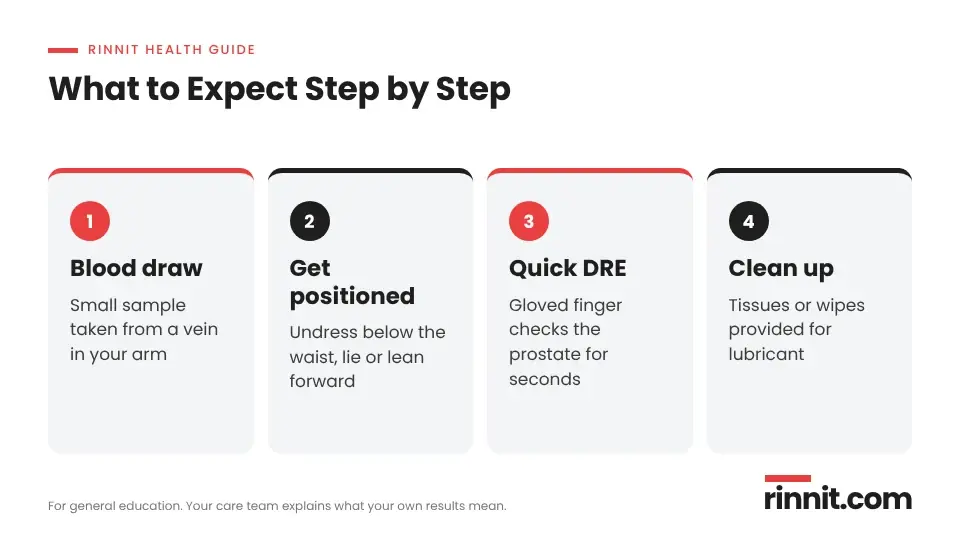
The whole exam is quick, and the rectal part lasts only seconds.
PSA blood test
A provider usually draws blood from a vein in your arm. The sample goes to a lab, where it is checked for a high PSA level. [1]
Most people feel only a quick pinch when the needle goes in. [1]
Digital rectal exam
You will undress from the waist down. Then you will either lie on your side or stand and lean forward slightly. [1]
Your provider gently inserts a gloved, lubricated finger into your rectum and feels the back of the prostate for lumps or bumps. This area matters because many prostate cancers begin there. [1]
The DRE is usually not painful, though it may feel uncomfortable. It takes just a few seconds. [1]
After the exam
You will get a bandage over the spot where blood was drawn. You may be told to skip heavy lifting or hard exercise for the rest of the day. [1]
After the DRE, you will be given tissues or wipes to clean off the lubricant. You can go back to your normal activities right away. [1]
Risks of a prostate exam
A prostate exam is generally safe, and serious problems are uncommon. Possible side effects include: [1]
Part of the exam | Possible side effect | What to know |
PSA blood draw | Bruising | Can appear where the needle went in |
PSA blood draw | Dizziness or fainting | Can happen after blood is drawn |
PSA blood draw | Infection | Rare |
Digital rectal exam | Light rectal bleeding | More likely if you have fissures or hemorrhoids |
Digital rectal exam | Mild rectal soreness | Usually goes away quickly |
Sources: [1]
Prostate exam results and what they mean
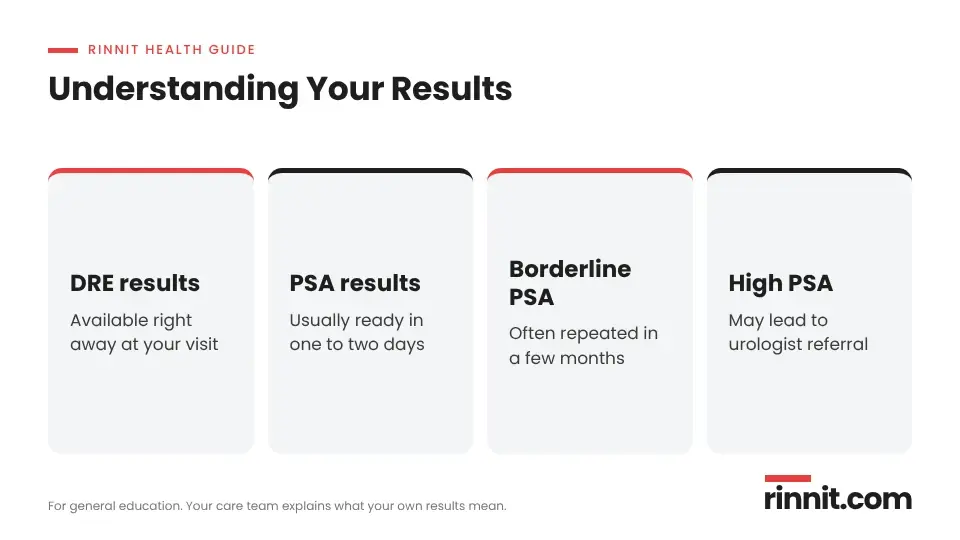
An abnormal result is a reason for more testing, not a diagnosis.
Digital rectal exam findings
You can learn your DRE results right away. Findings that may be abnormal include: [1]
PSA test results
PSA results take at least one to two days to come back. [1]
A higher PSA level does not always point to cancer. It can also go up because of ejaculation, some medicines, an infection or an enlarged prostate. [1]
What happens next
If your PSA level is borderline, your provider may repeat the test in a few months. [1]
If your PSA level stays high, you may be referred to a urologist for more evaluation. This can include imaging, such as MRI or ultrasound, or a biopsy. [1]
When to contact your healthcare provider
Make an appointment for a prostate exam if you are 50 or older and have not had one. If you are at higher risk, plan your first exam by age 45 or earlier. [1]
Also see your provider if you notice urinary symptoms such as: [1]
These symptoms are often caused by an enlarged prostate or a urinary tract infection. Prostate cancer itself usually causes no symptoms until it is advanced. [1]
Prostate exam vs. colonoscopy
People sometimes confuse these two tests, but they are quite different. [1]
Feature | Prostate exam | Colonoscopy |
What it checks | The prostate | The colon |
Where it happens | A provider's office | A hospital, as an outpatient procedure |
Uses a camera | No | Yes |
Sources: [1]
Providers do not usually check the prostate during a colonoscopy, so one test does not replace the other. [1]
Conclusion
A prostate exam is a quick, low-risk way to look for early signs of prostate cancer. It usually pairs a PSA blood test with a brief digital rectal exam, and most people start by age 50, or earlier if their risk is higher. [1]
Early detection gives you the best chance of successful treatment. If a result is unusual, follow-up tests help your care team find the cause and plan the next steps with you. [1]
Keep learning: Read our complete guide to the prostate, its function and health checks or our guide to benign prostatic hyperplasia (BPH). For more background, see the MedlinePlus Prostate Cancer Screening page.
FAQ
What is a prostate exam?
It is a screening check for early signs of prostate cancer. It usually includes a PSA blood test and a digital rectal exam of the prostate.
At what age should I get my first prostate exam?
Most people start by age 50. If you are Black or have a father or brother with prostate cancer, consider starting at 45 or younger.
How often do I need a prostate exam?
Many people repeat the exam every two to four years. Your provider can suggest a schedule based on your risk and past results.
Does a prostate exam hurt?
The rectal exam is usually not painful, though it can feel uncomfortable for a few seconds. The blood draw feels like a quick pinch.
How long does a digital rectal exam take?
The rectal part of the exam lasts only a few seconds. The full visit, including the blood draw, is usually quick.
How do I prepare for a prostate exam?
Little preparation is needed. You may be asked to avoid ejaculation for 48 hours, and you should mention hemorrhoids or anal fissures.
Do I need to have a bowel movement before the exam?
No, you do not need to empty your bowels first. If you feel the urge before the exam, it is fine to go.
When will I get my results?
Rectal exam findings are known right away. PSA blood test results usually take at least one to two days.
Does a high PSA level mean I have cancer?
Not necessarily. PSA can rise from ejaculation, some medicines, infection or an enlarged prostate, so more testing is needed to find the cause.
What happens if my prostate exam is abnormal?
Your provider may repeat the PSA test or refer you to a urologist, who may suggest imaging such as MRI or ultrasound, or a biopsy.
Are there any risks?
The exam is very safe. You may have bruising from the blood draw or mild rectal soreness or light bleeding after the rectal exam.
Related Reading
Benign Prostatic Hyperplasia (BPH): Symptoms, Causes, and Treatment explains the enlarged prostate that a rectal exam may detect and that can raise PSA levels.
Prostatitis Guide: Symptoms, Causes, Diagnosis, and Treatment covers prostate inflammation and infection, a common non-cancer reason for a higher PSA result.
Prostate: Location, Function, Conditions and Health Checks describes where the prostate sits and why your provider can feel it during a rectal exam.
What Is Metastatic Prostate Cancer? A Plain-Language Guide to Stage 4 Prostate Cancer explains advanced prostate cancer, which early screening aims to help prevent.
Prostate Cancer Recurrence: Complete Guide to Signs, Diagnosis, and Treatment Options covers how PSA tests and exams are used to watch for cancer returning after treatment.
Digital Rectal Exam (DRE): Why It's Done, Positions and What to Expect explains the gloved finger exam of the rectum, anus and prostate.
References
Cleveland Clinic. Prostate Exam: Age, Procedure, What To Expect & Results. Cleveland Clinic. Last updated April 21, 2026. https://my.clevelandclinic.org/health/diagnostics/22764-prostate-exam
Naji L, Randhawa H, Sohani Z, et al. Digital Rectal Examination for Prostate Cancer Screening in Primary Care: A Systematic Review and Meta-Analysis. Ann Fam Med. 2018;16(2):149-154. PMID 29531107. https://doi.org/10.1370/afm.2205
Roobol MJ, de Vos II, Månsson M, et al. European Study of Prostate Cancer Screening - 23-Year Follow-up. N Engl J Med. 2025;393(17):1669-1680. PMID 41160819. https://doi.org/10.1056/NEJMoa2503223
Franco JV, Hwang EC, Jung JH, et al. Prostate-specific antigen (PSA) test for prostate cancer screening. Cochrane Database Syst Rev. 2026;5(5):CD004720. PMID 42134821. https://doi.org/10.1002/14651858.CD004720.pub4
Medical disclaimer
This article is for general education only and does not replace advice from a qualified healthcare professional. Talk to your doctor about your own diagnosis and treatment, and seek emergency care right away for severe or sudden symptoms.



Comments