Benign Prostatic Hyperplasia (BPH): Symptoms, Causes, and Treatment

Updated: 2 days ago
Medically reviewed by Dr. Baraa Alnahhal, MD · Last reviewed: October 17, 2026
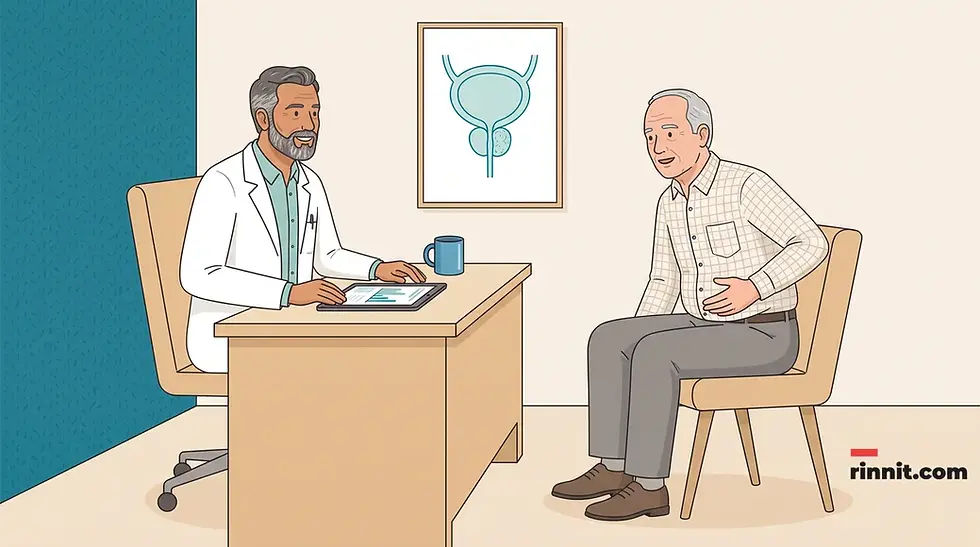
Quick Answer: What is benign prostatic hyperplasia (BPH)?
Benign prostatic hyperplasia (BPH) is a noncancerous growth of the prostate gland that squeezes the urethra and slows urine flow, without raising prostate cancer risk. It causes frequent or urgent urination, nighttime trips, a weak stream and incomplete emptying. Risk rises with age. Treatment depends on severity and ranges from lifestyle changes and medicines to scope-based procedures or surgery.
What the research says
Tadalafil-type drugs work about as well as alpha blockers for symptoms. A Cochrane review of 16 randomized trials found phosphodiesterase inhibitors gave a small improvement in the International Prostate Symptom Score (IPSS) versus placebo (1.89 points lower, 4,293 participants) and probably similar improvement to alpha blockers (0.22 points higher, 95% CI -0.49 to 0.93), mostly over 6 to 12 weeks (Pattanaik et al., Cochrane Database Syst Rev, 2018) [3].
Minimally invasive procedures trade some effectiveness for sexual function. A network meta-analysis of 59 studies (21,078 patients) found prostatic artery embolization and Aquablation reduced IPSS similarly to TURP. Water vapor thermal therapy and prostatic urethral lift were less effective than TURP but better preserved sexual function, and TURP had the lowest risk of re-intervention (Shin et al., World J Mens Health, 2026) [4].
Prostate artery embolization matches TURP on symptoms but may need repeat treatment. In a Cochrane review, symptom scores and quality of life were similar to TURP in the short term (low-certainty evidence), but retreatment was likely more common (RR 3.20, moderate-certainty evidence) (Jung et al., Cochrane Database Syst Rev, 2022) [5].
Study details are from PubMed abstracts.
What does benign prostatic hyperplasia (BPH) actually mean?
Your prostate is a small gland that sits just below the bladder. The tube that carries urine from the bladder out of the body, called the urethra, passes right through the center of the prostate. [1]
Normally, the prostate is about the size and shape of a walnut or golf ball. Its job is to help make semen. It is not a gland men typically think about, until it grows. [1]
With age, the prostate often keeps growing. When it enlarges enough, it presses on the urethra and narrows it. That is when urine flow starts to slow or get blocked. [1]
The growth itself is not cancer. An enlarged prostate is not thought to raise the risk of getting prostate cancer. [1]

What are the symptoms of benign prostatic hyperplasia (BPH)?
The warning signs of BPH tend to develop slowly and mostly center on how urine leaves the body, since they all come from the same problem: the urethra being squeezed.
Common symptoms include frequent or urgent need to pee, peeing more often at night, trouble starting to pee, a weak urine stream or one that stops and starts, dribbling at the end of urination, and not being able to fully empty the bladder. [1]
Less common symptoms include urinary tract infections, a complete inability to pee, and blood in the urine. [1]
Here is how the clues connect to what is happening inside:
Symptom clue | What it points to |
Frequent or urgent need to pee | The bladder works harder against the squeeze |
Peeing more often at night | The bladder cannot hold urine as well under pressure |
Trouble starting a stream | The narrowed urethra resists the first push |
Weak or stop-and-start stream | Flow is restricted by the narrowed tube |
Dribbling at the end of urination | The bladder cannot fully push urine out |
Feeling of incomplete emptying | Urine stays behind in the bladder |
One important point: prostate size does not always match symptom severity. Some men with slightly enlarged prostates have major symptoms, while some with very enlarged prostates have minor problems. Some men have no symptoms at all. [1]
Symptoms also tend to worsen slowly over time, but sometimes they stay the same or even improve. [1]
When might BPH symptoms be caused by something else?
Urinary symptoms that look like BPH can also come from other conditions and some medicines, so BPH should never be assumed. These include urinary tract infections, an inflamed prostate, a narrowed urethra, scarring in the bladder neck from past surgery, bladder or kidney stones, nerve problems that control the bladder, and prostate or bladder cancer. [1]
Some medicines can also mimic BPH symptoms, including opioid pain relievers, cold and allergy medicines, and older tricyclic antidepressants. [1]
What causes BPH and who is at risk?
Doctors are not certain what drives the prostate to enlarge. The prostate typically keeps growing throughout life, and the cause may involve changes in the balance of sex hormones as men get older. [1]
Risk factor | Why it raises the risk |
Aging | Symptoms rarely appear before age 40, then rise steadily |
Family history | A blood relative with prostate problems raises your odds |
Diabetes and heart disease | Studies link both with higher BPH risk |
Lifestyle | Obesity raises risk; exercise can lower it |
What complications can BPH cause?
Untreated BPH can lead to urinary retention, urinary tract infections, bladder stones, bladder damage and kidney damage.
Urinary retention. A complete inability to pee may require a catheter, a tube placed into the bladder to drain urine, and sometimes surgery. [1]
Urinary tract infections. A bladder that does not empty fully invites repeated infections, which may eventually require surgery to remove part of the prostate. [1]
Bladder stones. Leftover urine hardens into stones that can cause illness, bladder irritation, blood in the urine, and blocked flow. [1]
Bladder damage. Over time, the stretched bladder wall weakens and can no longer squeeze out urine properly, making emptying even harder. [1]
Kidney damage. Backed-up pressure or infections spreading upward can harm the kidneys. [1]
Treatment for BPH lowers the risk of these complications, but urinary retention and kidney damage can be serious health threats. [1]
How is BPH diagnosed?
Diagnosis starts with questions about your symptoms and a physical exam. The exam usually includes a digital rectal exam, where the doctor checks whether the prostate is enlarged; a urine test to look for infection or other problems that mimic BPH; and a blood test to check kidney function. [2]
Further tests may confirm the diagnosis and measure how much the blockage affects you:
Diagnostic step | What happens | What it shows |
PSA blood test | A blood draw measuring a protein made by the prostate | Levels rise with enlargement, but also with procedures, illness, surgery, or cancer |
Urinary flow test | You pee into a machine-attached container | How strong and how much urine flows; tracks changes over time |
Postvoid residual test | Ultrasound or catheter measures urine left behind | Whether the bladder empties fully |
24-hour voiding diary | You record every trip and amount for a day | Frequency and volume, especially useful if over a third of urine is made at night |
For more complex cases, doctors may use a transrectal ultrasound to measure prostate size, a biopsy to rule out cancer, pressure flow studies to test how the bladder muscles work, or a cystoscopy, a lighted tool that looks inside the urethra and bladder. [2]
What are the treatment options for BPH?
The right plan depends on the size of your prostate, your age, your overall health, and how bothersome your symptoms are. If symptoms are not getting in the way of your life, some men choose to wait and watch, since symptoms can stay stable or even ease on their own. [2]
Medicines
Medicine is the most common treatment for mild to moderate symptoms. The main classes work in different ways: [2]
Medicine type | How it works | Examples |
Alpha blockers | Relax the smooth muscle of the bladder neck and prostate. Often work quickly, especially in smaller prostates. May cause dizziness or retrograde ejaculation, a harmless condition where semen flows backward into the bladder | Alfuzosin, doxazosin, tamsulosin, silodosin, terazosin |
5-alpha reductase inhibitors | Shrink the prostate by blocking growth-causing hormone changes. Can take up to six months; sexual side effects possible | Finasteride, dutasteride |
Combination therapy | Both types taken together when either alone is not enough | One of each class |
Tadalafil | An erectile dysfunction medicine that studies suggest can also treat an enlarged prostate | Cialis |
Procedures and surgery
Procedures become an option when medicines fall short, you prefer to avoid them, you cannot pee, you have kidney problems, or you keep getting bladder stones, blood in the urine, or infections. They may not be available if you have an untreated infection, urethral stricture disease, prior prostate radiation or urinary surgery, or a neurological disorder such as Parkinson's disease or multiple sclerosis. [2]
Every prostate procedure carries some risk of side effects, including retrograde ejaculation, accidental urine leakage, urinary tract infection, bleeding, and erectile dysfunction. [2]
Procedure | How it works | Best suited for |
TURP | A scope removes most of the prostate through the urethra; fast, reliable relief; may need a temporary catheter | Standard option for reliable symptom relief |
TUIP | One or two small cuts open the pathway | Small prostates or higher surgical risk |
TUMT | Microwave energy shrinks inner prostate tissue; results can be slow or partial | Small prostates in special situations |
Laser therapy | A laser destroys or removes blocking tissue; fewer side effects than nonlaser surgery | People on blood thinners |
Prostate lift | Small implants compress the prostate sides; fewer sexual side effects | When the middle of the prostate is not the problem |
Water vapor thermal therapy (WVTT) | Steam wears away extra tissue; fewer sexual side effects | Fewer sexual side effects than many surgical options |
Robotic waterjet treatment | Robotic jets of water remove tissue; similar relief and side effects to TURP | Similar relief to TURP |
Open or robot-assisted prostatectomy | Tissue is removed through cuts in the lower abdomen; requires a short hospital stay | Very large prostates |
Prostate artery embolization (PAE) | Blood supply to the prostate is blocked so it shrinks; must be performed by a specially trained interventional radiologist | Selected patients |

What lifestyle changes and home remedies help with BPH?
Alongside medical treatment, several habits can ease day-to-day symptoms.
Cut evening fluids by stopping drinks an hour or two before bed to reduce overnight trips. Limit caffeine and alcohol, since both increase urine production and irritate the bladder. Watch your diet, because heavily seasoned foods can irritate the bladder. Move more and stay at a healthy weight; exercise helps, and obesity is linked with a larger prostate. [2]
Go when the urge hits, because holding it too long can stretch and damage the bladder muscle. Schedule bathroom breaks, since timed trips every couple of hours help when urgency is strong. Try double voiding: pee, wait a few moments, then pee again. Limit decongestants and antihistamines, because these tighten the muscles around the urethra and make urination harder. Stay warm, since cold can trigger urine retention and urgency. [2]
What about herbal supplements?
No herbal supplement is approved in the United States to treat an enlarged prostate. Guideline reviewers have found that most supplement studies have weaknesses, and two stronger studies showed saw palmetto performed no better than a placebo. Beta-sitosterol extracts, pygeum, and rye grass have been suggested but their safety and long-term effectiveness are unproven. If you take any herbal remedy, tell your doctor, since some increase bleeding risk or interact with medicines. [2]
When should you see a doctor for BPH?
Talk to a doctor about your urinary symptoms even if they do not bother you yet, since treatable causes should be found and untreated blockage risk grows over time. [1]
Seek help right away if you cannot pass urine at all. Urinary retention is a medical emergency.
How should you prepare for a BPH appointment?
You may be referred to a urologist, a doctor who specializes in urinary issues. Before the visit, note your symptoms, track how often and how much you pee and how full your bladder feels, list your medicines and supplements, and write down your questions. [2]
Questions worth asking include whether something other than an enlarged prostate could be causing your symptoms, which tests you need, your treatment options, how to manage other health problems alongside BPH, and whether sexual activity has any restrictions. [2]
Expect your doctor to ask about when symptoms started and how they progressed, how often you pee day and night, leakage, urgency, difficulty starting, whether the bladder feels empty, burning or blood, family history, sexual function, past procedures, blood thinners, and your caffeine and fluid intake. [2]
What is the bottom line on benign prostatic hyperplasia (BPH)?
An enlarged prostate is one of the most common health changes men face with age, and it is among the most treatable. The prostate grows, the urethra narrows, and the symptoms follow, but modern medicine offers a clear path from medicines to minimally invasive procedures to surgery, matched to your prostate size and health.
The good news is that with early attention, serious complications such as retention and kidney damage are largely preventable. Lifestyle steps such as limiting evening fluids and caffeine, staying active, and going when the urge hits help every day, and a wide range of procedures can restore comfortable urination.
If you or a family member are noticing urinary symptoms, do not wait to see whether they pass. See a doctor early, and go to emergency care if urine stops flowing entirely.
Next steps: If you have urinary symptoms that do not go away, seek medical evaluation rather than assuming they are just part of aging.
FAQ
Is benign prostatic hyperplasia the same thing as prostate cancer?
No. BPH is a noncancerous growth of the prostate that squeezes the urethra. Having an enlarged prostate is not thought to raise the risk of developing prostate cancer.
Can an enlarged prostate be cured without surgery?
Medicines such as alpha blockers and 5-alpha reductase inhibitors control symptoms for many men, and some symptoms ease without any treatment. Surgery or procedures are usually reserved for cases where medicines fail or complications develop.
How long does it take for BPH medicine to work?
Alpha blockers often work quickly, especially with smaller prostates. 5-alpha reductase inhibitors shrink the prostate gradually and can take up to six months to show full effect.
Is BPH surgery safe for men taking blood thinners?
Laser therapy in particular carries a lower risk of side effects than nonlaser surgery and may be used in people who take blood-thinning medicines, since laser treatments can remove blocking tissue with reduced bleeding risk.
Can lifestyle changes really help an enlarged prostate?
Yes. Limiting evening fluids, cutting caffeine and alcohol, avoiding bladder-irritating foods, staying active, keeping a healthy weight, and emptying the bladder before it overfills can all ease day-to-day symptoms.
Disclaimer: This article is for general informational purposes only and does not constitute medical advice. Always consult a qualified health care provider for individual questions.
Related Reading
Prostatectomy: Types, Surgery, Risks and Recovery explains prostate removal surgery and recovery.
Urodynamic Testing: Bladder Function Tests, Prep and Results explains the bladder function tests used to find the cause of urinary symptoms.
Learn more in our guide to Cystoscopy: Purpose, Procedure, Recovery and Risks.
Prostate Exam: What It Is, Why It's Done, What to Expect and Results explains what happens during a prostate exam, including the digital rectal exam and the PSA blood test.
PSA Test: Normal Levels by Age, How to Prepare and What High Results Mean explains the blood test used to screen for and monitor prostate problems.
Learn more in our guide to Bladder Ultrasound: Why It's Done, How to Prepare and What Results Mean.
Prostate Ultrasound and Biopsy: Why It's Done, How to Prepare, What to Expect and Recovery explains the ultrasound-guided biopsy used to check for prostate cancer, how to prepare and what recovery is like.
Intravenous Pyelogram (IVP): What It Is, Why It's Done, Risks and Results explains the contrast X-ray of the kidneys, ureters and bladder that can show this condition.
Digital Rectal Exam (DRE): Why It's Done, Positions and What to Expect explains the gloved finger exam of the rectum, anus and prostate.
Post-Void Residual (PVR) Test: How It's Done, Normal Levels and High PVR explains the test that measures urine left in the bladder after peeing.
References
Mayo Clinic Staff. Benign prostatic hyperplasia (BPH) - Symptoms and causes. Mayo Clinic. December 23, 2025. https://www.mayoclinic.org/diseases-conditions/benign-prostatic-hyperplasia/symptoms-causes/syc-20370087
Mayo Clinic Staff. Benign prostatic hyperplasia (BPH) - Diagnosis and treatment. Mayo Clinic. December 23, 2025. https://www.mayoclinic.org/diseases-conditions/benign-prostatic-hyperplasia/diagnosis-treatment/drc-20370093
Pattanaik S, et al. Phosphodiesterase inhibitors for lower urinary tract symptoms consistent with benign prostatic hyperplasia. Cochrane Database Syst Rev. 2018;11(11):CD010060. PMID 30480763. https://doi.org/10.1002/14651858.CD010060.pub2
Shin BNH, et al. Efficacy and Tolerability Outcomes of Minimally Invasive Surgical Treatments for Benign Prostatic Hyperplasia: A Random-Effects Network Meta-Analysis. World J Mens Health. 2026;44(1):49-63. PMID 40759591. https://doi.org/10.5534/wjmh.250092
Jung JH, et al. Prostatic arterial embolization for the treatment of lower urinary tract symptoms in men with benign prostatic hyperplasia. Cochrane Database Syst Rev. 2022;3(3):CD012867. PMID 35349161. https://doi.org/10.1002/14651858.CD012867.pub3
National Cancer Institute. Understanding Prostate Changes and Conditions. National Cancer Institute. Updated May 8, 2024. https://www.cancer.gov/types/prostate/understanding-prostate-changes
American Urological Association. Management of Lower Urinary Tract Symptoms Attributed to Benign Prostatic Hyperplasia: AUA Guideline (2026). American Urological Association. Accessed October 14, 2026. https://www.auanet.org/guidelines-and-quality/guidelines/benign-prostatic-hyperplasia-%28bph%29-guideline



Comments