Urodynamic Testing: Bladder Function Tests, Prep and Results

Updated: 3 days ago
Written and medically reviewed by Dr. Baraa Alnahhal, MD · Last reviewed: November 2026 · How we review
Quick Answer
Urodynamic testing is a group of tests that show how well the bladder, sphincter and urethra store and release urine. Providers use them to find the cause of urinary incontinence, overactive bladder symptoms, a weak stream and trouble emptying the bladder. Testing takes 30 to 45 minutes, is generally painless and is safe, with a small risk of infection.
What the research says
Not every woman needs urodynamics before surgery: in 630 women with uncomplicated stress incontinence, success 1 year after surgery was 76.9% with urodynamic testing vs. 77.2% with an office evaluation alone (Nager CW et al., New England Journal of Medicine, 2012) [2]
In men, results were similar with or without it: in 820 men considering prostate surgery for urinary symptoms, adding urodynamics gave similar symptom scores at 18 months and didn't change how many men had surgery (38% vs. 36%) (Drake MJ et al., European Urology, 2020) [3]
Key takeaways
Urodynamics measures how your bladder fills, stores and empties.
It helps explain leaking, urgency, weak flow and incomplete emptying.
Most tests use a thin catheter and take 30 to 45 minutes.
Mild burning when urinating for a few hours afterward is common.
Results guide treatment, including whether surgery is likely to help.
What is urodynamic testing?
Normal urination depends on the bladder muscle, the sphincter muscles that keep urine in and the nerves that coordinate them. Urodynamic tests record pressures, volumes and flow while your bladder fills and empties, showing where a problem lies. A urologist, urogynecologist or trained nurse usually performs them. Sources: [1]
Types of urodynamic tests
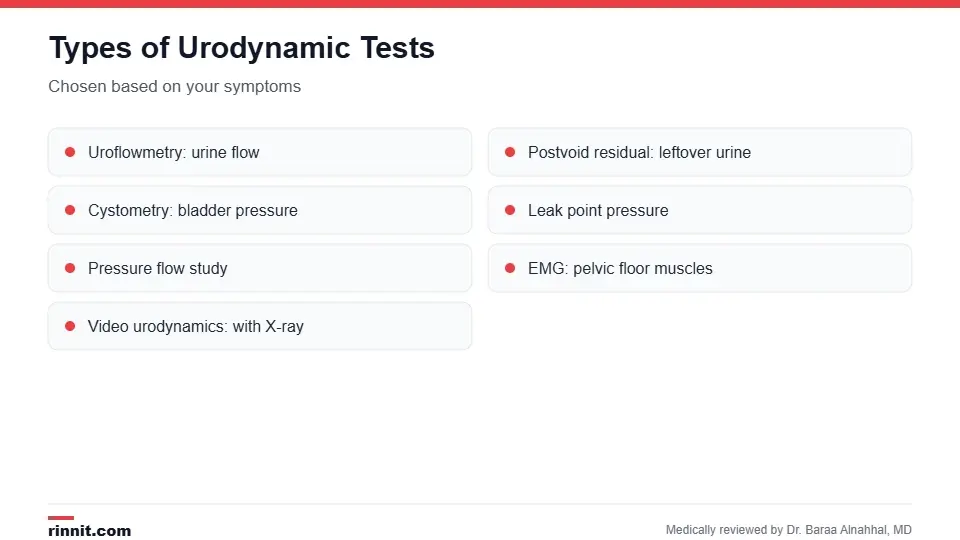
Your provider chooses the tests based on your symptoms.
Test | What it measures |
Uroflowmetry | How fast and how much you urinate, shown as a graph |
Postvoid residual | Urine left in the bladder after urinating, by bladder scanner or catheter |
Cystometry | Bladder pressure, capacity and unwanted contractions as it fills |
Leak point pressure | The pressure at which urine leaks when you cough or strain |
Pressure flow study | Bladder pressure and urine flow while you urinate |
Electromyography (EMG) | Pelvic floor muscle activity, using sticky patches |
Video urodynamics | Cystometry and flow combined with X-ray pictures |
Sources: [1]
Why it's done

The tests help pinpoint the cause of bladder symptoms.
Leaking urine, including stress incontinence.
Urgency or frequent urination.
Trouble starting urination, or a weak, slow or stop-start stream, which can occur with an enlarged prostate.
Not emptying the bladder completely (urinary retention).
Painful urination or repeated urinary tract infections. Sources: [1]
How to prepare
Usually no special preparation is needed.
You may be asked to arrive with a comfortably full bladder.
Ask whether to stop any medicines beforehand.
Tell your provider if you're allergic to contrast dye, if X-rays will be used. Sources: [1]
What happens during the test

The test takes about 30 to 45 minutes.
You may first urinate into a special toilet that measures your flow.
A thin catheter is placed through the urethra into the bladder; a small sensor may also be placed in the rectum.
Your bladder is slowly filled with warm sterile fluid while pressures are recorded.
You report when you first feel the urge to urinate and when you feel full, and you may be asked to cough or strain.
You urinate with the catheter in place so pressure and flow can be measured together. Sources: [1]
Adults usually don't need sedation; it may help some children. Sources: [1]
Risks and aftercare
Urodynamic testing is very safe. There's a small risk of a urinary tract infection from the catheter. Mild burning when you urinate and small amounts of blood in the urine are common for a few hours. Drinking 8 to 16 ounces of water every hour for 2 hours, warm baths and over-the-counter pain relievers can help. Call your provider right away for fever, chills or pain. Sources: [1]
Results
Cystometry and uroflowmetry results are often available the same day; EMG and video urodynamic results may take a few days. Your provider will explain what the tests show and discuss treatment, such as pelvic floor therapy, bladder training, medicine or surgery. Sources: [1]
Conclusion
Urodynamic testing shows how your bladder actually works when it fills and empties. This information helps your provider understand the cause of bothersome urinary symptoms and choose the treatment most likely to help.
Keep learning: read about urinary incontinence and cystoscopy.
Frequently asked questions
What is urodynamic testing?
Tests that measure how well your bladder stores and releases urine.
Why would I need urodynamics?
To find the cause of leaking, urgency, weak flow or trouble emptying.
Does urodynamic testing hurt?
It's usually painless, though the catheter may feel uncomfortable.
How long does it take?
About 30 to 45 minutes.
Do I need a full bladder?
Sometimes; follow your provider's instructions.
What is uroflowmetry?
A test that measures how fast and how much you urinate.
What is a postvoid residual?
The amount of urine left in your bladder after you urinate.
Is there burning afterward?
Mild burning for a few hours is common.
What are the risks?
A small risk of urinary tract infection.
When will I get results?
Some the same day; others within a few days.
Related Reading
Urinary Incontinence: Symptoms, Causes, and Treatment Options Explained a main reason for urodynamic testing.
Overactive Bladder: Symptoms, Causes, and Treatment Explained urgency and frequency symptoms urodynamics can assess.
Stress Incontinence: Symptoms, Causes, and Treatment Options Explained leakage with coughing or exercise.
Benign Prostatic Hyperplasia (BPH): Symptoms, Causes, and Treatment a common cause of weak urine flow in men.
Cystoscopy: Purpose, Procedure, Recovery and Risks a scope exam of the bladder.
References
Cleveland Clinic. Urodynamic Testing: Purpose, Procedure, Risks & Results. Cleveland Clinic. Last updated October 20, 2023. https://my.clevelandclinic.org/health/diagnostics/15684-urodynamic-testing
Nager CW, Brubaker L, Litman HJ, et al. A randomized trial of urodynamic testing before stress-incontinence surgery. New England Journal of Medicine. 2012;366(21):1987-1997. PMID 22551104. https://doi.org/10.1056/NEJMoa1113595
Drake MJ, Lewis AL, Young GJ, et al. Diagnostic assessment of lower urinary tract symptoms in men considering prostate surgery: a noninferiority randomised controlled trial of urodynamics in 26 hospitals. European Urology. 2020;78(5):701-710. PMID 32616406. https://doi.org/10.1016/j.eururo.2020.06.004
Medical disclaimer
This article is for general education only and does not replace advice from a qualified healthcare professional. Talk to your doctor about your own diagnosis and treatment, and seek emergency care right away for severe or sudden symptoms.



Comments