Cystoscopy: Purpose, Procedure, Recovery and Risks

Updated: 2 days ago
Written and medically reviewed by Dr. Baraa Alnahhal, MD · Last reviewed: November 2026 · How we review
Quick Answer: What is a cystoscopy?
A cystoscopy is a procedure in which a urologist slides a thin, lighted scope (cystoscope) through the urethra into the bladder to look at the lining of both. It's used to find the cause of symptoms such as blood in the urine or painful urination and to treat some problems. A diagnostic cystoscopy takes 5 to 10 minutes. [1]
What the research says
Infection after cystoscopy is uncommon, and antibiotics help only modestly. A Cochrane review of 22 trials with 7,711 adults found preventive antibiotics may lower symptomatic urinary tract infections (risk ratio 0.49, about 30 fewer per 1,000 people) but had little or no effect on more serious systemic infections, based on low-quality evidence. (Zeng et al., Cochrane Database of Systematic Reviews, 2019) [2]
Listening to music can make cystoscopy more comfortable. A meta-analysis of 6 randomized trials with 639 patients found music during cystoscopy lowered pain scores, anxiety and heart rate, in both flexible and rigid procedures. (Chen et al., Frontiers in Surgery, 2021) [3]
Key takeaways
A cystoscopy lets a urologist see inside the bladder and urethra. [1]
It can diagnose and treat problems, from bladder stones to tumors. [1]
Flexible scopes are often used with numbing gel while you are awake; rigid scopes usually need sedation or anesthesia. [1]
A diagnostic cystoscopy takes about 5 to 10 minutes. [1]
Mild burning or blood-tinged pee for a day or two is common afterward. [1]
What is a cystoscopy?
Cystoscopy is a procedure used to view the inside of your bladder and urethra, the tube that drains pee out of your body. A urologist performs it with a lighted device that has a camera or viewing lens. It can help rule out serious conditions, such as bladder cancer, as a cause of your symptoms. [1]
Why is a cystoscopy done?
Your provider may recommend a cystoscopy if you have: [1]
Blood in your pee (hematuria)
Painful urination (dysuria)
Bladder control problems, such as leaking pee or being unable to empty your bladder fully (urinary retention)
Bladder stones
A cystoscopy can diagnose bladder or urethral cancer, bladder stones, urinary incontinence, an enlarged prostate (benign prostatic hyperplasia), interstitial cystitis/bladder pain syndrome, urethral strictures, urinary fistulas and urinary tract infections. [1]
Treatments done through a cystoscope
Your urologist can also use the cystoscope to: [1]
Collect urine samples from the ureters, the tubes that carry pee from the kidneys
Inject dye for tests that track urine flow, or inject medicine to stop leaking
Remove a ureteral stent placed during an earlier procedure
Remove bladder stones, abnormal tissue, polyps or tumors
Take small tissue samples for a biopsy
Treat urethral strictures or fistulas
Sources: [1]
Flexible vs rigid cystoscopy
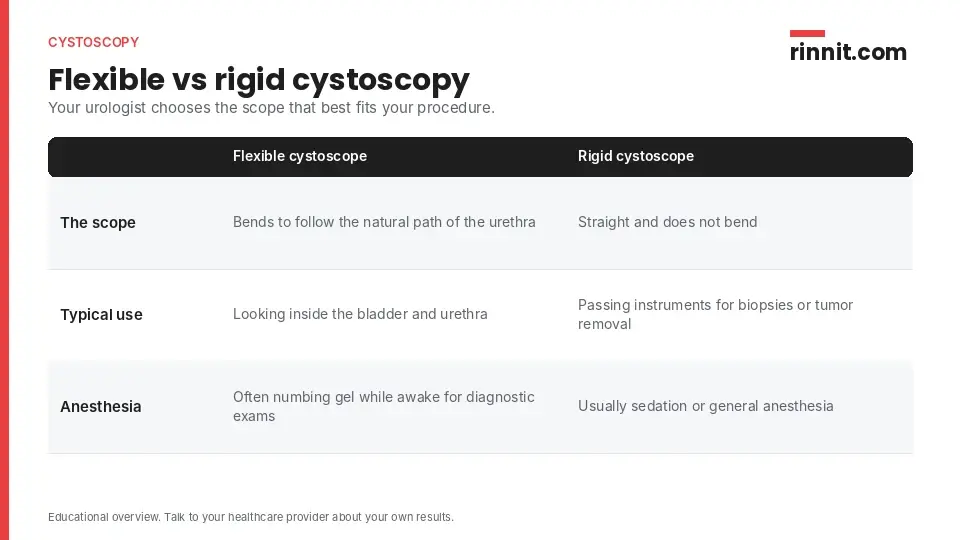
Flexible cystoscope | Rigid cystoscope | |
The scope | Bends to follow the natural path of the urethra | Straight; does not bend |
Typical use | Examining the inside of the bladder and urethra | Passing instruments for biopsies or tumor removal |
Anesthesia | Diagnostic exams usually done awake with numbing gel | Usually sedation or general anesthesia |
Sources: [1]
How do you prepare for a cystoscopy?
Tell your provider about all your medicines and whether you might be pregnant. Your preparation depends mostly on the type of anesthesia and why you are having the procedure. You may be asked to: [1]
Give a urine sample on the day to check for a UTI. An infection usually needs treatment first.
Not eat for 8 hours beforehand, usually only if you will have general anesthesia.
Stop certain medicines or take them with just a sip of water. Do not stop any medicine unless your provider tells you to.
Arrange for someone to drive you home if you will be sedated.
Sources: [1]
What happens during a cystoscopy?
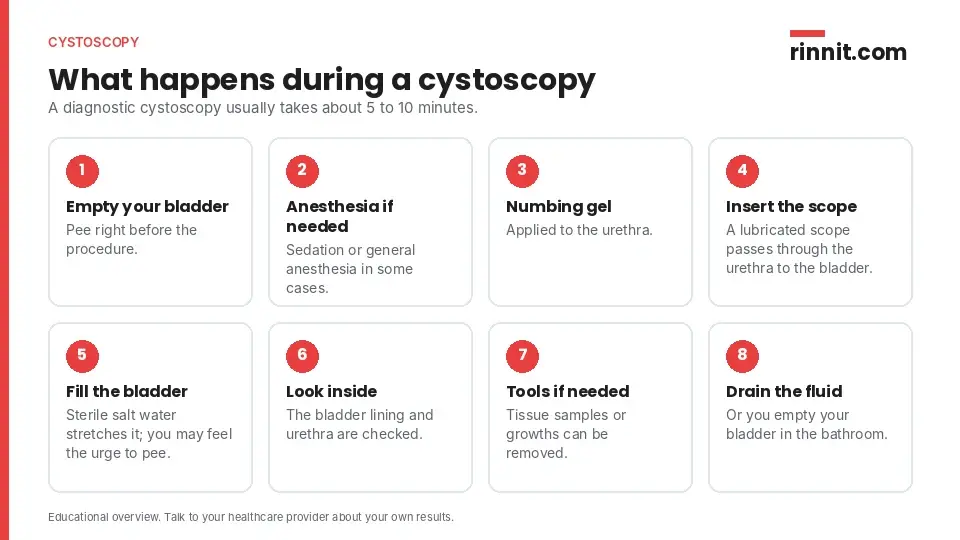
You pee right before the procedure.
In some cases, you receive sedation or general anesthesia.
Your urethra is numbed with gel.
A lubricated cystoscope slides through your urethra into your bladder.
Sterile salt water fills your bladder to stretch it so the lining is easier to see. You will probably feel like you need to pee.
The urologist examines the inside of your bladder and urethra.
If needed, small instruments pass through the scope to remove tissue samples or tumors.
The fluid is drained, or you empty your bladder in the bathroom.
Sources: [1]
A diagnostic cystoscopy usually takes about 5 to 10 minutes, and longer if a biopsy or treatment is done. It may feel uncomfortable, but numbing gel or anesthesia keeps you from feeling pain. [1]
What happens after a cystoscopy?
Depending on the reason for the procedure, you may go home the same day or stay overnight. Your provider may prescribe antibiotics to prevent infection; take them as directed. Most people recover within a day or two, though recovery may take longer after a biopsy. [1]

Common for 1 to 2 days | Call your provider |
Mild belly pain | Severe pain when you pee |
Blood-tinged pee | A lot of blood or blood clots in your pee |
Pain or burning when peeing | A painfully full bladder and inability to pee |
Needing to pee often or urgently | Fever, pelvic pain, or cloudy or strong-smelling pee, or symptoms lasting longer than a day or two |
Sources: [1]
To ease mild symptoms, place a warm, damp washcloth over the urethral opening or relax in a warm bath, drink several glasses of water each day to flush your bladder and take an over-the-counter pain reliever such as an NSAID. [1]
What are the risks of a cystoscopy?
Cystoscopy is relatively low risk. Possible complications include a urinary tract infection, bladder spasms that cause painful cramps and leaking, damage to the bladder, and damage to the urethra such as scarring or narrowing. [1]
What do cystoscopy results mean?
Your urologist notes anything they see, such as blockages, a narrowed urethra, bladder stones, abnormal tissue or growths, or whether everything looks normal. If only a cystoscopy was done, they know the results during the procedure and may discuss them right away or at a follow-up visit. If tissue was taken for a biopsy, a lab checks it for cancer cells, and results can take up to 2 weeks. [1]
Conclusion
A cystoscopy is a quick procedure with minimal risks and a short recovery that helps your urologist find the cause of urinary symptoms and, in many cases, treat it at the same time. Mild burning or blood-tinged pee for a day or two is expected; anything more should prompt a call. Ask your provider about any concerns before or after the procedure. [1]
Keep learning: Read our guides to blood in urine (hematuria), interstitial cystitis and the endoscopy overview. For more, see the Urology Care Foundation's guide to cystoscopy.
FAQ
What is a cystoscopy?
A cystoscopy is a procedure in which a urologist passes a lighted scope (cystoscope) through the urethra to look inside the bladder and urethra [1].
Why would I need a cystoscopy?
Common reasons include blood in your pee, painful urination, leaking pee, being unable to empty your bladder and bladder stones [1].
What can a cystoscopy diagnose?
It can diagnose bladder or urethral cancer, bladder stones, incontinence, an enlarged prostate, interstitial cystitis, urethral strictures, fistulas and UTIs [1].
Is a cystoscopy painful?
It may feel uncomfortable or like you need to pee, but numbing gel or anesthesia keeps you from feeling pain [1].
Are you awake during a cystoscopy?
Usually yes for a diagnostic cystoscopy, with numbing gel. Biopsies or treatments may need sedation or general anesthesia [1].
How long does a cystoscopy take?
A diagnostic cystoscopy usually takes about 5 to 10 minutes, longer if a biopsy or treatment is done [1].
How do I prepare for a cystoscopy?
You may give a urine sample to check for infection, fast for 8 hours if you will have general anesthesia, adjust medicines only as told and arrange a ride if sedated [1].
How long does recovery from a cystoscopy take?
Most people recover within a day or two, though it can take longer after a biopsy [1].
Is it normal to have blood in urine after a cystoscopy?
Blood-tinged pee, burning and needing to pee often are common for a day or two. Call if you see a lot of blood or clots [1].
What are the risks of a cystoscopy?
It is relatively low risk. Possible complications include a UTI, bladder spasms and damage to the bladder or urethra [1].
Related Reading
Urethral Dilation: Procedure, Recovery and Results explains urethral dilation.
Urethroplasty: Procedure, Recovery and Success Rate explains urethroplasty for urethral stricture.
Urodynamic Testing: Bladder Function Tests, Prep and Results explains the bladder function tests used to find the cause of urinary symptoms.
Learn more in our guide to Blood in Urine (Hematuria): Symptoms, Causes, and Treatment.
Learn more in our guide to Interstitial Cystitis: Symptoms, Causes, and Treatment.
Learn more in our guide to Benign Prostatic Hyperplasia (BPH): Symptoms, Causes, and Treatment.
Learn more in our guide to Urinary Tract Infection (UTI): Symptoms, Causes, Treatment, and Prevention.
Learn more in our guide to Urinary Incontinence: Symptoms, Causes, and Treatment Options Explained.
Urine Cytology: Testing Urine for Bladder Cancer Cells explains the urine test that looks for bladder and urinary tract cancer cells.
References
Cleveland Clinic. Cystoscopy: Purpose, Procedure, Risks & Recovery. Cleveland Clinic. Last updated January 29, 2024. https://my.clevelandclinic.org/health/diagnostics/16553-cystoscopy
Zeng S, Zhang Z, Bai Y, et al. Antimicrobial agents for preventing urinary tract infections in adults undergoing cystoscopy. Cochrane Database Syst Rev. 2019;2(2):CD012305. PMID 30789676. https://doi.org/10.1002/14651858.CD012305.pub2
Chen G, Tang C, Liu Y, et al. Does Listening to Music Improve Pain Perception and Anxiety in Patients Undergoing Cystoscopy: A Meta-Analysis. Front Surg. 2021;8:689782. PMID 34262933. https://doi.org/10.3389/fsurg.2021.689782
Medical disclaimer
This article is for general education only and does not replace advice from a qualified healthcare professional. Talk to your doctor about your own diagnosis and treatment, and seek emergency care right away for severe or sudden symptoms.



Comments