Urethral Dilation: Procedure, Recovery and Results

Updated: 2 days ago
Written and medically reviewed by Dr. Baraa Alnahhal, MD · Last reviewed: November 2026 · How we review
Quick Answer
Urethral dilation is a minimally invasive procedure that widens a urethra narrowed by a urethral stricture, a band of scar tissue that can block urine flow. A urologist stretches the narrow area with gradually thicker rods or a balloon. You typically go home the same day with a catheter. Strictures often come back, and urethroplasty is then usually recommended.
What the research says
Dilation and urethrotomy worked about the same: a Cochrane review found that in 210 men, dilation and urethrotomy gave similar stricture-free rates at three years, while in a trial of 50 men with traumatic strictures, 64% needed more treatment after urethrotomy versus 24% after urethroplasty at two years (Wong SS et al., Cochrane Database of Systematic Reviews, 2012) [2]
A drug-coated balloon kept strictures open longer: in the ROBUST III trial of 127 men with recurrent strictures of 3 cm or less, 77.8% were free of repeat treatment at 2 years after drug-coated balloon dilation versus 23.6% at 1 year with standard dilation (VanDyke ME et al., BJUI Compass, 2024) [3]
Key takeaways
Urethral dilation widens a urethra narrowed by scar tissue.
It uses rods, a balloon or a small blade (urethrotomy).
It takes less than an hour, usually as an outpatient.
You'll have a catheter for a few days.
Strictures often return, and urethroplasty may be needed.
What is urethral dilation?
Your urethra carries urine out of your body. A urethral stricture can come from infection, inflammation or injury, or have no clear cause, and it's more common in men. Dilation makes urination easier. Sources: [1]
Types of procedures
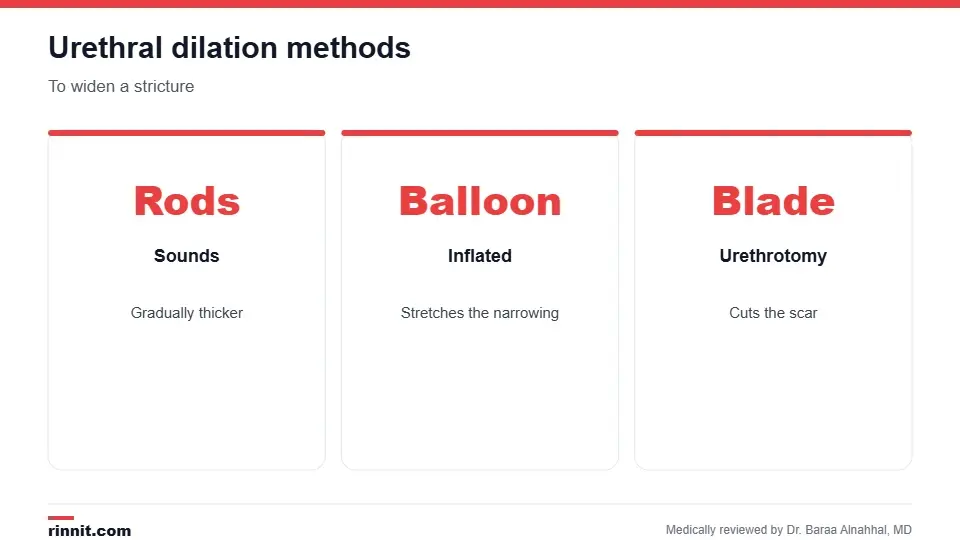
Urethroplasty is a more extensive surgery for strictures that come back.
Method | How it works |
Sounds (rods) | Thin rods that gradually get thicker |
Balloon | A balloon slowly inflated in the narrow area |
Urethrotomy | A cystoscope with a small blade cuts the scar |
For strictures that keep coming back, urethroplasty rebuilds the urethra. Sources: [1, 2]
How to prepare
You'll have an exam, imaging or cystoscopy, and possibly a urine test.
A urine infection may need treatment first.
Tell your provider about all medicines and supplements; aspirin and NSAIDs can raise bleeding risk.
If you'll be asleep, don't eat or drink for at least six hours before. Sources: [1]
What happens during the procedure

It usually takes less than an hour.
You usually get anesthesia; if awake, numbing gel is placed in the urethra.
The urologist widens the narrow area.
A camera may check your bladder for other problems.
A urinary catheter is placed to drain urine while you heal. Sources: [1]
Risks
Moderate pain or soreness.
Burning when you urinate.
Bladder spasms from the catheter.
Blood in the urine.
The stricture coming back. Sources: [1]
If a stricture returns after one dilation, it usually comes back again, so urethroplasty is generally recommended. Sources: [1, 2]
Recovery
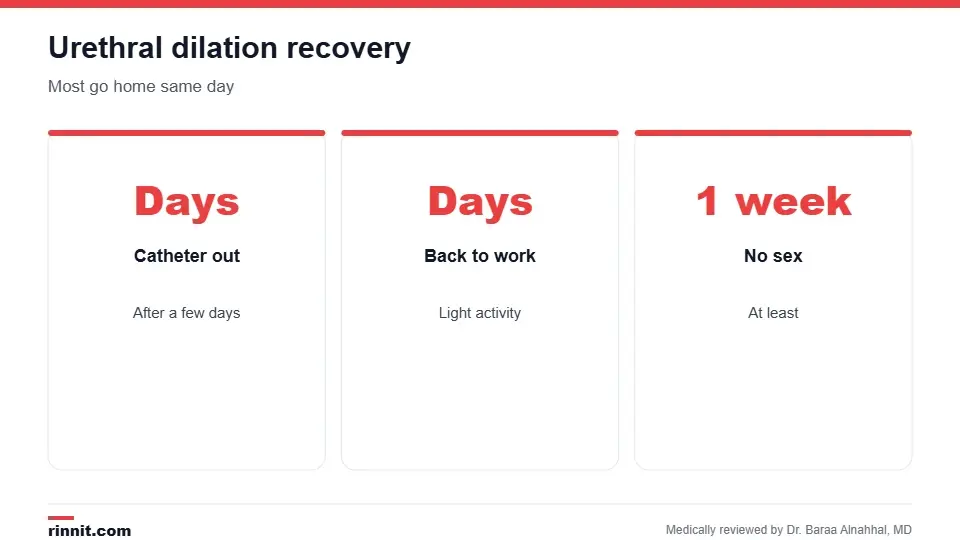
Some people learn to do self-dilation at home.
Most people go home the same day.
The catheter usually comes out after a few days.
Pain improves over several days.
Return to work and light activity in a few days.
Avoid sex for at least a week. Sources: [1]
At your follow-up, your provider may check how well you empty your bladder and your urine flow. Some people learn self-catheterization or self-dilation at home. Sources: [1]
Outlook
Urethral dilation works well in the short term, with success up to 60% for strictures shorter than 2 cm, but success usually declines over time. Newer drug-coated balloons may last longer. Sources: [1, 3]
When to call your provider
You can't urinate.
Your catheter is clogged or isn't draining.
Signs of infection, such as fever, chills or new pain when urinating.
More pain or swelling.
Stricture symptoms come back after healing. Sources: [1]
Conclusion
Urethral dilation is a quick, low-risk way to ease a urethral stricture and improve urine flow. Because strictures often return, ask your urologist about longer-lasting options if yours comes back.
Keep learning: read about urethral strictures and urethroplasty.
Frequently asked questions
What is urethral dilation?
A procedure that widens a narrowed urethra.
What does it treat?
Urethral strictures, which are bands of scar tissue.
How is it done?
With thin rods, a balloon or a small blade.
What is a urethrotomy?
Cutting the scar with a blade on a camera tube.
How long does it take?
Usually less than an hour.
Will I stay overnight?
Usually not.
How long will I have a catheter?
Usually a few days.
Does the stricture come back?
Often. Success declines over time.
What if it comes back?
Urethroplasty is usually recommended.
When can I have sex again?
After at least a week.
Related Reading
Urethral Stricture: Symptoms, Causes, Diagnosis, and Treatment Explained the condition it treats.
Urethroplasty: Procedure, Recovery and Success Rate surgery for recurring strictures.
Cystoscopy: Purpose, Procedure, Recovery and Risks a camera exam of the bladder.
Urinary Catheter: Types, Placement, Care and Risks draining urine while you heal.
Clean Intermittent Catheterization (CIC) self-catheterization at home.
References
Cleveland Clinic. Urethral Dilation: Purpose, Procedure, Risks & Results. Cleveland Clinic. Last updated May 30, 2023. https://my.clevelandclinic.org/health/treatments/25044-urethral-dilation
Wong SS, Aboumarzouk OM, Narahari R, et al. Simple urethral dilatation, endoscopic urethrotomy, and urethroplasty for urethral stricture disease in adult men. Cochrane Database of Systematic Reviews. 2012;12(12):CD006934. PMID 23235635. https://doi.org/10.1002/14651858.CD006934.pub3
VanDyke ME, Morey AF, Coutinho K, et al. Optilume drug-coated balloon for anterior urethral stricture: 2-year results of the ROBUST III trial. BJUI Compass. 2024;5(3):366-373. PMID 38481667. https://doi.org/10.1002/bco2.312
Medical disclaimer
This article is for general education only and does not replace advice from a qualified healthcare professional. Talk to your doctor about your own diagnosis and treatment, and seek emergency care right away for severe or sudden symptoms.



Comments