Urinary Catheter: Types, Placement, Care and Risks

Updated: 2 days ago
Written and medically reviewed by Dr. Baraa Alnahhal, MD · Last reviewed: November 2026 · How we review
Quick Answer
A urinary catheter is a thin, flexible tube that drains urine from the bladder when you can't urinate on your own. It's used for urinary retention, incontinence, an enlarged prostate, nerve conditions and during and after surgery. The main types are intermittent, indwelling (Foley) and suprapubic catheters. The most common problem is a urinary tract infection.
What the research says
Catheter infections are common: across 10 studies of 8,785 hospital patients, catheter-related urinary infections occurred at about 14 per 1,000 catheter days, with higher risk in women, people with diabetes and those catheterized longer (Li F et al., J Adv Nurs, 2019) [2]
Removing catheters sooner cuts infections: in 14 studies, reminders or stop orders to take out catheters no longer needed lowered catheter infection rates by 52% and catheter time by 37% (Meddings J et al., Clin Infect Dis, 2010) [3]
Key takeaways
A urinary catheter drains urine when you can't empty your bladder.
Types include intermittent, indwelling (Foley) and suprapubic catheters.
The most common risk is a urinary tract infection.
Wash your hands and clean the tubing at least twice a day.
Call your provider for fever, cloudy urine, blood or no urine in the bag.
What is a urinary catheter?
A urinary catheter is a rubber or plastic tube with drainage holes near the tip. Urine flows through it into a collection bag (drainage bag) on its own, so you can't control the speed or force. Some catheters are used for a few minutes, while others stay in for weeks or permanently. Sources: [1]
Why it's used

Catheters lower the risk of bladder and kidney damage.
Urinary retention, when you can't empty your bladder.
An enlarged prostate (benign prostatic hyperplasia), scarring, bladder stones or blood clots in the urine.
Nerve conditions such as spinal cord injury, multiple sclerosis or dementia.
Draining the bladder during and after surgery.
Measuring urine output in the hospital.
Giving medicine directly into the bladder. Sources: [1]
Types of urinary catheters
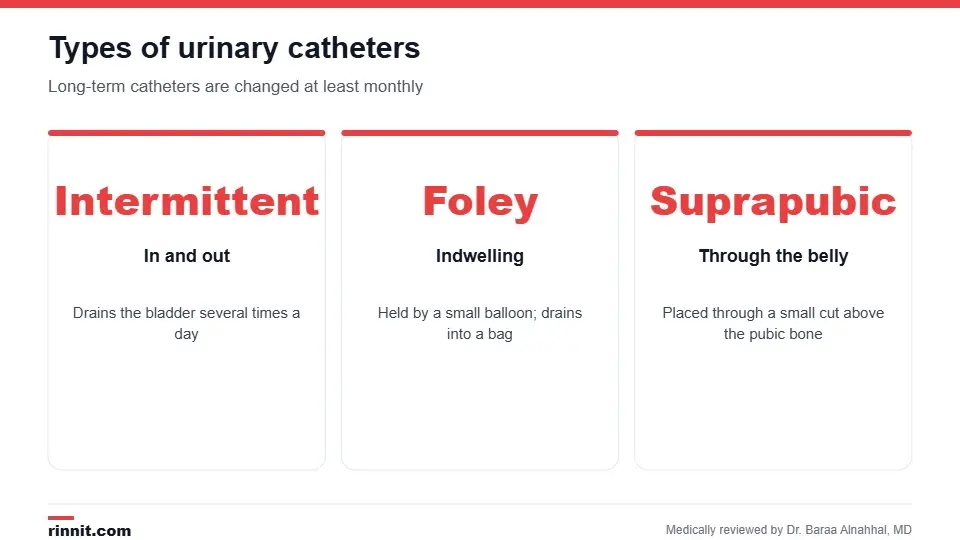
Long-term catheters are changed at least once a month.
Type | How it works | Typical use |
Intermittent | A single-channel tube is passed into the bladder, drains it and is removed | Several times a day, often by yourself (self-catheterization) |
Indwelling (Foley) | A tube through the urethra is held in place by a small water-filled balloon and drains into a bag | Days to months; changed at least monthly |
A tube enters the bladder through a small cut in the lower belly | Long-term use; less common than Foley |
Some catheters have a curved "coudé" tip to pass a blockage such as an enlarged prostate. External devices such as condom catheters are another option for some people with incontinence. Sources: [1]
How a catheter is placed
For a urethral catheter, your provider cleans the genital area with antiseptic and applies numbing gel and lubricant.
The catheter is gently passed through the urethra until urine starts to flow into the bag.
An indwelling catheter is secured by filling its balloon with sterile water; a temporary catheter is removed once the bladder is empty.
For a suprapubic catheter, an X-ray or ultrasound confirms a safe spot, the belly is numbed and the tube is placed through a small cut. Sources: [1]
Risks and complications
Problem | What it looks like |
Urinary tract infection | Fever, cloudy or foul-smelling urine |
Bladder spasms | Cramping in the lower belly |
Leaking | Urine around the catheter |
Blockage | Kinks or twists stop urine from draining |
Bleeding or accidental removal | Blood in urine or the catheter falls out |
Insertion can be uncomfortable. Not draining a full bladder is risky too: it can lead to infections, bladder stones and permanent bladder or kidney damage. Sources: [1, 2]
Living with a catheter
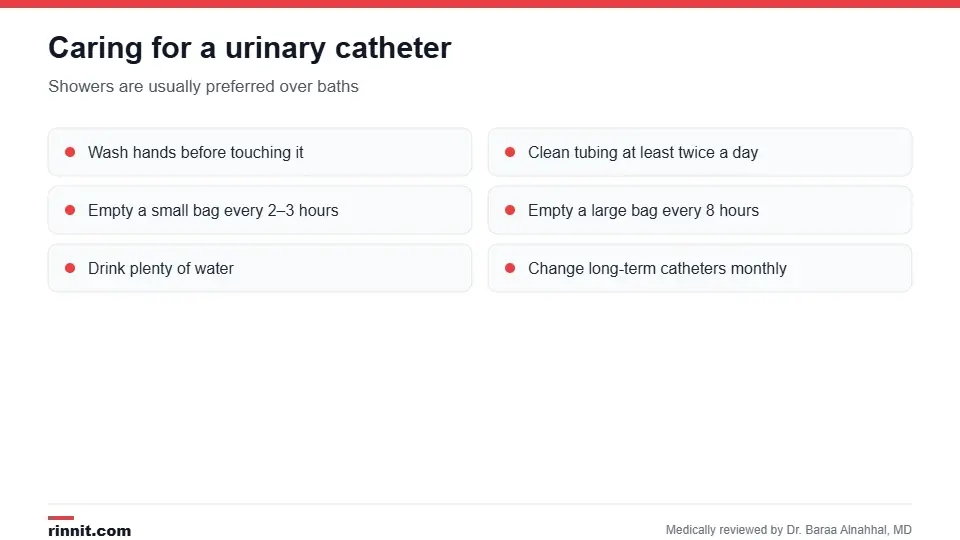
Showers are usually preferred over baths.
Wash your hands before touching the catheter or bag.
Clean the tubing at least twice a day with soap and water.
Empty a small leg bag every 2 to 3 hours and a larger night bag every 8 hours.
Wash a bag used for more than a week, or one that smells, with a mix of 1¼ cups white vinegar and 2 quarts of water.
Drink plenty of water and ask before baths, swimming, exercise or sex.
Long-term catheters are changed at least once a month. Sources: [1]
Hospitals that remove catheters as soon as they're no longer needed see far fewer infections. Ask your provider each day whether you still need yours. Sources: [3]
When to call your provider
Fever.
Cloudy, strong-smelling or foul-smelling urine.
Leaking around the catheter.
Belly pain or fullness.
Blood or clots in the urine.
No urine draining into the bag.
The catheter has come out. Sources: [1]
Conclusion
A urinary catheter protects your bladder and kidneys when you can't urinate on your own. With clean hands, daily care and quick attention to warning signs, most people manage a catheter safely at home.
Keep learning: read about urinary catheterization and urinary tract infections.
Frequently asked questions
What is a urinary catheter?
A thin tube that drains urine from your bladder into a bag.
Why would I need a catheter?
For urinary retention, incontinence, an enlarged prostate, nerve damage or surgery.
What is a Foley catheter?
The most common indwelling catheter, held in place by a small balloon.
What is a suprapubic catheter?
A catheter placed through a small cut in the lower belly.
Does putting in a catheter hurt?
It can be uncomfortable, but numbing gel helps.
How often is a long-term catheter changed?
At least once a month.
How often should I empty the bag?
A small bag every 2 to 3 hours and a large bag every 8 hours.
What is the biggest risk?
A urinary tract infection.
Can I shower with a catheter?
Yes. Showers are usually preferred over baths.
When should I call my provider?
For fever, cloudy urine, blood, leaking or no urine in the bag.
Related Reading
Urethral Dilation: Procedure, Recovery and Results explains urethral dilation.
Nephrostomy Tube: Purpose, Placement and Care explains nephrostomy tubes and how to care for them.
Continuous Bladder Irrigation (CBI): Purpose and Procedure explains how bladder irrigation clears clots after surgery.
Urinary Catheterization: Types, Uses, and Essential Care how catheters are placed and cared for.
Foley Catheter: A Comprehensive Guide to Indwelling Urinary Drainage the most common indwelling catheter.
Suprapubic Catheter: Placement, Care, Risks and Recovery a catheter placed through the belly.
Clean Intermittent Catheterization (CIC) how to catheterize yourself.
What is Urinary Retention? a main reason people need a catheter.
References
Cleveland Clinic. Urinary Catheter: Purpose, Types, Placement & Complications. Cleveland Clinic. Last updated May 21, 2025. https://my.clevelandclinic.org/health/treatments/catheter
Li F, Song M, Xu L, et al. Risk factors for catheter-associated urinary tract infection among hospitalized patients: a systematic review and meta-analysis of observational studies. J Adv Nurs. 2019;75(3):517-527. PMID 30259542. https://doi.org/10.1111/jan.13863
Meddings J, Rogers MA, Macy M, et al. Systematic review and meta-analysis: reminder systems to reduce catheter-associated urinary tract infections and urinary catheter use in hospitalized patients. Clin Infect Dis. 2010;51(5):550-560. PMID 20673003. https://doi.org/10.1086/655133
Medical disclaimer
This article is for general education only and does not replace advice from a qualified healthcare professional. Talk to your doctor about your own diagnosis and treatment, and seek emergency care right away for severe or sudden symptoms.



Comments