Urinary Catheterization: Types, Uses, and Essential Care

Updated: 2 days ago
Medically reviewed by Dr. Baraa Alnahhal, MD | Last reviewed: October 7, 2026

Quick Answer
A urinary catheter is a thin, flexible rubber or plastic tube that drains urine from the bladder when conditions like urinary retention, prostate enlargement or surgical recovery prevent natural urination. It can be intermittent or indwelling. Successful use depends on sterile connections, frequent bag emptying and regular cleaning to prevent urinary tract infections and other complications.
What the research says
For people who self-catheterize, no single technique or design has been proven to prevent infections. A Cochrane review of 23 trials (1,339 participants) concluded that it remains unclear whether the incidence of urinary tract infection is affected by aseptic versus clean technique (RR 1.20, 95% CI 0.54–2.66), single-use versus multiple-use catheters (RR 0.98, 95% CI 0.55–1.74), or hydrophilic-coated versus uncoated catheters (RR 0.89, 95% CI 0.69–1.14). Uncoated catheters probably slightly reduce the risk of urethral trauma and bleeding compared with hydrophilic-coated ones (RR 1.37, 95% CI 1.01–1.87) (Prieto et al., Cochrane Database of Systematic Reviews, 2021) [1].
External (condom-style) catheters in men may lower urinary tract infection rates, but the evidence is not firm. A systematic review of 42 publications (40 observational studies and 2 randomized trials) pooled 8 articles and found a non-significant 27% decrease in urinary tract infections among male external catheter users (OR 0.73, 95% CI 0.44–1.22), with moderate heterogeneity; the authors called for standardized reporting in future studies (Mercado et al., Cureus, 2025) [2].
What Is Urinary Catheterization?
Urinary catheterization is a fundamental medical procedure used across clinical and home care settings. These devices provide a critical pathway for urine drainage, ensuring that the bladder is emptied effectively when the body’s natural mechanisms are compromised. By facilitating consistent drainage, catheters help prevent serious complications such as kidney damage, bladder stones and severe abdominal pain associated with urinary retention.
Primary Types of Urinary Catheters
The selection of a catheter depends on the underlying medical need and the expected duration of use. Medical professionals categorize these devices based on their insertion method and how long they are intended to remain in the body.
Catheter type | Insertion method | Duration of use | Key features |
Intermittent | Through the urethra | Periodic (minutes) | Used several times daily; removed after drainage |
Foley (indwelling) | Through the urethra | Long-term (up to 1 month) | Held in place by an internal balloon; drains into a bag |
Suprapubic | Through an abdominal incision | Long-term (up to 1 month) | Bypasses the urethra; requires surgical placement |
Intermittent catheters are often used by patients who can perform self-catheterization, providing independence and reducing the risk of long-term complications. Indwelling catheters, such as the Foley system, are more common for patients requiring continuous drainage, particularly during hospital stays or for chronic conditions. The suprapubic approach is typically reserved for cases where urethral access is obstructed or undesirable.

Clinical Indications and Applications
Urinary catheters are used for a wide range of medical reasons, from acute surgical needs to chronic disease management. The primary goal is always to ensure safe and effective bladder emptying.
Category | Specific indications |
Urinary conditions | Retention, incontinence, bladder stones and prostate enlargement (BPH) |
Surgical needs | Intraoperative drainage, post-surgical recovery and blood clot control |
Chronic diseases | Multiple sclerosis (MS), dementia and spinal cord injuries |
Diagnostic/other | Measuring urine output, delivering medication and managing bleeding |
The Placement Procedure
Inserting a urinary catheter is done with close attention to sterility and patient comfort. For urethral insertion, a healthcare provider first cleans the genital area with an antiseptic solution. A numbing gel, often containing lidocaine, and a lubricant are applied to the insertion site to minimize discomfort and help the catheter slide in smoothly.
Once the area is prepared, the catheter is gently advanced through the urethra until it reaches the bladder. For indwelling catheters, a small balloon at the tip is then inflated with sterile water to secure the device in place. Suprapubic catheters require a slightly different approach, involving a small incision in the lower abdomen under local anesthesia, often guided by imaging such as ultrasound or X-ray to ensure precise placement.
Essential Care and Maintenance
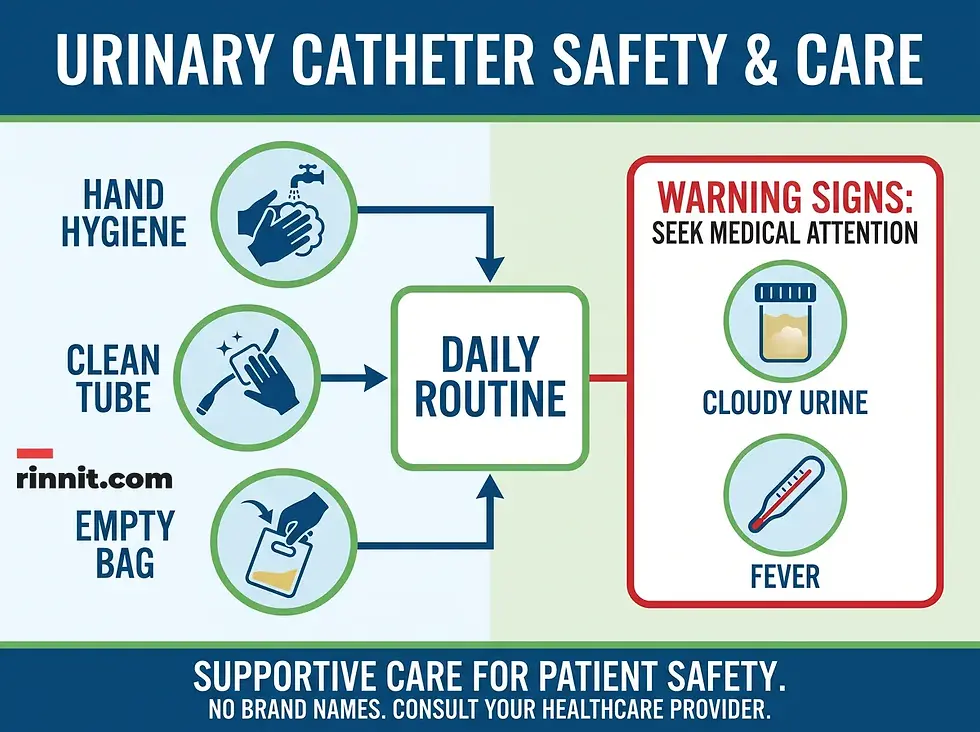
Maintaining a urinary catheter requires a disciplined hygiene routine to prevent infections, which are the most common risk associated with these devices. Hand washing with antibacterial soap is the most critical step before touching any part of the catheter system.
Patients and caregivers should clean the external tubing at least twice daily using mild soap and water, wiping away from the body to prevent the introduction of bacteria. Collection bags also need regular attention: smaller bags should be emptied every two to three hours, while larger overnight bags can typically go up to eight hours. For long-term use, the entire catheter system must be replaced at least once a month.
Conclusion
Urinary catheters are indispensable tools in modern medicine, providing a safe and effective means of bladder drainage for millions of patients. Whether used temporarily for surgery or as a long-term solution for chronic conditions, their success depends heavily on proper selection, sterile placement and rigorous daily care. By following established hygiene protocols and monitoring for signs of complications, patients can manage catheterization effectively and maintain their overall health.
Next Steps
Consult a professional: Discuss the most appropriate catheter type for your specific condition with a urologist or primary care provider.
Training: If self-catheterization is required, make sure you receive comprehensive hands-on training from a healthcare professional.
Supply management: Keep an adequate stock of sterile catheters, lubricants and collection bags to avoid interruptions in care.
Monitor your health: Keep a log of urine output and watch for changes in color, clarity or odor.
Scheduled maintenance: Set reminders for monthly catheter changes and regular bag replacements as advised by your medical team.
Related Reading
Urinary Catheter: Types, Placement, Care and Risks explains urinary catheter types, placement and care.
Frequently Asked Questions
What is the most common reason for needing a catheter?
The most common reasons include urinary retention (inability to empty the bladder), recovery from urological surgery and managing severe urinary incontinence.
Does catheter insertion hurt?
The sensation can be uncomfortable or involve pressure, but providers use numbing gels and lubricants to significantly reduce pain during the procedure.
How often should I empty the drainage bag?
Small bags should be emptied every 2 to 3 hours, while larger bags can typically be emptied every 8 hours or when they are about half full.
Can I still feel the urge to pee with a catheter?
Some patients may feel a need to urinate because of the catheter itself or bladder spasms, but urine will drain automatically.
How do I prevent infections?
Strict hand hygiene, cleaning the tubing twice daily and keeping the drainage bag below the level of the bladder are essential for preventing infections.
What is a Foley catheter?
A Foley catheter is a common type of indwelling catheter that remains in the bladder, held in place by a small water-filled balloon.
Can I shower with a catheter?
Yes, you can typically shower with a catheter. It is important to keep the area clean and make sure the tubing is secured and not pulled during the process.
What should I do if the catheter stops draining?
Check the tubing for kinks or loops. If there are no obvious obstructions and drainage does not resume, contact a healthcare provider immediately.
How often must a long-term catheter be changed?
Most indwelling catheters should be replaced at least once every month to prevent mineral buildup and infection.
What is a suprapubic catheter?
A suprapubic catheter is a device that enters the bladder through a small surgical incision in the abdomen rather than through the urethra.
Are there different sizes of catheters?
Yes. Catheters come in various diameters (measured in French units) and lengths to accommodate different anatomical needs and patient ages.
What are the signs of a catheter-associated infection?
Warning signs include cloudy or foul-smelling urine, fever, chills, and increased pain or pressure in the lower abdomen.
Can I use a catheter permanently?
In some cases involving chronic conditions like spinal cord injuries or advanced neurological diseases, permanent catheterization may be necessary.
What is a coudé tip catheter?
A coudé tip catheter has a slightly curved end, designed to help navigate past obstructions such as an enlarged prostate.
Is it normal to see blood in the catheter tubing?
Small amounts of blood may occasionally appear after insertion or a change, but persistent or heavy bleeding should be reported to a doctor.
Sources
Prieto JA, Murphy CL, Stewart F, Fader M. Intermittent catheter techniques, strategies and designs for managing long-term bladder conditions. Cochrane Database Syst Rev. 2021;10(10):CD006008. PMID 34699062. https://doi.org/10.1002/14651858.CD006008.pub5
Mercado FS, Kop MM, Danko A, Zimmerman H, Watase C. Male external catheters and urinary tract infections: a systematic review and meta-analysis of current evidence and the need for standardized reporting. Cureus. 2025;17(8):e90264. PMID 40964565. https://doi.org/10.7759/cureus.90264
Medical disclaimer
The information in this article is for educational purposes only and is not intended as a substitute for professional medical advice, diagnosis or treatment. Always seek the advice of your physician or other qualified health provider with any questions you may have regarding a medical condition. Contact a healthcare provider promptly for fever, chills, cloudy or foul-smelling urine, or a catheter that stops draining.



Comments