Nephrostomy Tube: Purpose, Placement and Care

Updated: 2 days ago
Written and medically reviewed by Dr. Baraa Alnahhal, MD · Last reviewed: November 2026 · How we review
Quick Answer
A nephrostomy tube is a thin, flexible tube placed through the skin of the lower back into the kidney to drain urine into a bag outside the body when urine can't flow normally. It's used for blockages from kidney stones, infection, tumors or scar tissue and protects kidney function. Tubes stay in for days, weeks or months.
What the research says
Nephrostomy and stents work equally well: in 7 trials with 667 people with blocked kidneys, nephrostomy tubes and ureteral stents were equally effective for infection control, quality of life and pain, but nephrostomy caused less blood in the urine and painful urination (Zul Khairul Azwadi I et al., Scientific Reports, 2021) [2]
Nephrostomy had fewer infections in stone patients: in a trial of 143 kidney stone patients with kidney injury, kidney function recovered equally fast with a nephrostomy or a stent, but nephrostomy had higher success and fewer urinary tract infections (Elbatanouny AM et al., International Journal of Urology, 2020) [3]
Key takeaways
A nephrostomy tube drains urine from the kidney into a bag.
It's used when kidney stones, tumors or other problems block urine flow.
Placement takes about an hour, often as an outpatient.
Empty the bag when half full and change the dressing at least twice a week.
The tube is usually temporary.
What is a nephrostomy tube?
A nephrostomy tube, also called a percutaneous nephrostomy, bypasses a blockage so urine can leave the kidney. You may have one in one or both kidneys. It's often temporary but can be lifesaving. Sources: [1]
Why it's used
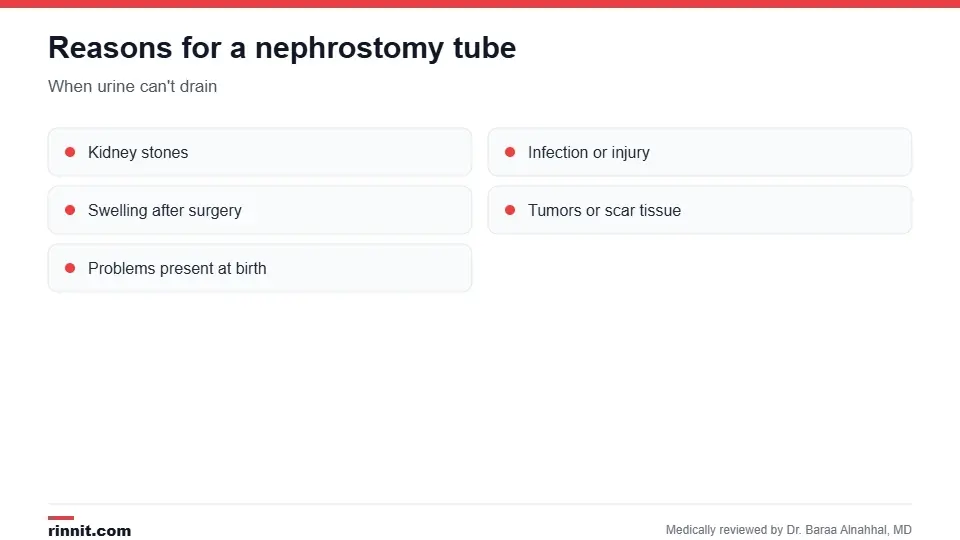
Draining the kidney prevents damage from backed-up urine.
Kidney infection or injury.
Swelling after kidney surgery.
Tumors or cancer of the ureter, bladder or prostate.
Scar tissue or ureteral obstruction.
Urinary tract problems present at birth. Sources: [1]
Without drainage, urine backs up and causes hydronephrosis and kidney damage. Sources: [1]
What happens during placement
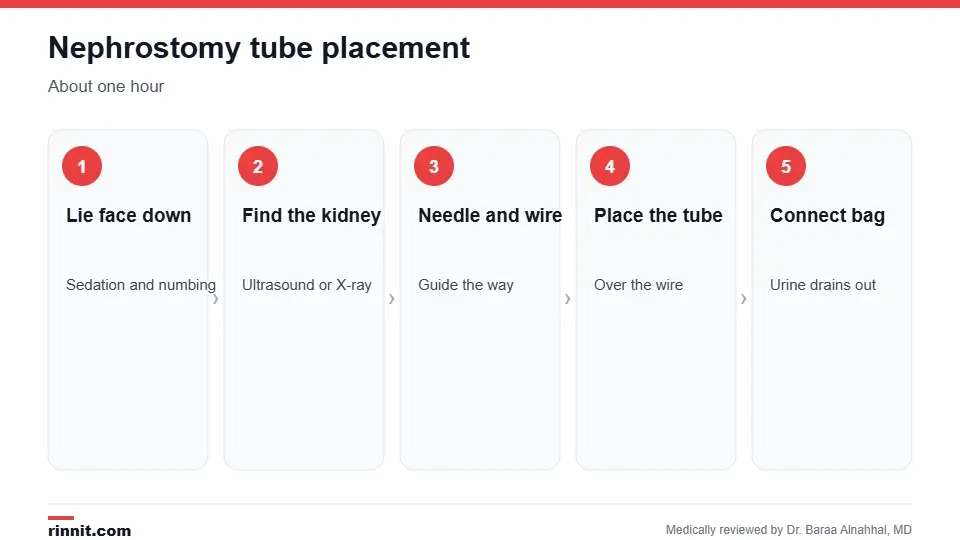
The procedure takes about one hour.
You lie face down and may get IV sedation; your lower back is numbed.
An interventional radiologist uses ultrasound or X-ray to find the kidney.
A needle and guide wire are placed into the kidney.
The tube is passed over the wire into place.
Contrast dye may confirm the position.
The outside end is connected to a drainage bag. Sources: [1]
Children and some adults may get general anesthesia. Sources: [1]
Caring for your tube
Pink urine for the first 48 hours is normal.
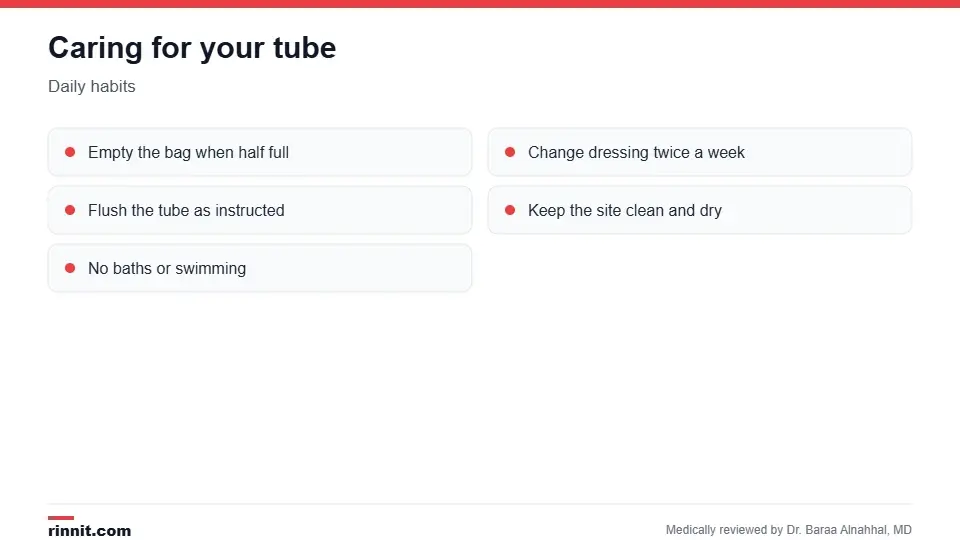
Empty the bag when it's about half full, often every 2 to 3 hours.
Change the dressing at least twice a week and whenever it's wet or dirty.
Flush the tube with sterile solution as instructed.
Keep the site clean and dry; don't take baths or swim.
You can shower after 48 hours; change the dressing right afterward. Sources: [1]
Risks
Risk | Notes |
Bleeding | Pink urine for 48 hours is normal |
Infection | Risk rises with long-term use and tube changes |
Injury to the kidney, bladder or ureter | Uncommon |
Tube falling out | Call your provider |
Reaction to contrast dye | If dye is used |
The procedure is considered low-risk and safe. Sources: [1, 2, 3]
Recovery
You'll rest in a recovery area for several hours; some people stay overnight.
Soreness at the site lasts several days.
Avoid vigorous exercise and sudden movements for several days.
The tube may stay for days, weeks, months or longer.
Removal is quick and done with numbing medicine. Sources: [1]
For some blockages, a ureteral stent placed from inside the urinary tract, often during ureteroscopy, is an alternative. Sources: [2]
When to call your provider
No urine is flowing into the bag.
Bright red urine.
Pus or cloudy yellow fluid from the tube.
Urine leaking around the tube.
A fever above 101°F (38.3°C) lasting more than 24 hours.
Severe pain or site pain that doesn't improve. Sources: [1]
Conclusion
A nephrostomy tube protects your kidney when urine can't drain normally. Careful daily care and knowing the warning signs help you avoid problems until the blockage is treated.
Keep learning: read about hydronephrosis and kidney stones.
Frequently asked questions
What is a nephrostomy tube?
A tube through the back into the kidney that drains urine into a bag.
Why would I need a nephrostomy tube?
When something blocks urine from leaving the kidney.
How long does placement take?
About one hour.
Does it hurt?
The area is numbed; soreness lasts a few days.
How long will I have the tube?
Days, weeks or months, depending on the cause.
How often do I empty the bag?
When it's about half full, often every 2 to 3 hours.
Can I shower with a nephrostomy tube?
Yes, after 48 hours; change the dressing afterward.
Can I swim or bathe?
No.
Is pink urine normal?
Yes, for the first 48 hours.
What if the tube falls out?
Call your provider right away.
Related Reading
Ureterostomy: Purpose, Procedure, Care and Recovery explains ureterostomy.
Ureteral Stent: Why It's Used, Placement, Side Effects and Removal explains ureteral stents and what to expect.
Hydronephrosis: What Causes Kidney Swelling, How It Is Found, and How It Is Treated kidney swelling from backed-up urine.
Kidney Stones: Symptoms, Causes, and Treatment Guide a common cause of blockage.
Ureteral Obstruction: Symptoms, Causes, and Treatment a blocked ureter.
Ureteroscopy: Procedures, Stone Treatment, and Recovery Guidelines treating stones from inside the urinary tract.
Urinary Catheter: Types, Placement, Care and Risks another type of urinary drainage.
References
Cleveland Clinic. Nephrostomy Tube: Care, Purpose & Complications. Cleveland Clinic. Last updated July 20, 2023. https://my.clevelandclinic.org/health/treatments/25141-nephrostomy-tube
Zul Khairul Azwadi I, Norhayati MN, Abdullah MS. Percutaneous nephrostomy versus retrograde ureteral stenting for acute upper obstructive uropathy: a systematic review and meta-analysis. Scientific Reports. 2021;11(1):6613. PMID 33758312. https://doi.org/10.1038/s41598-021-86136-y
Elbatanouny AM, Ragheb AM, Abdelbary AM, et al. Percutaneous nephrostomy versus JJ ureteric stent as the initial drainage method in kidney stone patients presenting with acute kidney injury: a prospective randomized study. International Journal of Urology. 2020;27(10):916-921. PMID 32851713. https://doi.org/10.1111/iju.14331
Medical disclaimer
This article is for general education only and does not replace advice from a qualified healthcare professional. Talk to your doctor about your own diagnosis and treatment, and seek emergency care right away for severe or sudden symptoms.



Comments