Ureteral Stent: Why It's Used, Placement, Side Effects and Removal

Updated: 2 days ago
Written and medically reviewed by Dr. Baraa Alnahhal, MD · Last reviewed: November 2026 · How we review
Quick Answer
A ureteral stent is a thin, flexible tube placed inside a ureter, the tube that carries urine from the kidney to the bladder, to keep it open. It's most often used to let urine get past a kidney stone. Most stents stay in for a few days to a few weeks. Side effects like bladder irritation are common.
What the research says
Medicines eased stent discomfort: a meta-analysis of 14 trials with 2,842 patients found alpha-blockers, antimuscarinics and PDE5 inhibitors each reduced stent symptoms compared with placebo, and combining an alpha-blocker with an antimuscarinic worked better than either alone (Pecoraro A et al., Urologia Internationalis, 2023) [2]
Solifenacin lowered stent symptom scores: in 10 studies of 1,786 people with ureteral stents, solifenacin lowered stent symptom scores by 14.90 points compared with control, with only slightly more dry mouth (Wang J et al., World Journal of Urology, 2017) [3]
Key takeaways
A ureteral stent keeps a ureter open so urine can drain.
It's most often used with kidney stones.
Placement usually takes less than 30 minutes.
Bladder irritation and blood in urine are common side effects.
Most stents stay in for a few days to a few weeks.
What is a ureteral stent?
A ureteral stent is also called a urinary, ureteric or double-J stent. It's usually about 8 to 12 inches long and only a few millimeters wide, with a coil in the kidney and a loop in the bladder. It's different from a nephrostomy tube, which drains urine to a bag outside your body. Learn about your ureters. Sources: [1]
Why it's used
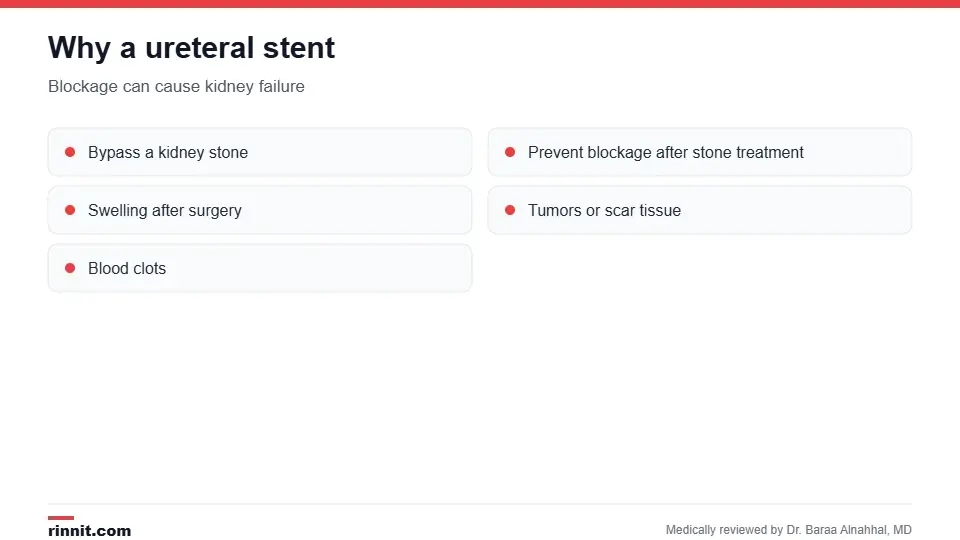
Untreated blockage can lead to kidney failure or sepsis.
Let urine get past a kidney stone.
Prevent new blockage after stone treatment, such as ureteroscopy.
Prevent blockage from swelling after surgery.
Treat blockages from tumors, scar tissue, blood clots or ureteropelvic junction obstruction. Sources: [1]
Without treatment, a blocked ureter can lead to life-threatening kidney failure or sepsis. Sources: [1]
How to prepare
Share your medicines, supplements and allergies; some supplements raise bleeding risk.
You may have blood tests to check kidney function.
Don't eat or drink for at least eight hours; take needed medicines with a small sip of water.
Arrange a ride home. Sources: [1]
What happens during placement

Placement usually takes less than 30 minutes.
You get general anesthesia and lie on your back.
The urologist passes a cystoscope through your urethra into your bladder.
Using X-ray or ultrasound, a guidewire is passed into the blocked ureter.
The stent is placed over the wire.
The wire and scope are removed. Sources: [1]
Side effects
Side effect | Notes |
Bladder irritation and spasms | Common |
Frequent or painful urination | Common |
Blood in urine | Usually improves in a few days |
Pain when peeing | From the loop rubbing the bladder wall |
Urinary tract infections | Possible |
Blocked, broken or moved stent | Possible |
Up to 80% of people have one or more side effects. Sources: [1, 2, 3]
Recovery
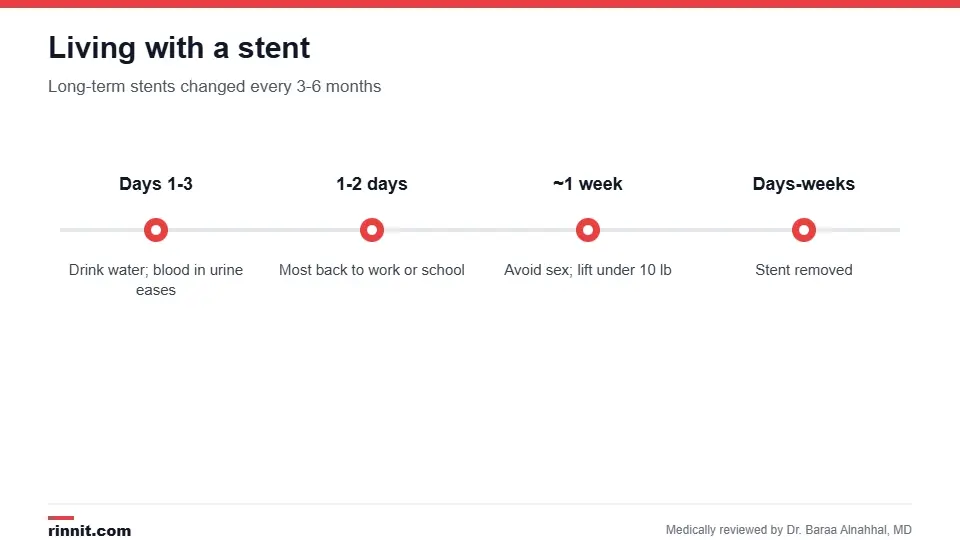
Long-term stents are replaced every three to six months.
Drink lots of water for a few days.
Blood in your urine and discomfort usually improve within a few days.
Your provider may suggest NSAIDs or prescribe tamsulosin (Flomax).
Most people return to work or school in a day or two.
Avoid lifting more than 10 pounds for a few days and sex for at least a week. Sources: [1, 2]
Stent removal
Most stents stay in for a few days to a few weeks. Some are removed by pulling a string; others need a quick office procedure with numbing gel and a cystoscope. Don't miss your removal or replacement appointment: a stent left in too long can become crusted, blocked or infected and can damage your kidney. Long-term stents are replaced every three to six months. Sources: [1]
When to call your provider
Clots in your urine.
Dark, cloudy or foul-smelling urine.
Trouble urinating or severe pain or burning.
Kidney pain.
Nausea and vomiting.
Fever or chills. Sources: [1]
Conclusion
A ureteral stent keeps urine flowing when a ureter is blocked, protecting your kidney. Side effects are common but usually manageable and go away once the stent is removed.
Keep learning: read about kidney stones and ureteroscopy.
Frequently asked questions
What is a ureteral stent?
A thin tube that keeps a ureter open so urine can drain.
Why would I need a ureteral stent?
Most often for a kidney stone or swelling after stone treatment.
How is a stent placed?
With a cystoscope through the urethra under anesthesia.
How long does placement take?
Usually less than 30 minutes.
How long does a stent stay in?
Usually a few days to a few weeks.
Is it normal to see blood in my urine?
Yes, especially in the first few days.
Why does a stent hurt when I pee?
The loop can rub the bladder wall.
Can medicine help stent pain?
Yes. Medicines like tamsulosin can ease symptoms.
How is a stent removed?
By pulling a string or with a quick office procedure.
When should I call my provider?
For fever, chills, severe pain or trouble urinating.
Related Reading
Kidney Stones: Symptoms, Causes, and Treatment Guide the most common reason for a stent.
Ureteroscopy: Procedures, Stone Treatment, and Recovery Guidelines stone treatment that often uses a stent.
Ureteral Obstruction: Symptoms, Causes, and Treatment blockages stents treat.
Nephrostomy Tube: Purpose, Placement and Care another way to drain a blocked kidney.
Hydronephrosis: What Causes Kidney Swelling, How It Is Found, and How It Is Treated kidney swelling from blocked urine.
References
Cleveland Clinic. Ureteral Stent: Purpose, Procedure, Results & Removal. Cleveland Clinic. Last updated January 7, 2025. https://my.clevelandclinic.org/health/treatments/21795-ureteral-stents
Pecoraro A, Peretti D, Tian Z, et al. Treatment of ureteral stent-related symptoms. Urol Int. 2023;107(3):288-303. PMID 34818261. https://doi.org/10.1159/000518387
Wang J, Zhang X, Zhang T, et al. The role of solifenacin, as monotherapy or combination with tamsulosin in ureteral stent-related symptoms: a systematic review and meta-analysis. World J Urol. 2017;35(11):1669-1680. PMID 28550362. https://doi.org/10.1007/s00345-017-2051-3
Medical disclaimer
This article is for general education only and does not replace advice from a qualified healthcare professional. Talk to your doctor about your own diagnosis and treatment, and seek emergency care right away for severe or sudden symptoms.



Comments