Ureteropelvic Junction (UPJ) Obstruction: Causes, Symptoms, and Treatments

Updated: 2 days ago
Medically reviewed by Dr. Baraa Alnahhal, MD · Last reviewed: October 17, 2026
Quick Answer
Ureteropelvic junction obstruction is a blockage at the upper end of the ureter where it meets the kidney's renal pelvis. [1] It is usually congenital, affecting approximately 1 in 1,500 infants, and often detected on prenatal ultrasound showing kidney swelling. [1] Symptoms include flank pain and recurrent UTIs. [1] Mild cases in infants are observed, while persistent blockages are treated with pyeloplasty. [1]
What the research says
Pyeloplasty in infants has a low failure rate, whether open or minimally invasive. A meta-analysis of 9 studies covering 3,145 pyeloplasties in infants found surgical failure in 5.2% of open procedures versus 4.2% of minimally invasive procedures, a difference that was not statistically significant; minimally invasive surgery took longer but shortened hospital stay (2.2 versus 3.2 days). (Cascini et al., Front Pediatr, 2022) [2]
Robot-assisted surgery matches open surgery for children. Pooling 26 studies with 6,074 pyeloplasties in children, researchers found no significant difference in success rate or postoperative complications between robotic-assisted laparoscopic and open pyeloplasty, with a shorter hospital stay for the robotic approach (mean difference −1.00 day). (Sun et al., Pediatr Surg Int, 2023) [3]
Long-term follow-up matters because partial blockage has been linked to higher blood pressure. A review of experimental and clinical studies reports that partial UPJ obstruction is causally linked to hypertension in animal models, and that clinical reports in adults and recent prospective studies in children have associated hydronephrosis with elevated blood pressure that could be reduced by surgical management. (Carlström, Acta Paediatr, 2019) [4]
What Is Ureteropelvic Junction (UPJ) Obstruction?
Ureteropelvic Junction (UPJ) obstruction refers to a significant blockage at the upper end of the ureter, specifically where it joins the renal pelvis of the kidney. [1] The renal pelvis is a funnel-like structure that collects urine filtered by the kidney before it travels down the ureter to the bladder. [1] When this junction is obstructed, urine flow is slowed or stopped entirely, causing fluid to back up and the kidney to swell—a condition known as hydronephrosis. [1]
This condition is primarily a congenital abnormality, meaning it is present at birth, and it occurs in roughly 1 out of every 1,500 births. [1] While it typically affects only one kidney, it is a serious condition because prolonged obstruction can lead to permanent kidney damage or even complete kidney failure if not managed appropriately. [1]

Symptoms and Warning Signs
The symptoms of UPJ obstruction can vary depending on the age of the patient and the severity of the blockage. In many infants, the condition is asymptomatic and only discovered through routine prenatal imaging. However, visible or physical signs may emerge as the child grows or if the condition develops in an adult.
Commonly reported symptoms include:
Abdominal and side pain: Known as flank pain, this is often the most noticeable sign in older children and adults. [1]
Physical changes: An observable lump or mass in the abdomen, often caused by the enlarged, fluid-filled kidney. [1]
Urinary issues: Recurrent urinary tract infections (UTIs) accompanied by fever, or the presence of blood in the urine (hematuria). [1]
Systemic distress: Nausea, vomiting, and in infants, a failure to thrive or developmental delays. [1]
Understanding the Causes
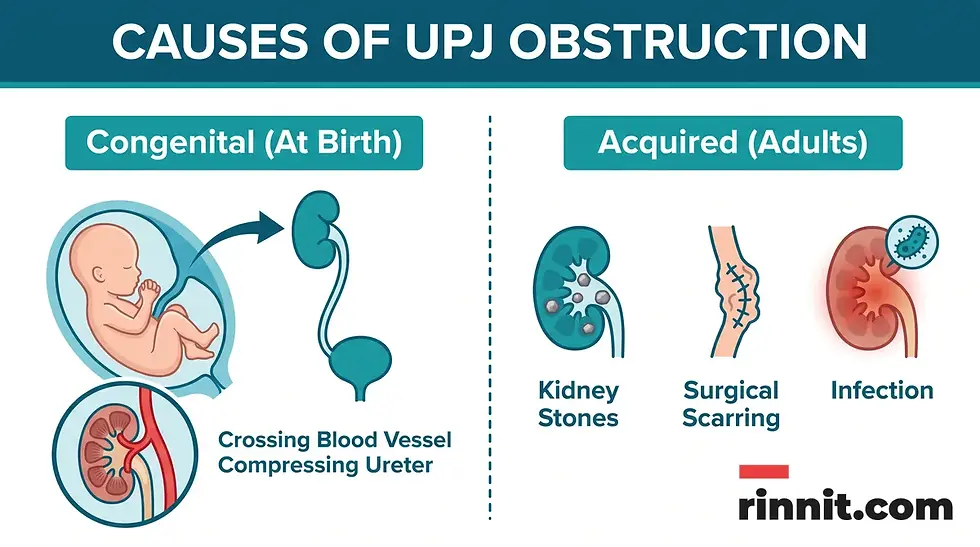
The vast majority of UPJ obstructions are congenital, resulting from the kidney or ureter failing to form correctly during fetal development. [1] These occurrences are typically random and not linked to any specific maternal diet or lifestyle choices during pregnancy.
In some cases, the obstruction is caused by a "crossing vessel"—a blood vessel that abnormally crosses over the UPJ and compresses it. [1] While rare, adults can also develop UPJ obstruction later in life. Acquired causes in adults include:
Diagnosis and Clinical Testing
Modern medicine allows for early detection, often before a child is even born. Prenatal ultrasounds frequently identify hydronephrosis [1], prompting further investigation after birth. For older children and adults, healthcare providers use a combination of laboratory tests and advanced imaging to confirm the diagnosis and assess kidney function.
Test type | Purpose and function |
Urinalysis & blood tests | Checks for infection and measures markers like BUN and creatinine to assess kidney health. [1] |
Renal scan | Uses a radioactive tracer to visualize how well the kidneys are filtering and draining. [1] |
Intravenous pyelogram (IVP) | An X-ray procedure using dye to trace the path of urine through the kidneys and ureters. [1] |
Imaging (CT/MRI) | Provides detailed structural views of the obstruction and the surrounding anatomy. [1] |
Treatment and Management Strategies
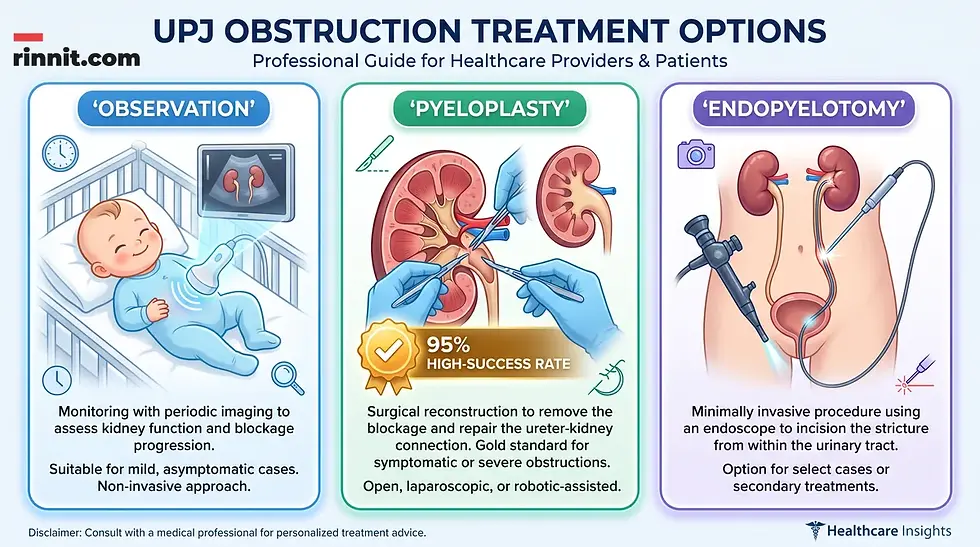
The treatment path for UPJ obstruction is highly individualized. In many infants, the blockage is mild and may resolve spontaneously within the first 18 months of life. [1] In these cases, a "watch and wait" approach with regular ultrasound monitoring is standard. [1]
If the obstruction persists or causes symptoms, surgical intervention is necessary:
Pyeloplasty: The gold standard for treatment. A urologist removes the blocked segment and reattaches the ureter to the kidney with a wider opening. [1] This can be done through a traditional open incision or using minimally invasive robotic techniques. [1] Both methods boast a success rate of approximately 95%.
Endopyelotomy: A less invasive procedure where the surgeon uses an endoscope to cut the blockage from the inside. [1] While it requires no external incisions, it generally has a lower success rate than pyeloplasty. [1]
Conclusion and Long-Term Outlook
With early diagnosis and appropriate intervention, the prognosis for individuals with UPJ obstruction is excellent. Most children who undergo treatment lead healthy lives without long-term kidney issues. However, awareness is key—recognizing symptoms like flank pain or recurrent UTIs can prevent the progression toward kidney failure.
For more expert health guides and wellness resources, visit Rinnit.com.
Frequently Asked Questions
Can UPJ obstruction be prevented during pregnancy?
No, there is no known link between maternal diet or lifestyle and the development of congenital UPJ obstruction.
Does UPJ obstruction always require surgery?
Not always. Many cases in infants improve on their own and only require careful monitoring.
Which kidney is more commonly affected?
The left kidney is statistically twice as likely to have a UPJ obstruction than the right kidney.
What is hydronephrosis?
Hydronephrosis is the swelling of a kidney due to a backup of urine, often caused by a blockage like UPJ obstruction.
How long is the recovery after pyeloplasty?
Most patients recover within two to four weeks, though this varies by individual.
Can adults develop UPJ obstruction for the first time?
Yes, though rare, it can occur due to kidney stones, surgery, or infections.
Is UPJ obstruction hereditary?
While most cases occur randomly, you may be slightly more likely to have it if a family member was also affected.
What happens if I don't treat a UPJ obstruction?
Untreated, it can lead to chronic pain, recurrent infections, and eventually kidney failure.
Are males or females more at risk?
Males are more than twice as likely to be born with this condition.
What is a "crossing vessel"?
A crossing vessel is a blood vessel that passes over the ureter in a way that pinches it shut, causing a blockage.
Will my child need multiple surgeries?
Most children only need one pyeloplasty, as it has a very high success rate (about 95%).
Can a renal scan show how much kidney function is left?
Yes, it is one of the best tools for measuring the relative function of each kidney.
Is blood in the urine a common sign?
Yes, hematuria can occur, especially if the blockage has led to the formation of kidney stones.
Can UPJ obstruction cause high blood pressure?
In some cases, kidney issues related to obstruction can lead to secondary hypertension.
When should I take my child to the ER?
Seek emergency care if your child is unable to urinate or has a high fever with severe back pain.
Related Reading
Renal Scan (Kidney Scan): Types, Preparation, Risks and Results explains the nuclear medicine scan used to measure kidney function, blood flow and blockages.
Renal MAG3 Scan: Kidney Function and Drainage Test Explained explains the nuclear scan that shows how well the kidneys work and drain.
References
Cleveland Clinic. Ureteropelvic junction obstruction. Cleveland Clinic Health Library. Last updated December 13, 2024. Accessed October 14, 2026. https://my.clevelandclinic.org/health/diseases/16596-ureteropelvic-junction-obstruction
Cascini V, Lauriti G, Di Renzo D, Miscia ME, Lisi G. Ureteropelvic junction obstruction in infants: open or minimally invasive surgery? A systematic review and meta-analysis. Front Pediatr. 2022;10:1052440. PMID: 36507128. https://doi.org/10.3389/fped.2022.1052440
Sun M, Yu C, Zhao J, et al. The efficacy of robotic-assisted laparoscopic pyeloplasty for pediatric ureteropelvic junction obstruction: a systematic review and meta-analysis. Pediatr Surg Int. 2023;39(1):265. PMID: 37673951. https://doi.org/10.1007/s00383-023-05541-8
Carlström M. Hydronephrosis and risk of later development of hypertension. Acta Paediatr. 2019;108(1):50-57. PMID: 29959876. https://doi.org/10.1111/apa.14482
Disclaimer: The information provided in this article is for educational purposes only and should not be considered medical advice. Always consult with a qualified healthcare provider for diagnosis and treatment of any medical condition. If you are experiencing a medical emergency, call 911 or your local emergency services immediately.
Medical disclaimer
The information provided in this article is for educational purposes only and should not be used as a substitute for professional medical advice, diagnosis, or treatment. Always seek the advice of your physician or other qualified health provider with any questions you may have regarding a medical condition.



Comments