Pyeloplasty: Restoring Kidney Drainage and Function

Updated: 3 days ago
Medically reviewed by Dr. Baraa Alnahhal, MD · Last reviewed: October 2026
Pyeloplasty is a surgical procedure designed to correct a blockage at the ureteropelvic junction (UPJ), where the kidney meets the ureter. [1] By removing the obstructed segment and reattaching the healthy tissues, surgeons restore normal urine flow to the bladder. [1] This procedure is highly effective, with a 95% success rate, and can be performed using minimally invasive techniques to reduce recovery time and improve long-term kidney health.
Quick Answer
Pyeloplasty is a surgery that removes a blockage or narrowing at the ureteropelvic junction, where the kidney meets the ureter. [1] Restoring urine flow prevents kidney damage, chronic pain and recurrent infections from urine backing up. It is commonly performed on infants born with obstructions and on adults with symptoms, typically with full recovery in three to four weeks.
What the research says
Minimally invasive and open pyeloplasty work about equally well in infants. A meta-analysis of 11 studies found no significant difference in success rate between the two approaches (odds ratio 1.35, 95% CI 0.59 to 3.07); minimally invasive surgery took longer in the operating room but was linked to a shorter hospital stay (Wang et al., PeerJ, 2023 [2]).
Kidney swelling usually improves after surgery. In 125 children followed for two years, 90% had reached resolution of hydronephrosis by 12 months and 93% by 24 months (defined as a pelvic diameter under 10 mm or a drop of more than 50%), and the study reported a total success rate of 91% (121/135) (Värelä et al., Journal of Pediatric Urology, 2021 [3]).
Complete disappearance of the swelling is uncommon. In children who had pyeloplasty, the kidney pelvis measured 0 cm in only 11.5% (12 of 105) at a median of 3 months and 13.8% (9 of 65) at a median of 1.9 years, and no clinical factor predicted full resolution (Carpenter et al., Urology, 2018 [4]).
What Is Pyeloplasty?
Pyeloplasty serves as a critical intervention for individuals experiencing ureteropelvic junction (UPJ) obstruction, a condition that prevents urine from traveling naturally from the kidney to the bladder. [1] When urine becomes trapped in the renal pelvis, it can lead to hydronephrosis, which is the swelling of the kidney. [1] If left untreated, this pressure can cause permanent kidney damage or chronic infections. The surgical process involves removing the narrowed or blocked portion of the ureter and rejoining the healthy ureter to the kidney's renal pelvis to ensure an unobstructed pathway for waste elimination. [1]

Who Requires Pyeloplasty?
UPJ obstructions are often congenital, affecting approximately 1 in 1,500 newborns. [1] While some cases in infants improve naturally within 18 months, others require surgical correction to protect kidney function. Beyond infancy, older children, teenagers, and adults may develop obstructions due to scarring, kidney stones, or other factors. Healthcare providers typically identify the need for surgery through imaging tests such as ultrasounds or CT scans that reveal significant kidney swelling or decreased function.
Patient Group | Indication for Surgery |
Infants | Congenital UPJ obstruction that does not improve by 18 months. [1] |
Children & Teens | Symptomatic obstruction causing pain, infections, or kidney swelling. |
Adults | New or chronic blockages leading to decreased kidney function or pain. |
What surgical methods are used for pyeloplasty, and how do you prepare?
Modern pyeloplasty is often performed using minimally invasive techniques, though the specific approach depends on the patient's anatomy and the nature of the blockage. Surgeons may utilize laparoscopic methods involving small incisions, endoscopic routes through the urethra, or traditional open surgery for more complex cases. Preparation generally involves fasting for eight hours prior to the procedure and adjusting current medications under medical guidance. [1] Most patients should arrange for a hospital stay of at least one night following the operation. [1]
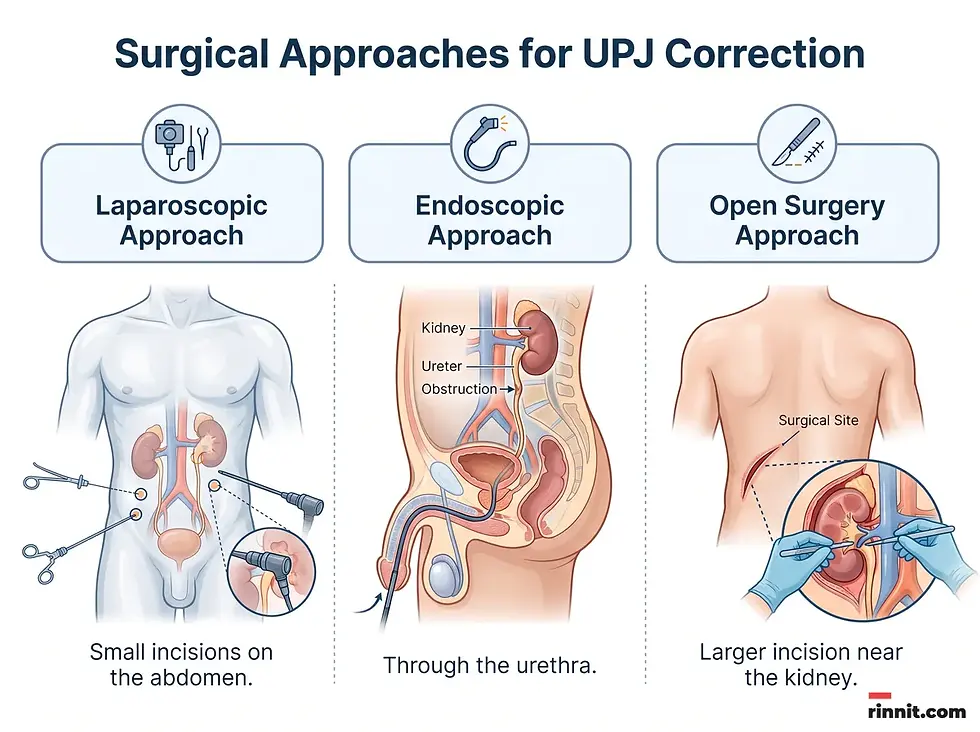
The procedure itself typically lasts between two and three hours under general anesthesia. [1] During the surgery, the surgeon removes the blocked segment and reattaches the ureter. [1] In many cases, a temporary stent is placed to keep the new junction open and allow for proper drainage during the initial healing phase. This stent is removed once the tissues have sufficiently recovered. [1]
What is recovery like after pyeloplasty, and what is the long-term outlook?
Initial recovery from pyeloplasty usually takes one to two weeks, with most patients returning to their normal daily activities within three to four weeks. [1] During the first week, it is common to experience mild pain or see small amounts of blood in the urine, particularly if a stent is in place. Stent removal is a straightforward process; external stents are pulled out by removing skin stitches, while internal stents may require a brief procedure under anesthesia. While kidney swelling (hydronephrosis) often begins to resolve within a year, some residual swelling may persist permanently even after successful drainage is restored. [1] [4]

What are the success rates and risks of pyeloplasty?
Pyeloplasty is highly effective, boasting a success rate of approximately 95% in both pediatric and adult populations. [1] This high level of efficacy means that the vast majority of patients experience significant symptom relief and long-term protection of their kidney health. However, as with any major surgical intervention, there are inherent risks, including potential reactions to anesthesia, bleeding, infection, or damage to nearby organs. [1] In rare cases, scarring may cause the obstruction to recur, necessitating further treatment.
Conclusion and Next Steps
Pyeloplasty is a vital and highly successful surgical solution for correcting ureteropelvic junction obstructions. By restoring the natural flow of urine, the procedure relieves pain and prevents the long-term complications associated with kidney swelling. If you or your child have been diagnosed with a UPJ obstruction, consult with a urologist to determine if pyeloplasty is the most appropriate path for restoring kidney health and ensuring a high quality of life.
Frequently Asked Questions
How long does a pyeloplasty procedure typically take?
A pyeloplasty surgery usually takes between two and three hours to complete, depending on the complexity of the blockage and the surgical approach used.
Is pyeloplasty considered a major surgery?
Pyeloplasty is a significant operation performed under general anesthesia, but it is usually done with minimally invasive laparoscopic or endoscopic techniques to limit trauma and recovery time.
What is the success rate of pyeloplasty?
The procedure has a very high success rate of approximately 95%, effectively restoring urine flow and relieving symptoms for the vast majority of patients.
How long is the hospital stay after pyeloplasty?
Most patients remain in the hospital for one to two days after the surgery for monitoring and to ensure they can eat, drink, and move comfortably.
When can I return to normal activities after surgery?
Patients can typically return to their standard daily activities within three to four weeks, though strenuous lifting and exercise should be avoided for at least four to six weeks.
Will the kidney swelling go away immediately?
While urine drainage is restored quickly, kidney swelling (hydronephrosis) may take one to two years to decrease and may not disappear entirely in all cases.
What are the main risks of pyeloplasty?
Potential risks include infection, bleeding, scarring that causes a repeat blockage, urine leakage at the surgical site, and typical risks associated with general anesthesia.
Is a stent always used during pyeloplasty?
Surgeons frequently place a temporary stent (a small tube) to ensure the ureter remains open and drains properly while the new junction heals.
How is the stent removed after surgery?
External stents are removed by cutting skin stitches and pulling the tube out, while internal stents are removed during a brief follow-up procedure, often under anesthesia.
What warning signs should I look for after surgery?
Contact your healthcare provider if you experience a fever, signs of infection at the incision site, severe uncontrolled pain, or bright red blood in your urine.
How do I prepare for pyeloplasty?
Preparation generally involves fasting for eight hours before the procedure and adjusting your current medications under medical guidance. Plan for a hospital stay of at least one night after the operation [1].
Does pyeloplasty hurt, and what anesthesia is used?
The procedure is done under general anesthesia, so you are asleep and do not feel it. During the first week of recovery, mild pain and small amounts of blood in the urine are common, particularly if a stent is in place [1].
Related Reading
References
Cleveland Clinic. Pyeloplasty. Cleveland Clinic. February 12, 2024. https://my.clevelandclinic.org/health/procedures/16545-pyeloplasty
Wang M, et al. Minimally invasive pyeloplasty versus open pyeloplasty for ureteropelvic junction obstruction in infants: a systematic review and meta-analysis. PeerJ. 2023;11:e16468. PMID 38025670. https://doi.org/10.7717/peerj.16468
Värelä S, et al. Resolution of hydronephrosis after pyeloplasty in children. Journal of Pediatric Urology. 2021;17(1):102.e1-102.e7. PMID 33218882. https://doi.org/10.1016/j.jpurol.2020.10.031
Carpenter CP, et al. Hydronephrosis after pyeloplasty: "Will it go away?" Urology. 2018;121:158-163. PMID 30125645. https://doi.org/10.1016/j.urology.2018.08.010
Medical disclaimer
The information provided in this article is for educational purposes only and should not be used as a substitute for professional medical advice, diagnosis, or treatment. Always seek the advice of your physician or other qualified health provider with any questions you may have regarding a medical condition.



Comments