Renal MAG3 Scan: Kidney Function and Drainage Test Explained

Updated: 3 days ago
Written and medically reviewed by Dr. Baraa Alnahhal, MD · Last reviewed: November 2026 · How we review
Quick Answer
A renal MAG3 scan is a nuclear imaging test that shows how well each kidney works and how urine drains. A radioactive tracer called MAG3 is injected into a vein, and a gamma camera follows it. It helps diagnose blockages and hydronephrosis. It's safe for children and adults and takes about one to two hours.
What the research says
Drainage time helps predict who needs surgery: in 535 infants with ureteropelvic junction obstruction, the urine drainage half-time on the first diuretic renogram predicted future surgery, and about half of those with a half-time of 21–40 minutes could be managed without an operation (Krill AJ et al., J Pediatr Urol, 2021) [2]
Scans work best with ultrasound: a study of children with hydronephrosis concluded that combining ultrasound with a MAG3 scan gives both the anatomy and function needed to decide between surgery and watchful follow-up (Kandur Y et al., Int Urol Nephrol, 2018) [3]
Key takeaways
Nuclear scan showing kidney function, blood flow and drainage.
Helps find blockages, hydronephrosis and renal artery stenosis.
Used for children and adults, and before kidney transplant.
Usually no special preparation; takes about 1–2 hours.
Very low radiation; the tracer leaves in your urine.
What is a MAG3 scan?
MAG3 (mercaptoacetyltriglycine) is a tracer that the kidneys filter and send into the urine. A gamma camera tracks it to show how well each kidney works and drains. MAG3 can give clearer images than other tracers in some people, especially children and people with poor kidney function. It's a type of renal scan. Sources: [1]
Why is it done?
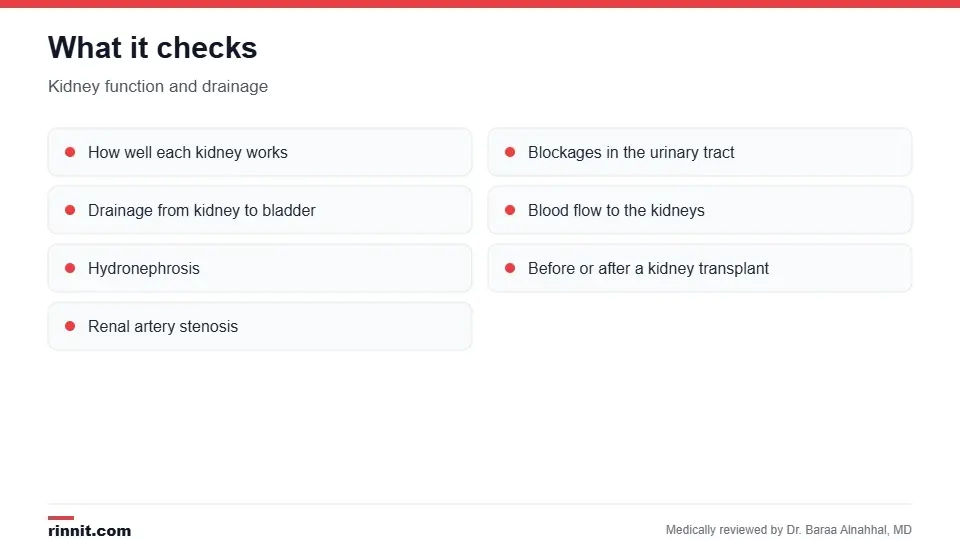
A MAG3 scan checks how the kidneys work and drain.
To check overall kidney function and how much each kidney contributes.
To look for blockages, such as ureteropelvic junction obstruction or ureteral obstruction.
To evaluate hydronephrosis, a swollen kidney.
To check blood flow, including renal artery stenosis.
To help diagnose acute tubular necrosis.
To assess the kidneys before a kidney transplant. Sources: [1]
How do I prepare?
Usually no special preparation is needed; eat, drink and take your medicines as normal unless told otherwise. Tell your provider if you're pregnant. Children can bring a comfort item, and a parent can usually stay with them. Sources: [1]
What happens during the scan?

The scan takes about one to two hours in total.
You empty your bladder; young children may have a catheter placed.
You lie on a table and an IV is placed, usually in your arm.
MAG3 tracer is injected, and the gamma camera takes images for 20–40 minutes while you lie very still.
Sometimes a diuretic is given to increase urine flow and test drainage.
You empty your bladder again, and a final image is taken. Sources: [1]
Risks
The scan is generally safe with no side effects. It uses a very small amount of radiation; the tracer becomes inactive within hours and leaves your body in your urine. The camera itself gives off no radiation. The IV may cause mild discomfort or bruising. Sources: [1]
Understanding your results
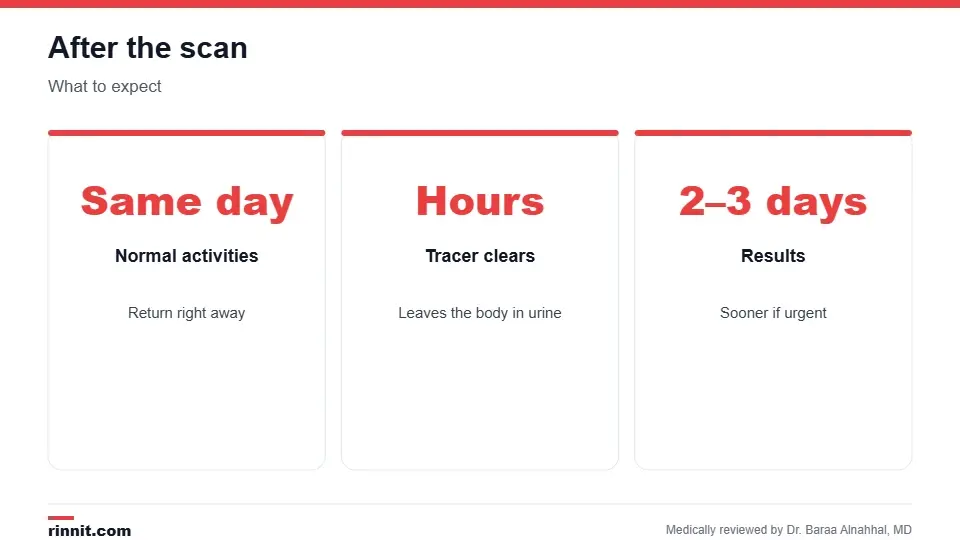
You can return to normal activities right away.
A radiologist reviews the images with your history and earlier scans. Results are usually ready in two to three days, or right away if urgent. They show how well each kidney works and whether urine drains normally; slow drainage can suggest a blockage. In children with hydronephrosis, results are often followed over time with ultrasound and repeat scans. Sources: [1, 2, 3]
Conclusion
A renal MAG3 scan is a safe, gentle way to see how well each kidney works and drains. It's especially valuable for children with hydronephrosis and for anyone being checked for a urinary blockage or before a transplant.
Keep learning: read about hydronephrosis and the renal scan.
Frequently asked questions
What is a MAG3 scan?
A nuclear scan showing kidney function and drainage.
Why is it done?
To check kidney function, blockages, blood flow and before transplant.
Is it safe for children?
Yes. It's commonly used in children.
Do I need to prepare?
Usually not; eat and drink normally.
How long does it take?
About one to two hours.
Does it hurt?
Only the IV placement may cause mild discomfort.
Is there radiation?
A very small amount that leaves your body in urine.
Why is a diuretic sometimes given?
To test how well urine drains from the kidneys.
When will I get results?
Usually within two to three days.
Can I go back to normal activities?
Yes, right after the scan.
Related Reading
Nuclear Medicine Imaging: How Tracer Scans Work, Safety and Results explains how tracer-based scans show how organs work.
Renal Scan (Kidney Scan): Types, Preparation, Risks and Results an overview of nuclear kidney scans.
Hydronephrosis: What Causes Kidney Swelling, How It Is Found, and How It Is Treated kidney swelling often checked with MAG3.
Ureteropelvic Junction (UPJ) Obstruction: Causes, Symptoms, and Treatments a common blockage MAG3 evaluates.
Obstructive Uropathy: Symptoms, Causes, and Recovery urinary blockage and its effects.
Kidney Transplant: Understanding the Procedure, Benefits, and Recovery when MAG3 may be used.
References
Cleveland Clinic. Renal MAG3 Scan: What It Is, Purpose, Procedure & Side Effects. Cleveland Clinic. Last updated July 15, 2024. https://my.clevelandclinic.org/health/diagnostics/15365-renal-mag3-scan
Krill AJ, Varda BK, Freidberg NA, et al. Predicting the likelihood of prolongation of half-time among infants with initially indeterminate drainage values: a single-institution retrospective study of 535 patients with ureteropelvic junction obstruction. J Pediatr Urol. 2021;17(4):512.e1-512.e7. PMID 34253460. https://doi.org/10.1016/j.jpurol.2021.05.022
Kandur Y, Salan A, Guler AG, et al. Diuretic renography in hydronephrosis: a retrospective single-center study. Int Urol Nephrol. 2018;50(7):1199-1204. PMID 29797216. https://doi.org/10.1007/s11255-018-1893-y
Medical disclaimer
This article is for general education only and does not replace advice from a qualified healthcare professional. Talk to your doctor about your own diagnosis and treatment, and seek emergency care right away for severe or sudden symptoms.



Comments