Continuous Bladder Irrigation (CBI): Purpose and Procedure

Updated: 2 days ago
Written and medically reviewed by Dr. Baraa Alnahhal, MD · Last reviewed: November 2026 · How we review
Quick Answer
Continuous bladder irrigation (CBI) is a hospital procedure that constantly flushes the bladder with sterile saline while draining urine at the same time. It's most often used after bladder or prostate surgery to prevent or clear blood clots that can block urine flow. It uses a three-way Foley catheter. CBI is generally safe, though it may feel uncomfortable.
What the research says
Irrigation may lower bladder cancer recurrence: in a review of 6 trials after bladder tumor removal, saline irrigation reduced 2-year recurrence compared with no irrigation in 2 studies with 935 people, and matched bladder chemotherapy with fewer side effects (Li M et al., ANZ Journal of Surgery, 2021) [2]
Saline irrigation matched bladder chemotherapy: in 4 randomized trials with 861 people, saline irrigation after bladder tumor surgery gave similar 1- and 2-year recurrence-free survival as chemotherapy instilled into the bladder, with less bleeding and bladder irritation (Zhou Z et al., World Journal of Urology, 2019) [3]
Key takeaways
CBI continuously flushes the bladder with sterile saline.
It's used mainly after bladder or prostate surgery to clear blood clots.
A three-way Foley catheter delivers fluid and drains urine.
Irrigation continues until urine is clear or light pink.
It's generally very safe.
What is continuous bladder irrigation?
After surgery on the bladder or prostate, blood in the urine can form clots that block the catheter. CBI keeps fluid moving so clots can't build up. Irrigation can also be intermittent, done only when needed or at set times. Sources: [1]
Why it's done
Irrigation after surgery continues until your urine is clear or slightly pink.
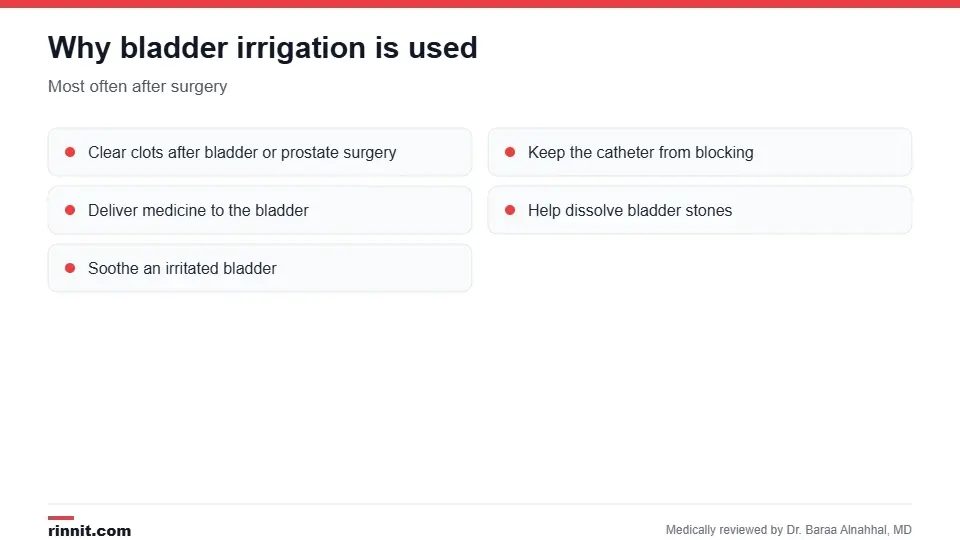
Clear blood clots, tissue or debris after surgery such as TURP or bladder tumor removal.
Prevent a blocked catheter, which can cause pain, infection, hydronephrosis or kidney damage.
Deliver medicine into the bladder.
Help dissolve bladder stones.
Soothe an irritated, infected or inflamed bladder lining. Sources: [1]
How it works

The nurse compares fluid in and out.
Part | What it does |
Three-way Foley catheter | One port drains urine, one inflates the balloon and one delivers saline |
Saline bag | Hangs on a pole and feeds fluid into the catheter |
Drainage bag | Collects urine and irrigation fluid |
Sources: [1]
What to expect

Checks can happen as often as every 15 minutes.
A urinary catheter is placed, often during surgery.
A nurse or urologist cleans the ports and connects the bags.
The drip rate is set faster when urine is darker.
Your team empties the drainage bag and compares the fluid going in and out.
When urine is clear or slightly pink, irrigation stops and the catheter is removed. Sources: [1]
Risks
Risk | Notes |
Blocked catheter | May need flushing or replacement |
Urinary tract infection | Uncommon; the equipment is sterile |
Paraphimosis | Rare swelling of a retracted foreskin |
Bladder tear | Rare |
Sources: [1]
How it feels
The catheter can be uncomfortable.
You may feel like your bladder is full or have a constant urge to urinate.
Don't pull on the catheter.
Tell your nurse about pain or leaking. Sources: [1]
When to call your provider
Blood in your urine after going home.
Burning when you urinate.
Pain when urinating.
Being unable to urinate. Sources: [1]
Conclusion
Continuous bladder irrigation is a simple, safe way to keep the bladder clear of clots after surgery. It may be uncomfortable for a short time, but it helps protect your bladder and kidneys while you heal.
Keep learning: read about TURP and Foley catheters.
Frequently asked questions
What is continuous bladder irrigation?
A procedure that constantly flushes the bladder with sterile saline.
Why is CBI used?
To prevent or clear blood clots after bladder or prostate surgery.
What kind of catheter is used?
A three-way Foley catheter.
How long does CBI last?
Until urine is clear or light pink.
Does CBI hurt?
It can be uncomfortable but usually isn't painful.
What fluid is used?
Sterile saline, sometimes with medicine.
How often is it checked?
As often as every 15 minutes.
What are the risks?
A blocked catheter and, rarely, infection or a bladder tear.
What's the difference between continuous and intermittent irrigation?
Continuous runs constantly; intermittent is done when needed or at set times.
Is there recovery after CBI?
No recovery is needed for CBI itself.
Related Reading
Transurethral Resection of the Prostate (TURP): Procedure, Risks, and Recovery a surgery often followed by bladder irrigation.
Foley Catheter: A Comprehensive Guide to Indwelling Urinary Drainage the catheter used for irrigation.
Urinary Catheter: Types, Placement, Care and Risks types of urinary catheters.
Blood in Urine (Hematuria): Symptoms, Causes, and Treatment a common reason for irrigation.
BCG Treatment for Bladder Cancer: How It Works, Schedule, Side Effects and Aftercare another treatment delivered into the bladder.
References
Cleveland Clinic. Continuous Bladder Irrigation (CBI): Purpose & Procedure. Cleveland Clinic. Last updated February 12, 2026. https://my.clevelandclinic.org/health/treatments/22597-continuous-bladder-irrigation
Li M, Toniolo J, Nandurkar R, et al. Continuous bladder irrigation after transurethral resection of non-muscle invasive bladder cancer for prevention of tumour recurrence: a systematic review. ANZ Journal of Surgery. 2021;91(12):2592-2598. PMID 33890701. https://doi.org/10.1111/ans.16740
Zhou Z, Zhao S, Lu Y, et al. Meta-analysis of efficacy and safety of continuous saline bladder irrigation compared with intravesical chemotherapy after transurethral resection of bladder tumors. World Journal of Urology. 2019;37(6):1075-1084. PMID 30612154. https://doi.org/10.1007/s00345-019-02628-7
Medical disclaimer
This article is for general education only and does not replace advice from a qualified healthcare professional. Talk to your doctor about your own diagnosis and treatment, and seek emergency care right away for severe or sudden symptoms.



Comments