BCG Treatment for Bladder Cancer: Procedure, Schedule and Side Effects

Updated: 2 days ago
Written and medically reviewed by Dr. Baraa Alnahhal, MD · Last reviewed: November 2026 · How we review
Quick Answer
BCG treatment is an immunotherapy for early-stage bladder cancer in which a liquid made from a weakened strain of bacteria is placed in the bladder through a catheter, triggering the immune system to attack cancer cells. Treatment starts weekly for six weeks, then maintenance doses for up to three years. Cancer comes back in up to 40% of people.
What the research says
BCG lowered the risk of cancer progression: across 24 trials of 4,863 patients, 9.8% treated with BCG versus 13.8% of controls progressed to muscle-invasive bladder cancer, a 27% reduction in the odds, with benefit only in those given maintenance BCG (Sylvester RJ et al., Journal of Urology, 2002) [2]
BCG beat chemotherapy at preventing recurrence: in 11 trials of 2,749 patients, tumors came back in 38.6% on BCG versus 46.4% on mitomycin C, and BCG was clearly better in every study that used maintenance BCG (Böhle A et al., Journal of Urology, 2003) [3]
Maintenance doses cut the chance of cancer coming back: a meta-analysis of randomized trials found that maintenance BCG after the first six-week course lowered the risk of recurrence by 21% and reduced the risk of progression (Chen S et al., International Journal of Surgery, 2018) [4]
Stopping after the first course roughly doubled recurrence odds: in 19 studies of 3,957 people with high-risk early bladder cancer, those who had only the induction course had about twice the odds of recurrence as those given a year or more of maintenance (Moon YJ et al., PLoS One, 2022) [5]
A lower dose was slightly less protective: across 17 studies of 3,757 patients, reduced-dose BCG led to a little more recurrence (odds ratio 1.19), with no difference in progression or death (Verri P et al., Actas Urologicas Espanolas, 2023) [6]
Key takeaways
BCG is immunotherapy placed directly into the bladder.
It treats early-stage bladder cancer after TURBT.
You hold the liquid for two hours.
Treatment is weekly for six weeks, then maintenance.
Careful hygiene for six hours protects others.
What is BCG treatment?
BCG stands for bacillus Calmette-Guerin. It's an intravesical (in-bladder) immunotherapy, not chemotherapy. It's the most common in-bladder immunotherapy for early bladder cancer, and with TURBT it's the most effective treatment for early-stage disease. Sources: [1]
Who it's for

It can slow tumor growth and lower the chance of needing bladder removal.
Non-muscle invasive bladder cancer.
Carcinoma in situ.
Usually after TURBT removes visible cancer. Sources: [1]
It isn't effective for cancer that has spread. It can slow tumor growth and lower the chance of a future cystectomy. Sources: [1, 2]
Treatment schedule
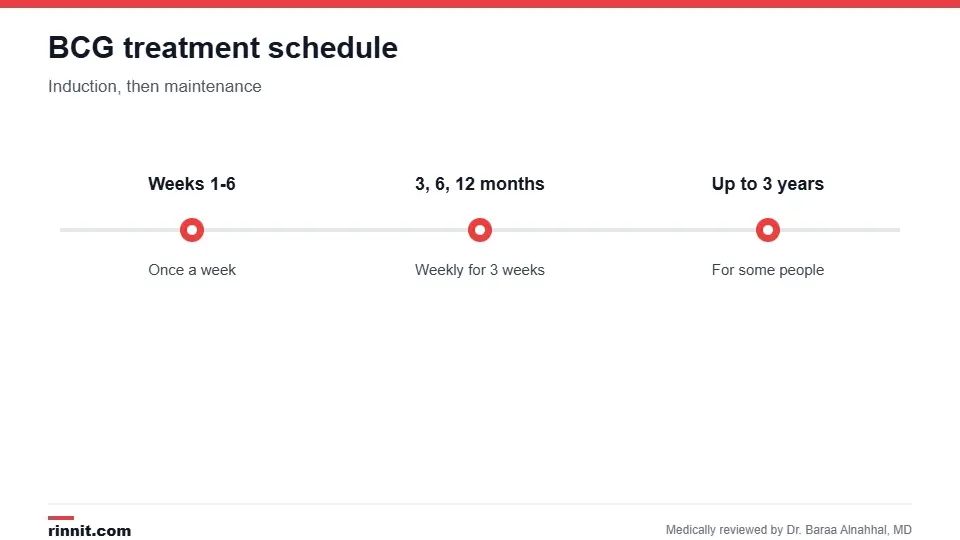
Maintenance BCG gives the most benefit.
Phase | Schedule |
Induction | Once a week for six weeks |
Maintenance | Once a week for three weeks at 3, 6 and 12 months |
Long-term | For some people, up to three years |
Sources: [1, 2, 3]
How to prepare
Avoid caffeine and diuretics for four hours before.
Urinate when you arrive so your bladder is empty. Sources: [1]
What happens during treatment
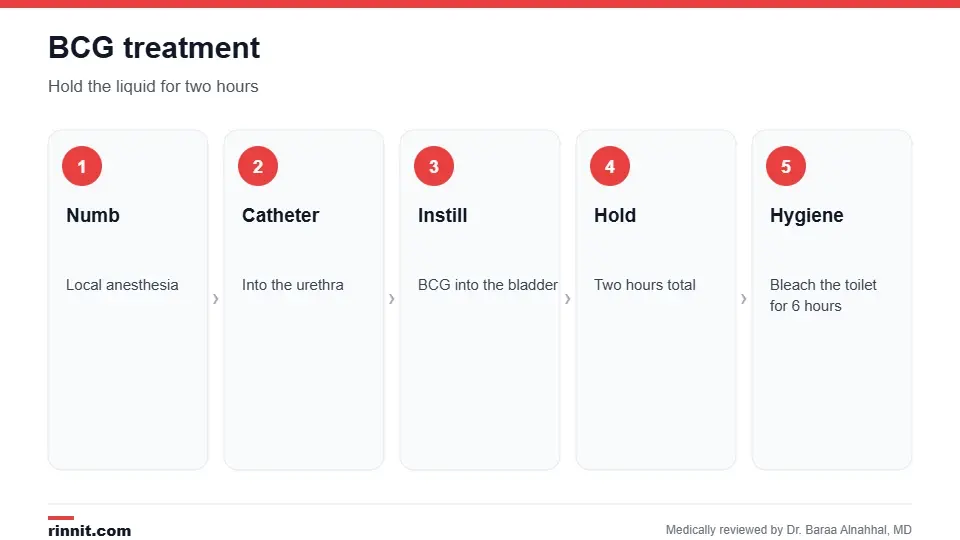
Live bacteria can pass to others, so hygiene steps matter.
You get local anesthesia.
A catheter is placed into your urethra.
BCG liquid is put into your bladder.
You hold it for a total of two hours, without urinating for at least the first hour.
Your immune cells then attack the cancer cells. Sources: [1]
Safety steps for six hours after
Avoid public toilets and drink plenty of fluids.
Sit down to urinate.
Add 2 cups of undiluted bleach to the toilet, close the lid, wait 15 to 20 minutes, then flush.
Wash soiled clothes right away and separately.
Use a condom during your whole course and avoid sex for a few days after each session. Sources: [1]
Side effects
How common | Examples |
Common, first 24 hours | Small amount of blood in urine, low fever of 99 to 100 F, tiredness, burning or frequent urination, muscle and joint pain |
Less common | Rash, fever above 101.3 F, nausea, bladder spasms, UTIs, testicular inflammation |
Rare but serious | BCG sepsis, a tuberculosis-like infection if BCG enters the blood |
Most side effects go away within two to three days. Most people return to work or school in one to two days. Sources: [1]
Outlook
Cancer can come back in up to 40% of people who get BCG, but recurrence doesn't always mean it's getting worse. If aggressive cancer develops, bladder removal is usually recommended. Sources: [1, 3]
When to call your provider
Fever above 101.3 F (38.5 C), chills or severe shivering.
Bladder spasms.
Severe pain or signs of infection.
Side effects that last longer than 72 hours. Sources: [1]
Conclusion
BCG treatment uses your immune system to keep early bladder cancer from coming back or getting worse. Completing maintenance doses and following safety steps after each session give you the best results.
Keep learning: read about TURBT and cancer immunotherapy.
Frequently asked questions
What is BCG treatment?
Immunotherapy put directly into the bladder to treat early bladder cancer.
Is BCG chemotherapy?
No. It's immunotherapy.
What is BCG made of?
A weakened strain of the bacterium *Mycobacterium bovis*.
How is BCG given?
Through a catheter into the bladder.
How long do I hold it?
Two hours total.
How often is BCG given?
Weekly for six weeks, then maintenance doses.
Why do I need bleach in the toilet?
Live bacteria can pass to others.
What are common side effects?
Burning urination, low fever and tiredness.
Can I work after treatment?
Most people return in one to two days.
Can bladder cancer come back after BCG?
Yes, in up to 40% of people.
Related Reading
TURBT (Transurethral Resection of Bladder Tumor): Procedure, Risks and Recovery surgery before BCG.
Cystectomy (Bladder Removal Surgery): Types, Procedure, Risks and Recovery bladder removal surgery.
Immunotherapy for Cancer: How It Works and What to Expect how immunotherapy works.
Robotic Cystectomy: A Comprehensive Guide to Minimally Invasive Bladder Surgery minimally invasive bladder removal.
References
Cleveland Clinic. BCG Treatment: What It Is, Procedure & Side Effects. Cleveland Clinic. Last updated March 21, 2025. https://my.clevelandclinic.org/health/treatments/17908-bacillus-calmette-guerin-bcg-treatment
Sylvester RJ, van der Meijden AP, Lamm DL. Intravesical bacillus Calmette-Guerin reduces the risk of progression in patients with superficial bladder cancer: a meta-analysis of the published results of randomized clinical trials. J Urol. 2002;168(5):1964-1970. PMID 12394686. https://doi.org/10.1016/S0022-5347(05)64273-5
Böhle A, Jocham D, Bock PR. Intravesical bacillus Calmette-Guerin versus mitomycin C for superficial bladder cancer: a formal meta-analysis of comparative studies on recurrence and toxicity. J Urol. 2003;169(1):90-95. PMID 12478111. https://doi.org/10.1016/S0022-5347(05)64043-8
Chen S, Zhang N, Shao J, et al. Maintenance versus non-maintenance intravesical Bacillus Calmette-Guerin instillation for non-muscle invasive bladder cancer: a systematic review and meta-analysis of randomized clinical trials. Int J Surg. 2018;52:248-257. PMID 29499363. https://doi.org/10.1016/j.ijsu.2018.02.045
Moon YJ, Cho KS, Jeong JY, et al. Effects of intravesical BCG maintenance therapy duration on recurrence rate in high-risk non-muscle invasive bladder cancer (NMIBC): systematic review and network meta-analysis according to EAU COVID-19 recommendations. PLoS One. 2022;17(9):e0273733. PMID 36074771. https://doi.org/10.1371/journal.pone.0273733
Verri P, Baboudjian M, Diana P, et al. Reduced- vs full-dose BCG in bladder cancer: a systematic review and meta-analysis. Actas Urol Esp (Engl Ed). 2023;47(1):4-14. PMID 37078844. https://doi.org/10.1016/j.acuroe.2022.08.005
Medical disclaimer
This article is for general education only and does not replace advice from a qualified healthcare professional. Talk to your doctor about your own diagnosis and treatment, and seek emergency care right away for severe or sudden symptoms.



Comments