Cystectomy (Bladder Removal Surgery): Types, Procedure, Risks and Recovery

Updated: 6 days ago
Written and medically reviewed by Dr. Baraa Alnahhal, MD · Last reviewed: October 2026 · How we review
Quick Answer: What is a cystectomy?
A cystectomy is surgery to remove part or all of the urinary bladder, most often to treat bladder cancer. When the whole bladder is removed, the surgeon builds a new route for urine to leave the body. Main risks include bleeding, infection, blood clots and sexual side effects, and full recovery can take several weeks to months. [1]
What the research says
Robotic surgery may shorten the hard part of recovery. In a randomized trial of 338 people with bladder cancer, those who had robotic surgery spent a median of 82 of the first 90 days alive and out of hospital, versus 80 days after open surgery. Blood clots (1.9% vs 8.3%) and wound problems (5.6% vs 16.0%) were less common with the robotic approach, with no clear difference in cancer return or death at about 18 months. (Catto et al., JAMA, 2022)
Robotic and open surgery control cancer about equally well. In a randomized trial of 302 patients, 72.3% of the robotic group and 71.6% of the open group were alive without cancer progression at 2 years, showing robotic surgery was not worse. (Parekh et al., Lancet, 2018)
Long-term survival depends mostly on how far the cancer had spread. A nationwide study of 2,047 people found that 3.8% died within 90 days of radical cystectomy, and 66% were alive at 5 years and 55% at 10 years. Five-year survival was 74% when lymph nodes were cancer-free, compared with 44% when cancer had reached them. (Nikulainen et al., Acta Oncol, 2023)
Key takeaways
A cystectomy removes part of the bladder (partial) or the whole bladder (simple or radical).
Bladder cancer is the most common reason, but it also treats some noncancerous bladder problems.
After whole-bladder removal, urine leaves the body through a new route your surgeon creates.
The operation takes about six hours and can be done through one large cut or several small ones.
Most people return to light activity within a few weeks, but full recovery can take months.
What is a cystectomy?
A cystectomy is a major operation that removes some or all of your urinary bladder, the organ that stores urine before it leaves your body through the urethra.
Surgeons most often perform it to treat bladder cancer. It can also treat certain noncancerous conditions of the urinary system, including some that are present from birth.
In the United States, about 18 in every 100,000 people develop bladder cancer each year. Removing the entire bladder is the treatment for about 1 in 5 of them. [1]
To learn more about the organ itself, see our guide to the bladder's anatomy and function.
What are the types of cystectomy?
There are three types of cystectomy: partial, simple and radical, which differ in how much tissue the surgeon removes.
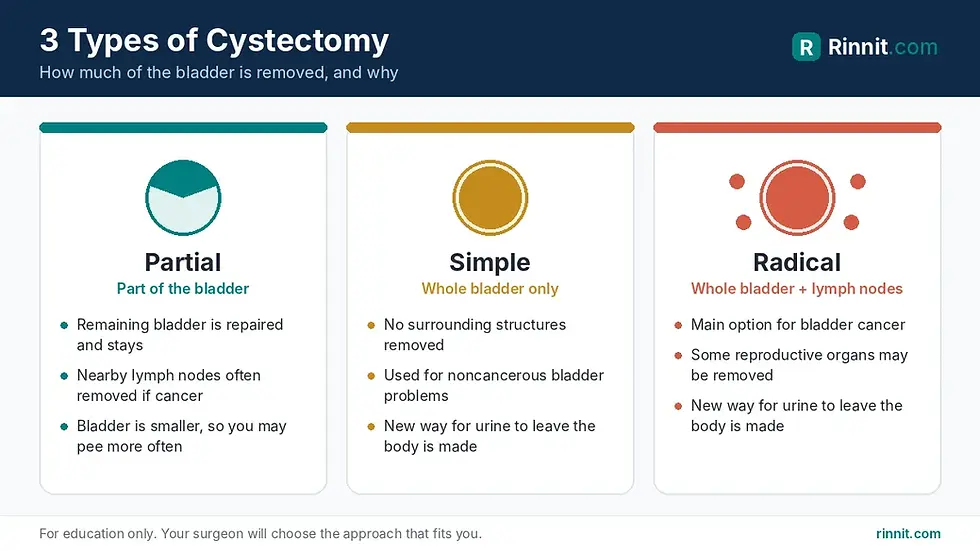
The three types of cystectomy differ in how much of the bladder and nearby tissue is removed.
Type | What is removed | Usually used for |
Partial cystectomy | Only part of the bladder; the rest is repaired and stays in place. Nearby lymph nodes are usually removed too if cancer is present. | Bladder cancer |
Simple cystectomy | The whole bladder, but no structures around it | Noncancerous conditions such as neurogenic bladder, radiation cystitis, urinary fistula and severe interstitial cystitis |
Radical cystectomy | The whole bladder plus nearby lymph nodes, and often some reproductive organs | Bladder cancer |
In a radical cystectomy, removing nearby lymph nodes helps show whether cancer has spread. Surgeons often also remove the prostate in men or part of the vagina in women.
How do you prepare for a cystectomy?
Preparing for a cystectomy starts with a visit where your care team checks your overall health and explains which type of surgery and approach they plan to use.
At this visit, your provider checks your temperature, pulse and blood pressure. Then you go over a few safety steps together:
Medicines: List every prescription, over-the-counter medicine and herbal supplement you take. Aspirin, anti-inflammatory drugs, blood thinners and some herbal supplements can raise your bleeding risk. Don't stop any medicine until your provider tells you to.
Allergies: Share all known allergies, including to medicines, latex, foods and skin cleaners such as iodine or isopropyl alcohol.
Eating and drinking: You usually shouldn't eat or drink anything after midnight the night before surgery. If you must take medicines that morning, take them with a small sip of water.
Bring a written list of questions. This is a good time to ask which urine drainage option your surgeon recommends and why.
What happens during a cystectomy?
During a cystectomy, the surgeon removes part or all of the bladder while you are asleep under general anesthesia, then rebuilds a way for urine to drain.
The surgeon uses one of two approaches:

Open surgery uses one long cut; minimally invasive (robotic) surgery uses several small ones.
Open surgery | Minimally invasive (robotic) surgery | |
Incision | One vertical cut of about 6–7 inches (15–18 cm), between the belly button and pubic bone | Five to six small cuts of about ½ inch (1 cm) each |
How it works | The surgeon works directly inside the abdomen | The surgeon controls a robot holding a camera and small tools |
Typical hospital stay | Up to about a week | At least one day |
Learn more about the minimally invasive option in our guide to robotic cystectomy.
What are the steps of the operation?
The operation follows the same basic steps whichever approach is used:
You receive general anesthesia, so you are fully asleep.
The surgeon makes either one long cut (open) or several small cuts (minimally invasive).
Part or all of the bladder is removed.
The surgeon creates a new way for urine to drain, such as an ileal conduit (urostomy), an Indiana pouch or a neobladder.
The cuts are stitched closed and covered with bandages.
Your surgeon will recommend a drainage option based on your health history and personal goals. Our guide to urinary reconstruction and diversion explains these options in more detail.
How long does a cystectomy take?
A cystectomy takes about six hours to perform.
What are the benefits and risks of a cystectomy?
The main benefit of a cystectomy is that it treats bladder cancer, and it can also treat other noncancerous bladder and urinary problems.
Like any major surgery, it carries risks:
Risk | What it means |
Bleeding | Blood loss during or after surgery |
Blood clots | Clots that can form in the veins, such as deep vein thrombosis |
Infection | At the wound or inside the body |
Bowel complications | Problems with how the intestines work after surgery |
Scar tissue | Can block urine flowing from the kidneys |
Organ damage | Injury to nearby organs |
Anesthesia reaction | A bad response to the medicines that put you to sleep |
Healing problems | Wounds that are slow to heal |
Fluid buildup | Collections of fluid at the surgical sites |
What happens after a cystectomy?
Right after a cystectomy, you are moved to a recovery room where your care team stops the anesthesia, monitors your health closely and treats your pain.
In the days that follow, it is common to notice:
A poor appetite
Bowel changes, with too much or too little stool
Changes in how you pee
After a partial cystectomy, your bladder is smaller, so you may need to pee more often. Mucus in the urine is also normal.
After whole-bladder removal, you will pee in a new way. How this works depends on the type of reconstruction you had.
Can you live without a bladder?
Yes, you can live without a bladder, because surgery creates a new reservoir to hold the urine your kidneys make.
Most people can return to many of the activities they enjoyed before surgery. If you need an ostomy bag for urine, your care team teaches you how to attach, empty and change it before you leave the hospital.
How long is cystectomy recovery?
Full recovery from a cystectomy usually takes several weeks to months, and people who have a partial cystectomy typically recover faster than those who have a radical one.
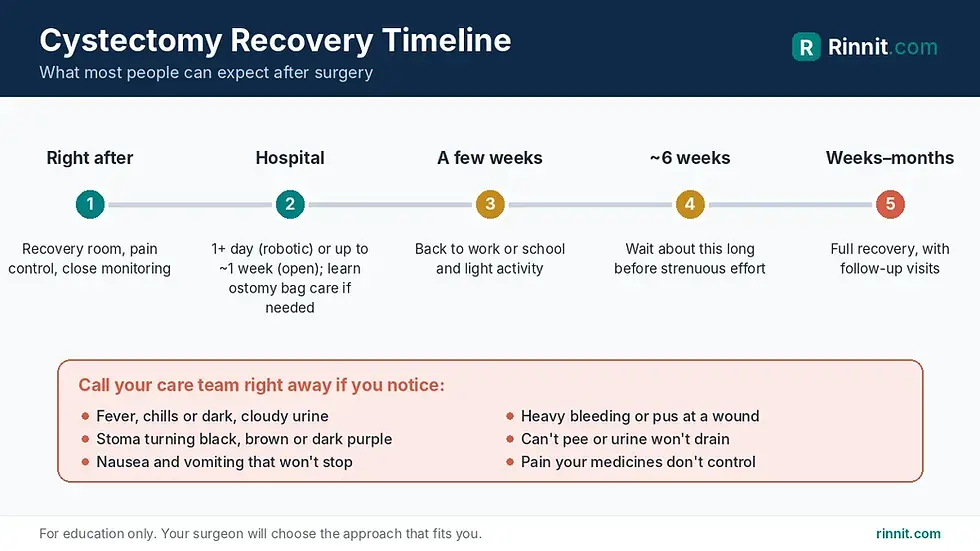
A typical recovery timeline after cystectomy, plus warning signs to report right away.
Stage | What to expect |
Right after surgery | Recovery room, pain control and close monitoring |
Hospital stay | At least one day after minimally invasive surgery; up to about a week after open surgery |
A few weeks | Return to work or school and light physical activity |
About 6 weeks | Wait this long before strenuous exertion |
Several weeks to months | Full recovery, with follow-up visits to check urine is draining well |
When should you call your doctor after a cystectomy?
You should contact your care team right away after a cystectomy if you notice any of these signs:
Fever, chills, or dark and cloudy urine (possible infection)
Nausea and vomiting that don't go away
Heavy bleeding from a surgical wound
Increasing color change, swelling, pain or pus at a wound
A stoma (the new urine opening) that turns black, brown or dark purple
Severe pain that your prescribed medicine doesn't control
Being unable to pee, or urine that won't drain
What are the long-term effects of a cystectomy?
The long-term effects of a cystectomy come mostly from the new urine drainage route, which can change how you pee, your sex life and how you feel about your body. [1][5]
Does a cystectomy affect your sex life?
A cystectomy can affect your sex life by making it harder to become aroused. If part of the vagina is removed, sex may also feel uncomfortable.
These changes are worth raising openly with your care team. Our guides to erectile dysfunction and female sexual dysfunction cover support options.
What is the survival rate after a cystectomy?
The survival rate after radical cystectomy for bladder cancer is about 66% at 5 years and 55% at 10 years, based on a large nationwide study of 2,047 people. [2]
Survival is much higher when cancer has not reached the lymph nodes (74% at 5 years) than when it has (44%). [2] Your own outlook depends on your cancer stage and overall health, so ask your doctor what these numbers mean for you.
Conclusion
A cystectomy is a major operation. It removes part or all of the bladder, most often to treat bladder cancer, and creates a new way for urine to leave the body when the whole bladder is taken out.
Knowing the three types, what happens in the operating room and what recovery looks like can make the process feel less overwhelming. It also helps you ask sharper questions at your next appointment.
Preparing for surgery or supporting someone who is? Save or print this guide to bring to your next visit, and explore our related guides on urostomy care, TURBT for bladder tumors and blood in the urine to build a complete picture of your care.
FAQ
Is a cystectomy a major surgery?
Yes. A cystectomy is a major operation done under general anesthesia that takes about six hours, followed by a hospital stay and several weeks to months of recovery.
What is the difference between a partial and a radical cystectomy?
A partial cystectomy removes only part of the bladder and leaves the rest in place. A radical cystectomy removes the whole bladder and nearby lymph nodes, and often some reproductive organs.
How long do you stay in the hospital after a cystectomy?
Most people stay at least one day after minimally invasive surgery and up to about a week after open surgery.
How do you pee after your bladder is removed?
Your surgeon creates a new drainage route, such as an ileal conduit (urostomy) that empties into a bag, an Indiana pouch or a neobladder. The best option depends on your health and goals.
When can you go back to work after a cystectomy?
Most people can return to work or school and light activity after a few weeks. Wait about six weeks before strenuous exertion.
Is robotic cystectomy better than open surgery?
Research shows both approaches control bladder cancer about equally well. Robotic surgery may mean slightly more days out of hospital and fewer blood clots and wound problems in the first 90 days. [3][4]
What is a neobladder?
A neobladder is a new bladder made from a piece of your intestine and connected to your urethra, so you pee through your urethra again. It takes practice to learn how to empty it fully.
What is an Indiana pouch?
An Indiana pouch is a pouch made from intestine that stores urine inside your body. You drain it several times a day by passing a thin tube through a small opening on your belly, so there is no outside bag.
Will I need chemotherapy before a cystectomy?
Many people with bladder cancer that has grown into the bladder muscle get chemotherapy before surgery, because it can improve results. Your cancer team will tell you whether it is right for you.
Can men still get erections after a cystectomy?
A radical cystectomy can damage the nerves that control erections, so erectile problems are common afterward. Nerve-sparing surgery and treatments for erectile dysfunction may help, so talk with your care team.
Related Reading
Ureterostomy: Purpose, Procedure, Care and Recovery explains ureterostomy.
Pelvic Exenteration: Types, Surgery and Recovery explains pelvic exenteration surgery.
BCG Treatment for Bladder Cancer: Procedure, Schedule and Side Effects explains BCG treatment for bladder cancer.
Loopogram: How It Checks Your Ileal Conduit After Bladder Removal explains the X-ray test that checks urine drainage through an ileal conduit.
References
Cleveland Clinic. Cystectomy (Bladder Removal): Procedure & Results. Cleveland Clinic. Last updated September 2, 2025. https://my.clevelandclinic.org/health/treatments/21049-cystectomy
Nikulainen I, Salminen AP, Seikkula H, et al. Nationwide analysis of survival after radical cystectomy for bladder cancer in Finland. Acta Oncol. 2023;62(8):829-835. PMID: 37377029. https://doi.org/10.1080/0284186X.2023.2228446
Catto JWF, Khetrapal P, Ricciardi F, et al. Effect of Robot-Assisted Radical Cystectomy With Intracorporeal Urinary Diversion vs Open Radical Cystectomy on 90-Day Morbidity and Mortality Among Patients With Bladder Cancer: A Randomized Clinical Trial. JAMA. 2022;327(21):2092-2103. PMID: 35569079. https://doi.org/10.1001/jama.2022.7393
Parekh DJ, Reis IM, Castle EP, et al. Robot-assisted radical cystectomy versus open radical cystectomy in patients with bladder cancer (RAZOR): an open-label, randomised, phase 3, non-inferiority trial. Lancet. 2018;391(10139):2525-2536. PMID: 29976469. https://doi.org/10.1016/S0140-6736(18)30996-6
Tyson MD 2nd, Barocas DA. Quality of Life After Radical Cystectomy. Urol Clin North Am. 2018;45(2):249-256. PMID: 29650140. https://doi.org/10.1016/j.ucl.2017.12.008
Further reading (external)
American Cancer Society Medical and Editorial Content Team. Bladder Cancer Surgery. American Cancer Society. Last revised March 12, 2024. https://www.cancer.org/cancer/types/bladder-cancer/treating/surgery.html
Cancer Research UK. Removing the bladder (cystectomy) for early bladder cancer. Cancer Research UK. Last reviewed August 7, 2025. https://www.cancerresearchuk.org/about-cancer/bladder-cancer/treatment/invasive/surgery/removing-bladder
Medical disclaimer
This article is for general education and does not replace advice from your doctor or surgical team. Always talk with a qualified healthcare professional about your diagnosis, treatment options and recovery.



Comments