Urinary Reconstruction and Diversion: Types, Benefits, Risks and Recovery

Updated: 3 days ago
Medically reviewed by Dr. Baraa Alnahhal, MD · Last reviewed: October 2026
Quick Answer: What is urinary diversion?
Urinary diversion is surgery that creates a new way for urine to leave the body when the bladder has been removed or does not work properly, for reasons such as bladder cancer or severe trauma. An incontinent diversion, most commonly an ileal conduit, drains urine into an external bag, while a continent diversion creates an internal pouch or neobladder.
What the research says
Complications are common, and the types are hard to compare. A systematic review of 14 studies covering 4,436 patients found that up to 50% had at least one low-grade complication that needed medicine to heal, high-grade complications occurred in 0.7–42% of cases and mortality ranged from 0.4–7%. Six quality-of-life studies (445 patients) gave conflicting results on whether external diversions or neobladders were better, and because patients are carefully selected for each type, a randomized comparison is not possible (Cicione et al., Minerva Urol Nefrol, 2020).
Using intestine can change blood chemistry. In a systematic review of 29 studies, post-operative metabolic acidosis occurred in 1–86% of patients after continent urinary diversion and 1–27% after ileal conduit. Poorer kidney function, diabetes and older age were associated with acidosis, and there was little uniformity in how bicarbonate treatment was used (Desai et al., Bladder Cancer, 2026).
What are urinary reconstruction and urinary diversion?
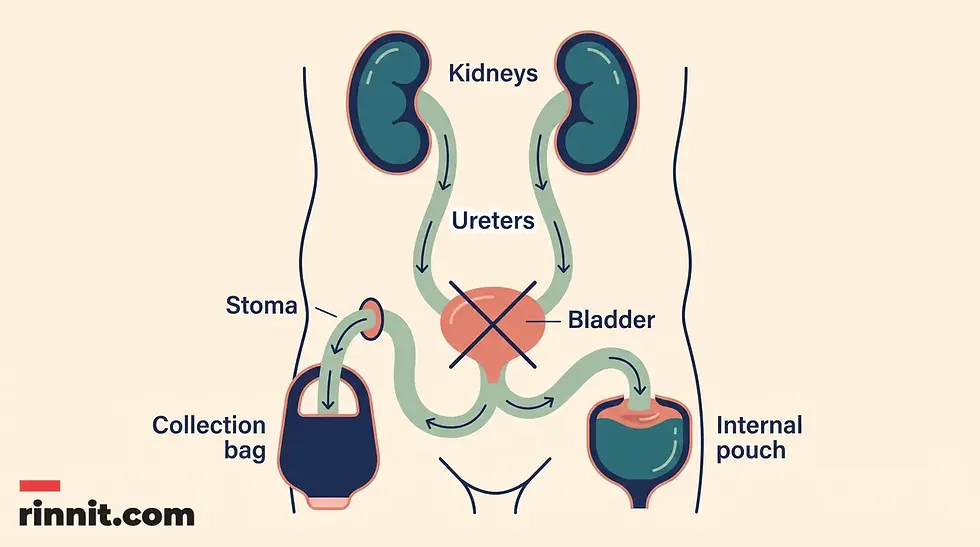
Urinary diversion is a surgical method for creating a new way for urine to leave the body when the bladder has been removed or is not working properly. The goal is to provide a route for urine to leave the body.
If urine cannot leave, it can back up into the kidneys and cause permanent harm, including kidney disease or kidney failure. Urinary diversion may be the only way to stop that backup in some situations. The usual urinary system includes two kidneys, two ureters, a bladder and a urethra.
Both continent and incontinent urinary diversions use a piece of intestine to redirect urine. The new route, storage method and daily care depend on the type of diversion.
Why might someone need urinary diversion?
It is usually considered because the bladder was removed (cystectomy) or no longer works properly. Reasons include bladder cancer, damage from radiation therapy for cancer, chronic bladder infections, severe trauma to the urinary tract, congenital disorders such as spina bifida, neurological disorders such as multiple sclerosis, severe urinary incontinence and bladder pain.
Reason | How it relates to urinary diversion |
Bladder removal | A new route is needed when the bladder is no longer present. |
Bladder cancer | Treatment may involve bladder removal or a bladder that cannot function normally. |
Radiation-related damage | Radiation therapy for cancer can damage bladder function. |
Chronic bladder infections | Repeated or ongoing bladder problems may affect function. |
Severe urinary-tract trauma | Major injury can make the usual urinary route unusable. |
Congenital disorder | Conditions present from birth, such as spina bifida, can affect urinary function. |
Neurological disorder | Conditions such as multiple sclerosis can affect bladder control or function. |
Severe incontinence or bladder pain | Significant symptoms may be among the reasons diversion is considered. |
The reason for surgery is only one part of the decision. Age, medical conditions and health history also influence which type of urinary diversion may be used.
What are the main types of urinary diversion?
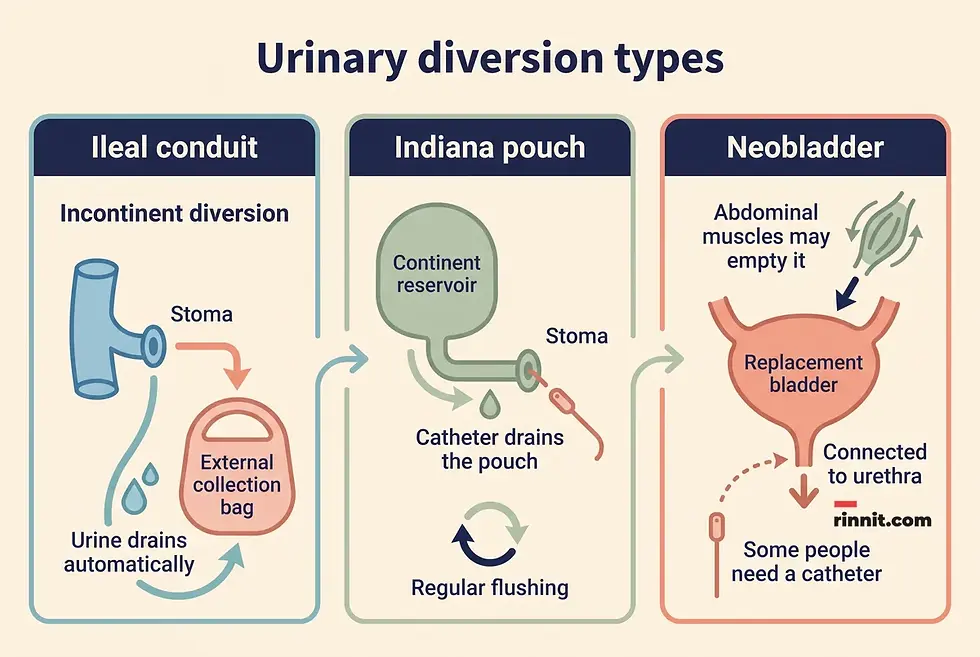
Urinary diversion is broadly categorized as incontinent or continent. An incontinent diversion sends urine continuously through a stoma into an external collection bag. A continent diversion stores urine inside the body in a pouch or neobladder and uses a controlled route for emptying.
Type | Where urine is stored | How urine leaves the body |
Incontinent diversion | External ostomy bag. | Urine drains automatically through a stoma into the bag. |
Continent cutaneous reservoir | Internal pouch. | A catheter is passed through a stoma to drain the pouch. |
Neobladder | Internal replacement bladder. | Urine passes through the urethra; some people may also need catheterization. |
A general comparison cannot determine which option is appropriate for a particular person.
Incontinent urinary diversion and ileal conduit
An incontinent urinary diversion creates an opening in the abdomen. The ureters are connected to a piece of intestine that is brought through the abdominal wall as a stoma, and urine collects in an external ostomy bag. This is also called a urostomy. The stoma and bag are part of the wider topic of ostomy surgery.
The main type is the ileal conduit, the most common incontinent method. The ureters are attached to a separated piece of intestine, which is brought through the belly wall as a stoma. Urine moves automatically through the stoma into an external collection bag that must be emptied every few hours.
Potential advantages: an ileal conduit is more straightforward than other diversion methods and does not require self-catheterization. Possible challenges: some people may feel self-conscious about wearing a bag that collects urine, and the bag can leak urine and cause an odor.
Ileal-conduit feature | What to know |
Route | Ureters connect to a piece of intestine brought through the abdominal wall. |
Stoma | The intestinal segment exits through the belly wall as a stoma. |
Collection | Urine drains automatically into an external bag. |
Emptying | The bag must be emptied every few hours. |
Potential advantage | No self-catheterization is needed. |
Potential challenge | Leaking or odor from the bag may occur, and some people may feel self-conscious. |
What is a urostomy?
A urostomy is a type of incontinent urinary diversion. It uses an opening in the abdominal wall so urine can pass into a bag worn under clothing.
Continent urinary diversion
A continent urinary diversion creates an internal pouch or a replacement bladder and provides more control over urination. Two examples are an Indiana pouch and a neobladder.
Indiana pouch reservoir
An Indiana pouch is made from portions of the intestine. The ureters are sewn into the pouch, and a short piece of small intestine forms a channel that is brought out through a stoma, often near the belly button. The stoma is smaller than an ileal-conduit stoma and does not drain spontaneously.
The pouch stores urine until a person places a catheter through the stoma to drain it. A surgically created one-way valve helps keep urine inside, and the pouch needs regular flushing to clear mucus that can build up. Catheter drainage is usually needed every four hours, around the clock; the care team should teach the exact schedule and technique.
Potential advantages: urine stays inside the body, so no external bag is needed under clothing; the absence of a bag may reduce urine leakage and odor, and the stoma can be covered with an adhesive bandage. Possible challenges: surgery takes longer than an incontinent diversion, catheterization is needed around the clock, and channel complications are common. The channel can leak or develop scar tissue, and mucus buildup can cause stones and recurrent infections. If a catheter cannot be passed to drain the pouch, the pouch can rupture; this is an emergency.
Neobladder or bladder substitute
A neobladder is a replacement bladder made from a portion of the small intestine and connected to the urethra. Urine passes from the kidneys through the ureters into the new bladder and then through the urethra, similar to the usual route. To empty it, a person contracts the abdominal muscles. Candidacy requires a low risk of cancer recurrence in the urethra and no scar tissue or blockage in the urethra.
Some people cannot empty a neobladder by contracting the abdominal muscles. In those cases, a catheter may be needed through the urethra up to six times a day.
Potential advantages: urination most closely resembles usual urination, and there is no stoma to care for. Possible challenges: surgery is usually longer; urinary incontinence is normal after surgery and may last up to six months. About 20% of people with this type of diversion have nighttime incontinence and up to 10% have daytime incontinence requiring pads. Some people may never fully empty the new bladder and may need temporary or permanent catheterization.
Neobladder feature | What to know |
Construction | A portion of the small intestine forms a replacement bladder. |
Connection | The new bladder is connected to the urethra. |
Emptying | Abdominal-muscle contraction may empty it; some people need a urethral catheter. |
Potential advantage | Urination most closely resembles usual urination, with no stoma to care for. |
Possible challenge | Incontinence may last up to six months, and some people may need catheterization. |
What are the benefits of urinary diversion?
The central benefit is creating a route for urine to leave the body. Without a functioning route, urine can back up into the kidneys and cause permanent damage such as kidney disease or kidney failure. Urinary diversion may therefore protect the kidneys by redirecting urine when the bladder has been removed or cannot function properly.
The practical trade-offs vary by type. An ileal conduit avoids self-catheterization but requires an external bag. An Indiana pouch avoids an external bag but requires catheterization. A neobladder can resemble usual urination but may involve incontinence or difficulty fully emptying the new bladder.
What are the risks and complications?
Different urinary diversion procedures have different risks. Problems that can occur with all types include difficulty with the stoma, leaking stool or blocked bowels, injury to nearby organs, rupture of the neobladder or pouch, and scar tissue where the ureters are sewn into the diversion.
Potential complication | What it can involve |
Stoma difficulty | Trouble inserting a tube into the stoma or skin growing over it. |
Bowel problems | Leaking stool or blocked bowels. |
Nearby-organ injury | Injury to organs near the surgical area. |
Pouch or neobladder rupture | A tear or rupture of the internal urinary reservoir. |
Ureter-connection scar tissue | Scar tissue where the ureters are sewn into the diversion. |
Type-specific problems | For example, channel leaks, scar tissue, mucus-related stones or recurrent infections with an Indiana pouch, or persistent emptying problems with a neobladder. |
Being unable to pass a catheter to drain an Indiana pouch is an emergency because the pouch can burst. Follow the care team's emergency instructions rather than relying on a general article.
What is recovery like?
After urinary reconstruction and diversion, it can take one to two months to feel well and regain strength. It may take several weeks to get used to a new way of urinating. The care team should provide instructions for caring for a stoma and ostomy bag or draining a pouch with a catheter before you leave the hospital.
Most people can return to work and hobbies they enjoy. People can generally return to work in one or two months on average, while the care team determines when exercise, sports, lifting, swimming and contact activities are appropriate.
Recovery area | What to expect |
Strength and wellbeing | One to two months may be needed to feel well and regain strength. |
Adapting to urination | Several weeks may be needed to learn the new urinary routine. |
Work | Most people can return in one or two months on average. |
Exercise and sports | Return after recovery as directed; contact sports or swimming may be temporarily restricted. |
Lifting | Ask the surgeon about temporary restrictions. |
Eating | Soft, easy-to-digest foods may be recommended for a month. |
Travel | There are no travel restrictions, but bring needed supplies and emergency extras. |
Equipment care | Learn stoma, ostomy-bag or catheter-pouch care before leaving the hospital. |
Emotional adjustment and relationships
Urinary diversion can affect a person emotionally as well as physically. It is understandable to feel anxious about sexual intimacy, relationships or changes in daily life after surgery. Discuss these concerns with a healthcare professional; medication, sex therapy or support groups may help some people.

When should you contact a healthcare professional?
Contact a healthcare professional for symptoms that may indicate a urinary tract infection, including fever, chills, nausea or vomiting, back or abdominal pain, more frequent urination, painful urination, cloudy urine or urine with a strong smell. Also contact the care team if you have problems caring for the ostomy bag or stoma, such as skin irritation with swelling or redness, leaking pus or leaking urine.
Sign or symptom | Recommended action |
Fever or chills | Contact the care team. |
Nausea or vomiting | Contact the care team. |
Back or abdominal pain | Contact the care team. |
More frequent or painful urination | Contact the care team. |
Cloudy or strong-smelling urine | Contact the care team. |
Swelling or redness around the stoma | Contact the care team. |
Pus or urine leaking around the stoma or bag | Contact the care team. |
Inability to pass a catheter into an Indiana pouch | Treat as an emergency and follow the care team's instructions. |
If symptoms are severe or rapidly worsening, use the urgent-care instructions provided by the treating team. This article cannot determine the cause or severity of an individual symptom.
How do you choose among diversion types?
The type of urinary diversion depends on factors such as age, medical conditions and health history. The choice also affects whether urine drains into a bag, is emptied with a catheter through a stoma, or passes through the urethra.
Decision area | Questions to discuss with the care team |
Storage | Will urine collect in an external bag, an internal pouch or a neobladder? |
Emptying | Will it drain automatically, require a catheter through a stoma or pass through the urethra? |
Daily care | What stoma, bag, pouch-flushing or catheter routines will be needed? |
Health factors | How do age, medical conditions and health history affect the options? |
Activity | When can work, exercise, sports, swimming and lifting resume? |
Supplies | What bags, catheters or emergency supplies should be kept available? |
Emotional support | What resources are available for body-image, intimacy or relationship concerns? |
No general comparison can select the right diversion for an individual. A urology team should explain the expected benefits, trade-offs, complications and daily care for the proposed option.
Questions to ask before surgery
Topic | Example question |
Reason | Why is urinary reconstruction or diversion being recommended? |
Type | Which type is being considered, and what alternatives are available? |
Stoma | Will I have a stoma, and where will it be located? |
Bag | Will urine drain into an ostomy bag, and how will I care for it? |
Catheter | Will I need catheterization, how often and through which route? |
Neobladder | If a neobladder is planned, how will I learn to empty it? |
Recovery | When should I expect to regain strength and adapt to the new urinary routine? |
Activities | When can I return to work, exercise, sports, swimming and lifting? |
Diet | Should I follow a soft or easy-to-digest eating plan temporarily? |
Travel | Which supplies and emergency extras should I carry? |
Warning signs | Who should I call for fever, urine changes, pain, vomiting or stoma problems? |
Emotional support | What support is available for intimacy, relationships or adjustment? |
Conclusion: Understand the route, the routine and the warning signs
Urinary reconstruction and diversion create a new route for urine when the bladder has been removed or is not working properly. Incontinent diversion, including an ileal conduit and urostomy, directs urine through a stoma into an external bag. Continent options include an Indiana pouch, which is drained through a stoma with a catheter, and a neobladder, which is connected to the urethra.
Each option has different daily-care needs, advantages and challenges. Recovery often takes one to two months to regain strength, and adapting to a new way of urinating can take several weeks.
If urinary diversion is being discussed, ask the urology team to explain the proposed type, storage and emptying route, stoma or catheter care, activity restrictions, supplies, emotional support and warning signs. Contact a healthcare professional for fever, chills, nausea or vomiting, back or abdominal pain, painful or frequent urination, cloudy or strong-smelling urine, or stoma and ostomy-bag problems.
Frequently Asked Questions
What is urinary reconstruction?
Urinary reconstruction and diversion create a new route for urine to leave the body when the bladder has been removed or is not working properly.
Why is urinary diversion needed?
Urinary diversion may be needed after bladder removal or when the bladder does not work properly, for example due to bladder cancer, radiation-related damage, chronic bladder infections, severe trauma, congenital or neurological disorders, severe incontinence or bladder pain.
What is the difference between continent and incontinent diversion?
Incontinent diversion sends urine automatically through a stoma into an external bag. Continent diversion stores urine inside the body in a pouch or neobladder and provides a controlled way to empty it.
Is an ileal conduit a urostomy?
An ileal conduit is the main type of incontinent diversion. A urostomy is an incontinent diversion in which an abdominal opening lets urine pass into an ostomy bag.
What is an Indiana pouch?
An Indiana pouch is an internal reservoir made from intestine with a channel to a stoma, often near the belly button. Urine is drained with a catheter, and the pouch needs regular flushing to clear mucus.
What is a neobladder?
A neobladder is a replacement bladder made from a portion of small intestine and connected to the urethra. Emptying may involve contracting abdominal muscles, although some people need catheterization.
Which urinary diversion is best?
There is no single best option. The type depends on factors such as age, medical conditions and health history, and a urology team should explain which options fit.
Will I need a catheter?
An Indiana pouch requires a catheter through the stoma. Some people with a neobladder need a urethral catheter temporarily or permanently. An ileal conduit does not require self-catheterization.
How long does recovery take?
It may take one to two months to feel well and regain strength, and several weeks to adapt to a new way of urinating.
Can I return to work and exercise?
Most people can return to work in one or two months on average. Contact sports, swimming and lifting may require temporary restrictions.
Can urinary diversion affect intimacy or relationships?
Yes. Discuss concerns with a healthcare professional; medication, sex therapy or support groups may help.
When should I call the care team?
Call for fever, chills, nausea or vomiting, back or abdominal pain, frequent or painful urination, cloudy or strong-smelling urine, or stoma problems such as redness, swelling, leaking pus or urine.
How do I prepare for urinary diversion surgery?
Before ileal conduit surgery, tell your care team about the medicines, vitamins and supplements you take, follow their instructions about eating and drinking, and stop smoking, because nicotine can slow healing. [4] You may meet an ostomy nurse to choose a spot on your belly for the stoma, and you should arrange for someone to help you after you leave the hospital. [4]
Does urinary diversion surgery hurt, and what anesthesia is used?
Ileal conduit surgery is done using general anesthesia, which puts you in a sleeplike state during the procedure, and you receive medicine to help ease pain. [4]
Related guides
Robotic Cystectomy: A Comprehensive Guide to Minimally Invasive Bladder Surgery
Radiation Therapy: A Comprehensive Guide to Treatment and Recovery
What Is Multiple Sclerosis? A Plain-Language Guide to Symptoms, Types, and How It's Treated
Urinary Incontinence: Symptoms, Causes, and Treatment Options Explained
Understanding Ostomy Surgery: Types, Procedure, and Recovery
Urostomy: A Comprehensive Guide to Urinary Diversion Surgery
Understanding the Indiana Pouch: A Comprehensive Guide to Urinary Diversion
Understanding the Small Intestine: Anatomy, Function, and Digestive Health
Urinary Tract Infection (UTI): Symptoms, Causes, Treatment, and Prevention
References
Cleveland Clinic. Urinary Reconstruction & Diversion: Purpose & Types. Cleveland Clinic. Last updated July 22, 2024. https://my.clevelandclinic.org/health/procedures/12546-urinary-reconstruction--diversion
Cicione A, De Nunzio C, Lombardo R, et al. Complications and quality of life of ileal conduit, orthotopic neobladder and ureterocutaneostomy: systematic review of reports using the Clavien-Dindo Classification. Minerva Urol Nefrol. 2020;72(4):408-419. PMID 32734749. https://doi.org/10.23736/S0393-2249.20.03641-3
Desai S, Frisbie J, Moreton E, et al. Systematic review: the role of bicarbonate therapy after urinary diversion. Bladder Cancer. 2026;12(1):23523735261424587. PMID 41710209. https://doi.org/10.1177/23523735261424587
Mayo Clinic. Ileal conduit surgery. Mayo Clinic. Last updated September 15, 2026. https://www.mayoclinic.org/tests-procedures/ileal-conduit/about/pac-20606682
Disclaimer
This article is for general educational purposes and is not a substitute for professional medical advice, diagnosis or treatment. Always seek the advice of a qualified healthcare professional with any questions about a medical condition or treatment.


Comments