The Urethra: Anatomy, Function, and Urinary Health

Updated: 3 days ago
Medically reviewed by Dr. Baraa Alnahhal, MD | Last reviewed: October 7, 2026

Quick Answer: What is the urethra?
The urethra is a thin-walled tube that carries urine from the bladder out of the body through the urethral meatus. [1] In females it is about 1.5 inches (3 to 4 centimeters) long and carries only urine. [1] In males it is about 7 to 8 inches (20 centimeters) long, passes through the prostate and penis and carries urine and semen. [1]
What the research says
Drinking more fluid can lower the risk of repeat urinary tract infections. A systematic review and meta-analysis of 8 randomized trials found that increased fluid intake reduced the overall rate of recurrent UTIs (rate ratio 0.46, 95% CI 0.40–0.54), with a clear reduction at 6 months or less (OR 0.13, 95% CI 0.07–0.25) but a statistically non-significant reduction at 12 months (OR 0.39, 95% CI 0.15–1.03) (Scott et al., British Journal of General Practice, 2020). [2]
Sex, spermicides and holding urine are linked to recurrent UTIs in women, while water intake looks protective. A systematic review of 11 studies found that sexual intercourse was the most consistent behavioral risk factor, spermicide-based contraception added risk, habitual urine holding was a potential modifiable factor, increased daily water intake was the most robust protective factor, and hygiene practices showed inconsistent associations (Alhazmi et al., Cureus, 2026). [3]
Self-dilation may reduce the chance that a urethral stricture comes back, but the evidence is weak. A meta-analysis of 6 trials in men (rated very low quality) found that recurrent stricture was less likely in men who performed intermittent self-dilatation (RR 0.70, 95% CI 0.48–1.00) (Ivaz et al., Neurourology and Urodynamics, 2016). [4]
What does the urethra do?
The urethra is the final gateway of the urinary system. The urinary system also includes the kidneys, which clean the blood and make urine, the ureters, which carry urine to the bladder, and, in males, the prostate. [1] The urethra has two sphincters, which are muscles that act as valves that open and close. [1] The internal sphincter sits where the urethra leaves the bladder, and the external sphincter is in the pelvic floor. [1] These muscles work with the bladder to get urine out of the body when you intend it to.
In males, the urethra also plays a role in the reproductive system, because semen comes out through it during sex. [1] This dual role makes the male urethra much longer and more complex than the female urethra, passing through the prostate gland and the length of the penis.
Feature | Female Urethra | Male Urethra |
Primary Function | Urinary elimination | Urinary and reproductive elimination |
Approximate Length | About 1.5 inches (3–4 cm) | About 7–8 inches (20 cm) |
Anatomical Path | From the bladder to an opening in front of the vagina | From the bladder through the prostate and penis |
Fluids Carried | Urine only | Urine and semen |
What is the anatomical structure of the urethra?
The walls of the urethra are thin and made up of epithelial tissue, smooth muscle cells, and connective tissue. [1] In males, the urethra has three parts: the prostatic urethra, the membranous urethra, and the penile (or spongy) urethra. [1]
The prostatic urethra is the part that carries semen through the prostate gland. [1] The membranous urethra is the short part that moves fluids through the pelvic floor, and the penile urethra is the longest section, extending the whole length of the penis and ending at the urethral meatus. [1]
Section (Male) | Location | Primary Role |
Prostatic | Within the prostate gland | Carries semen through the prostate |
Membranous | Through the pelvic floor | Moves fluids through the pelvic floor |
Penile (Spongy) | Along the length of the penis | Final passage to the urethral meatus |
What conditions affect the urethra, and how are they diagnosed?
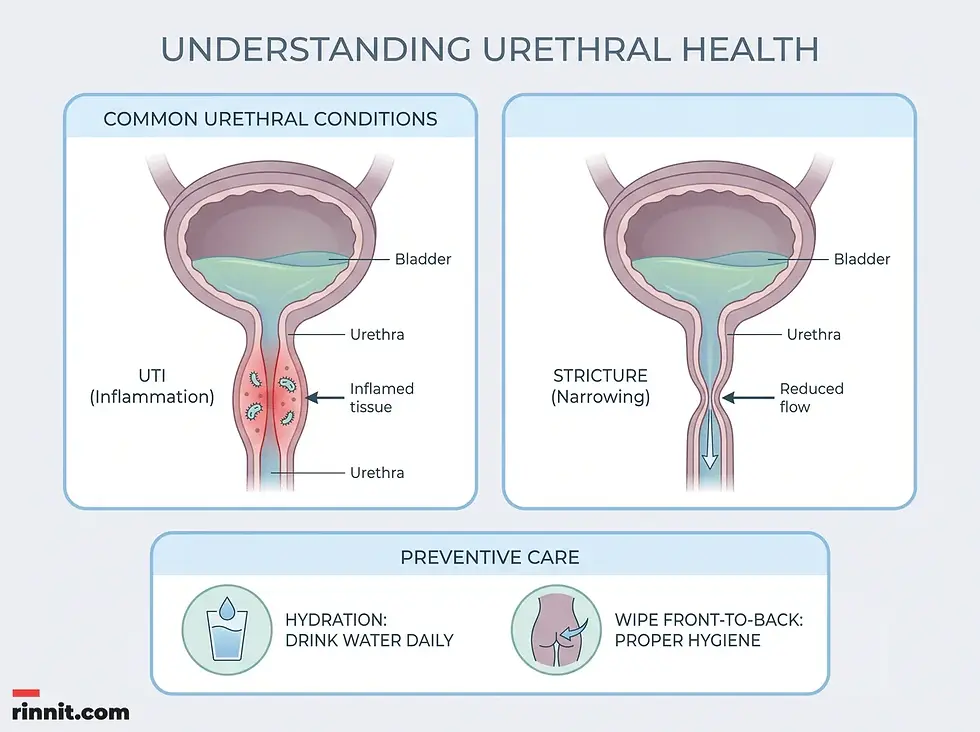
Several conditions can affect the urethra, and problems with it are more common in males. [1] Urinary tract infections (UTIs) are very common and can occur anywhere along the urinary tract, including the urethra, and you can also get one if you have a urinary catheter. [1] Urethritis, or inflammation of the urethra, is usually caused by a sexually transmitted infection; nongonococcal urethritis, most often from chlamydia, is more common than urethritis from gonorrhea. [1] Scarring can make the urethra narrower, which is called a urethral stricture and can lead to inflammation, infections, pain with peeing and difficulty emptying the bladder. [1] Injuries, fistulas, and, very rarely, urethral cancer can also affect it. [1] For a closer look at infections, see our guide to urinary tract infections.
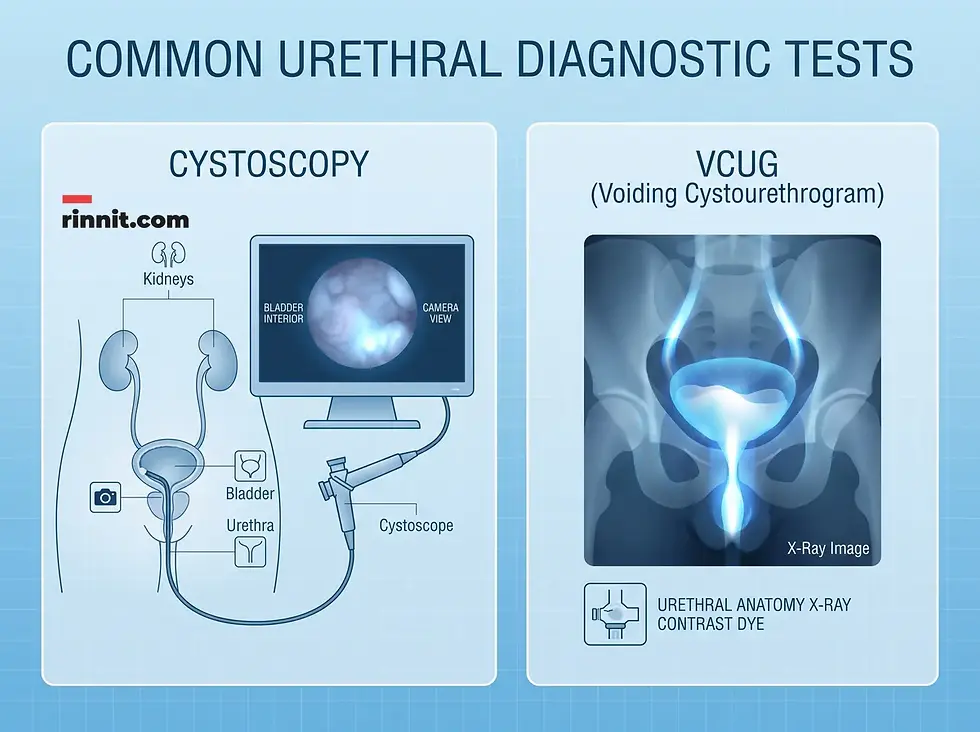
If a urethral problem is suspected, providers may order urine tests, a cystoscopy, in which a small scope with a camera is used to look into the urethra and bladder, and X-ray or ultrasound imaging. [1] A retrograde urethrogram combines an X-ray with a contrast agent, and a voiding cystourethrogram (VCUG) uses a contrast agent to show what happens as the bladder fills and then empties. [1] Signs that something is wrong include pain or difficulty peeing or being unable to pee, blood in the urine, changes in how often you pee, discharge from the urethra, bruising near the urethra, and swelling. [1]
Condition | Description | Potential Complications |
UTI | Infection anywhere along the urinary tract, including the urethra | Pain, frequent urination, and spread of infection if untreated |
Stricture | Narrowing of the urethra due to scarring | Difficulty emptying the bladder, inflammation, infections |
Urethritis | Inflammation of the urethra, often from infection | Discharge, pain when peeing, bleeding |
Fistula | Abnormal hole between the urinary system and another organ, such as the vagina | Leakage of urine into nearby tissues |
How can you care for your urethra and prevent problems?
One of the most important things you can do for a healthy urethra is drink enough fluids. [1] Water is best, and if your pee is pale yellow, you are drinking enough. [1] Other helpful habits include wiping from front to back, peeing after sex, not holding your urine for too long, emptying your bladder all the way, wearing cotton underwear, and avoiding tight pants. [1]
Lifestyle choices also play a role. Cleveland Clinic recommends not using tobacco products, reducing alcohol and caffeine, maintaining a healthy weight, getting regular exercise, and avoiding constipation. [1] If you play sports, using a jockstrap can help protect the area. [1] If you have urinary problems, review your medicines, foods and choice of birth control with your healthcare provider, because some can affect the urinary system. [1]
Conclusion
The urethra is a small but essential part of human anatomy, serving as the exit point for urine and, in males, a pathway for semen. By understanding its structure and the factors that influence its health, you can take practical steps to prevent discomfort and support long-term urinary wellness. Simple habits such as staying hydrated and practicing good hygiene are among the best defenses against common urethral problems.
Next Steps
If you have persistent pain when you pee, notice blood in your urine, or have difficulty emptying your bladder, contact your healthcare provider promptly. Early diagnosis and treatment are key to resolving urethral problems and preventing long-term complications.
Frequently Asked Questions
What is the urethra?
The urethra is the tube that lets urine leave the bladder and exit the body.
How long is the female urethra?
The female urethra is about 1.5 inches (3 to 4 centimeters) long.
How long is the male urethra?
The male urethra is about 7 to 8 inches (20 centimeters) long.
Does the urethra carry anything besides urine?
In males, it also carries semen during sex.
What is the urethral meatus?
The urethral meatus is the opening at the end of the urethra where urine leaves the body.
What are the three parts of the male urethra?
The three parts of the male urethra are the prostatic urethra, the membranous urethra, and the penile (spongy) urethra.
What is urethritis?
Urethritis is inflammation of the urethra. A sexually transmitted infection usually causes it. Nongonococcal urethritis, most often from chlamydia, is more common than urethritis from gonorrhea.
What causes urethral strictures?
Urethral strictures happen when scarring makes the urethra narrower, which can lead to inflammation, infections, pain with peeing and difficulty emptying the bladder.
How can I tell if I’m drinking enough water for my urinary health?
If your pee is pale yellow, you are drinking enough.
Is urethral cancer common?
No. Urethral cancer is very rare.
What is a cystoscopy?
A cystoscopy is a test in which a provider uses a cystoscope, a small scope with a camera, to look into the urethra and bladder.
Why are UTIs more common in females?
The shorter female urethra is commonly given as the reason, because it gives bacteria a shorter path to the bladder.
Can an injury to the urethra cause erection problems?
Yes. A damaged urethra can lead to problems such as infection, bleeding, strictures, loss of bladder control and erection problems.
What should I do if I see blood in my urine?
Contact a healthcare provider promptly for an evaluation.
Does constipation affect the urethra?
Cleveland Clinic lists avoiding constipation among the lifestyle tips for keeping the urethra and urinary system healthy.
Related Reading
Retrograde Urethrogram (RUG): Why It's Done, What to Expect and Results explains the X-ray test that checks the urethra for strictures and injury.
Sources
Cleveland Clinic. Urethra. Cleveland Clinic. Last updated July 30, 2025. https://my.clevelandclinic.org/health/body/23002-urethra
Scott AM, Clark J, Del Mar C, et al. Increased fluid intake to prevent urinary tract infections: systematic review and meta-analysis. Br J Gen Pract. 2020;70(692):e200-e207. PMID: 31988085. DOI: 10.3399/bjgp20X708125
Alhazmi SM, Khormi MA, Halawi NG, et al. Risk factors for recurrent urinary tract infections in female patients: a systematic review of behavioral and gynecologic determinants. Cureus. 2026;18(5):e108846. PMID: 42291933. DOI: 10.7759/cureus.108846
Ivaz SL, Veeratterapillay R, Jackson MJ, et al. Intermittent self-dilatation for urethral stricture disease in males: a systematic review and meta-analysis. Neurourol Urodyn. 2016;35(7):759-763. PMID: 26094812. DOI: 10.1002/nau.22803
Medical disclaimer
This information is for educational purposes only and does not constitute medical advice. Always consult a healthcare professional for diagnosis and treatment.



Comments