The Kidney: Anatomy, Function, and Vital Health Roles

Updated: 3 days ago
Medically reviewed by Dr. Baraa Alnahhal, MD · Last reviewed: October 2026
The kidneys are two fist-sized organs in the lower back that act as the body's primary filtration system [1]. By processing about 200 quarts of fluid daily, they remove toxins and waste and balance electrolytes like sodium and potassium [1]. They also regulate blood pressure and produce hormones for red blood cell production and bone health. Conditions such as chronic kidney disease and kidney stones can lead to serious complications.
Quick Answer
The kidneys are bean-shaped organs that filter all of the blood approximately once every hour, removing waste and excess fluid [1]. They manage the body's pH, regulate blood pressure through renin and make hormones such as erythropoietin for red blood cell production. Most people have two, just below the rib cage. Managing diabetes and high blood pressure helps protect them [1].
What the research says
Chronic kidney disease (CKD) is common worldwide. A meta-analysis of 100 studies (6,908,440 people) estimated a global CKD prevalence of 13.4% (95% CI 11.7-15.1%) across all five stages, and 10.6% (95% CI 9.2-12.2%) for stages 3-5 (Hill et al., PLOS ONE, 2016) [2].
The global burden is large. The Global Burden of Disease Study estimated 697.5 million cases of CKD worldwide in 2017 (prevalence 9.1%; 95% uncertainty interval 8.5-9.8) and 1.2 million deaths from CKD that year (GBD Chronic Kidney Disease Collaboration, The Lancet, 2020) [3].
Protein in the urine and reduced filtration both predict higher mortality. In pooled general-population cohorts (105,872 participants with urine albumin-to-creatinine ratio [ACR] data), the adjusted hazard ratio for all-cause mortality was 1.57 (95% CI 1.39-1.78) at an eGFR of 45 versus 95 mL/min/1.73 m², and 2.22 (95% CI 1.97-2.51) at an ACR of 33.9 versus 0.6 mg/mmol (Matsushita et al., The Lancet, 2010) [4].
What is a Kidney?
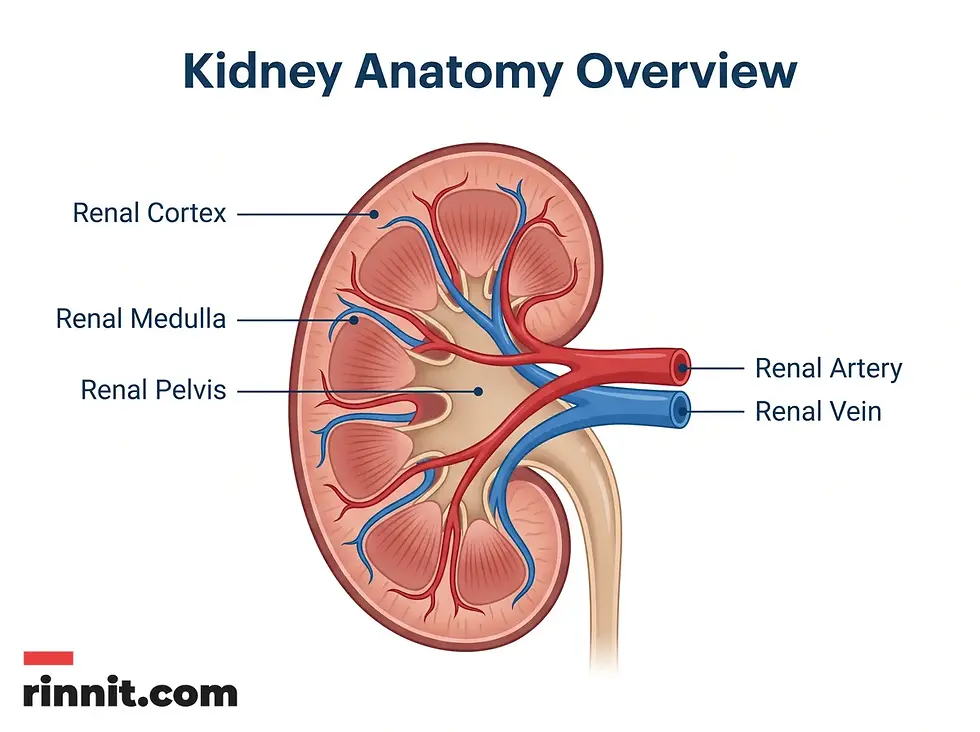
The kidneys are essential components of the urinary system, typically appearing as reddish-brown, bean-shaped organs about the size of a fist [1]. Most individuals have two kidneys, one on each side of the spine [1] in the lower back. These organs are responsible for filtering approximately 200 quarts of fluid every day, resulting in the production of about 2 quarts of urine while the remaining fluid is recycled by the body [1].
Primary Functions of the Kidney
The kidneys perform a wide array of tasks that are critical for maintaining homeostasis. Their primary role is cleaning toxins and metabolic waste from the bloodstream, including nitrogen waste (urea) and muscle waste (creatinine) [1].
Function Category | Specific Action | Impact on Health |
Filtration | Removes toxins and metabolic waste [1] | Prevents internal poisoning and azotemia [1]. |
Fluid Balance | Regulates water and electrolyte levels [1] | Maintains proper hydration and mineral levels. |
Hormone Production | Makes renin, calcitriol, and erythropoietin [1] | Controls blood pressure and supports bone/blood health. |
pH Regulation | Manages acid-base balance in the blood [1] | Prevents life-threatening metabolic acidosis. |
How do the kidneys filter blood?
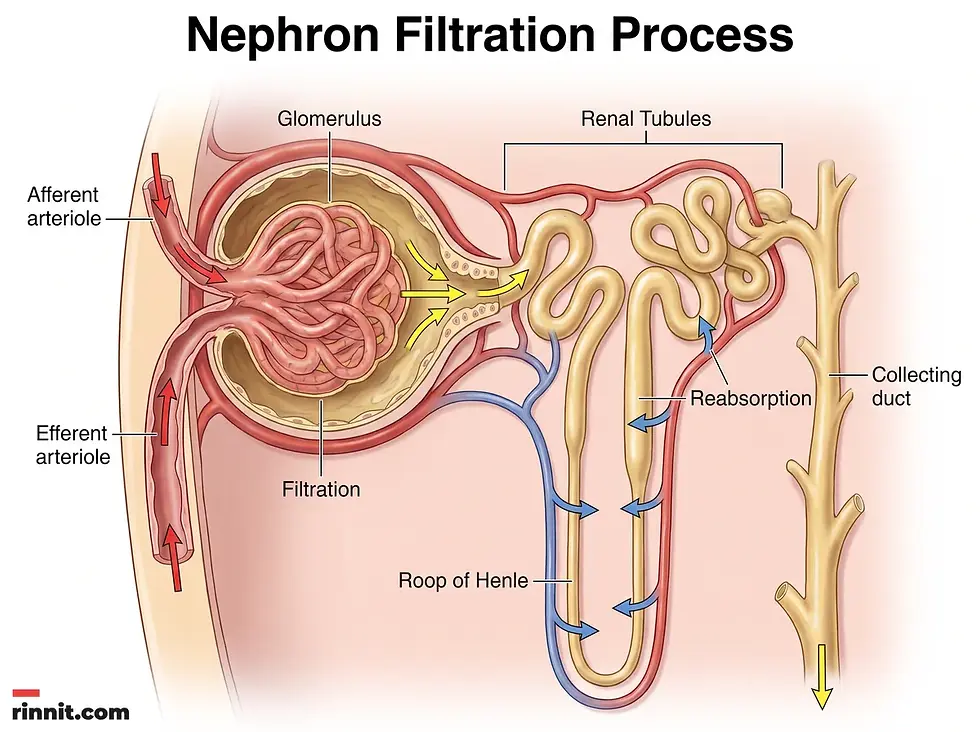
Filtration occurs within more than a million tiny units called nephrons found in each kidney [1]. The process begins at the glomeruli, which are clusters of tiny blood vessels that perform the initial filtering stage [1]. The filtered fluid then passes through renal tubules, which reabsorb necessary nutrients and water while channeling waste into collecting chambers to be excreted as urine [1].
What are common kidney conditions?
Kidney health can be compromised by various diseases, many of which do not show symptoms in their early stages [1]. Chronic kidney disease (CKD) is one of the most prevalent conditions, often resulting from unmanaged diabetes or hypertension [1].
Kidney Stones: Crystals that form in the urine and can block the flow of waste [1].
Kidney Infections: Bacteria that travel up from the bladder, causing sudden inflammation.
Polycystic Kidney Disease (PKD): A genetic condition where fluid-filled cysts grow on the kidneys [1].
Kidney Failure: A severe loss of function that can be acute or chronic [1], potentially requiring dialysis or a transplant.
What are the signs of kidney damage?
As kidney damage progresses, the body may exhibit several warning signs. Early detection is crucial for preventing total renal failure.
Foamy or Bloody Urine: Signals that the kidneys' filters are leaking protein or blood cells [1].
Swelling (Edema): Often noticed as puffy eyes or swollen ankles and feet due to fluid retention [1].
Muscle Cramping: Caused by imbalances in electrolytes like sodium and potassium [1].
Itchy, Dry Skin: A result of mineral and nutrient imbalances in the bloodstream [1].
How can you keep your kidneys healthy?
Protecting your kidneys primarily involves managing the risk factors that lead to damage. Since diabetes and high blood pressure are the leading causes of kidney disease, regular monitoring and management of these conditions are essential [1]. Additionally, avoiding physical trauma to the lower back and staying hydrated can help support long-term kidney function.

Conclusion
The kidneys are vital organs that work tirelessly to keep the body's internal environment clean and balanced. From filtering toxins to regulating blood pressure, their impact on overall health is profound. By understanding kidney anatomy and recognizing the early signs of dysfunction, individuals can take proactive steps to protect these essential organs and ensure long-term wellness.
Next step: If you are concerned about your kidney health or experiencing symptoms like swelling or changes in urination, schedule a checkup with your healthcare provider to evaluate your kidney function.
Frequently Asked Questions
How big is a typical kidney?
A kidney is about 4 to 5 inches long, roughly the size of a human fist.
How much fluid do the kidneys filter daily?
The kidneys filter about 200 quarts of fluid every day, which is enough to fill a large bathtub.
What are nephrons?
Nephrons are the primary filtering units of the kidney; there are over a million in each organ.
What is the leading cause of kidney disease?
Diabetes and high blood pressure are the most common causes of chronic kidney disease.
What does foamy urine indicate?
Foamy urine can be a sign of excess protein in the pee, which may indicate kidney damage.
Where are the kidneys located?
The kidneys sit just below the rib cage in the lower back, with one on each side of the spine.
What hormone do kidneys produce for blood cells?
The kidneys produce erythropoietin, which helps the body make red blood cells.
Can you live with only one kidney?
Yes, most people can lead a healthy life with just one functioning kidney.
What are kidney stones made of?
Kidney stones are made of crystals that form from substances in the urine and join together.
What is the renal pelvis?
The renal pelvis is a funnel-shaped structure that collects urine and passes it to the ureters.
Related Reading
Chronic Kidney Disease: What It Is, Its 5 Stages, Causes, and How It's Treated explains CKD stages, causes and ways to protect kidney function.
Kidney Stones: Symptoms, Causes, and Treatment Guide covers kidney stone pain, treatment and prevention.
Acute Kidney Injury: What Causes Sudden Kidney Failure, and How It Is Treated explains sudden loss of kidney function and its treatment.
Kidney Function Tests: Types, Normal eGFR by Age and What Results Mean describes the blood and urine tests that check kidney health.
References
Cleveland Clinic. Kidney. Cleveland Clinic. Last updated November 5, 2025. https://my.clevelandclinic.org/health/body/21824-kidney
Hill NR, Fatoba ST, Oke JL, et al. Global prevalence of chronic kidney disease - a systematic review and meta-analysis. PLOS ONE. 2016;11(7):e0158765. PMID 27383068. https://doi.org/10.1371/journal.pone.0158765
GBD Chronic Kidney Disease Collaboration. Global, regional, and national burden of chronic kidney disease, 1990-2017: a systematic analysis for the Global Burden of Disease Study 2017. The Lancet. 2020;395(10225):709-733. PMID 32061315. https://doi.org/10.1016/S0140-6736(20)30045-3
Matsushita K, van der Velde M, Astor BC, et al. Association of estimated glomerular filtration rate and albuminuria with all-cause and cardiovascular mortality in general population cohorts: a collaborative meta-analysis. The Lancet. 2010;375(9731):2073-2081. PMID 20483451. https://doi.org/10.1016/S0140-6736(10)60674-5
Medical disclaimer
The information provided in this article is for educational purposes only and should not be used as a substitute for professional medical advice, diagnosis, or treatment. Always seek the advice of your physician or other qualified health provider with any questions you may have regarding a medical condition.



Comments