Kidney Function Tests: Types, Normal eGFR by Age and What Results Mean

Updated: 2 days ago
Written and medically reviewed by Dr. Baraa Alnahhal, MD · Last reviewed: November 2026 · How we review
Quick Answer: What are kidney function tests?
Kidney function tests are blood and urine tests that show how well the kidneys work. The two key results are the estimated glomerular filtration rate (eGFR) and the urine albumin-creatinine ratio (uACR). An eGFR of 100 or higher is typical for adults, and below 60 may point to chronic kidney disease. A uACR below 30 mg/g is typical. [1]
What the research says
Newer eGFR equations no longer use race. Equations developed in 2021 that combine creatinine and cystatin C, and omit race, estimated kidney function more accurately and with smaller differences between groups than creatinine-only equations. (Inker et al., The New England Journal of Medicine, 2021) [2]
Both eGFR and urine albumin predict health risks. A meta-analysis of general population studies found that, compared with an eGFR of 95, the risk of death from any cause was 1.18 times higher at an eGFR of 60, 1.57 times higher at 45 and 3.14 times higher at 15, and rising urine albumin added risk on its own. (Chronic Kidney Disease Prognosis Consortium, The Lancet, 2010) [3]
Key takeaways
Kidney function tests are also called renal function tests. [1]
Blood tests include BUN, serum creatinine and eGFR; urine tests look for albumin and other signs. [1]
eGFR naturally declines with age, even without kidney disease. [1]
A uACR of 300 mg/g or higher means a very high risk of kidney failure. [1]
Results usually come back the same day or within a few days. [1]
What are kidney function tests?
Kidney function tests are urine and blood tests that check how well your kidneys are working. Most measure how well the glomeruli, the tiny filters in your kidneys, clear waste from your blood. [1]
Your kidneys do much more than make urine. They: [1]
Remove waste from your body as urine
Balance fluids and electrolytes
Make hormones that help control blood pressure
Make erythropoietin, which your body needs to produce red blood cells
Make vitamin D, which helps keep bones and muscles healthy
What are the types of kidney function tests?
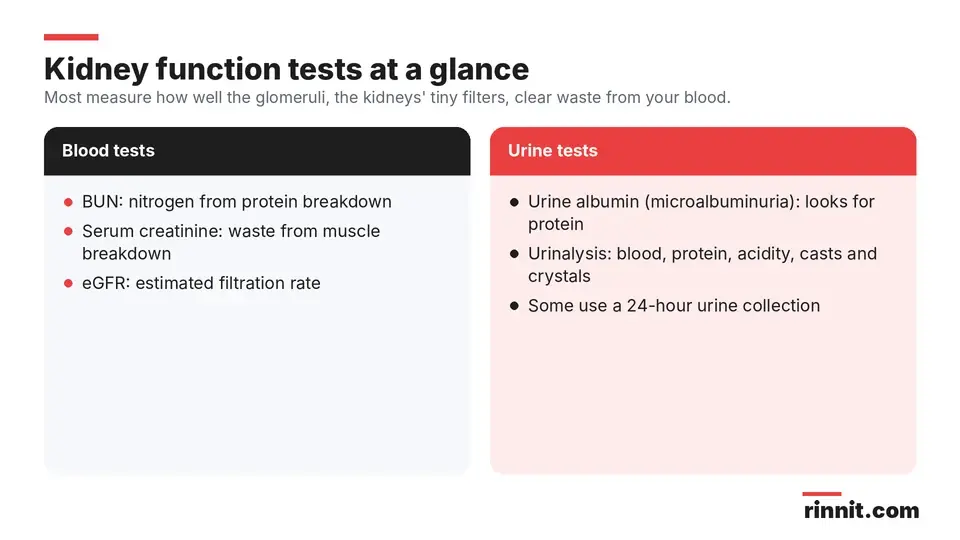
Your provider may order a blood test, a urine test or both. [1]
Test | Sample | What it measures |
Blood urea nitrogen (BUN) | Blood | Nitrogen from the breakdown of protein |
Serum creatinine | Blood | Buildup of creatinine, a waste product of muscle breakdown |
Estimated GFR (eGFR) | Blood | How well your kidneys filter, estimated from a blood test plus factors such as age, sex and body size |
Urine albumin (microalbuminuria) | Urine | Albumin, a protein that should stay in your blood |
Urinalysis | Urine | Blood, protein, acidity, concentration, casts and crystals |
Sources: [1]
Who needs kidney function tests?
Diabetes and high blood pressure can damage your kidneys, so providers use these tests to monitor people with those conditions. [1]
You may also need testing if you have symptoms that could signal a kidney problem: [1]
Blood in your urine (hematuria)
Foamy urine, which may mean protein in the urine
Painful or burning urination
Frequent urges to urinate, or trouble starting
Passing less urine than usual
Swelling (edema)
Fatigue, nausea, vomiting or loss of appetite
How do you prepare?
Blood tests: some require fasting for several hours, and your provider will tell you if yours does. Moisturizing your arms can make the needle easier to insert. If you are afraid of needles, tell your provider so they can help you cope. [1]
Urine tests: you usually don't need to prepare, but an extra glass of water beforehand helps you give enough urine. Tell your provider if you are menstruating, because blood and discharge can affect the result. [1]
How are the tests done?
Blood test: a phlebotomist draws a small amount of blood from a vein, usually in your arm, using a small needle. [1]
24-hour urine test: you collect your urine at home: [1]
On day one, urinate into the toilet as usual when you wake up.
For the rest of the day and night, collect all your urine in the container you were given.
On day two, collect your first urine of the morning in the container.
Return the container to your provider's office or the lab.
What are the risks?
These tests are simple and rarely carry long-term risks. After a blood draw, some people have bruising, dizziness or fatigue. Contact your provider if pain, fatigue or other symptoms don't go away. [1]
What do the results mean?
eGFR results

eGFR is reported in milliliters of filtered blood per minute per body surface area. [1]
About 100 or higher: typical for adults.
60 to 100: may mean mild kidney damage, though your kidneys still work well.
Below 60: may point to chronic kidney disease (CKD).
Average eGFR by age
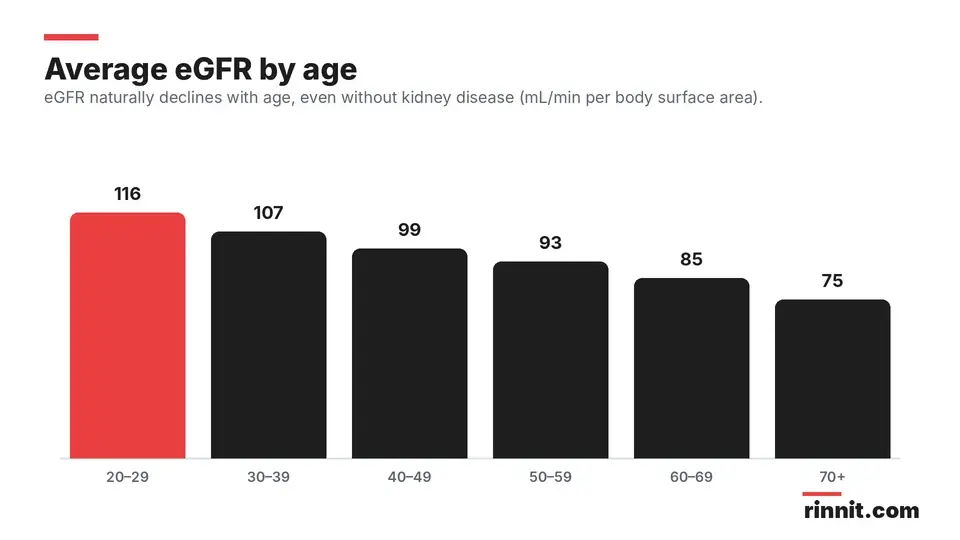
eGFR goes down as you get older, even if you don't have kidney disease. [1]
Age (years) | Average eGFR |
20 to 29 | 116 |
30 to 39 | 107 |
40 to 49 | 99 |
50 to 59 | 93 |
60 to 69 | 85 |
70 and older | 75 |
Sources: [1]
uACR results
The urine albumin-creatinine ratio compares albumin with creatinine in your urine. [1]
Less than 30 mg/g: typical.
300 mg/g or higher: a very high risk of kidney failure and a greater risk of heart attack or stroke.
What happens next?
If your results suggest early kidney disease, your provider will talk with you about treatment. This may include blood pressure medicine and a referral to a nephrologist (kidney specialist). If your results are unexpected, you may need more frequent testing. [1]
If you have early CKD, a nephrologist and a kidney (renal) dietitian can help you plan kidney-friendly meals. [1]
Drinking a lot of water right before a blood test can briefly lower your creatinine level, but it does not reverse kidney damage. [1]
When should you call your provider?
If you have CKD or are at risk, contact your provider if you notice: [1]
Urinating more often
Bloody or foamy urine
Extreme fatigue
Muscle cramps or spasms
Nausea or vomiting
Shortness of breath
Swelling in your hands, feet or ankles
Conclusion
Kidney function tests are quick blood and urine checks that catch kidney problems early, often before you feel any symptoms. Your eGFR shows how well your kidneys filter, and your uACR shows whether protein is leaking into your urine.
If you have diabetes or high blood pressure, regular testing is one of the best ways to protect your kidneys. Ask your provider what your numbers mean for you.
Keep learning: Read our chronic kidney disease guide, our BUN test guide or our guide to the urine albumin-creatinine ratio. For more background, see the NIDDK page on chronic kidney disease tests and diagnosis.
FAQ
What are kidney function tests?
They are blood and urine tests that show how well your kidneys filter waste from your blood. [1]
What is a normal eGFR?
About 100 or higher is typical for adults, and it declines naturally with age. [1]
What eGFR suggests chronic kidney disease?
An eGFR below 60 may point to chronic kidney disease. [1]
What is a normal uACR?
Less than 30 mg/g. [1]
What does a high uACR mean?
300 mg/g or higher means a very high risk of kidney failure and a higher risk of heart attack or stroke. [1]
Which blood tests check kidney function?
BUN, serum creatinine and eGFR. [1]
Do I need to fast for kidney function tests?
Some blood tests require fasting for several hours; your provider will tell you. [1]
How do I do a 24-hour urine test?
Flush your first morning urine, collect all urine for the rest of the day and night, then add the next morning's first urine. [1]
Who should get kidney function tests?
People with diabetes, high blood pressure or symptoms such as foamy urine, blood in the urine or swelling. [1]
Can drinking water improve my creatinine?
It can briefly lower creatinine before a test, but it does not reverse kidney damage. [1]
Related Reading
Creatine: Benefits, How It Works, Side Effects and Safety explains how creatine supplements work and their safety.
Chronic Kidney Disease: What It Is, Its 5 Stages, Causes, and How It's Treated explains the condition these tests are used to find and track.
Acute Kidney Injury: What Causes Sudden Kidney Failure, and How It Is Treated covers a sudden loss of kidney function shown by rising creatinine.
Diabetic Nephropathy (Diabetic Kidney Disease): Symptoms, Causes, Diagnosis & Treatment — Complete Guide explains why people with diabetes need regular kidney testing.
Glomerulonephritis: Why Your Kidney Filters Inflame, the 6 Warning Signs, and How Treatment Protects Your Kidneys describes inflammation of the kidney filters these tests measure.
Nephrotic Syndrome: Symptoms, Causes, and Treatment Guide covers a condition marked by heavy protein in the urine.
eGFR (Estimated Glomerular Filtration Rate): Normal Values, CKD Stages and What Results Mean explains the eGFR number used to measure kidney function and stage CKD.
References
Cleveland Clinic. Kidney Function Tests: Types, Results & Follow Up. Cleveland Clinic. Last updated February 3, 2025. https://my.clevelandclinic.org/health/diagnostics/21659-kidney-function-tests
Inker LA, Eneanya ND, Coresh J, et al. New Creatinine- and Cystatin C-Based Equations to Estimate GFR without Race. N Engl J Med. 2021;385(19):1737-1749. PMID 34554658. https://doi.org/10.1056/NEJMoa2102953
Chronic Kidney Disease Prognosis Consortium; Matsushita K, van der Velde M, Astor BC, et al. Association of estimated glomerular filtration rate and albuminuria with all-cause and cardiovascular mortality in general population cohorts: a collaborative meta-analysis. Lancet. 2010;375(9731):2073-2081. PMID 20483451. https://doi.org/10.1016/S0140-6736(10)60674-5
Medical disclaimer
This article is for general education only and does not replace advice from a qualified healthcare professional. Talk to your doctor about your own diagnosis and treatment, and seek emergency care right away for severe or sudden symptoms.



Comments