eGFR (Estimated Glomerular Filtration Rate): Normal Values, CKD Stages and What Results Mean

Updated: 2 days ago
Written and medically reviewed by Dr. Baraa Alnahhal, MD · Last reviewed: November 2026 · How we review
Quick Answer
eGFR (estimated glomerular filtration rate) is a number that estimates how well the kidneys filter waste from the blood. It's calculated from a blood test for creatinine together with age and sex. An eGFR of 90 or higher is normal; a value below 60 for three months can mean chronic kidney disease, and below 15 means kidney failure.
What the research says
Race-free equations with cystatin C are most accurate: a study developing the 2021 CKD-EPI equations found that formulas combining creatinine and cystatin C without race were more accurate than creatinine-only formulas, with 85% or more of estimates within 30% of measured kidney function and smaller differences between Black and non-Black participants (Inker LA et al., New England Journal of Medicine, 2021) [2]
Lower eGFR predicts higher risk: in a meta-analysis of general-population cohorts including 105,872 people, compared with an eGFR of 95, the risk of death was 18% higher at an eGFR of 60, 57% higher at 45 and more than three times higher at 15, independent of urine albumin (Matsushita K et al., Lancet, 2010) [3]
Key takeaways
eGFR estimates kidney filtering from a creatinine blood test, sometimes with cystatin C.
Normal adult eGFR is about 90–120; values fall gradually with age.
An eGFR below 60 for three months, or signs of kidney damage, suggests chronic kidney disease.
Stages run from 1 (90 or higher) to 5 (below 15, kidney failure).
Diet, muscle mass, hydration and some medicines can affect creatinine-based results.
What is eGFR?
The kidneys contain about a million tiny filters called glomeruli that clean waste and extra fluid from the blood. The glomerular filtration rate (GFR) is how much blood they filter each minute. Measuring GFR directly is complicated, so labs estimate it from creatinine, a waste product of muscle that healthy kidneys remove. When the kidneys slow down, creatinine builds up and eGFR falls. If creatinine results are unclear, providers may measure cystatin C, which may be more accurate in people over 65 or with a lot of muscle mass. Sources: [1, 2]

eGFR is calculated from a routine blood test.
Why is it done?
eGFR is reported routinely with a basic metabolic panel and is the main way providers screen for, diagnose and monitor chronic kidney disease. Regular testing is recommended if you have: Sources: [1]
Diabetes or high blood pressure.
Heart disease, including coronary artery disease.
A family history of kidney disease.
A BMI above 25.
Frequent urinary tract infections or urinary blockages.
A congenital kidney condition or a kidney transplant.
How do I prepare?
Follow your provider's instructions. You may be asked to fast, to pause certain medicines, or to avoid eating cooked meat for a day or two before the test, because meat can raise creatinine and lower your eGFR. Sources: [1]
What happens during the test?
A provider draws a blood sample, usually from a vein in your arm.
The lab measures creatinine (and sometimes cystatin C).
A formula combines the result with your age and sex to calculate eGFR. Sources: [1]
Results are usually ready within a few days. Risks are minor: brief pain, bleeding or bruising, and rarely fainting or infection. Sources: [1]
Understanding your results

Kidney disease stages based on eGFR.
Stage | eGFR (mL/min/1.73 m²) | What it means |
Stage 1 | 90 or higher | Normal filtering, but other signs of kidney damage |
Stage 2 | 60–89 | Mildly reduced function |
Stage 3 | 30–59 | Moderately reduced function |
Stage 4 | 15–29 | Severely reduced function |
Stage 5 | Below 15 | Kidney failure; dialysis or a transplant may be needed |
CKD may be diagnosed if your eGFR stays below 60 for at least three months, or if it's above 60 but there are other signs of kidney damage, such as protein in the urine on a urine albumin-creatinine ratio. A sudden drop can signal acute kidney injury. Sources: [1]
eGFR by age
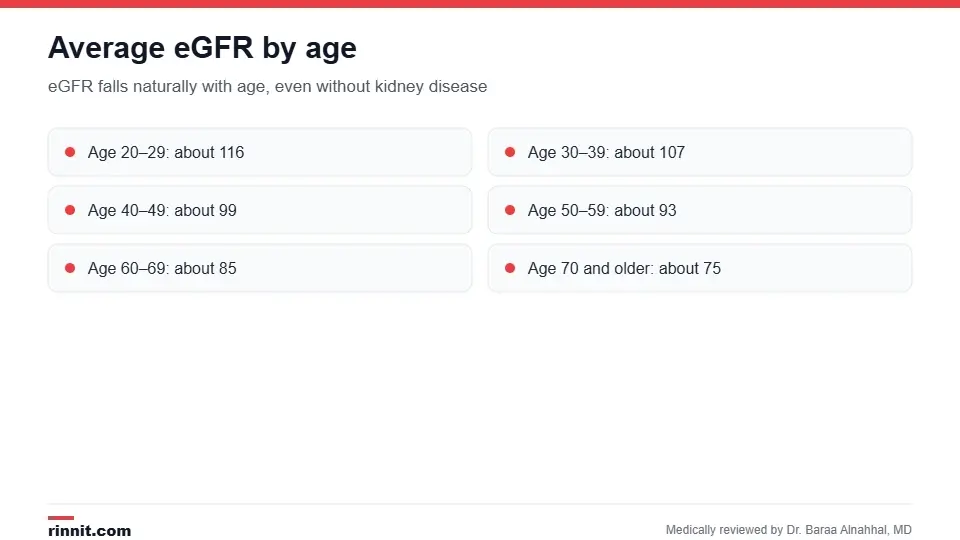
Average eGFR falls with age.
Age | Average eGFR |
20–29 | 116 |
30–39 | 107 |
40–49 | 99 |
50–59 | 93 |
60–69 | 85 |
70 and older | 75 |
Kidney function declines slowly with age even without disease, so a mildly reduced eGFR in an older adult may be normal for age. Sources: [1]
What affects the result?
Muscle mass: very muscular people can have a falsely low eGFR; people with little muscle, a falsely high one.
Diet: a large meat meal before the test can raise creatinine.
Hydration and medicines: dehydration and some medicines can change creatinine.
Cystatin C: isn't affected by muscle or diet, so it's used to confirm unclear results. Sources: [1, 2]
What happens after an abnormal result?
Your provider may repeat the test and order a urinalysis, a kidney ultrasound or CT, a 24-hour creatinine clearance test or, sometimes, a kidney biopsy. Lower eGFR is linked to a higher risk of heart disease and death, so treatment focuses on controlling blood pressure and blood sugar and protecting the kidneys. Sources: [1, 3]
Call your provider if you notice swelling in your hands, feet or ankles, shortness of breath, nausea or vomiting, muscle cramps, itchy or darkened skin, or changes in how often you urinate. Sources: [1]
Conclusion
eGFR is a simple, powerful number for tracking kidney health. One low result isn't a diagnosis, but a value that stays below 60, or keeps falling, needs a full kidney work-up. If you have diabetes, high blood pressure or heart disease, ask your provider how often to check it.
Keep learning: read about kidney function tests and chronic kidney disease.
Frequently asked questions
What is a normal eGFR?
About 90 or higher for most adults; values naturally fall with age.
What eGFR indicates kidney disease?
An eGFR below 60 for three months or longer, or signs of kidney damage at any eGFR.
What eGFR means kidney failure?
Below 15 mL/min/1.73 m².
How is eGFR calculated?
From blood creatinine (and sometimes cystatin C) with age and sex, using an equation such as CKD-EPI.
Do I need to fast?
Sometimes. Your provider may also ask you to avoid meat for a day or two.
Can eGFR improve?
Yes, if the drop was caused by dehydration, medicines or acute illness; CKD is usually managed to slow decline.
Why is my eGFR low if I feel fine?
Kidney disease often causes no symptoms until it's advanced, which is why testing matters.
What is cystatin C?
A protein made by all cells that isn't affected by muscle mass or diet, used to confirm eGFR.
Does eGFR change with age?
Yes. Average eGFR falls from about 116 in your 20s to about 75 at 70 and older.
How often should eGFR be checked?
At least yearly if you have diabetes, high blood pressure or kidney disease, or as your provider advises.
Related Reading
ACE Inhibitors: Uses, Side Effects and Examples explains how ACE inhibitors lower blood pressure.
Chronic Kidney Disease: What It Is, Its 5 Stages, Causes, and How It's Treated the condition eGFR is used to diagnose and stage.
Acute Kidney Injury: What Causes Sudden Kidney Failure, and How It Is Treated a sudden drop in kidney function.
Diabetic Nephropathy (Diabetic Kidney Disease): Symptoms, Causes, Diagnosis & Treatment — Complete Guide kidney damage from diabetes, tracked with eGFR.
Kidney Function Tests: Types, Normal eGFR by Age and What Results Mean the full set of blood and urine kidney tests.
Dialysis: Types, How It Works, Risks, and What to Expect treatment when eGFR falls into kidney failure.
References
Cleveland Clinic. Estimated Glomerular Filtration Rate (eGFR): Test & Levels. Cleveland Clinic. Last updated May 28, 2025. https://my.clevelandclinic.org/health/diagnostics/21593-estimated-glomerular-filtration-rate-egfr
Inker LA, Eneanya ND, Coresh J, et al. New creatinine- and cystatin C-based equations to estimate GFR without race. New England Journal of Medicine. 2021;385(19):1737-1749. PMID 34554658. https://doi.org/10.1056/NEJMoa2102953
Matsushita K, van der Velde M, Astor BC, et al. Association of estimated glomerular filtration rate and albuminuria with all-cause and cardiovascular mortality in general population cohorts: a collaborative meta-analysis. Lancet. 2010;375(9731):2073-2081. PMID 20483451. https://doi.org/10.1016/S0140-6736(10)60674-5
Medical disclaimer
This article is for general education only and does not replace advice from a qualified healthcare professional. Talk to your doctor about your own diagnosis and treatment, and seek emergency care right away for severe or sudden symptoms.



Comments