Dialysis: Types, How It Works, Risks, and What to Expect

Updated: 6 days ago
Written and medically reviewed by Dr. Baraa Alnahhal, MD · Last reviewed: October 2026 · How we review
Quick Answer: What is dialysis?
Dialysis is a treatment that filters waste, toxins and excess fluid from the blood when the kidneys are failing. The two types are hemodialysis, which cleans blood through a machine and artificial kidney, and peritoneal dialysis, which uses the abdominal lining as a filter. Dialysis cannot cure kidney failure, but without it or a transplant, kidney failure is fatal. [1]
What the research says
Both dialysis types offer similar survival overall. A 2025 meta-analysis of 27 studies covering 1,033,362 people starting dialysis found no overall survival difference between peritoneal dialysis and in-center hemodialysis (hazard ratio 1.01; 95% CI 0.93–1.10), although results varied by age, region and type of blood access. (Nardelli et al., BMC Nephrology, 2025) [2]
Exercise makes people on dialysis stronger and fitter. A 2026 review of 31 randomized trials (2,535 patients) found structured exercise raised handgrip strength by about 2.2 kg and added about 48 meters to the 6-minute walk test, with gains in physical quality of life — though it did not increase muscle mass. (Salameh et al., Kidney International Reports, 2026) [3]
Self-management education eases dialysis fatigue. A 2026 meta-analysis of 30 studies in adults on hemodialysis found self-management education reduced fatigue with a large effect (standardized mean difference 0.98, moderate-certainty evidence), and exercise training also helped (0.82, low certainty). (Zhang et al., Journal of Renal Care, 2026) [4]
Key takeaways
Dialysis takes over the filtering job of kidneys that work at less than 15% of their normal rate (stage 5 kidney disease). [1]
Hemodialysis is the most common type; peritoneal dialysis is done at home through a catheter in the abdomen. [1]
In-center hemodialysis usually means 3–4 hours, at least three times a week. [1]
Both types raise infection risk; each has its own extra complications. [1]
Dialysis is lifelong unless you receive a kidney transplant. [1]
Many people on dialysis keep working, raising families and traveling. [1]
What does dialysis do for your body?
Dialysis does the job your kidneys can no longer do: it removes waste products and extra fluid from your blood. [1]
Healthy kidneys filter your blood and send waste out of the body in urine. When the kidneys fail, that filtering stops working properly, and wastes and toxins build up in the bloodstream. [1]
The most common wastes that collect are:
Urea — a nitrogen waste
Creatinine — a muscle waste
Acids [1]
Dialysis clears these from the blood so your body can keep functioning.
Who needs dialysis?
People with late-stage chronic kidney disease, end-stage kidney disease (ESKD) or kidney failure may need dialysis. [1] You can read more in our guides to chronic kidney disease and its 5 stages and end-stage renal disease.
Kidney disease has five stages. In stage 5, the kidneys work at less than 15% of their normal rate, and doctors consider this kidney failure. At this point, you need dialysis or a kidney transplant to stay alive. [1]
Common conditions that damage the kidneys include:
High blood pressure
Diabetes (see diabetic nephropathy)
Lupus (see lupus nephritis) [1]
Some people develop kidney problems for no known reason. Kidney failure can be long-term, or it can come on suddenly after a severe illness or injury. Sudden (acute) kidney failure may recover. [1]
Dialysis is common: more than 2 million people worldwide treat kidney disease with dialysis or a kidney transplant. [1]
Is going on dialysis serious?
Yes, going on dialysis is serious, because it replaces organs your body cannot live without. [1]
If you need dialysis and do not start it, or you stop it, toxins build up in your blood — a condition called uremia. Kidney failure is fatal without treatment, and a person with kidney failure may survive only a few days or weeks without dialysis. [1]
What are the two types of dialysis?
The two types of dialysis are hemodialysis and peritoneal dialysis. Both filter waste and extra fluid from your blood, but they do it in different ways. [1]

Hemodialysis vs. peritoneal dialysis at a glance
Feature | Hemodialysis | Peritoneal dialysis |
What filters your blood | A machine with an artificial kidney (dialyzer) | The lining of your abdomen (peritoneum) |
Where it happens | Dialysis center or at home | At home |
Access needed | Enlarged artery and vein in the arm | Soft, permanent tube (catheter) in the abdomen |
Typical schedule | At least 3 times a week in-center | 3–5 exchanges daily (CAPD) or nightly by machine (APD) |
Main extra risks | Poor blood flow, clots or scar tissue at the access | Peritonitis, weakened abdominal muscles, hernia |
Sources: [1]
How does hemodialysis work?
Hemodialysis works by passing your blood through a machine that cleans it and returns it to you. It is the most common type of dialysis. [1]
The dialysis machine:
Removes blood from your body, usually from a vein in your arm
Filters it through an artificial kidney (dialyzer)
Returns the clean blood to your body [1]
You can have hemodialysis at a dialysis center or at home. Most people receive in-center hemodialysis at least three times a week. [1]
How does peritoneal dialysis work?
Peritoneal dialysis works by using the inner lining of your abdomen, the peritoneum, as a natural filter. [1]
You add a cleaning solution called dialysate into your abdomen. The blood vessels in the peritoneum filter your blood into this fluid. You then drain the used solution into a bag outside your body. Each fill-and-drain cycle is called an exchange. [1]
There are two main types:
Continuous ambulatory peritoneal dialysis (CAPD): A bag hung above your shoulder lets gravity slowly pull dialysate into your abdomen. You do this three to five times a day. [1]
Automated peritoneal dialysis (APD): A machine fills and drains your abdomen automatically. Each session includes three to five exchanges, and most people do it while they sleep. [1]
For a deeper look, see our complete guide to peritoneal dialysis.
How long does dialysis take?
How long dialysis takes depends on the type, ranging from a few hours three times a week to several sessions every day. [1]

Type | Session length | How often |
In-center hemodialysis | About 3–4 hours | At least 3 times a week |
Home hemodialysis | 3–8 hours | 3–7 days a week |
CAPD (manual peritoneal) | About 30–40 minutes per exchange | 3–5 times a day |
APD (automated peritoneal) | 8–12 hours, usually overnight | Possibly every day |
Sources: [1]
What happens before you start dialysis?
Before you start dialysis, a surgeon prepares an access point so the treatment can work. [1]
Before hemodialysis: A surgeon enlarges an artery and a vein in your arm. This makes access easier and lets blood flow in and out of your body faster. Learn more in our AV fistula guide. [1]
Before peritoneal dialysis: A provider surgically places a soft, permanent tube (catheter) in your abdomen and teaches you how to add and drain the dialysate through it. [1]
Is dialysis painful?
Dialysis itself is not painful, although some steps can feel uncomfortable. [1]
Hemodialysis: You may feel a slight pinch when the needle goes in, but the process does not hurt. [1]
Peritoneal dialysis: It is not painful, but the fluid in your abdomen can make you feel bloated, cold and uncomfortable. [1]
What are the risks and complications of dialysis?
The main risk shared by both types of dialysis is a higher chance of infection. Each type also carries its own complications. [1]
Type | Possible complications |
Both types | Higher risk of infection |
Hemodialysis | Poor blood flow or blockage from scar tissue or a blood clot; rarely, the needle comes out or a tube dislodges |
Peritoneal dialysis | Inflammation of the abdominal lining (peritonitis); weakened abdominal muscles over time; higher risk of hernia |
Sources: [1]
If a needle or tube comes loose during hemodialysis, a detection system pauses the machine and alerts staff to protect you from blood loss. [1] Ask your care team for the full list of risks for the type you are considering.
What are the benefits of dialysis?
The main benefit of dialysis is that it treats kidney failure by filtering waste and extra fluid from your blood, keeping you alive. [1]
Each type has its own advantages. A healthcare provider can walk you through both and help you choose the one that fits your health and lifestyle best. [1]
Can kidneys start working again after dialysis?
No — dialysis cannot cure end-stage kidney disease or kidney failure. Unless you receive a kidney transplant, you will need dialysis for the rest of your life. [1]
If you get a transplant, you can stop dialysis once the new kidney starts working. Read about the kidney transplant procedure and recovery. [1]
What is life expectancy on dialysis?
Life expectancy on dialysis varies from person to person, and some people live for many years on treatment. [1]
Your outlook depends on:
Your age
Your overall health
The cause of your kidney failure [1]
Can you work, travel and exercise on dialysis?
Yes — many people on dialysis continue to work, raise families and travel. [1]
Travel: Your care team can arrange dialysis at a center near your destination. On peritoneal dialysis, you can take solution bags and, if needed, a portable machine with you. [1]
Exercise: Exercise is generally fine on dialysis. If you use peritoneal dialysis, you may need to limit some activities while your abdomen is full of fluid. Ask your provider about specific sports. [1] Research shows structured exercise improves strength and walking distance in people on dialysis. [3]
When should you call a doctor during dialysis?
Call your healthcare provider if you notice any warning sign of a problem, especially infection, low blood pressure or a hernia. [1]
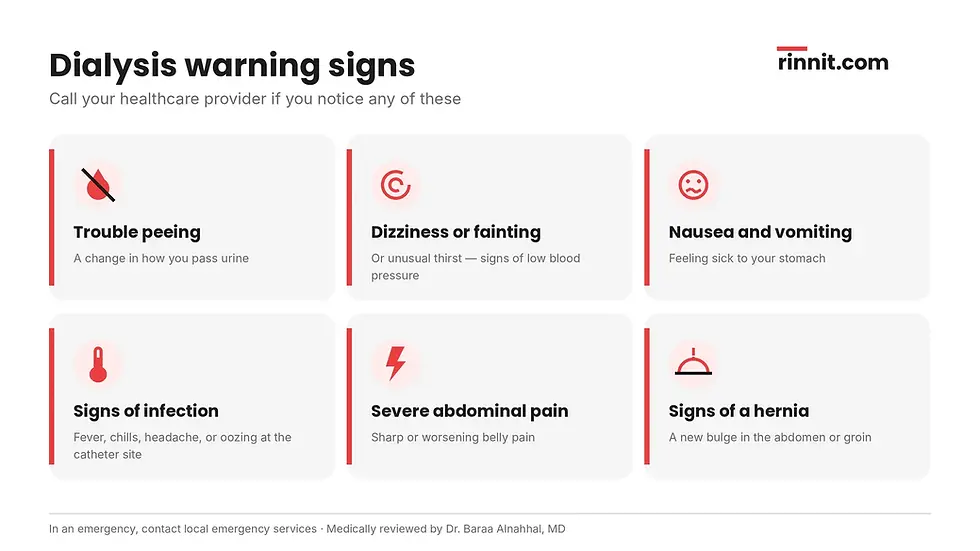
Contact your care team if you have:
Trouble peeing
Dizziness, fainting, unusual thirst or other signs of low blood pressure
Nausea and vomiting
Signs of infection: fever, chills, headache, or oozing or discoloration at your catheter site
Severe abdominal pain
Signs of a hernia, such as an unusual bulge in your abdomen or groin [1]
Conclusion
Dialysis is a lifesaving treatment for kidney failure and end-stage kidney disease. It cannot cure the condition, but it does the essential work of clearing waste and fluid from your blood until — or unless — you receive a kidney transplant. [1]
The schedule can feel demanding, and it may seem to take over your routine. Talking openly with your care team about both types — hemodialysis and peritoneal dialysis — is the best way to find the option that fits your body and your life.
Next step: Save or print this guide and bring it to your next nephrology appointment to talk through your options. Want to keep learning? Start with our guides to chronic kidney disease and kidney transplant rejection. Clinicians and health creators can also find ready-made patient-education and infographic templates in the Rinnit marketplace.
FAQ
What is dialysis in simple words?
Dialysis is a treatment that cleans waste and extra fluid out of your blood when your kidneys can no longer do it. It replaces the filtering work of failing kidneys. [1]
What are the two types of dialysis?
The two types are hemodialysis and peritoneal dialysis. Hemodialysis uses a machine and artificial kidney to clean blood outside the body, while peritoneal dialysis uses the lining of your abdomen as a filter. [1]
At what point do you need dialysis?
You usually need dialysis in stage 5 kidney disease, when your kidneys work at less than 15% of their normal rate. At this stage, dialysis or a kidney transplant is needed to stay alive. [1]
How long does a dialysis session take?
In-center hemodialysis takes about 3–4 hours, at least three times a week. Manual peritoneal dialysis exchanges take about 30–40 minutes, three to five times a day, while automated peritoneal dialysis runs 8–12 hours, usually overnight. [1]
Is dialysis painful?
Dialysis is not painful. You may feel a slight pinch when a hemodialysis needle is inserted, and peritoneal dialysis fluid can make you feel bloated, cold or uncomfortable. [1]
Can your kidneys recover after starting dialysis?
Dialysis cannot cure end-stage kidney disease or kidney failure, so most people need it for life unless they get a transplant. Sudden (acute) kidney failure, however, may recover. [1]
How long can you live on dialysis?
Life expectancy on dialysis varies, and some people live for many years on treatment. Your outlook depends on your age, overall health and the cause of your kidney failure. [1]
When should you seek urgent help while on dialysis?
Call your healthcare provider right away for fever, chills, oozing or discoloration at your catheter site, severe abdominal pain, fainting or dizziness, or a new bulge in your abdomen or groin. These can signal infection, low blood pressure or a hernia. [1]
Can I do dialysis at home?
Yes, for many people. Peritoneal dialysis is usually done at home, and some people learn to do home hemodialysis after training. Your kidney team can help you decide which fits your health and lifestyle.
Do I need a special diet on dialysis?
Most people on dialysis need to limit salt, fluids, potassium and phosphorus. A kidney dietitian will make a plan based on your blood tests and your type of dialysis.
Related Reading
eGFR (Estimated Glomerular Filtration Rate): Normal Values, CKD Stages and What Results Mean explains the eGFR number used to measure kidney function and stage CKD.
References
Cleveland Clinic. Dialysis: Types, How It Works, Procedure & Side Effects. Cleveland Clinic. Last updated March 28, 2025. https://my.clevelandclinic.org/health/treatments/14618-dialysis
Nardelli L, Passerini M, Zubidat D, et al. Association of incident dialysis modality with patient survival: a systematic review and meta-analysis. BMC Nephrology. 2025;26(1):588. PMID 41137014. https://doi.org/10.1186/s12882-025-04530-4
Salameh AR, Wathanavasin W, Jaturapisanukul S, et al. Systematic Review of Exercise Training and Musculoskeletal Health in Patients Receiving Dialysis. Kidney International Reports. 2026;11(6):106517. PMID 42112156. https://doi.org/10.1016/j.ekir.2026.106517
Zhang Q, Gong T, Ye Y. The Impact of Educational or Behavioural Interventions on Fatigue in Adults Receiving Haemodialysis: A Systematic Review and Meta-Analysis. Journal of Renal Care. 2026;52(3):e70079. PMID 42678025. https://doi.org/10.1111/jorc.70079
Further reading (external):
National Institute of Diabetes and Digestive and Kidney Diseases. Choosing a Treatment for Kidney Failure. NIDDK Health Information. Last reviewed January 2018. https://www.niddk.nih.gov/health-information/kidney-disease/kidney-failure/choosing-treatment
American Kidney Fund. Dialysis. American Kidney Fund. Accessed October 30, 2026. https://www.kidneyfund.org/treatments/dialysis
Disclaimer
This article is for educational purposes only and is not a substitute for professional medical advice, diagnosis or treatment. Always talk to your doctor or nephrology team about your own situation before making decisions about dialysis or any other kidney treatment. If you have a medical emergency, contact your local emergency services immediately.



Comments