ACE Inhibitors: Uses, Side Effects and Examples

Updated: 2 days ago
Written and medically reviewed by Dr. Baraa Alnahhal, MD · Last reviewed: November 2026 · How we review
Quick Answer
ACE inhibitors (angiotensin-converting enzyme inhibitors) are medicines that relax blood vessels and lower blood pressure by blocking a hormone called angiotensin II. They treat high blood pressure and heart failure. Rarely, they cause angioedema, a dangerous swelling of the face or throat that needs emergency care. They must not be taken during pregnancy.
What the research says
ACE inhibitors lower the risk of death: pooling 20 trials of 158,998 people with high blood pressure, ACE inhibitors lowered death from any cause by 10%, while ARB medicines showed no clear mortality reduction (van Vark LC et al., European Heart Journal, 2012) [2]
They protect the kidneys in diabetes: in 409 people with type 1 diabetes and kidney disease, captopril cut the risk of kidney function worsening by 48% and the risk of death, dialysis or transplant by 50% compared with placebo (Lewis EJ et al., New England Journal of Medicine, 1993) [3]
Key takeaways
ACE inhibitors lower blood pressure by relaxing blood vessels.
They treat high blood pressure and heart failure and protect the kidneys.
Common ones include lisinopril, enalapril and ramipril.
A dry cough is the most common side effect.
Get emergency help for swelling of the face, lips, tongue or throat.
What are ACE inhibitors?
Your body makes angiotensin II, a hormone that tightens blood vessels and makes your kidneys hold on to salt and water. ACE inhibitors block the enzyme that makes angiotensin II, so blood vessels relax and blood pressure falls. They also boost bradykinin, a substance that widens blood vessels and helps the kidneys remove sodium. They're often a first-choice medicine for high blood pressure. Sources: [1]
What they treat

They're often a first-choice blood pressure medicine.
High blood pressure.
Recovery after a heart attack or acute coronary syndrome.
Preventing heart attack and stroke in people at high risk.
Slowing kidney damage in people with diabetes.
Some kidney conditions, such as protein in the urine. Sources: [1, 3]
Common ACE inhibitors
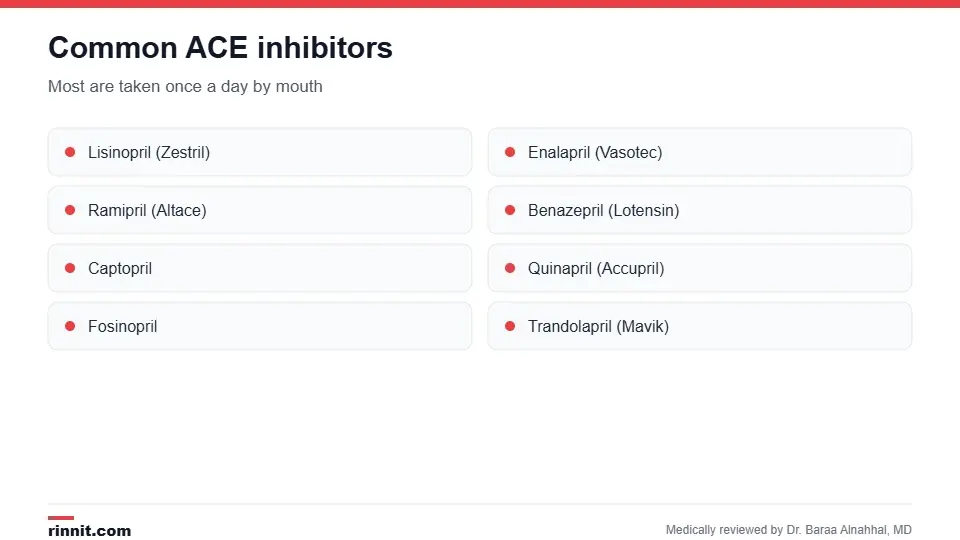
Most are taken once a day by mouth.
Medicine | Brand names |
Lisinopril | Zestril, Qbrelis |
Enalapril | Vasotec, Epaned |
Ramipril | Altace |
Benazepril | Lotensin |
Captopril | Capoten |
Quinapril | Accupril |
Fosinopril | Monopril |
Perindopril | Aceon |
Trandolapril | Mavik |
Moexipril | Univasc |
Enalaprilat | The only IV form; used in the hospital |
Sources: [1]
How to take them
Most are taken once a day; some need two doses.
Some work best taken an hour before a meal.
If you miss a dose, take it when you remember unless it's almost time for the next one; don't double up.
Stand up slowly to avoid dizziness.
Ask before using salt substitutes, which often contain potassium.
You'll have kidney and electrolyte blood tests at least once a year. Sources: [1]
For high blood pressure, you'll usually take them for years or for life. Learn more about other blood pressure medicines. Sources: [1]
Side effects
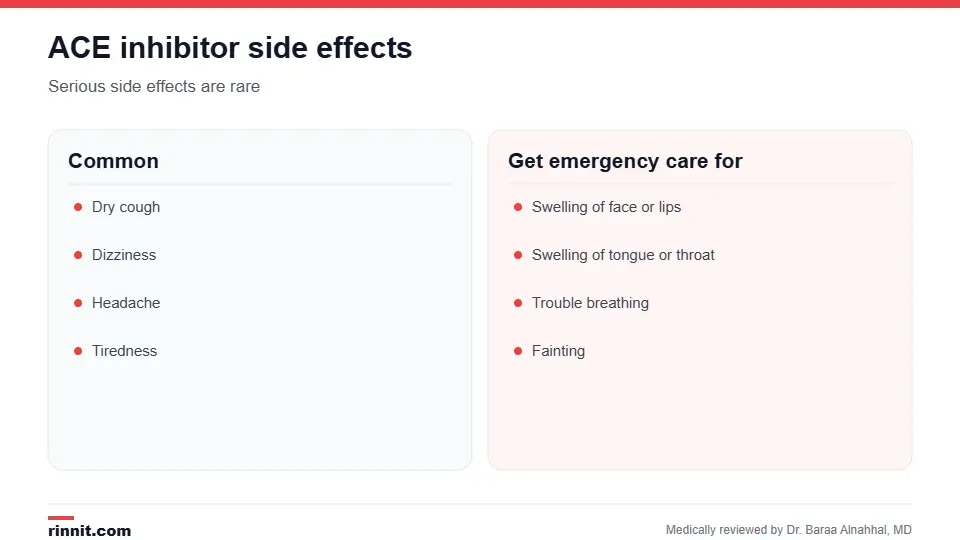
Serious side effects are rare.
Type | Examples |
Common | Dry cough, dizziness, headache, drowsiness, tiredness, weakness |
Less common | Changed or metallic taste, upset stomach, rash |
Rare but serious | Angioedema (swelling of the face, mouth or throat), severe allergic reaction |
Spicy foods may make the ACE inhibitor cough worse, but the cough isn't dangerous. If it bothers you, your provider may switch your medicine. Sources: [1]
Who shouldn't take them
People who are pregnant, trying to get pregnant or breastfeeding.
People who've had angioedema or a reaction to an ACE inhibitor.
People with severe kidney disease or narrowing of the kidney arteries. Sources: [1]
ACE inhibitors can interact with NSAIDs, potassium supplements, ARBs and aliskiren. Tell your provider about all your medicines. Sources: [1]
When to get help
Swelling of the face, lips, tongue or throat; get emergency care.
Hives, itching or trouble swallowing or breathing.
Fainting or nearly fainting.
Signs of a heart attack or stroke.
Yellow skin or eyes. Sources: [1]
Conclusion
ACE inhibitors are effective, well-studied medicines that lower blood pressure and protect the heart and kidneys. Taking them as prescribed and keeping up with blood tests helps you get the benefits safely.
Keep learning: read about high blood pressure and blood pressure medicines.
Frequently asked questions
What are ACE inhibitors?
Medicines that relax blood vessels to lower blood pressure.
What do ACE inhibitors treat?
High blood pressure, heart failure and kidney disease, and they help after a heart attack.
What are common ACE inhibitors?
Lisinopril, enalapril, ramipril, benazepril and captopril.
What is the most common side effect?
A dry cough.
What is angioedema?
Rare, dangerous swelling of the face, lips or throat that needs emergency care.
Can I take ACE inhibitors while pregnant?
No. They should be avoided in pregnancy and breastfeeding.
How long do I need to take them?
Usually long-term, often for life for high blood pressure.
Can I use salt substitutes?
Ask your provider first, since many contain potassium.
Do ACE inhibitors protect the kidneys?
Yes, especially in people with diabetes.
What if I miss a dose?
Take it when you remember unless the next dose is soon; don't double up.
Related Reading
High Blood Pressure: Silent Symptoms, Serious Risks, and Proven Ways to Lower It the main condition ACE inhibitors treat.
Blood Pressure Medications: Types, How They Work, and Side Effects other medicines for blood pressure.
Congestive Heart Failure: Symptoms, Stages, and How It's Treated a condition treated with ACE inhibitors.
Hives and Angioedema: Symptoms, Causes, Treatment & Complete Guide a rare but serious side effect.
eGFR (Estimated Glomerular Filtration Rate): Normal Values, CKD Stages and What Results Mean a kidney test used while taking ACE inhibitors.
References
Cleveland Clinic. ACE Inhibitors: Uses and Side Effects. Cleveland Clinic. Last updated November 7, 2025. https://my.clevelandclinic.org/health/treatments/21934-ace-inhibitors
van Vark LC, Bertrand M, Akkerhuis KM, et al. Angiotensin-converting enzyme inhibitors reduce mortality in hypertension: a meta-analysis of randomized clinical trials of renin-angiotensin-aldosterone system inhibitors involving 158,998 patients. European Heart Journal. 2012;33(16):2088-2097. PMID 22511654. https://doi.org/10.1093/eurheartj/ehs075
Lewis EJ, Hunsicker LG, Bain RP, et al. The effect of angiotensin-converting-enzyme inhibition on diabetic nephropathy. New England Journal of Medicine. 1993;329(20):1456-1462. PMID 8413456. https://doi.org/10.1056/NEJM199311113292004
Medical disclaimer
This article is for general education only and does not replace advice from a qualified healthcare professional. Talk to your doctor about your own diagnosis and treatment, and seek emergency care right away for severe or sudden symptoms.



Comments