Blood Pressure Medications: Types, How They Work, and Side Effects

Updated: 6 days ago
Written and medically reviewed by Dr. Baraa Alnahhal, MD · Last reviewed: October 2026 · How we review
Quick Answer
Blood pressure medications (antihypertensives) are prescription medicines that lower high blood pressure by relaxing blood vessels, removing extra fluid, slowing the heart, or blocking a substance that tightens vessels. Common first choices are thiazide diuretics and calcium channel blockers. Lowering blood pressure helps protect against heart attack, stroke, heart failure, and kidney failure. [1] [2]
What the research says
Every 10-point drop in top-number pressure cuts heart risks sharply. A review of 123 studies with 613,815 people found that lowering systolic pressure by 10 mm Hg reduced major heart and blood vessel events by 20%, stroke by 27%, heart failure by 28%, and death from any cause by 13% (Ettehad et al., Lancet, 2016).
Even a small drop helps, with or without past heart disease. Pooled data from 48 trials and 344,716 people showed that a 5 mm Hg drop in systolic pressure lowered the risk of major heart events by about 10%, whether or not people had heart disease before (Blood Pressure Lowering Treatment Trialists' Collaboration, Lancet, 2021).
The main drug types protect the heart about equally well. Across 147 trials and 464,000 people, the five main classes reduced heart disease and stroke by a similar amount for the same drop in pressure; calcium channel blockers gave slightly more stroke protection (Law et al., BMJ, 2009).
Key takeaways
Antihypertensives lower blood pressure to protect your heart, brain, and kidneys.
There are nine main classes, each working in a different way.
Your clinician picks a medicine based on your health history, age, sex, and how high your blood pressure is.
Many people need more than one medicine. Doses are often adjusted over time.
Take your medicine at the same time every day, and check your blood pressure at home.
What are blood pressure medications?
Blood pressure medications are medicines that lower your blood pressure. Doctors use them to treat high blood pressure (hypertension). [1]
Bringing your pressure down makes it easier for your heart to pump blood around your body, all day and night. Over time, this keeps your heart strong.
More than 1 billion people worldwide live with high blood pressure, so these medicines are among the most widely used in the world.
How you take them:
Most people swallow a pill once a day.
In the hospital, some antihypertensives are given through an IV (a drip into a vein).
Not sure where your numbers fall? See our guide to normal blood pressure by age and what counts as elevated blood pressure.
How do blood pressure medications lower blood pressure?
Blood pressure medications lower blood pressure in one of four main ways: relaxing blood vessels, removing extra fluid, easing the heart's work, or blocking a vessel-tightening signal. Each medicine works in its own way. [1]

Approach | What happens in your body | Medicine classes |
Relax blood vessels | Vessels widen, so blood flows more easily | Alpha-blockers, calcium channel blockers, vasodilators, central alpha-2 agonists |
Remove extra fluid | Kidneys move extra salt and water into your urine, so there is less blood to pump | Diuretics |
Ease the heart's work | The heart pumps more slowly or with less force | Beta-blockers |
Block a tightening signal | Your body makes or responds to less angiotensin, a substance that narrows blood vessels | ACE inhibitors, ARBs, renin inhibitors |
What are the types of blood pressure medications?
There are nine main classes of blood pressure medications: diuretics, calcium channel blockers, ACE inhibitors, ARBs, beta-blockers, alpha-blockers, central alpha-2 receptor agonists, renin inhibitors, and vasodilators. Here is what each one does, with common examples. [1] [2]

Class | How it works | Examples |
Diuretics | Widen blood vessels and help kidneys flush extra fluid and salt into urine | Hydrochlorothiazide, amiloride, furosemide |
Calcium channel blockers | Keep calcium out of vessel muscle so it relaxes and loosens | Amlodipine, diltiazem, verapamil |
ACE inhibitors | Help your body make less angiotensin, a vessel tightener | Lisinopril, captopril, ramipril |
Angiotensin II receptor blockers (ARBs) | Stop angiotensin II from tightening blood vessels | Losartan, valsartan, olmesartan |
Beta-blockers | Keep your heart rate low and may relax blood vessels | Metoprolol, atenolol, propranolol |
Relax the muscles in artery walls | Prazosin, doxazosin, terazosin | |
Central alpha-2 receptor agonists | Stop your nervous system from narrowing blood vessels | Clonidine, methyldopa, guanfacine |
Renin inhibitors | Block the enzyme renin, so your body makes less angiotensin | Aliskiren |
Vasodilators | Relax blood vessels so they open wider | Minoxidil, hydralazine |
Want a closer look at one beta-blocker? Read our guide to pindolol.
Which blood pressure medicine is usually tried first?
No single blood pressure medicine is best for everyone; thiazide diuretics or calcium channel blockers are common first choices for most adults, and the right one is the one that works for you and your health. [1]
Your clinician will consider your:
Health history and other conditions
Age, race, and sex
Current blood pressure level
Your situation | Common first choices |
Most adults with high blood pressure | Thiazide diuretics or calcium channel blockers |
Kidney disease | ACE inhibitors or ARBs |
Heart failure | ACE inhibitors or ARBs |
History of heart disease | Beta-blockers may be a first choice |
Pregnancy | Methyldopa, labetalol, or nifedipine |
If you have heart failure, our guide to congestive heart failure explains how treatment fits together.
What are the benefits and risks of blood pressure medications?
Blood pressure medications protect against heart attack, stroke, heart failure, and kidney failure, but they can cause a sudden drop in pressure when you stand up and changes in your electrolytes. [1]
Benefits
Lowering high blood pressure keeps your heart from being overworked. It also helps you avoid:
Heart attack
Stroke
Heart failure
Kidney failure
Long-standing high pressure can thicken and weaken the heart muscle. Learn more in our guide to hypertensive heart disease.
Risks
Two risks deserve special attention:
Risk | What it means | What to watch for |
Sudden drop on standing (orthostatic hypotension) | Blood pressure falls quickly when you stand up | Dizziness, light-headedness, or fainting when getting up |
Electrolyte changes | Losing extra fluid in urine can shift magnesium or potassium levels | These shifts can cause dangerous heart rhythms; your clinician may check your blood |
Learn more about low potassium (hypokalemia) and high potassium (hyperkalemia).
What are the side effects of blood pressure medications?
Side effects of blood pressure medications vary by type and can include dizziness, tiredness, headache, a fast or slow heart rate, upset stomach, cough, swelling, and changes in magnesium or potassium levels. [1]
Body area | Possible side effects |
Head and energy | Dizziness, fainting, tiredness, headache |
Heart | Fast or slow heart rate |
Stomach and mouth | Upset stomach, constipation, dry mouth |
Lungs and body | Cough, swelling |
Blood tests | High or low magnesium or potassium |
Each type has its own side effect profile, so ask what to expect from yours. If side effects bother you, talk to your clinician before stopping. They can change the dose or switch you to a different type.
What should you expect when you start blood pressure medication?
When you start blood pressure medication, some types begin working within one hour while others take longer, and most people continue treatment long term. [1]
How fast do blood pressure medications work?
Some blood pressure medicines start working within one hour. Others take longer to reach their full effect.
High blood pressure often has no symptoms for years. That is why home checks matter. Your readings show whether your medicine is working.
Is blood pressure treatment lifelong?
Usually, yes. Hypertension is a long-term condition, so most people keep taking medicine for life.
Your clinician may:
Start with one medicine, then add a second or third step by step
Adjust the dose if your pressure isn't at goal
Switch medicines if you get side effects or unsafe changes in blood tests
For people whose pressure stays high despite several medicines, procedures such as renal denervation may be an option to discuss.
How can you get the most from your blood pressure medication?
People who keep their blood pressure in a healthy range tend to take their medicine at the same time every day, check their pressure at home, and keep regular checkups. [1]
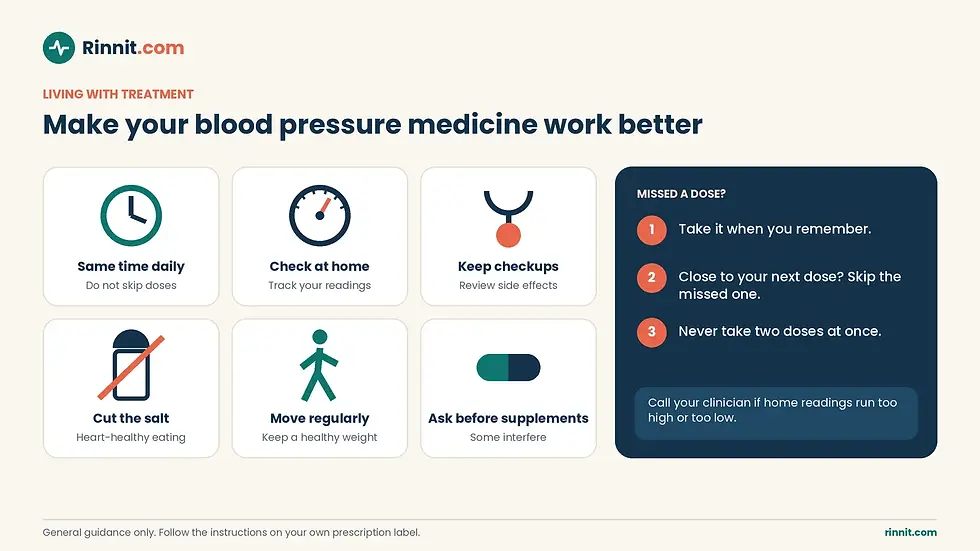
Take their medicine at the same time every day without missing doses.
Check blood pressure regularly at home.
Go to regular checkups.
Eat heart-healthy foods low in salt.
Limit alcohol.
Avoid drugs or supplements that may stop their medicine from working.
Stay physically active.
Keep a healthy weight.
What if you miss a dose?
Take it as soon as you remember.
If it's almost time for your next dose, skip the missed one.
Never take two doses at once.
Keeping your pills current matters too. Check our 2026 blood pressure medication recall list to make sure yours aren't affected.
When should you call your doctor about blood pressure medication?
Contact your healthcare provider about your blood pressure medication if side effects bother you, your home readings are too high or too low, you feel dizzy or faint, or you plan to become pregnant. [1]
Side effects are bothering you. Call 911 if your face, lips, tongue or throat swell or you have trouble breathing, which can be a rare, serious reaction to ACE inhibitors and similar medicines
Your home readings are too high
Your home readings are too low, or you feel dizzy or faint (see low blood pressure)
You plan to become pregnant or could be pregnant, since many blood pressure medicines aren't safe for a developing baby; ACE inhibitors, ARBs and aliskiren in particular can harm the baby and should be stopped as soon as pregnancy is known
Conclusion
Blood pressure medications are very helpful in managing high blood pressure and protecting your heart, brain, and kidneys. There are many types, and each lowers pressure in its own way.
Finding the right one can take some time. You may need a dose change, a switch, or a second medicine. That's normal.
Take your medicine every day, check your numbers at home, and keep your checkups. Small, steady steps add up to real protection.
Take this to your next appointment. Save or share this guide, write down your home readings, and ask your clinician: Which type am I taking, what is my target, and what side effects should I watch for? For more plain-language heart health guides, explore our health library.
Frequently asked questions
What is the most common blood pressure medication?
Thiazide diuretics and calcium channel blockers are common first choices for many adults. ACE inhibitors and ARBs are often preferred for people with kidney disease or heart failure.
Can I stop taking blood pressure medicine once my numbers are normal?
Normal readings usually mean the medicine is working, not that you no longer need it. High blood pressure is a long-term condition. Talk to your clinician before making any change.
How long does it take for blood pressure medicine to work?
Some start working within one hour. Others take longer. Home readings help you and your clinician see how well yours is working.
Can I take fish oil with blood pressure medicine?
Yes. But check your blood pressure regularly, because taking both may lower your pressure more.
Which blood pressure medications are safe in pregnancy?
Methyldopa, labetalol, and nifedipine can be used during pregnancy. Many others aren't safe for a developing baby, so tell your clinician if you plan to become pregnant. Learn more about gestational hypertension.
Why do I need more than one blood pressure medicine?
One medicine isn't always enough to reach your goal. Adding a second or third type, step by step, is a common and effective approach.
What should I do if I feel dizzy after taking my medicine?
Dizziness can come from a sudden drop in pressure when you stand up. Tell your clinician. They may adjust your dose or switch your medicine.
What happens if I miss a dose?
Take it when you remember. If your next dose is close, skip the missed one. Never take two doses at once.
What time of day should I take blood pressure medicine?
Take it at the same time each day, at the time your doctor or pharmacist recommends. Choosing a time that fits your routine makes it easier to remember.
Can blood pressure medicine cause a cough?
Yes. ACE inhibitors can cause a dry, tickly cough in some people. Tell your doctor, who may switch you to another medicine, but do not stop on your own.
Trusted resources
Related Reading
ACE Inhibitors: Uses, Side Effects and Examples explains how ACE inhibitors lower blood pressure.
References
Cleveland Clinic. Types of Blood Pressure Medications. Cleveland Clinic. Last updated August 10, 2026. https://my.clevelandclinic.org/health/treatments/21811-antihypertensives
American Heart Association. Types of Blood Pressure Medications. heart.org. Last reviewed August 14, 2025. https://www.heart.org/en/health-topics/high-blood-pressure/changes-you-can-make-to-manage-high-blood-pressure/types-of-blood-pressure-medications
Merck Manual Consumer Version. Medications for Treatment of High Blood Pressure. Merck Manuals. Last updated July 2025. https://www.merckmanuals.com/home/heart-and-blood-vessel-disorders/high-blood-pressure/medications-for-treatment-of-high-blood-pressure
Regalla DKR, Patel P. Antihypertensive Medications. In: StatPearls [Internet]. Treasure Island (FL): StatPearls Publishing; updated May 26, 2026. PMID: 32119466. https://www.ncbi.nlm.nih.gov/books/NBK554579/
Ettehad D, Emdin CA, Kiran A, et al. Blood pressure lowering for prevention of cardiovascular disease and death: a systematic review and meta-analysis. Lancet. 2016;387(10022):957-967. PMID: 26724178. https://doi.org/10.1016/S0140-6736(15)01225-8
Blood Pressure Lowering Treatment Trialists' Collaboration. Pharmacological blood pressure lowering for primary and secondary prevention of cardiovascular disease across different levels of blood pressure: an individual participant-level data meta-analysis. Lancet. 2021;397(10285):1625-1636. PMID: 33933205. https://doi.org/10.1016/S0140-6736(21)00590-0
Law MR, Morris JK, Wald NJ. Use of blood pressure lowering drugs in the prevention of cardiovascular disease: meta-analysis of 147 randomised trials in the context of expectations from prospective epidemiological studies. BMJ. 2009;338:b1665. PMID: 19454737. https://doi.org/10.1136/bmj.b1665
Medical disclaimer
This article is for education only and does not replace advice from your own healthcare provider.



Comments