Urine Albumin-Creatinine Ratio (uACR): What the Test Shows and What Your Numbers Mean

Updated: 4 days ago
Written and medically reviewed by Dr. Baraa Alnahhal, MD · Last reviewed: November 2026 · How we review
Quick Answer: What is a urine albumin-creatinine ratio (uACR)?
A urine albumin-creatinine ratio (uACR) is a urine test that compares the amount of albumin, a blood protein, with creatinine, a waste product, in your urine. Healthy kidneys keep albumin in the blood, so albumin in the urine can be an early sign of kidney damage. A normal uACR is less than 30 mg/g. [1]
What the research says
Even modest albumin in the urine predicts higher mortality. In 14 general-population studies with 105,872 people, the risk of death rose steadily with ACR; a level of 10 mg/g or more was an independent predictor of mortality, and an ACR of about 300 mg/g carried about 2.2 times the risk of a very low ACR. (Matsushita et al., The Lancet, 2010) [2]
Higher uACR means a much higher chance of kidney failure. In nine general-population cohorts with 845,125 people, compared with an ACR of 5 mg/g, the risk of end-stage kidney disease was about 5 times higher at 30 mg/g, 13 times at 300 mg/g and 28 times at 1,000 mg/g. (Gansevoort et al., Kidney International, 2011) [3]
Key takeaways
uACR measures albumin and creatinine in urine to check kidney health. [1]
It is usually ordered for people with diabetes or chronic kidney disease. [1]
Under 30 mg/g is normal; 30 to 299 mg/g means higher risk; 300 mg/g or more, when confirmed, suggests kidney disease. [1]
An abnormal result is usually repeated a few months later before a diagnosis. [1]
Collecting the sample has no risks. [1]
What does a uACR measure?
Albumin is a protein in your blood plasma. Your liver makes it, and it keeps fluid inside your blood vessels and carries vitamins, enzymes and hormones around the body. Creatinine is a waste product made when your muscles use energy. [1]
Healthy kidneys keep albumin in the blood and filter creatinine out into the urine. When the kidneys are damaged, small amounts of albumin (microalbumin) leak into the urine, and creatinine may stay in the body. The ratio of the two gives your provider a picture of your kidney health. [1]
Who needs a uACR test?
Providers usually order a uACR to check the kidneys of people with diabetes or chronic kidney disease (CKD). They may also order it if you have: [1]
High blood pressure
Heart disease
Cirrhosis of the liver
In some cases, a uACR is also ordered if you have obesity (a BMI over 30), smoke or are over 50. [1]
What are the types of uACR tests?
There are three ways to collect a sample for a uACR. [1]

A 24-hour collection is the most accurate type of uACR.
Type | How it works |
Spot sample | A one-time urine sample given at a provider's office or lab |
Early morning or timed | Collected at home in a cup when you wake up, or after not urinating for at least four hours |
24-hour collection | You urinate into a large container every time over 24 hours and keep it refrigerated; usually ordered only after an abnormal spot or timed result |
Sources: [1]
How do you prepare for a uACR test?
Your provider will give you specific instructions. In general: [1]
Drink enough fluids to give a sample.
Avoid intense exercise for at least 24 hours, because it can briefly raise albumin in urine.
Avoid eating meat for at least 24 hours, because it can briefly affect creatinine levels.
Tell your provider if you are on your period or have bleeding hemorrhoids, or if you have a urinary tract infection, fever, gum infection (periodontitis) or viral hepatitis. Blood or bacteria in the sample can also interfere with results. [1]
What happens during a uACR test?
Most uACR tests use the clean-catch method to prevent contamination. You get a sterile cup and wipes. [1]
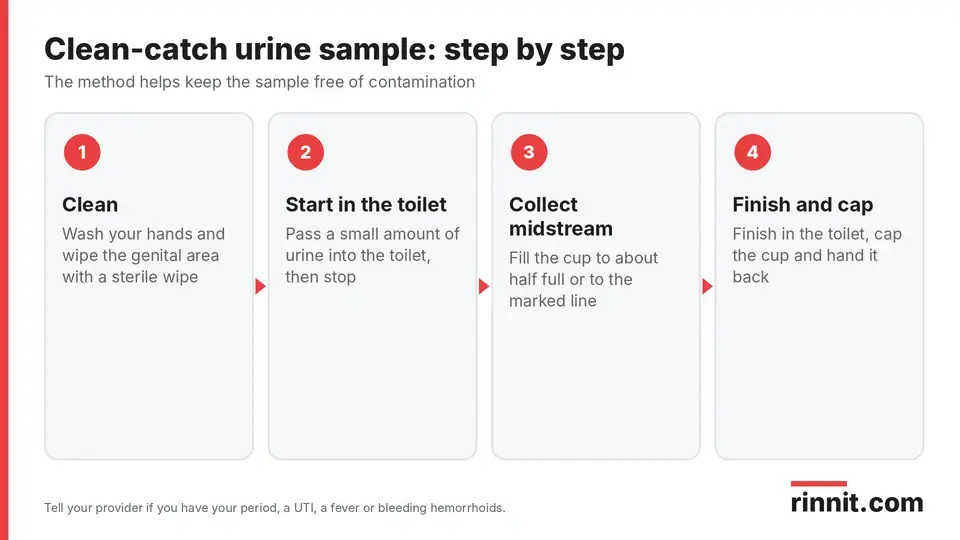
The clean-catch method keeps the sample free of contamination.
Wash your hands with antibacterial soap and water.
Clean your genital area with a sterile wipe.
Pass a small amount of urine into the toilet, then stop.
Hold the cup a few inches from your urethra.
Fill the cup to about half full or to the marked line.
Stop, put the cup down and finish urinating in the toilet.
Cap the cup and return it to your provider.
Sources: [1]
There are no risks to collecting a urine sample; the clean-catch method is noninvasive and painless. The sample goes to a lab, and results usually come back in a day or two. [1]
What do uACR results mean?
The uACR is reported in milligrams of albumin per gram of creatinine (mg/g). A lower number is better. [1]
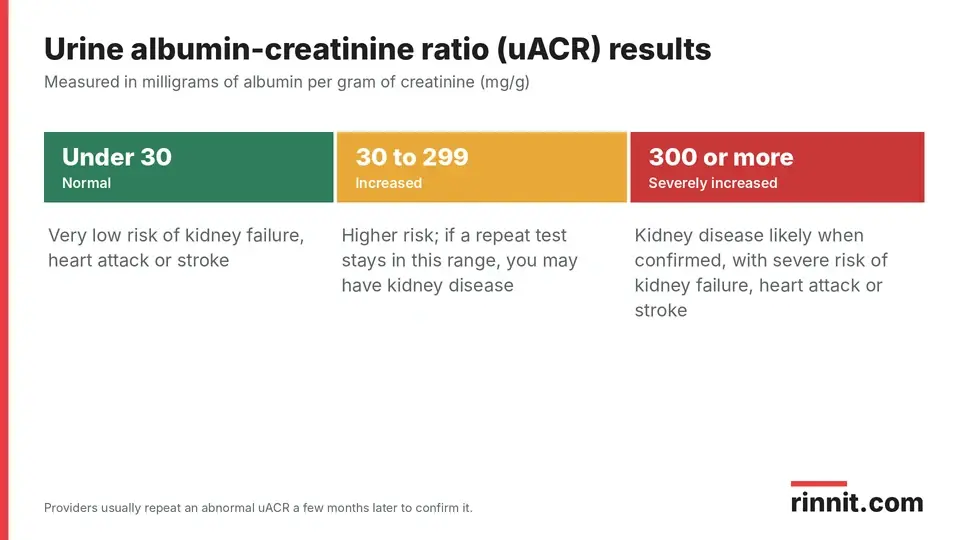
uACR results are grouped into three ranges.
uACR | What it usually means |
Less than 30 mg/g | Normal; very low risk of kidney failure, heart attack or stroke |
30 to 299 mg/g | Higher risk of kidney failure, heart failure or stroke; kidney disease is possible if a repeat test stays in this range |
300 mg/g or more | Kidney disease likely when confirmed, with severe risk of kidney failure, heart attack or stroke |
Sources: [1]
A slightly high uACR may point to mild kidney disease, while a high uACR suggests moderate or severe kidney disease. Your provider may repeat the test a few months later to confirm any result. [1]
What happens if my uACR is abnormal?
Your provider will likely repeat the uACR and may order other tests for kidney disease, such as: [1]
An estimated glomerular filtration rate (eGFR) blood test
Imaging such as an ultrasound
A kidney biopsy
When should you call your doctor?
Ask your provider about any questions on your results and book follow-up testing if needed. If you have kidney disease or your results show a risk of it, call your provider if you notice: [1]
Changes in urination, such as urinating more, foamy urine or blood in the urine
Dry, itchy or darkening skin
Fatigue
Nausea and vomiting
Swollen hands, feet or ankles
Conclusion
The uACR is a simple, painless urine test that can catch kidney damage early, often before any symptoms appear. A normal result is under 30 mg/g, and an abnormal result is usually confirmed with a repeat test before any diagnosis.
If you have diabetes, high blood pressure or another risk factor, ask how often you should have a uACR. Finding kidney disease early makes it easier to slow it down or prevent kidney failure.
Keep learning: Read our chronic kidney disease guide or our diabetic kidney disease guide. For more background, see the NHS page on the ACR test.
FAQ
What is a urine albumin-creatinine ratio?
It is a urine test that compares albumin, a protein, with creatinine, a waste product, to check how well your kidneys are working.
What is a normal uACR?
A normal uACR is less than 30 mg/g.
What does a uACR of 30 to 299 mg/g mean?
It means a higher risk of kidney failure, heart failure or stroke; if a repeat test stays in this range, you may have kidney disease.
What does a uACR of 300 mg/g or more mean?
If a repeat test confirms it, you may have kidney disease and are at severe risk of kidney failure, heart attack or stroke.
Who needs a uACR test?
People with diabetes or chronic kidney disease, and often those with high blood pressure, heart disease, cirrhosis, obesity, smoking or age over 50.
Do I need to prepare for a uACR test?
Drink enough fluids and avoid intense exercise and eating meat for 24 hours before the test.
What can affect uACR results?
Periods, bleeding hemorrhoids, a urinary tract infection, fever, gum infection, viral hepatitis, blood or bacteria in the sample.
What is the most accurate uACR sample?
A 24-hour urine collection, usually ordered after an abnormal spot or timed sample.
How long do uACR results take?
Usually a day or two.
What happens if my uACR is high?
Your provider will usually repeat the test and may order an eGFR blood test, kidney imaging or a kidney biopsy.
Related Reading
Chronic Kidney Disease: What It Is, Its 5 Stages, Causes, and How It's Treated explains the condition a uACR helps diagnose and monitor.
Diabetic Nephropathy (Diabetic Kidney Disease): Symptoms, Causes, Diagnosis & Treatment — Complete Guide covers the kidney damage diabetes screening with uACR is designed to catch.
Orthostatic Proteinuria (Postural Proteinuria): Symptoms, Causes, Diagnosis, and Management — What You Need to Know explains a harmless cause of protein in the urine.
References
Cleveland Clinic. Urine Albumin-Creatinine Ratio (uACR). Cleveland Clinic. Last updated November 13, 2024. https://my.clevelandclinic.org/health/diagnostics/urine-albumin-creatinine-ratio
Chronic Kidney Disease Prognosis Consortium; Matsushita K, van der Velde M, Astor BC, et al. Association of estimated glomerular filtration rate and albuminuria with all-cause and cardiovascular mortality in general population cohorts: a collaborative meta-analysis. Lancet. 2010;375(9731):2073-2081. PMID 20483451. https://doi.org/10.1016/S0140-6736(10)60674-5
Gansevoort RT, Matsushita K, van der Velde M, et al. Lower estimated GFR and higher albuminuria are associated with adverse kidney outcomes. A collaborative meta-analysis of general and high-risk population cohorts. Kidney Int. 2011;80(1):93-104. PMID 21289597. https://doi.org/10.1038/ki.2010.531
Medical disclaimer
This article is for general education only and does not replace advice from a qualified healthcare professional. Talk to your doctor about your own diagnosis and treatment, and seek emergency care right away for severe or sudden symptoms.



Comments