Creatinine Clearance Test: 24-Hour Urine Collection, Purpose and Results

Updated: 2 days ago
Written and medically reviewed by Dr. Baraa Alnahhal, MD · Last reviewed: November 2026 · How we review
Quick Answer: What is a creatinine clearance test?
A creatinine clearance test checks how well the kidneys filter waste by comparing the creatinine in the urine you pass over 24 hours with the creatinine in a blood sample. It's one way to estimate the glomerular filtration rate (GFR), the main measure of kidney function. It's used less often, mainly when a standard eGFR test may be inaccurate. [1]
What the research says
Creatinine clearance can make kidneys look healthier than they are. In 171 people with glomerular kidney disease, creatinine clearance averaged 1.64 times the true filtration rate measured with inulin, because damaged kidneys secrete extra creatinine into the urine. The gap grew as the disease worsened. (Shemesh et al., Kidney International, 1985) [2]
eGFR and urine albumin together predict risk. In a meta-analysis of more than 105,000 people from 14 cohorts, death risk rose as eGFR fell below about 60 mL/min/1.73 m² and as the urine albumin-creatinine ratio rose, with each measure adding independent information. (Matsushita et al., The Lancet, 2010) [3]
Key takeaways
The test needs a full 24-hour urine collection at home plus one blood draw. [1]
It estimates GFR, the main number used to judge kidney function. [1]
Providers now more often use an eGFR blood test with a single urine albumin-creatinine ratio (uACR). [1]
Missed collections, some medicines, diet, pregnancy, muscle mass and hard exercise can skew results. [1]
One abnormal result doesn't diagnose kidney disease on its own. [1]
What is creatinine?
Creatinine is a waste product made when your muscles break down creatine, which they use for energy. It enters your blood, and healthy kidneys filter it out into your urine. When kidney function drops, creatinine builds up in the blood. [1]
Why is a creatinine clearance test done?
The test helps your provider see how well your kidneys are working, and results can help lead to a kidney disease diagnosis. [1] Because collecting urine for 24 hours is inconvenient, providers usually start with an eGFR blood test and a urine albumin-creatinine ratio, which needs only one urine sample. They may order creatinine clearance when an eGFR result may not be accurate, such as in people with very low or very high muscle mass, like bodybuilders. [1]

Creatinine clearance | eGFR plus uACR | |
Samples | 24 hours of urine plus a blood draw | One blood draw plus one urine sample |
Convenience | Inconvenient; easy to make collection errors | Quick and simple |
When it's used | When eGFR may be inaccurate, such as with very high or low muscle mass | Most routine kidney checks |
Sources: [1]
Symptoms that may lead to testing
Early kidney disease often causes no symptoms. As it progresses, you may notice fatigue, changes in how often you pee, loss of appetite, a bad taste in your mouth, nausea or muscle twitches. [1]
How do you prepare for a creatinine clearance test?
Follow your provider's instructions closely, including how to store the urine container. [1]
Tell your provider about all your medicines, since some can affect the results. Only stop a medicine if your provider says so.
You can usually eat as normal, but you may be asked to avoid eating overnight or to skip meat, which contains creatine and can raise creatinine levels.
Drink as you normally would. Drinking extra water can lower creatinine temporarily, so don't force fluids to change your results.
Sources: [1]
How do you collect a 24-hour urine sample?
The urine collection happens at home, and the blood draw happens at a lab or your provider's office, often when you drop off the urine. [1]

Get the collection container and storage instructions from your provider.
Collect all of your urine every time you pee for 24 hours. Don't flush any.
Stick to the collection schedule and don't miss any collections.
Keep up your normal daily activities.
If you miss a collection, call your provider. You may need to continue or restart the next day.
Store the container as instructed and take it where directed when the 24 hours are up.
Have your blood drawn after the 24 hours.
Sources: [1]
Skipped collections or mistakes may mean you have to repeat the test. The urine part is painless; the blood draw may sting briefly. [1]
What are the risks?
There are few risks. The most common side effect of a blood draw is a bruise at the needle site, and some people may faint. [1]
What do creatinine clearance results mean?
Results may take a few days. Creatinine clearance is generally reliable, but it's only an estimate of GFR and can sometimes read higher than your true GFR. [1] [2]
High creatinine doesn't always mean kidney damage, because it can be temporary. Dehydration, heart failure and bladder problems are among the possible causes, so your provider looks at several tests and factors together. [1]
What can make results inaccurate?
These factors can push results too high or too low: [1]
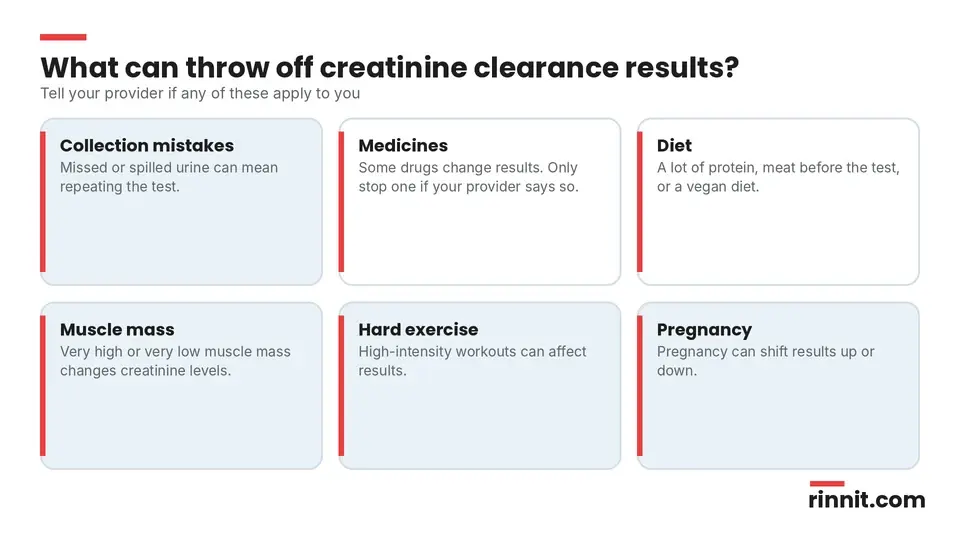
Collecting urine incorrectly
Medicines that affect results
Eating a lot of protein, or a vegan diet
Pregnancy
High or low muscle mass
High-intensity exercise
What are normal blood creatinine levels?
A serum creatinine blood test alone doesn't diagnose kidney disease. It's reported in mg/dL and depends on age, muscle mass and sex. Typical normal levels are up to 1.3 mg/dL for males and up to 1.1 mg/dL for females. [1]
Group | Typical upper limit of normal serum creatinine |
Males | Up to 1.3 mg/dL |
Females | Up to 1.1 mg/dL |
Sources: [1]
Creatinine clearance vs GFR
Creatinine clearance is one way to estimate GFR. Providers usually calculate eGFR from a creatinine blood test and an equation that includes your age, sex and other factors. [1]
When should you talk to your doctor?
Talk with your provider about your results and any concerns, especially if you have symptoms such as fatigue, changes in urination, poor appetite or nausea, or a condition that raises your kidney risk. [1]
Conclusion
A creatinine clearance test gives a direct look at how well your kidneys clear waste, but it depends on a careful, complete 24-hour urine collection. For most people, a simple eGFR blood test and a single urine sample do the job.
If your provider orders this test, ask for clear collection and storage instructions, check whether to avoid meat beforehand, and plan your day so you don't miss a collection.
Keep learning: Read our guide to chronic kidney disease or learn what happens in acute kidney injury. For more background, see the MedlinePlus page on the creatinine test.
FAQ
What is a creatinine clearance test?
It compares creatinine in 24 hours of urine with creatinine in your blood to estimate how well your kidneys filter waste.
Why is a creatinine clearance test done?
To check kidney function, especially when an eGFR blood test may be inaccurate, such as with very high or low muscle mass.
How do I collect a 24-hour urine sample?
Collect all your urine for 24 hours in the provided container, don't flush any, and store it as instructed.
What if I miss a urine collection?
Call your provider; you may need to continue or restart the test the next day.
Do I need to fast before a creatinine clearance test?
Usually not, but you may be asked to avoid eating overnight or to skip meat beforehand.
Is the creatinine clearance test painful?
The urine collection is painless; the blood draw may sting briefly.
What affects creatinine clearance results?
Collection errors, some medicines, a high-protein or vegan diet, pregnancy, muscle mass and intense exercise.
What is a normal creatinine level?
Typical serum creatinine is up to 1.3 mg/dL for males and up to 1.1 mg/dL for females.
Does high creatinine always mean kidney disease?
No. It can be temporary, and causes include dehydration, heart failure and bladder problems.
Is creatinine clearance the same as GFR?
No. It's one way to estimate GFR and can sometimes read higher than the true value.
Can drinking water lower creatinine?
Yes, temporarily, so drink as you normally would before the test.
Related Reading
Chronic Kidney Disease: What It Is, Its 5 Stages, Causes, and How It's Treated explains long-term kidney damage that creatinine clearance and eGFR help track.
Acute Kidney Injury: What Causes Sudden Kidney Failure, and How It Is Treated covers sudden loss of kidney function, which raises blood creatinine.
Diabetic Nephropathy (Diabetic Kidney Disease): Symptoms, Causes, Diagnosis & Treatment — Complete Guide explains a leading cause of reduced kidney filtration.
Nephrotic Syndrome: Symptoms, Causes, and Treatment Guide covers a kidney filter disorder often checked with urine and blood creatinine tests.
Glomerulonephritis: Why Your Kidney Filters Inflame, the 6 Warning Signs, and How Treatment Protects Your Kidneys explains inflamed kidney filters, where creatinine clearance can overestimate function.
References
Cleveland Clinic. Creatinine Clearance Test: Purpose, Levels & Results. Cleveland Clinic. Last updated November 27, 2023. https://my.clevelandclinic.org/health/diagnostics/16380-creatinine-clearance-test
Shemesh O, Golbetz H, Kriss JP, Myers BD. Limitations of creatinine as a filtration marker in glomerulopathic patients. Kidney Int. 1985;28(5):830-838. PMID 2418254. https://doi.org/10.1038/ki.1985.205
Chronic Kidney Disease Prognosis Consortium; Matsushita K, van der Velde M, Astor BC, et al. Association of estimated glomerular filtration rate and albuminuria with all-cause and cardiovascular mortality in general population cohorts: a collaborative meta-analysis. Lancet. 2010;375(9731):2073-2081. PMID 20483451. https://doi.org/10.1016/S0140-6736(10)60674-5
Medical disclaimer
This article is for general education only and does not replace advice from a qualified healthcare professional. Talk to your doctor about your own diagnosis and treatment, and seek emergency care right away for severe or sudden symptoms.



Comments