BUN Test (Blood Urea Nitrogen): Normal Range, High and Low Levels

Updated: 2 days ago
Written and medically reviewed by Dr. Baraa Alnahhal, MD · Last reviewed: November 2026 · How we review
Quick Answer: What is a BUN test?
A blood urea nitrogen (BUN) test measures how much urea nitrogen, a waste product made when the body breaks down protein, is in the blood. A high level can mean the kidneys are not working well. Normal ranges are 7 to 20 mg/dL in children, 6 to 21 in adult females and 8 to 24 in adult males. [1]
What the research says
A high BUN-to-creatinine ratio signals higher risk in heart failure. In a cohort of 509 people with acute heart failure plus a meta-analysis of 8 studies with 4,700 patients, those in the highest BUN-to-creatinine category had 77% higher all-cause mortality than those in the lowest (pooled hazard ratio 1.77). (Zhu et al., Cardiorenal Medicine, 2020) [2]
The BUN-to-creatinine ratio can hint at where gut bleeding comes from. A meta-analysis of 17 studies found the ratio was higher in upper than lower GI bleeding. At a cutoff above 30, specificity for upper GI bleeding was 89.3% but sensitivity was only 38.8%, giving moderate overall accuracy. (Simadibrata et al., Journal of Gastroenterology and Hepatology, 2026) [3]
Key takeaways
BUN is one marker of how well your kidneys filter waste. [1]
It is usually part of a basic or comprehensive metabolic panel. [1]
Normal ranges vary by age and sex. [1]
High BUN does not always mean kidney disease; dehydration and diet are common causes. [1]
BUN alone does not define kidney failure, but a high BUN with a high creatinine likely does. [1]
What is a BUN test?
A BUN test measures the amount of urea nitrogen in your blood. Urea nitrogen forms in your liver when your body breaks down protein from food, travels through your blood to your kidneys and leaves your body in your pee. A small amount in your blood is normal, but too much may mean a condition is preventing your kidneys from filtering it properly. [1]
Why is a BUN test done?
Your provider may order a BUN test during a regular checkup, usually as part of a comprehensive metabolic panel (CMP) or basic metabolic panel (BMP). It is also used if you are at risk of chronic kidney disease (CKD). Early CKD usually has no symptoms, but early diagnosis and treatment can help you keep kidney function for as long as possible. People with late-stage CKD may have BUN tests as part of routine monitoring. [1]
How do you prepare for a BUN test?
Your provider may ask whether you have bleeding risks, such as a bleeding disorder or taking blood thinners. If other blood tests are done at the same visit, you may need to fast for 8 to 12 hours, so ask whether fasting applies to you. Let your provider know if you are afraid of needles, as they can suggest ways to help you relax. [1]
What happens during a BUN test?
The blood draw takes just a few minutes. Your provider will: [1]

Clean the skin over a vein in your arm.
Use a thin needle to draw blood into small vials. You may feel a slight pinch.
Place a small bandage on your arm.
Send the sample to a lab for analysis.
Sources: [1]
A BUN test is safe with little risk. You may have a small bruise or feel lightheaded briefly; if so, your provider may help you lie down and offer something to eat or drink. [1]
What is a normal BUN level?
Normal BUN levels vary by age and sex and are measured in milligrams per deciliter (mg/dL). [1] Your lab's reference range may differ slightly.

Group | Normal BUN level |
Children ages 1 to 17 | 7 to 20 mg/dL |
Adult females | 6 to 21 mg/dL |
Adult males | 8 to 24 mg/dL |
Sources: [1]
What do high and low BUN levels mean?
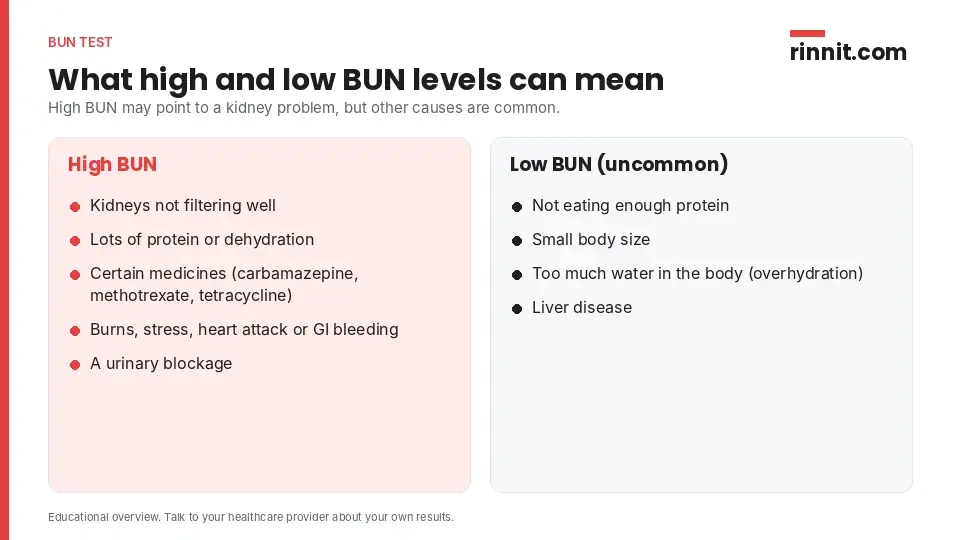
High BUN | Low BUN (uncommon) |
Kidneys not working as well as they should | Not eating enough protein |
Eating a lot of protein, or dehydration | Having a small body type |
Aging (infants and children have lower levels) | Too much water in the body (overhydration) |
Medicines such as carbamazepine, methotrexate and tetracycline | Liver disease |
Burns, stress, heart attack, GI bleeding or a urinary blockage | — |
Sources: [1]
What BUN level indicates kidney failure?
Providers do not use BUN to define kidney failure. But if your BUN is higher than expected and your creatinine, a waste product from muscle breakdown, is also high, you likely have kidney failure. [1]
What happens after a BUN test?
You should get results within 1 to 3 days, and your provider will explain them. If they suspect chronic kidney disease, they may recommend more tests, such as a kidney ultrasound. [1]
How do you lower high BUN levels?
Providers treat the reason your kidneys are not working as expected rather than the number itself. Changes to what you eat and drink can also help, if your provider agrees: [1]
If you do not have kidney disease and are not on dialysis, drink enough fluids. BUN can rise while creatinine stays low if you do not drink enough water.
Eat more low-protein foods, such as oats, rice, pasta, apples, berries, bananas, leafy greens, peppers, broccoli, avocados and nuts.
Limit high-protein foods such as beef, chicken, pork, salmon, milk, cheese and yogurt.
Most people need 40 to 60 grams of protein a day, but you may need to cut that by as much as half if your BUN is high. [1] Ask your provider or a dietitian before changing your diet, especially if you have kidney disease.
When should you call your provider?
Contact your provider if several days pass without hearing about your results, or if your BUN and creatinine show kidney damage and you develop signs of late-stage CKD, such as: [1]
Feeling more tired than usual or losing your appetite
Peeing more than usual
Trouble concentrating or sleeping
Swelling, especially around your feet and ankles
Muscle cramps or itchy skin
Questions to ask your provider
What do my test results mean?
Do I need other tests, and which ones?
Is a health condition causing my abnormal BUN level?
How can I lower my BUN level?
Conclusion
A BUN test is a simple blood test that helps your provider check how well your kidneys are working. An abnormal result does not automatically mean kidney disease; sometimes you simply need more fluids or a change in diet. If your levels are off, your provider may order more tests to find the cause. Reach out with any questions about your results. [1]
Keep learning: Read our guides to chronic kidney disease, acute kidney injury and dehydration. For more, see MedlinePlus: BUN (Blood Urea Nitrogen).
FAQ
What is a BUN test?
A blood urea nitrogen (BUN) test measures how much urea nitrogen, a waste product of protein breakdown, is in your blood. It helps show how well your kidneys are working [1].
What is a normal BUN level?
About 7 to 20 mg/dL for children ages 1 to 17, 6 to 21 mg/dL for adult females and 8 to 24 mg/dL for adult males [1].
What does a high BUN level mean?
It may mean your kidneys are not working as well as they should, but dehydration, a high-protein diet, some medicines, burns, stress, heart attack and GI bleeding can also raise it [1].
What does a low BUN level mean?
Low BUN is uncommon. Causes include too little protein, a small body size, overhydration and liver disease [1].
Do I need to fast for a BUN test?
Not usually for BUN alone, but other blood tests done at the same visit may require fasting for 8 to 12 hours, so ask your provider [1].
Why is a BUN test done?
It is usually part of a basic or comprehensive metabolic panel at a checkup, and it helps screen for and monitor chronic kidney disease [1].
How long do BUN test results take?
Usually 1 to 3 days [1].
Does a high BUN level mean kidney failure?
BUN alone is not used to define kidney failure, but a high BUN together with a high creatinine likely points to it [1].
How can I lower a high BUN level?
Your provider treats the cause. Drinking enough fluids and eating fewer high-protein foods can help, if your provider agrees [1].
What is the BUN to creatinine ratio?
It compares BUN with creatinine, another waste product. Research shows it can help suggest whether bleeding comes from the upper or lower gut [3].
Related Reading
Learn more in our guide to Chronic Kidney Disease: What It Is, Its 5 Stages, Causes, and How It's Treated.
Learn more in our guide to Acute Kidney Injury: What Causes Sudden Kidney Failure, and How It Is Treated.
Learn more in our guide to Dehydration: Symptoms, Causes, Risk Groups & Treatment — Complete Guide.
Learn more in our guide to Gastrointestinal Bleeding: Where It Comes From, and How Doctors Find and Stop It.
References
Cleveland Clinic. Blood Urea Nitrogen (BUN) Test: High, Low & Procedure. Cleveland Clinic. Last updated June 8, 2026. https://my.clevelandclinic.org/health/diagnostics/17684-blood-urea-nitrogen-bun-test
Zhu X, Cheang I, Liao S, et al. Blood Urea Nitrogen to Creatinine Ratio and Long-Term Mortality in Patients with Acute Heart Failure: A Prospective Cohort Study and Meta-Analysis. Cardiorenal Med. 2020;10(6):415-428. PMID 33113531. https://doi.org/10.1159/000509834
Simadibrata DM, Koo TH, Murlidhar M, et al. Blood Urea Nitrogen-to-Creatinine Ratio to Differentiate Upper From Lower Gastrointestinal Bleeding: A Systematic Review and Meta-Analysis. J Gastroenterol Hepatol. 2026;41(2):477-487. PMID 41555211. https://doi.org/10.1111/jgh.70224
Medical disclaimer
This article is for general education only and does not replace advice from a qualified healthcare professional. Talk to your doctor about your own diagnosis and treatment, and seek emergency care right away for severe or sudden symptoms.



Comments